

CEO & Emmy-Award Winner, Genvid. Previously 社長付 (President's Office) at Square Enix Holdings.
New York, NY
Joined February 2010
- Tweets8.7K
- Following929
- Followers6.5K
- Likes11.8K




I see a number of people making the point that western game dev costs no longer work.
I have been making this point for nearly two years. Below is one of my better analyses on this subject, from April of this year.
I have been correctly predicting things for a long time:
1. I pointed out years back that Square Enix would need to go multiplatform
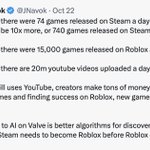
2. I pointed out over a year ago that we had entered a period of abundance of content which would change distribution models
3. I had a thread in summer 2025 where I wrote about Microsoft's layoffs and Metcalfe's law
My latest predictions are on how AI dynamics will change models to be about discovery algorithms as we enter the age of infinite content, and that developers not using AI will be left behind.
Bookmark this, my track record is very strong.

I’ve spoken a lot about certain industry problems from the last few years:
1. The increase in cost relative to revenue.
US costs now compete with tech industry salaries- if you’re a worker in Bellevue or Redwood City working for Bungie or EA your housing costs compete with people working for OpenAI or Meta which means your cost of living is outgrowing the industry’s ability to cover your salary.
2. The increase in outsourcing and acceleration of talent worldwide.
In the 1970s and 1980s when the industry was being born the west coast had the highest concentration of the world’s programming talent. Now game engines spread that talent everywhere and AI coding accelerates the ability for anyone to generate code at the same level. (Of course reading and modifying that code still requires specialized skill.)
But I haven’t spent as much time talking about the challenge of SELLING games.
There are a few things unique to Marathon and Sony’s live service strategy that aren’t globally applicable but we can still extract some lessons from it.
The first is that Sony traditionally excels at package disc sales where trailers, in store standees and billboards move units. It’s parallel to a movie theater film rollout.
But their live service titles don’t have traditional rollouts this way which means they don’t have the muscle memory to flex.
Worse, these games are reliant on algorithms that put Sony at the mercy of competition in ways that Sony isn’t used to.
Marathon competes with the tens of thousands of new games releasing on Steam annually.
Steam will give Sony an account manager but otherwise its titles are not treated different from other publishers.
Games sinking or swimming based on algorithms are old hat for mobile. Mobile has mostly moved to an LTV/CAC arbitrage model; the better your ML algorithm the more money you can make.
But this is new for AAA. I would place a bet that when the original budgets for many of the live service titles were made, in the days when only a few hundred titles launched on Steam a year, the notion that they'd be competing on an algorithm that Sony doesn't control against titles like Slay the Spire 2 wasn't being discussed as a possibility.
It puts the marketing departments responsible for the success of these titles in a bind. They have limited means to influence Steam success. There are no Steam ad slots you can buy, and Facebook ads haven't proven success to convert users to buy a $40 Steam game.
In the past you marketed regionally. You could place billboards in Times Square, major cities, on bus routes, and get people to pre order in their local Gamestop.
Meanwhile, the Steam algorithm is globally driven. You can put billboards in Times Square but a rush of users buying Crimson Desert in Korea will push that title up the charts and your title down the charts. You can't control for all the factors, and the success of titles with large Chinese userbases that are opaque to your marketing team mean that the best laid plans can be pushed aside.
There is no known gameplan of success for AAA publishers for Steam. Many are relying on really high quality word of mouth and discounts/sales. Some are starting to understand that Discord + international player bases help sustain.
The AA publishers who have learned to game the system rely on gimmicks (friendslop) or quirks and memes that drive influencers to talk about a game. Gimmicks and memes aren't really repeatable for AAA publishers, or at least in most cases it won't drive the level of revenues needed.
Perhaps the most interesting thing about the recent GAAS launches is seeing how bad Sony is at Steam marketing. It's only going to get worse now that Sony is pulling back first party. It's also unlikely that Steam gets weaker over time, which is going to put Sony in a bind going forward for anything that isn't single player, especially when we've seen consistently that console sales rarely eclipse Steam with these multiplayer titles. (I would bet that if Fortnite was on Steam, its PC base would be bigger than its Playstation base.)
Microsoft will have to learn these lessons too. Unclear how they do better than Sony on Steam, which is why you saw them try different strategies around Gamepass. No platform wants to be a rent payer on another's land, hence Epic and EGS. But Steam is a continent unto itself.

Jacob Navok retweeted

David Sears (Creative Director) said he would not have funded South of Midnight
David: “I literally told people, I was like yeah this is wow, this this could be terrible, because somebody is going to say one day you know the money tap it was like we're closing those floodgates and that's going to have really traumatic results downstream.”
Ben: “So the idea is you're you're thankful Microsoft supported the hell out of South of Midnight. Seems like positive experience overall, but You would not have funded it yourself. If you were actually running Xbox, you would have been like, "No, turn off that tap much quicker.”
David: “Yeah, probably.”
Ben: “That is a very confusing thing to hear.”
David: “Yeah. I mean, I wanted to make it, no doubt, right? And obviously because we made it. You know, would I have turned off, you know, someone else's money flow before South Midnight? Yeah, cuz, I'm not completely selfless. But, you know, it it just seems like in hindsight at least, it was unsustainable. So, of course, it was going to have a, you know, shocking
outcome.”
via: MinnMax
youtube.com/watch?v=_mHAV-7O…
It doesn't overlook the contribution to Xbox. You fail to state how many employees worked on contribution to other studios, which is to say, not many.
unavailable

Jacob Navok retweeted

THIS. IS. NOT. A. DRILL. 🚨
I’m spending < $40k a year on tokens/subscriptions from Anthropic, Loveable, Grok Bot, 11labs and a long tail of other products—and getting $2m+ in value @launch and @twistartups
We’ve automated at least seven full-time jobs at this point while becoming 100% faster at the average task we do
If you haven’t used the last 90 days' worth of products for at least 30 hours a week you have no idea how profound this software is
The last 90 days, things have changed more than in the last two years
Many of the things i spent hours on last year now take minutes… and the results are mind blowing
Jacob Navok retweeted

VRChat is under attack from anti AI people who would love nothing more than to kill the game for all of us just because they cant turn it into a bully simulator. This is awful behavior.

Readers added context they thought people might want to know
VRChat (Oct 28): 95% of 21,595 respondents wanted some AI-usage label, but 3,141 combinations with none over 10%. Only 33% would avoid AI-assisted worlds. Lack of consensus plus risks of inaccurate labels and harassment led to no AI label or filters.
ask.vrchat.com/t/where-were-l…

Chinese developers like Tencent and Netease invested into or acquired many western (US, CAN, European) developers over the last decade. They wholly own Riot, they have a large chunk of Epic.
Western investment into Chinese gaming has been far more difficult. Not impossible given that Tencent and Netease are public, and indeed Naspers owned a large chunk.
But given the up and coming crop of Chinese developers are AI focused and the government doesn't want foreign intervention in AI ownership (plus this created headaches for Bytedance and others in the last ten years) it has been much harder for foreign investment/ownership stakes into the next wave of Chinese gaming companies outside of the middle east (e.g. Savvy acquisition of Moonton).
To legally sell a game in China you must:
1. Have it registered with the government
2. Have a local development partner
These are very costly. As a result most developers do not do this. And as a result they cannot market or promote their games in China.
Chinese gamers are great purchasers of western content. I am very happy for them to do so. I wish the market was actually open, but it is not. The current size of Chinese AAA is a result of a grey market that isn't actually legal, and is a loophole the government can close at any time.
Jacob Navok retweeted
The majority of the game's budget was clearly spent on content, not on tech. The tech is the Unreal Engine. If you are spending loads of money to support Unreal Engine you are doing it wrong.
A "taps the sign" reminder for anyone who believes that AI games are rejected by players. (though I have to correct myself, I think the original Minecraft, developed by just notch, may take the prize as most profitable game of all time)
The below game, which features brainrots that are AI creations, made more money (nearly $200m) than 99% of all games last year, is dollar for dollar the most profitable (cost to revenue, less than a dozen people work at the studio) game of all time, and holds the world record for peak concurrency (25.8m concurrent players) of any game ever made.
More people at at McDonalds each week than any other restaurant.
Consumer taste is actually broad and in most cases very different from what you seem to believe is true.

This man should justify his math. $250m, half of that cost, requires there to be 200 devs a month, more than half the studio, worked on shared services. This is not true; there is nothing in the credits or their linkedin list that shows this to be correct.


The fight for free app stores and the fight against Steam monopoly are two sides of the same coin.
Pro-Steam advocates (bots, cultists, take your pick) want to enable a monopoly that harms developers and attempt to shout down any debate by pretending that Steam is pro-consumer.
Lack of store choice is not pro-consumer, and as we enter a world of 10-100x the number of games on Steam a year, Valve's algorithm will decide who wins and loses at this game, and it is sure to be opaque, confusing, and reward what they (Valve) want to see, even as they paint it as what you (the customer) actually wants.
Furthermore, Apple's app store behavior makes it difficult for any developer who wants to build products to do so without Apple's permission on its billions of devices, and then they cripple their browser so you can't go around it.
If you think any of this is good for gamers you are an idiot.

I am once again here to explain that a small team of shared Unreal resources and a Matrix demo may be up to $30m of a $500m cost, but in no way actually adds up to that. The bulk of that cost is very clearly game dev, despite people attempting to spin it otherwise.

PlayStation fan Jason Schreier says that Gears of War: E-Day cost $500 million to make. What makes much more sense is that 500 million is what was spent on Studio operations/projects and staff over the last 7 years.
▪️Work on Fable.
▪️Work on Forza.
▪️Work on the Matrix Unreal Tech Demo.
▪️Work on Gears of War Reloaded.
▪️Engine work and support for other teams via ATG.
▪️Salary for the 300 or so devs and, of course, E-Day.

Jacob Navok retweeted

I’ve never seen AI code comments say “do not touch this function, we don’t know why it works, but everything breaks when we change it”
This is an incredibly silly argument because it's easy to build credible estimates off of public data.
Assume $500m cost of the studio is correct over a 7 year period, that is about $72m per year.
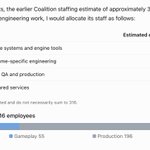
I asked chatgpt to estimate how many people in the studio worked on shared Unreal engine based off of credits in E-Day, attached are its estimates (10-20 people) which I believe to be realistic. You can be skeptical about AI, but it's just scanning the credits of the game relative to the known headcounts and it's pretty easy to determine whether people are or are not working on Unreal Tech there.
Let's take the upper bound, 20 people, and give them a $150k salary (cheap) plus about 30% more in benefits, making it to about $195k/year.
At $195k/year for 20 people that comes out to $3.9m out of $72m a year, and $27.3m in total out of $500m
This is a far cry from $500m, meaning the likelihood that shared Unreal Engine work had any impact on that $500m is bunk. If we subtract $27.3m of shared Unreal work over 7 years from the $500m we still get an E-Day cost of $472.7m
Furthermore, to the headline of the piece below, gamepass versus not gamepass is not the issue. The IP of Gears of War has never, in its history, shown that it could reach the level of players that would be required to make such a massive investment return. No PS5 release or otherwise would have resolved this.
The problem is instead very clear: the studio set out to make the game it wanted to make, WITHOUT MANAGEMENT INTERFERENCE, spent way too much, and built something that would never make a return, ever.


unavailable
Of the studios beow, Ninja Thory, Undead Labs, Arcane, Compulsion, Tango and DF are gone, and Playground Games doesn't use UE for Forza.


Former XBOX Senior Product Manager, Derek Reese sheds light on The Coalition studio expenses🚀
“So much of that cost is The Coalition being on the hook for the Microsoft branch of Unreal and one of the flagship titles.
I should know, I tried to get leadership to support a plan to have other studios adopt it and write off the support costs.
Same problem with Turn10 and ForzaTech.”
Source: Derek Reese on BSKY


Jacob Navok retweeted

Former Apple App Review chief on Apple’s recent banning of developer accounts with long histories of being in good standing.
The App Store needs competition, worldwide! Why does Apple block competing stores in the US, Canada, Korea, and China?

If you have an Apple developer account or an app in the App Store, read this now and share it.
Apple rejects your app. The notice is vague, so you fix what you reasonably think is wrong and resubmit.
Apple approves it.
Months later, with nothing in review, Apple terminates your account under 3.2(f) for “a pattern of manipulative or misleading behavior.” Every app gone. No explanation of what you did.
Your crime? Trusting the approval.
Apple’s own reviewer looked at your fix, with your rejection history in front of them, and said yes. Then Apple turned that yes into evidence against you.
So who’s misleading whom?
I ran App Review for seven years and wrote the guidelines. 3.2(f) used to mean real fraud. Now it’s being used against developers who did exactly what Apple approved.
I’ve made this Substack post free for everyone. Every developer needs to see it before this happens to them.
Share it before someone you know gets that email.
phillipshoemaker.substack.co…