

I write about the boring stuff behind AI. Longer analysis available on my Substack. NFA
Joined September 2016
- Tweets5.7K
- Following316
- Followers36.6K
- Likes6.6K


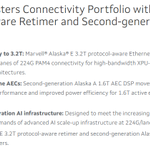

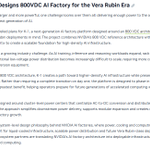


Someone, a big account, seems to have a crush on me.
My posts somehow gets rewritten into his words from time to time. I am flattered.
Pay me $5 a month for godlike buys like these $MRVL

I’m starting to think $ETN could become a more significant competitor to $VRT than I’ve given it credit for. Reading Eaton’s November 3 call alongside Peter de Bock’s EEPower interview brought that into focus, particularly the ambition to sell complete power and cooling systems.
I own both, and Eaton is giving me more reasons to like the position. Data center revenue grew approximately 65% year over year, with orders more than doubling on a rolling 12-month basis. Electrical backlog exceeded $20 billion, even as shipments accelerated.
Boyd is where my thinking has changed most. Eaton paid around $9.5 billion for it, and the performance is making that price easier to understand. Sales grew 24% sequentially, backlog nearly tripled year over year, and management discussed at least $2.7 billion in revenue for 2027 against an updated $1.9 billion outlook for 2026.
I’m particularly interested in what Eaton can do with Boyd through its existing customer relationships. Eaton already supplies the electrical infrastructure for many of these projects. Adding cooling gives it a larger potential order and a reason to get involved earlier in the design. I suspect that combination will become increasingly valuable as customers try to get facilities operational faster.
De Bock’s interview takes that ambition further. He describes complete modules integrating power and cooling, backed by Eaton’s manufacturing scale. That sounds like a company moving further into the territory where we’ve liked Vertiv.
The manufacturing side is already showing up in Eaton’s results. Electrical Americas margins improved to 29.8% from 27.5% in Q2, with 18 of 25 expansion projects completed. After spending to build that capacity, Eaton is starting to get more earnings out of it. Cash flow guidance stayed unchanged despite the earnings upgrade, so cash conversion is something I’ll be watching over the next few quarters.
On 800 VDC, the call gave us more concrete progress. Management said its 2 MW solid-state transformer passed all UL tests in October, with ten pilots running and volumes expected to build next year. I like that Eaton can participate in the transition while continuing to supply customers building with existing AC systems.
For Vertiv, I remain positive. Eaton’s orders and Boyd’s growth are encouraging evidence of the spending going into power and liquid cooling. Vertiv has been preparing for this transition too, and I still like the service opportunity attached to its growing installed base.
But Eaton is becoming a competitor I would take more seriously on larger contracts. It has the electrical relationships, manufacturing capacity and now a rapidly growing cooling business. I can see that putting pressure on pricing as the two companies compete for more of the same work.
There’s also something worth digging into around revenue per MW. Centralized DC systems can remove conversion stages and consolidate equipment. I want to understand how much profit Eaton and Vertiv can earn from those replacement systems, especially if customers start buying more of the infrastructure as one package.
I come away more confident in Eaton heading into 2027. Boyd is growing faster than I expected, and the existing electrical business is converting new capacity into earnings. For Vertiv, I’ll be paying closer attention to margins on the larger integrated projects. Eaton increasingly looks capable of making those contracts harder to win.
JP Insights retweeted

FinX gets this wrong. Market is not meant to be ‘fun.’
Market is neutral static thing. That’s it. It doesn’t care whether we have fun or not.
‘Fun’, ‘good’, ‘bad’ is us labeling a future we can’t see. Waste of time.
-BP

This market is just not fun anymore. Stocks are trading like memecoins, up and down.
They run 100% in 3 weeks, just to drop 60% over the next 30 weeks.
Every stock seems to trade completely disconnected from company fundamentals and improvements, heading straight toward delisting.
2026 was even more worse and volatile than 2025.
Tired.
$LITE also reported earnings today, although most of the discussion is about the Marvell deal.
Revenue came in at $1.26B, up 136.5% YoY and 25.5% sequentially. Adjusted operating margin reached 42.3%, above guidance of 39.5–40.5%, with adjusted EPS of $4.57 versus the guided $4.05–4.35.
I like that revenue was within guidance and they still beat their profit forecast by that much. The margin improvement is doing a lot of work here.
For next quarter, management expects revenue of $1.575–1.625B and an adjusted operating margin of 45–46%. That’s another roughly 27% sequential revenue increase at the midpoint. Adjusted EPS guidance is $5.90–6.20, compared with $4.57 this quarter.
They also secured a second major NPO/CPO win with purchase commitments exceeding $5B. I’d like to know how those deliveries are spread across the coming years before putting numbers into a model.
As a $MRVL shareholder, this gives me plenty to think about.
Still gathering my thoughts on that subject.

A good question on my $VRT article: how much of the cash generation comes from the business itself, and how much comes from customers paying ahead of delivery?
This is exactly what I wanted to test in my $VRT article.
For the first nine months, Vertiv generated $2.23bn after capex and capitalized software. Removing the entire $540m net working-capital benefit still leaves roughly $1.69bn.
That gives me confidence in the business’s ability to fund itself. It isn’t a scenario with all customer advances removed, since those also help finance inventory and receivables, but the cash generation goes well beyond the net working-capital benefit.
My $VRT Q3 review is finally done. I went back through my earlier articles to see how the thesis is holding up.
I go through:
• How Q3 compares with the delivery targets I highlighted in July.
• What the order growth and backlog tell us about 2027.
• Service profitability and how customer advances help fund the expansion.
• The NVIDIA opportunity and what Vertiv is paying to expand its capabilities.
• Whether my EPS estimates still hold up, and what valuation a potential doubling would require.
More confidence in the business after this quarter, with a few assumptions from my earlier articles that deserved another look.
Link in comments. It's free.
Taiwan's Economic Daily says $INTC, $NVDA and $AMD prepaid about $5B to lock up substrate capacity, with Intel at roughly $3B of it. That split is an industry estimate, so take it loosely.
Substrates are the boards chips sit on, and they're scarce enough now that buyers pay years in advance. Unimicron just lifted 2026 capex to NT$53.7B to keep up.
The Intel part surprised me most.
I'd watch one line in $SPCX filings. Anthropic pays $1.25B a month for compute, and either side can end it on 90 days' notice.
Meanwhile Q4 capex is guided at $35-40B. So they're spending for years ahead while their biggest customer could leave in three months.
I'm not saying it happens but caught my attention.
Blackstone said on its call compute prices are up 50% year over year and H100s, chips from 2022, still hold a lot of value. That is important because many GPU loans assume chips lose value on a set schedule. If old chips keep earning, those loans look safer than the stocks suggest.
$CRWV CoreWeave's credit default swaps are past 11% and its 2031 and 2032 bonds yield over 15%. In normal words, lenders want 15% a year to lend to a company that rents out GPUs everyone says are in short supply...
$NVDA has over $500B in off-balance-sheet commitments, per CNBC's read of its filings, most maturing through fiscal 2029. That means it isn't counted as debt, but they could still owe it if a customer stumbles. I doubt most people pricing it as a chip company know that.
$BE
Revenue up 138% and they still burned cash. That happens when you're building ahead of orders, because you pay for parts and factories before customers pay you. The market just stopped giving anyone a pass on that.

$NBIS $CRWV $IREN
GPU rents are beating CoreWeave's 6-year depreciation schedule, even H100s by 54%. In plain terms, the chips are earning more than the company assumed they would as they age. Most of that gap opened after April, so I'd want a few more quarters of it first.

Zooming out, GPUs are still renting ahead of a standard 6-year depreciation schedule
Rental price vs. schedule:
- H200: +143%
- B200: +111%
- RTX PRO 6000: +73%
- H100: +54%
- A100: +9%
Most of the gap opened up after April, when token demand took off
Charts of the Week: a16z.news/p/charts-of-the-we…

Last quarter $VRT sold off to around $220 because revenue slipped, even with margin up 410bps, free cash flow way up and guidance raised. I disagreed with that reaction pretty loudly. Curious whether the timing shifts they flagged in July show up as Q3 revenue now.