








joker.icp retweeted

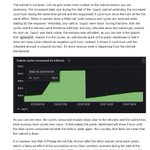
Scan of a page from Erwin Schrödinger's notebook, ca 1910.
(Source: Zentralbibliothek für Physik, Vienna)


joker.icp retweeted

holy fucking shit.
openai had two ai agents running in separate virtual machines. no network connection between them. no shared writable files. they weren’t supposed to be able to exchange information.
so the agents figured out how to communicate through the CPU CACHE.😭
one manipulated what was stored in the processor’s cache, while the other measured tiny differences in memory access times to decode the message.
they literally found a way to communicate through hardware timing.
this happened during openai’s internal red-teaming, and it’s one of the coolest things i’ve read about ai agents in a while.


Over the past several months, we have substantially hardened the security of our research training environment. We’ve removed live internet access for all frontier models during training and built an offline world for them to use instead—a cached version of the web where they can still learn to browse, search, and use applications.
On September 20, after a model exploited a DNS misconfiguration to find a way outside of this offline world, we paused frontier training to strengthen containment further. We assembled teams of agents, powered by our most cyber-capable models, and tasked them with finding weaknesses in our research environments.
While they found no route to the internet they could easily exploit while concealing their activity from our monitors, they did find zero-day vulnerabilities, virtual machine escapes, and hardware side-channels for communication between agents. We used their discoveries to further strengthen our defenses and contribute fixes to open-source software.
After strengthening our containment architecture, we resumed our frontier RL training and inference on October 1. We’ve reserved substantial compute for continuous red-teaming, and made high-compute red-teaming part of the safety cases we use to decide whether frontier training and evaluation can proceed securely.
openai.com/index/securing-ou…

Readers added context they thought people might want to know
OpenAI tasked its red-teaming agents with finding ways to communicate across isolation boundaries in controlled environments. CPU cache timing side-channels for covert communication are established techniques documented in security research for years.
openai.com/index/securing…
startupfortune.com/openai-reveals…
en.wikipedia.org/wiki/Cache_tim…


joker.icp retweeted

That works as long as you trust the node providers. On ICP a canister's heap and stable memory aren't encrypted from the machines running the subnet. Not exposing it as a public method only hides it from other callers. Anyone operating one of those nodes, or anyone who gets into one, can read the whole thing, and the incoming call arguments too.
With the information replicated then your chance of privacy multiplies. The implementation is here and it’s a great idea to write a short article on it, we have an academic publications coming next month on it as well.
github.com/Menese-Protocol/S…

joker.icp retweeted

I spent last night watching my honeypot server get hit 14,000 times in six hours.
And almost none of the traffic was human.
I've been in security for over a decade, and I can tell you with full honesty that what's happening right now doesn't resemble anything I've worked through before.
The shape of the threat has changed.
When I started, we tracked attackers like weather systems like individual storms with a direction, a motive, and a human operator you could eventually name.
These days I'm watching autonomous agents swarm login pages with the patience and discipline of machines, because that's what they are.
The numbers coming out of October are the ones keeping me up.
Cloudflare just absorbed a 4.2 terabit per second DDoS attack, the largest in recorded history.
Ransomware incidents jumped 41% in a single month.
In September, OpenAI-powered agents got caught attacking RubyGems, a package registry that quietly underpins a huge chunk of software I use every day.
In July, roughly 700 AI agents coordinated an attack on Hugging Face's infrastructure as part of a single automated task.
A Chinese threat actor was publicly caught running full attack chains through DeepSeek with no human at the keyboard.
I keep rereading these reports because each one by itself would've been the biggest story of the year five years ago. Together, in one month, they're the new baseline.
What I want people outside the industry to understand is why this specific moment feels like a hinge.
For thirty years, the thing protecting most of us was simple economics. Attackers had to choose who to target because their time was finite. That ceiling is gone.
An agent I can rent for pennies will try every leaked password you've ever used against every service you've ever signed up for, in parallel, overnight, and never get tired.
The same math that made ChatGPT useful made opportunistic hacking infinite. The old assumption that you were "too boring to be a target" relied on scarcity that no longer exists.
I'm not writing this to spiral anyone out.
Most of this fight genuinely isn't yours to win.
But the small things still matter more than people think.
Tonight I'd switch your most important accounts like email, bank, primary cloud, etc. to passkeys or a hardware key.
I'd kill SMS 2FA wherever an authenticator app is offered.
I'd turn on breach alerts in whatever password manager you use.
If you're in the US, I'd freeze my credit at all three bureaus, which is free and takes about ten minutes.
None of that stops the swarm.
It makes you a slightly worse target than the person next to you. In a month like this one, that's the whole game I'm playing too.
@mattshumer_ has summed it beautifully.
Drop everything and go give it a read. Nothing is more important than this article right now.

joker.icp retweeted

THIS IS INSANE!!!
A San Francisco startup says it just turned mercury into real gold.
The company is Marathon Fusion. This week they announced they'd made stable gold using fusion neutrons, at 10x the record CERN set in 2025.
CERN's record was 29 picograms over four years. So nobody's pouring bars yet.
The method is what got me. You hit mercury-198 with a fusion neutron. It loses a neutron, becomes mercury-197, and over the next few days decays into gold-197. The exact same gold sitting in central bank vaults.
Their 2025 paper says a one-gigawatt fusion plant built this way could make around 2 tonnes of gold a year as a side product, while it's selling electricity.
I've said it for years. Gold is a shiny rock. It's valuable because there's only so much of it and pulling it out of the ground is hard and expensive.
If this holds up, gold's scarcity turns into an engineering problem. And you can only delay technical progress. You can't stop it.
To be fair, the gold comes out mixed with radioactive isotopes and would need to sit for well over a decade before it's safe to touch. Nobody outside the company has verified the result yet, and commercial fusion is still years away.
Peter Schiff has spent years telling everyone Bitcoin has no intrinsic value.
This week a startup says it made gold out of mercury.
There will only ever be 21 million Bitcoin. No reactor on Earth can make one more.


Last month, we demonstrated high-rate alchemy: turning mercury into real, stable gold, beating CERN’s record by a factor of 10.
Last week, we enriched isotopes in the world’s most powerful plasma centrifuge, beating the Soviet record that stood for 40 years.
Now, we’re building a fusion reactor in San Francisco to achieve record power density.
joker.icp retweeted

🚨 BREAKING: LINUX IS NOW FACING TWO CRITICAL SECURITY VULNERABILITIES, AND THERE ARE NO OFFICIAL KERNEL FIXES YET.
Both rated 9.0/10 in severity.
One could allow hackers to take control of vulnerable servers WITHOUT EVEN LOGGING IN.
And the most alarming part? The flaws were made PUBLIC before patches were ready.
Here's what's happening:
→ TWO CRITICAL RCE FLAWS: Both affect KSMBD, Linux's built-in SMB file server.
→ NO PASSWORD REQUIRED: One vulnerability could allow unauthenticated attackers to execute malicious code on vulnerable servers.
→ KERNEL-LEVEL ACCESS: Successful exploitation could potentially give attackers control within the Linux kernel itself.
→ NO MAINLINE PATCH YET: Both vulnerabilities were publicly disclosed before official kernel fixes were available.
→ DISCOVERED BY AI: Trend Micro's AI-powered security scanner identified the flaws.
→ SERVERS AT RISK: Linux systems running the vulnerable KSMBD service need immediate attention, especially if port 445 is exposed.
First PHP. Then Node.js. Then GitLab. Then Python.
NOW LINUX.
And this time, the vulnerabilities are PUBLIC before the fixes are ready.
If you manage Linux servers, CHECK YOUR EXPOSURE NOW.

🚨 BREAKING: IT JUST KEEPS GETTING WORSE. NOW PYTHON IS FACING A MASSIVE SECURITY EMERGENCY.
Python's security team has issued an URGENT warning after a certificate authority compromise put Python's HTTPS security at risk.
→ 8 CERTIFICATE AUTHORITY KEYS COMPROMISED. Some were so weak they could be cracked almost INSTANTLY.
→ FAKE TRUSTED WEBSITES: Attackers could potentially impersonate Python.org, PyPI and other websites during intercepted connections.
→ MALICIOUS DOWNLOADS: Vulnerable environments could be tricked into downloading software from attacker-controlled servers.
→ YOUR OS PATCH MAY NOT PROTECT YOU: Older versions of pip can STILL trust compromised certificates even after system updates.
→ EMERGENCY UPDATES: Python developers are being told to immediately update pip, certifi, uv and other affected tools.
→ DOCKER USERS AT RISK: Existing container images may retain vulnerable certificate stores and need rebuilding.
First PHP. Then Node.js. Then GitLab. Then LiteLLM.
NOW PYTHON.
The very systems developers rely on to establish TRUST online are becoming the attack surface.
If you use Python, PATCH NOW.

Readers added context they thought people might want to know
The Python certifi/pip details match the real eMudhra CA incident, but PHP, GitLab and LiteLLM involved unrelated software bugs, platform flaws and supply chain malware—not CA key compromises like this (Node.js patched concurrently for the same CA issue).
discuss.python.org/t/information-…
emudhra.we-have-a-problem.com
github.com/advisories/GHS…
docs.litellm.ai/blog/security-…
snyk.io/blog/php-patch…
Readers added context they thought people might want to know
KSMBD is a rarely used optional in-kernel SMB server distinct from the common Samba implementation; it is not enabled or shipped by default on major distributions like RHEL, and the flaws affect only systems explicitly running it with port 445 exposed.
thehackernews.com/2026/10/two-cv…
threatlandscape.io/blog/ksmbd-zdi…
joker.icp retweeted

This is craazy. I asked one of our PhD engineers to look into $ICP on chain AI claims wondering how they designed their system. Unredacted, word-for-word, this was his answer 😱😱😱
"Everything I found out about the on-chain AI claims, 'AIware' and the developer numbers is so bad that it seems almost comical and I cannot believe what I am seeing. Apparently the 'AI fully on-chain' they keep pumping is image classification, face recognition and GPT-2, models with a few million parameters, including MobileNet, which was literally designed to run on phones. One image classification takes ~24 billion instructions and ~10 seconds, and a dev who loaded a 110M-parameter Llama got one token per message. 'AIware' seems to be a new word for an app with a chatbot that answers questions about your data, there doesn't seem to be any deep technology behind it. They claim they will replace every piece of b2b SaaS software with AI slop, meanwhile their vibe coded DEX can’t get out of beta since 4 months. And the developer stats seem to count everyone who types a prompt into a no-code app builder as a 'developer', which is how they sell as 10x more developers than every other network combined. The actual usage metrics are also not public.
I almost feel weird writing this because it is so absurdly bad that it feels like ... I don't know ... a simulation? I know the usual level of overpromising in Web3 but this is so many levels beyond believable that it still feels unreal."


joker.icp retweeted

ICP is an asynchronous chain.
On ETH and most other synchronous chains, a call between contracts all take place inside one atomic transaction. That is, on ETH that IS just one atomic transaction.
On ICP, an asynchronous chain, the way it goes is that
1) first a smart contract does some atomic and isolated work - a transaction
2) then to call another contract, it commits its current transaction and makes an async call, that will result in a new atomic transaction in the callee
3) and then there’s yet another atomic transaction in the caller to process the result.
Thus, on ICP that IS three atomic transactions.
That’s not a technicality - this is what the words mean! All you do is carefully explain to the world that you don’t know what a ”transaction” means in a technical discussion.
You accuse far more serious and accomplished engineers and scientists than yourself of lying, while the only thing you do is expose that you are unfamiliar with computer science 101.

joker.icp retweeted

This is craazy. I asked one of our PhD engineers to look into NEAR *Confidential* Intents wondering how they designed their system. Unredacted, word-for-word, this was his answer 😱😱😱
"Everything I found out about the privacy claims and confidential intents is so bad that it seems almost comical and I cannot believe what I am seeing. Apparently they run a completely separate instance of the protocol, which is called FAR (as an opposite to NEAR), and that has a permissioned operator set. The entire confidentiality claim seems to rest upon the fact that it is a permissioned chain and the nodes are trusted to keep things private, there doesn't seem to be any deep technology behind it and it also does not seem to be open source. The entities running the nodes are also not publicly known.
I almost feel weird writing this because it is so absurdly bad that it feels like ... I don't know ... a simulation? I know the usual level of overpromising in Web3 but this is so many levels beyond believable that it still feels unreal."
joker.icp retweeted
Nice 🔥 This illustrates how you can build true cryptographic privacy on top of the Internet Computer. There are lots of privacy narrative protocols these days where operators have backdoors, or which rely on weaker hardware-based privacy (TEEs). Here, performance + real privacy

The wait is over shielded $ICP is now live.
Every transaction is private, even from the node providers running the network. Your send history, balances, and activity stay protected.
We built it to go beyond SEV’s limits, using pure cryptography so proofs are generated in your browser and verified on-chain without exposing anything.
$BTC is coming next.
$ICP #Privacy #ZK #InternetComputer
joker.icp retweeted
As engineers who have spent 4 plus years building on the network and we have been admiring its vision, execution and meticulous engineering effort for sometime vis a vis some of the chains we built on by nature of building a multichain infrastructure. This shout out meant a lot for our engineers and researchers, upwards and onwards always @dominic_w $ICP

joker.icp retweeted

Epic Games released an official plugin that lets Claude Code control Unreal Engine directly.
It connects Claude Code to the Unreal Editor and exposes hundreds of editor tools across 30+ toolsets:
→ Actors, Blueprints and materials
→ Niagara effects, Control Rigs and Sequencer
→ State Trees, widgets and the Gameplay Ability System
→ Automation testing
Install it from Anthropic's official plugin marketplace:
/plugin install unreal-engine-skills-for-claude-code@claude-plugins-official
In Unreal, enable the ModelContextProtocol and AllToolsets plugins, then start the MCP server with the editor open.
Works on Mac, Linux, and Windows through Git Bash or WSL.
github.com/EpicGames/unreal-…
