

AI Supply Chain / Space
Stronghole
Joined November 2022
- Tweets425
- Following55
- Followers278
- Likes396


Something interesting is happening with memory.
7 smartphone makers reportedly cut their 2027 shipment targets by a combined 125M units (~14%).
AI is essentially eating up memory capacity because why would memory suppliers allocate wafers to lower-margin consumer products?
So smartphone BOM costs go up -> fewer phones get made -> not so fun for $QCOM, $SWKS, $QRVO.
Obviously bullish for $MU pricing in 2027.
But I’m more curious about 2028…
New memory capacity starts coming online, but you’ve already priced some consumer demand out of the market.
Kinda makes me wonder if memory margins could peak while AI demand is still growing.
That’s probably the part I’d pay more attention to going into 2028.

According to Chinese media reports, several major smartphone makers have set lower shipment targets for 2027.
- Xiaomi is targeting about 90 million units in 2027, down 25% from its 2026 target of about 120 million.
- Lenovo (primarily Motorola) is targeting about 40 million units in 2027, down 20% from about 50 million in 2026.
- Apple is targeting about 220 million units in 2027, down 5.6% from about 233 million in 2026.
- Samsung is targeting about 210 million units in 2027, down 9.5% from about 232 million in 2026.
- OPPO is targeting about 90 million units in 2027, down 14% from about 105 million in 2026.
- vivo is targeting about 60 million units in 2027, down 29% from about 85 million in 2026.
- Huawei lowered its 2027 target to fewer than 50 million units, a decline of at least 16% from its 2026 target of about 60 million.
GPU-backed lending is starting to crack in Southeast Asia.
Banks are getting nervous about neocloud credit risk, even as Hopper rental rates have reportedly doubled and B300 rates surged over 60%.
That's the interesting part.
GPU demand is still strong, but financing is getting harder.
For $CRWV, higher rental income means little if lenders start pulling back.


24
China isn't slowing down on AI. It's just spending that money differently.
Tencent is ramping CapEx, while Alibaba is leaning harder into its own chips.
Here's what I think matters:
-> China's AI market can keep growing while $NVDA and $AMD capture less of it.
The real risk isn't weaker Chinese AI demand. It's a shrinking market for US chipmakers.


2
81
TL;DR:
1. US stocks have lost roughly $6 trillion in market value over 45 days, as AI-related selling intensifies.
2. AI CapEx is hitting record highs, raising serious concerns about free cash flow and returns on investment in 2027–2028.
3. Corporate earnings remain strong despite the selloff. The market is pricing in a much weaker future than current fundamentals suggest.
4. Political uncertainty and potential AI regulations are adding pressure to tech valuations.
5. Higher interest rates are making AI infrastructure financing more expensive, although potential monetary easing in 2027 could change the picture.
6. NVDA and AMD face company-specific uncertainty, but Kobeissi argues that much of the downside may already be reflected in valuations.
7. Tech valuations have compressed dramatically. The real question is whether investors still believe future earnings estimates.
8. Extreme fear, hedge fund selling, and liquidity pressure surrounding Anthropic's IPO have amplified the market decline.
9. Kobeissi doesn't believe the AI bubble has burst. They see this as a correction, although further downside remains possible.
10. The biggest opportunity may be in quality tech companies with strong balance sheets, accelerating earnings, and durable competitive advantages. The market is pricing in plenty of bad news, but very little room for positive surprises.


3
872
The new BIS rules are shutting Chinese chipmakers out of $TSM advanced nodes.
But I think the market is missing something.
For $NVDA, this isn't necessarily about losing revenue. It's about losing potential upside.
With demand already exceeding supply, the real damage may be to future earnings upgrades, not today's sales.

2
65
HBM4 prices could jump 1.5-2.7x in 2027, and customers are already shifting from 12-high to 8-high stacks.
That's a pretty big signal.
AI demand isn't slowing, but memory costs are getting harder to absorb.
$MU gets the pricing power. $NVDA, $AMD, and $AVGO face a tougher margin equation.
The next AI bottleneck might be profitability, not compute.

3
127
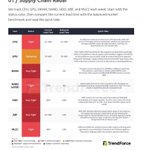
TrendForce just moved GPU supply from "balanced" to "starting to tighten" as the Rubin transition kicks in.
-> MLCC lead times: 38 weeks
-> DRAM lead times: down to 19 weeks but still very tight, especially 32GB and 64GB RDIMMs
A tiny capacitor taking almost 9 months to arrive can hold up an entire AI server. $NVDA, $MU, Murata, Samsung, Electro-Mechanics, Yageo.

Interesting… new TrendForce lead times (normal lead time in brackets):
- DRAM: 18 weeks, down from 19 [8]
- ABF substrate: 48-56 weeks [12]
- HDD: 50 weeks
- MLCC: 38 weeks
- GPU: 30-45 weeks
Memory is loosening a tiny bit, but substrates are still 4x+ normal. The squeeze just moved downstream. Ibiden, Unimicron, SEMCO, Murata.


Macro Voss retweeted

$AAOI เซ็นสัญญา 5 ปีกับ Yunnan Germanium เพื่อซื้อแผ่น InP (วัตถุดิบทำ laser)
ตอนนี้ใครคุมวัตถุดิบ InP ได้ก่อนจะได้เปรียบมากๆ ในเวฟ optics รุ่นใหม่ๆ ในอนาคต
และดีลนี้ไม่ได้ดีแค่กับ $AAOI เพราะอีกเจ้าที่เป็นต้นน้ำ InP อย่าง $AXTI ก็อาจจะได้รับความสนใจด้วย


$AAOI signs $194.4M/year contract with Yuunan Germanium.
This is for 2027 alone, with a 5 year contract. Given an implied total of ~$970M in InP substrates over 5 years (before price hikes)
Hmm just some thoughts:
- AOI laser capacity expansion seems bigger than what’s disclosed based on procurement patterns?
180K wafers seems like an extreme amount compared to what’s needed for lasers within their own transceivers… if they can consume all of that
So maybe we’ll hear about a new UHP laser contracts in earnings, after $LITE announced a $5B contract.
- read through on $AXTI is positive, given they’ll probably be #1 in InP substrates manufacturing scale in the future + have contracts with $LITE and $COHR.
- positive AOI was able to secure capacity during the bottleneck
More spend is probably the boogeyman in the AI trade, but it’s a good signal for earnings.

Macro Voss retweeted
TrendForce just moved GPU supply from "balanced" to "starting to tighten" as the Rubin transition kicks in.
-> MLCC lead times: 38 weeks
-> DRAM lead times: down to 19 weeks but still very tight, especially 32GB and 64GB RDIMMs
A tiny capacitor taking almost 9 months to arrive can hold up an entire AI server. $NVDA, $MU, Murata, Samsung, Electro-Mechanics, Yageo.
Macro Voss retweeted
The bottleneck isn't chips anymore. It's peak power.
OpenAI just launched "Grid Protectors", where future data center campuses cut their power use when the grid is stressed.
First site: Effingham, Georgia, with Georgia Power. The campus can shed up to 1,000MW on request, and OpenAI pays for all the power infrastructure itself.
Flexible load means faster grid hookups… which means more demand for on-site batteries, power gear, and backup generation. $SO, $VRT, $GEV
$TSEM just printed a record quarter.
-> Q3 revenue: $526M, +33% YoY
-> Q4 guide: $600M
-> Silicon photonics alone targeting a ~$1.1B annual run rate in Q4… 5x 2025
-> Customers extended contracts into 2029 and prepaid another ~$305M in 9 months
When customers are prepaying just to reserve capacity, that's what a real chokepoint looks like. $GFS $COHR $LITE

Macro Voss retweeted
Holy sht, it's official! $MRVL and $LITE are combining.
All-stock deal, $115B enterprise value:
-> 4.5 $MRVL shares per $LITE share
-> ~$1,132/share, a 23.9% premium
-> They're pitching a $550B addressable market and $1B+ in annual cost savings
-> Expected to close H1 2028
Marvell is pulling the laser chokepoint (InP/EML) in-house. $AVGO now faces a full-stack rival… and every other optics buyer may need a second source. Makes $COHR more strategically valuable overnight.
$SKHY just held its first ever Partners Day in Japan.
20+ Japanese suppliers showed up: Shin-Etsu, Sumco, JSR, Namics, Tokyo Electron, Screen, Disco, Advantest…
They shared the mid-to-long term roadmap so suppliers can plan capacity expansions.
With HBM sold out through 2029, the next chokepoint becomes Japanese materials, wafers, dicing and test tools.

Interesting… analysts estimate $INTC EMIB packaging yields are way behind CoWoS.
- EMIB overall: ~60-65%
- Silicon bridge embedding into ABF: ~25-30%
- $TSM CoWoS: ~98%
They also argue the 7.2% SOX drop was about Intel's guide and hyperscaler FCF worries… not AI demand.
So the CoWoS alternative isn't ready yet. $TSM still owns the packaging chokepoint, which fits the CoWoS price hike talk.
Oh look… Taiwan's biggest PCB makers are now personally flying to Japan just to get in line for equipment.
Zhen Ding, Compeq, and Unimicron execs went in person… and only cut tool lead times from 30 months to 28.
Low CTE glass cloth for high-end substrates is still short too, since new suppliers need customer qualification first.
New capacity is ~2.5 years away. Japanese suppliers like Nittobo hold the pricing power.