

Economist @ https://teapaw.org/t.co/KWGtdi0Mju | Research interests: macro & public finance | All-around econ nerd
München, Germany
Joined January 2019
- Tweets3K
- Following474
- Followers1.4K
- Likes7.1K




Pinned Tweet
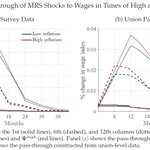
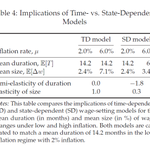
*Update*: "Wage Setting in Times of High and Low Inflation"
Core empirical finding: when inflation is high, German firms and unions reset wages more often and by larger amounts.
Joint work with @GoedlHanischIsa & Simon Velten;
Link: sites.google.com/site/maxgoe…

Max Goedl retweeted

Das Gutachten des @SVR_Wirtschaft ist wieder einmal sehr lesenswert. Den Titel finde ich sehr treffend.
Auf eine, wenn auch kleinere, Schwierigkeit bei den Konsolidierungsvorschlägen bzgl. "umweltschädl." Subventionen möchte ich allerdings hinweisen. /1
Max Goedl retweeted

A few weeks ago the Fed released the latest wave of its Survey of Consumer Finances (SCF), covering 2025. The SCF comes out only every three years, so this is a great time to update our evidence on the share of hand-to-mouth households in the United States.
Max Goedl retweeted

Don't tell me you still think of sovereign default as an all-or-nothing decision, Anon! And debt capacity as determined by the value of market access v exclusion? There is a better way. At least you know multiplicities abound, right? 🤔 gmihalache.com/docs/KM_parti…

Max Goedl retweeted

Come and join Isabel and me in Venice! We’re looking forward to great discussions, with keynotes by Ayşegül Şahin and Adrien Auclert. Submit your papers by 18 January!

📢Join @bornecon & me in beautiful Venice, 30 Jun-1 Jul 2027, for our @CESifoNetwork workshop on monetary transmission & structural change!
Keynotes: Ayşegül Şahin & @a_auclert
Broad range of topics welcome!
Deadline: 18 Jan 2027
ifo.de/en/cesifo/event/2027-…

This call is self-recommending!!
📢Join @bornecon & me in beautiful Venice, 30 Jun-1 Jul 2027, for our @CESifoNetwork workshop on monetary transmission & structural change!
Keynotes: Ayşegül Şahin & @a_auclert
Broad range of topics welcome!
Deadline: 18 Jan 2027
ifo.de/en/cesifo/event/2027-…
4
345
This should become the authoritative paper of its genre. Case closed.

Post-Covid-19 inflation was predominantly driven by unexpectedly strong demand forces, both in the United States and in the Euro Area, from @DomenicoGiannon and @gprimice nber.org/papers/w35980

Max Goedl retweeted
I went to see last night “The Standard of Living”, the play now in London about John Maynard Keynes’s life, and I really enjoyed it. It captures well his life and the times. However I disagree with an important part of the economics, a confusion that is behind the entire economic policy debate in Britain and the rest of Europe today: the confusion between Beveridge and Keynes.
The report by William Beveridge (an LSE economist and ex-director) led to an enormous expansion of the welfare state. That is often confused (also in the play) with Keynes’s views, as if the large and continuously growing post-war welfare state had anything to do with demand stabilization.
Keynesian demand management is what Andrés Velasco (also an LSE prof), as Finance Minister in Chile, did during the 2000s copper boom: he ran surpluses of 7% of GDP and more in 2006 and 2007 and put the money in a stabilization fund abroad. This was 12% of GDP by the end of 2008, when public debt was 4% of GDP. Public sector workers burned his effigy in Santiago asking for it to be spent. When the copper price collapsed along with the global economy, this surplus allowed him to introduce a massive stimulus package worth 2.8% of GDP, larger relative to the economy than the American one, which allowed him to stabilize Chile’s economy through the financial crisis. “Being a Keynesian means being one in both parts of the cycle,” he told The Economist. Today, very few governments are doing this. It is “whatever it takes” in crisis, and “welfare is untouchable” when the crisis finishes. This leads to a continuous ratchet up of spending that strangles any productive activity.
Keynes was in favour of using debt to stimulate demand, but under no circumnstances to finance permanent welfare spending. He wanted an ordinary budget for the state and then a capital budget that would be used for the demand management and that would be invested only in productive capacity. While Beveridge was about social redistribution, an issue of social policy, Keynes was about stabilization. The play and a lot of commentary seem to conflate both things and use demand management to justify permanent structural social policy.
I think this is pretty instructive for what’s happening in the UK and in the rest of Europe today. There is a widespread confusion that it’s neoliberalism which is hollowing out the state, when in fact the UK’s public spending burden is at around 45.6% of GDP this year, and the OBR expects it to stay around 45% for ten years running, the longest sustained period of spending this high since the Second World War; EU governments spend 49.5% of GDP (Eurostat, 2025). Outside wartime and the pandemic, the state has never been this large for this long. Neither neoliberalism nor austerity is at fault for the lack of investment.
Governments cannot hit the fiscal rules without touching the triple lock, and other welfare entitlements (free transport for the over 60s here in London!) that most MPs consider untouchable. What gets cut all the time to make the numbers add up is infrastructure, energy, grids, R&D, innovation, etc. The UK’s gross fixed capital formation is at 18-19% of GDP, which is the lowest in the G7, and the general government investment is also behind the OECD average.
The debate misunderstands the risk of pension sustainability. It is not that at some point in the future pensions become unsustainable. It is that today, their relentless growth eliminates the space to invest in infrastructure, innovation and the rest. Sadly, no party dares to make this argument. And even economists who defend the entrepreneurial or innovative state cannot bring themselves to state the obvious: that there is a huge opportunity cost in having one of every 5 new cars sold in the UK being paid by the state as a disability benefit, or in having free transport for all over 60 year olds.

This issue has to be tackled at a higher level to change the whole incentive structure.
1) abolish take-home exams university-wide;
2) supplement student evals with peer review from external experts;
3) substitute oral exams for written theses;

Ok, so the students go full AI on my take home exam on an elective course. It's a completely pointless exercise, and everyone - even those not attending the lectures - will get top marks. A student told me yesterday that all his friends only pick electives with take-homes, don't go to lectures, and ace the exam with AI.
So the question is: should I make it a written sit-in, risking that the course will close down (must have a certain # of students for it to run), or keep everyone happy with a take home?
I'd say about 30% of participants take the course seriously regardless, and learn (and appreciate the course) a lot.
Max Goedl retweeted

Neue Crazy-Story vom Taximarkt: Neue Praxis schränkt den ohnehin kaum vorhandenen Wettbewerb weiter ein. Spannend auch hier: Woher kommt die staatliche Bürokratie? In Wahrheit steckt dahinter ein Revierkampf der Unternehmen. Hier entlang zur Story: derstandard.at/story/3000000…
Max Goedl retweeted

Okay, once and for all: there are some statements of Pirenne that our paper agrees with, and some (many?) statements that our paper disagrees with. For more info, please read the paper :)

I usually find Tyler’s takes insightful. But this is a pretty bad one. The paper shows that the Arab conquests disrupted N-S trade (echoing Pirenne). But let’s not forget they also created a huge new common market stretching from India to Spain & from Caucasus to East Africa!

Trade and the end of antiquity, or did Islam serve to deglobalize the world? marginalrevolution.com/margi…

2
419
Max Goedl retweeted

Bizarre how much crazy hate the (great) Pirenne Thesis paper is getting in some corners.


Max Goedl retweeted

📉 Werden die reichen Länder bei der Einkommensungleichheit immer ähnlicher?
In einer heute in PNAS erschienenen Studie untersuchen wir (58 Ökonomen!) die Einkommensungleichheit in 17 europäischen und nordamerikanischen Ländern zwischen 1995 und 2021.
📊 Die Unterschiede in der Einkommensungleichheit zwischen den Ländern sind um knapp 30 % zurückgegangen. Gleichzeitig ist die Ungleichheit innerhalb der Länder im Durchschnitt gestiegen.
🧐 Überraschend: Bei den Markteinkommen (vor Steuern und Transfers) entwickeln sich die Länder auseinander. Bei den verfügbaren Einkommen nach Steuern und Transfers zeigt sich hingegen eine Annäherung.
🇩🇰🇸🇪 Besonders interessant ist Skandinavien: Die traditionell starke Umverteilungswirkung hat dort deutlich abgenommen – in 🇩🇰 seit den 1990er-Jahren um fast 40 %. In anderen Ländern, etwa Irland, hat sie hingegen zugenommen.
Und 🇦🇹? Hier hat sich vergleichsweise wenig verändert. Mehr dazu im Folgetweet.
Die Pointe: Die Einkommensungleichheit in den reichen Ländern wird ähnlicher, obwohl sich die Ungleichheit ihrer Markteinkommen auseinanderentwickelt. Verantwortlich ist die Annäherung der Umverteilungswirkung von Steuern und Transfers – insbesondere durch deren Rückgang in den nordischen Ländern.
pnas.org/doi/10.1073/pnas.26…


Turns out the Pirenne thesis is true after all

@johannesmboehm and Chaney combine data on half a million ancient coins with a model of trade and money to reconstruct trade and consumption from AD 325 to 950. The estimates show economic activity shifting away from the Mediterranean from the 6th century.
econometricsociety.org/publi…

1
11
898


Are you Wittman, Friedman, Galbraith, or Lenin?
Do the online test NOW!


Here is Caplan's detailed response. Also read the dabate between him and Wittman that ensued! econjwatch.org/articles/from…

1
10
868
I think @bryan_caplan has shown that Wittman's argument relies on the assumption that voters have unbiased beliefs about critical issues (like trade, technology, taxation, etc.). If voter beliefs are biased, competition can make matters worse!


Here is Caplan's detailed response. Also read the dabate between him and Wittman that ensued! econjwatch.org/articles/from…