

United States
Joined October 2009
- Tweets12.8K
- Following2.6K
- Followers2.2K
- Likes1.7K





When will a CEO of a health care system ever come out a say we care about this community and we are committed to making healthcare affordable and to than end we have reduced our charges...... #healthcare
55
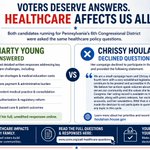
#ChesterCounty voters find out where the PA6 candidates stand on #healthcare. @VoteMartyYoung @RepHoulahan ccms.org/post/pa-6-district-…
🤖 Made with AI

59


Hippocrates retweeted

My job is to make sure your surgery center never gets built.
Eleven years, and I have never lost.
The kid had it all lined up. Board-certified, two partners, a lease on a space where he could do the same procedures my client does across town. He showed up to the hearing with a slide deck and patient testimonials.
Adorable.
I did not bring a deck.
I brought one sentence.
“This facility is not necessary.”
That is the whole game.
In this town, you cannot pour a foundation until a board agrees the community “needs” the place. The people who get to argue that you are not needed are the incumbents who would lose the business.
My client gets a seat at the table where his own competition is approved or killed.
I have sat in that chair for eleven years.
I have never once said yes.
The kid drained himself dry to file.
The application alone is the moat: thick, slow, and expensive enough to stop most physicians before they ever reach a vote.
He cleared it anyway, which I respected, right up until I buried him in it.
We said “duplication of services.”
We said “protecting the safety net.”
Language that tested well in 1974 and continues to test well today.
The board tabled him for review.
Review became a year.
The year became a withdrawn lease, and three physicians quietly returned to working for the health system.
You want to know what we were actually protecting?
A physician down the street doing the same procedure for less. Medicare pays us more. Which means commercial pays more. I don’t share.
That is the threat.
Everything else on the record, the duplication, the waste, the safety net, we wrote for the transcript.
Patients kept paying more.
My client called it a win.
I bought a boat last spring.
I named her Certificate of Need.

Physician, Heal Thyself: Physician, Heal Thyself
#PhysicianLeadership #HealthcareReform #Burnout #MedicalProfession #Physician @DutchRojas linkedin.com/posts/andrew-mu…
🤖 Made with AI

1
45
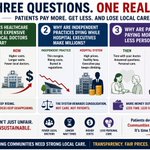
Patients are paying more, waiting longer, and losing the local relationships that once defined healthcare.
This isn’t sustainable.
And it isn’t patient-centered. @VoteMartyYoung @RepHoulahan
#Healthcare #PatientsFirst #SaveLocalCare #HealthcareReform #Transparency
🤖 Made with AI

41
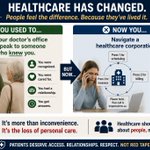
Healthcare used to feel personal.
Healthcare should be about relationships, access, and trust — not bureaucracy and red tape.
Patients deserve better. @VoteMartyYoung @RepHoulahan
#Healthcare #PatientCare #SaveLocalCare #HealthcareReform #PatientsFirst

19
See this Instagram video by @aafanational instagram.com/reel/DX910EFpZ…

19
Same test. Same doctor. Same building.
Higher costs. Less transparency. Fewer choices.
Patients deserve better.
#Healthcare #PatientCare #HealthcareCosts #Transparency #SaveLocalCare @VoteMartyYoung @HoulahanForPa @RepHoulahan
🤖 Made with AI

20
Dear #Radiology colleagues: If you do not want to be replaced by A/I then don't tell me that it will take 7-14 business days for a CXR to be read and finalized!!!!! @mainlinehealth
76
Local farms disappear.
Local businesses disappear.
Local newspapers disappear.
Now independent community medical care is disappearing too.
This isn’t just about doctors.
It’s about what kind of communities we want to live in.
#Healthcare#IndependentMedicine #HealthcareCosts
🤖 Made with AI

1
10
Hey @Walgreens denying my patient their albuterol inhaler for their asthma is absolutely indefensible. #asthma #albuterol
We keep asking why #physicians are burned out.
But we never ask a better question:
Why does the system only add—and never subtract?
More requirements.
Less time.
Less control.
Burnout isn’t a mystery. It’s the design. @DutchRojas @GeBaiDC
🤖 Made with AI

33
The #Stark Law was meant to stop self-referral. It didn’t—it scaled it. Health systems employ physicians, own the services, and keep referrals in-house.
Same incentives. Bigger players. Higher costs. @DutchRojas @GeBaiDC @mcuban
🤖 Made with AI

1
78
#Starklaws initially intended to punish #physicians from self referral now ACTIVELY ALLOW physician self referral to the benefit of the #Academic / #HealthCareSystem. Who pays? The #patient with higher cost and less access to care. @DutchRojas @mass_marion @GeBaiDC
🤖 Made with AI

2
37
Consolidation rewarded; Competition restricted; Pricing power protected. Patients pay the cost. @DutchRojas #healthcare
🤖 Made with AI

The irony of Stark laws is that it has now institutionalized the exact practices it wanted to stop -employed Doc are not "required" to use the systems lab, radiology, PT/OT, surgeons etc all of which has resulted in increased health care costs /insurance cost

“I would like to just go back to the old law.” - Pete Stark
When I talk about hospital consolidation, I typically blame market forces. Economies of scale, thin margins, and the complexity of modern healthcare all weigh heavily.
I rarely mention the federal law that made independent physician ownership structurally illegal, but it is important to include.
Stark created a legal environment where the only compliant way to build integrated referral relationships was through employment or complex written arrangements requiring teams of healthcare attorneys to maintain. Independent physicians who wanted to own ancillary facilities or build integrated care models faced Stark liability at every turn. Hospital systems faced none of that friction.
The result was predictable. The practice model Stark was supposedly neutral toward was systematically disadvantaged while the practice model it left untouched captured everything. Independent physician ownership gave way to large employed systems.
In 1983, more than 75% of physicians were independent. Today that number is below 25% and falling. Stark didn’t cause all of that but it built the legal architecture that made consolidation the path of least resistance and independent ownership the path of maximum legal exposure.
Patients pay the price. Hospital-employed physicians practice in the most expensive care settings in the system. Every referral to a hospital-owned facility carries a facility fee that an independent practice cannot charge. While site-neutral payment reform is the demand-side fix for this problem, Stark modernization is a potential supply-side fix.
You cannot solve consolidation without first addressing laws that incentivized it.

56
Hippocrates retweeted

AHA in 2010: " We can't make money just taking care of sick patients. We need elective, commercially insured patients. Shut down these damn doctor owned hospitals."
AHA in 2021:"We had record revenues in spite of the pandemic throttling high margin elective cases. Looks like we figured out how to make money caring for sick patients."
AHA in 2023:"Yeah so even though we had record revenues post pandemic, and our C suites got crazy production bonuses; we lost money on our balance sheets because our investment arms took a bath in the market. Can you guys at CMS maybe give us a pay bump to offset our losses?"
AHA in 2026:"We can't make money taking care of sick patients. We need elective, commercially insured patients. Don't repeal the ban on physician owned hospitals. Doctors are just greedy interlopers anyway.
Hey can I show you my new Maybach?????"
@GeBaiDC @DrDiGiorgio @DrBruggeman @DutchRojas @anish_koka @nickshirleyy @DrOz

There is no issue with physician-led hospitals- the issue is about the conflict of interest when physicians self-refer patients to their own hospitals.
The data is clear: POHs tend to treat more commercially insured and healthier patients than full-service hospitals.
In rural communities, this can leave rural hospitals with a greater financial burden, further threatening their ability to keep their doors open and keep 24/7 care available in their communities.
Read more: fah.org/wp-content/uploads/2…
US healthcare echoes dot-com & housing bubbles: Admin consolidation, insurer monopolies, & opaque pricing; true prices hidden like subprime risks. VC floods telehealth unicorns; fed subsidies mimic Fannie/Freddie. Burst ahead? @DutchRojas @GeBaiDC @mass_marion
🤖 Made with AI

1
63