

22, GenAI Engineer @MNC • prev 1x startup • Projects @ https://teapaw.org/t.co/kJzFaMcaE6 • Applied AI
Mumbai , Maharashtra
Joined December 2025
- Tweets630
- Following77
- Followers308
- Likes4.7K






swarajjj retweeted

As an Agentic AI Engineer in 2026.
Please learn:
1. Context engineering & memory: what enters the context window, what gets summarised, what gets retrieved later. Otherwise the agent re-reads the same files every loop, or forgets a constraint from twenty turns ago.
2. Tool design & schemas: a tool that returns ambiguous free text leaves room for the agent to improvise. Strict schemas and validation make failures visible instead of letting bad output pass silently.
3. Permissions & credentials: enforce these outside the model. The prompt says don't write to production. The prompt isn't the thing holding the token.
4. Retries, backoff, iteration limits & budgets: retrying a side-effecting call can repeat the operation. Without iteration limits, an agent loops until the budget is gone.
5. Idempotency & durable execution: the request timed out, but the write landed anyway. The retry creates a second record. You need to handle retries, checkpoints and partially completed work.
6. Orchestration & handoffs: every handoff compresses context. A worker solves the wrong problem cleanly, while the orchestrator gets more confident as it knows less.
7. Verification & completion detection: the agent will decide it's done. Something outside the agent needs to check whether the outcome was actually achieved.
8. Evals as regression tests: if you built the suite from failures you already understood, it stays green until the first failure nobody anticipated.
9. Observability & traces: which tool was called, with what arguments, in what order, at what cost. Without that, debugging a bad outcome is guesswork.
10. Failure recovery & state reconstruction: runs die halfway. If the system can't reconstruct what happened, it can't reliably resume.
11. Sandboxes & isolated execution: give the agent somewhere to experiment, execute code and test changes without putting the real system at risk.
12. Inference economics & latency: model routing, caching, parallel tool calls, P95 latency and TTFT. An agent that works but costs too much or takes too long to finish won't reach production.
Repository context is not production context. Most of this list is the gap between them.
None of it makes the model smarter. It makes the model's mistakes cheap, visible and recoverable.
swarajjj retweeted

推荐一篇写得非常清楚的 LLM Eval 指南。没有概念堆砌,而是用一个客服助手例子把「怎么测、测什么、数字怎么看」讲透了。做 AI 产品的人值得收藏。


swarajjj retweeted

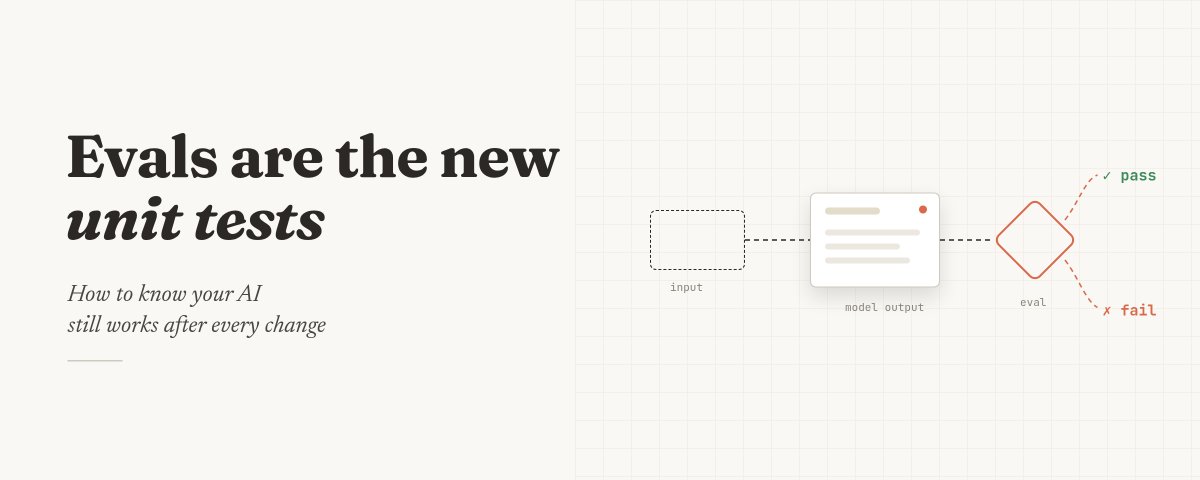
Evals are the most important skill in AI right now & most engineers still don't get them



swarajjj retweeted

i had claude go through every @kirat_tw podcast. 83 episodes, 40 hours
100+ devs explaining exactly how they got hired. most had no big college name
wrote down everything that worked

swarajjj retweeted

@ghumare64's AI Engineering from Scratch is one of the best free AI courses out there: 542 lessons, 20 phases, all open source.
It was a bit hard to navigate when starting out, so I made a simple reader: one order, progress tracking, Next buttons.
ai-engineering-from-scratch-…

swarajjj retweeted

🚨 giving AI agents direct access to your API keys is a security nightmare waiting to happen
Unreal Labs uses an egress proxy + credential broker to keep secrets out of the agent's hands
• isolated sandboxes for agent execution
• credentials injected after requests leave the sandbox
• destination-level access controls
• least-privilege permissions
the agent can use authenticated APIs without ever seeing the underlying API keys
this is the kind of infrastructure detail people underestimate when shipping agents to production.

swarajjj retweeted
you wanna crack agentic ai roles?
don't ignore agent memory.
if you understand these 3 major areas, you'll cover a huge chunk of memory systems in agentic ai:
1. memory architectures & design
- short-term vs long-term memory
- working, episodic, semantic & procedural memory
- conversation history vs persistent memory
- memory extraction, consolidation & summarization
- memory lifecycle: write, update, retrieve & delete
- designing a memory layer for multi-agent systems
2. memory retrieval & intelligence
- semantic search vs keyword search vs hybrid search
- embeddings, vector databases & similarity metrics
- metadata filtering, reranking & top-k retrieval
- temporal memory, recency & relevance scoring
- entity resolution, deduplication & conflict resolution
- memory compression, forgetting & token-budget management
- memory-aware planning and retrieval before action
3. memory evaluation & production
- memory precision, recall & retrieval relevance
- measuring whether agents remember the right things
- long-term recall across conversations and sessions
- memory contamination, stale facts & conflicting memories
- memory isolation across users, agents & sessions
- latency, token costs & retrieval overhead
- observability, memory provenance & debugging
- testing memory updates, persistence & failure recovery
i've built OpenMemoryUI, a memory glassbox for AI agents.
🔗 openmemoryui.netlify.app/
it lets you observe how agent memory works through a visible pipeline:
retrieve → act → generate → extract → write
it includes session, episodic, semantic and contextual memory, provenance tracking, and in-place memory updates instead of blindly creating duplicates.
building an agent that can store information is the easy part.
building one that remembers the right things, at the right time, without hallucinating or forgetting critical context, is the real skill.
if you're preparing for an agentic ai interview, understanding memory systems can be the difference between "i added a vector database" and "i designed a reliable agent memory layer."

swarajjj retweeted

If you are nothing without the suit, you shouldn’t have it.
basically, if you’re nothing without your AI subscriptions, you probably shouldn’t be relying on them this much..
LLMs should make you faster, not make you stop learning.
you should always have the curiosity to understand how things work yourself. the moment that curiosity dies, you stop growing. 🍀


swarajjj retweeted

If I had 1 month to build my Portfolio Project which will get me hired as an AI RAG Engineer, I would do these, starting from basics to advance:
1) Build your vectordb: Arrange a dataset with thousands of unstructured files. You can get it from any open source repository or platform. Now before chunking, you choose type of vectordb you require. Do you need a dedicated vectordb or pg vector extension? This should be a business impact based decision. If you need Vectordb + Crud operations in one database then go with pgvector extension. If you don't have crud operations in your business and require a high scalable vectordb then go with a dedicated vectordb.
2) Engineer the chunking strategy: The first and foremost strategy of any RAG pipeline is chunking. There are various types of chunking strategies like paragraph chunking, paragraph with overlap chunking, document layout aware based chunking, LLM based reasoning chunking, etc.
For the files which contains text + images + tables, you can opt for either document layout aware based chunking or build a pipeline to process three different chunking for this three different requirements.
3) Build and Evaluate your first retriever like a real engineer: Choose your retriever strategy, either it could be semantic or keyword based or both. Now question is how you gonna choose? It could be usecase wise too, if that dataset has some keywords which is hard to retrieve semantically then use hybrid approch. In interview they will ask how do you know that semantically it will be harder to fetch those?? To answer this question like a True Real Engineer, you do experiments with this two different retriever strategies semantic vs hybrid. You take 1 eval dataset, and example queries, and give those examples queries to retrieval to fetch chunks from vectordb and then you evaluate those chunks with eval dataset with metrices like Precision, Recall, MRR, Hitrate, Context Recall and Context Relevance. Now you make decisions based on this.
4) Choose LLM like a real engineer: In interview, they will ask why you chose that xyz specific model when alot of options where already there? How you gonna answer??? For that, you need to answer it in layers. First layer is resource constraint. You could choose gpt-3.5 or even gpt-5.5, and the very practical decision is based on cost vs accuracy tradeoffs. You can legit say that i chose gpt-3.5 as in my rag pipeline, even though universally we all know gpt-5.5 is better in terms of accuracy, but the cost is a big constraint. This is a legit explanation. Now interviewer might ask you that in the cost range of gpt-3.5, you have many models then why only gpt-3.5, then there to answer that, you do experiments with 3-4 models by taking eval dataset, and comparing with the answers these models generate, and log their metrices like Faithfulness, Groundness, Answer relevancy, and we can have these metrics evaluated by LLM as a judge or Human Evaluation. And then you say that i found gpt-3.5 metrics better than other 3 models so I chose that.
5) Parameters and hyperparameters: In short, you need to build intutions with experiments. When interviewer ask that why did you choose top-k=3 in llm generation part, or temperature=2, then you better answer it with evidences.
6) Deploy in AWS or Azure and practise system design concepts there. Try load testing and see if your vectordb is handling load, monitor the logs, increase load again and log the metrices. Play around, some will break, fix and debug.
The more your decisions are grounded, the more you are closer to real engineering. Otherwise you are just another vibe coder who don't understand a shitt in depth.
⭐ Save. Repost. Follow
swarajjj retweeted

If I had 6 months to become an AI Evals Engineer.
I’d do this.
Stage 1: Testing Foundations and Statistics for AI
- Learn: pytest (fixtures, parametrize), JSONL pipelines, precision/recall/F1, confidence intervals, Cohen's kappa.
- Practice: Build a pytest plugin that loads a JSONL eval dataset and emits a metric report on every run.
- Why: Evals are tests and tests are math. If you cannot quantify agreement, you cannot prove improvement.
Stage 2: LLM Failure Modes and Behavior
- Learn: temperature and top-p sampling, seed control, tokenization edge cases, instruction drift, hallucination taxonomies.
- Practice: Fuzz one model with 500 adversarial inputs and classify every failure into a taxonomy with reproduction steps.
- Why: Every eval suite is a map of known failure modes. You cannot evaluate what you do not understand.
Stage 3: Golden Dataset Engineering
- Learn: annotation guidelines, stratified sampling, inter-annotator agreement, dataset versioning, contamination detection.
- Practice: Build a 300-case golden dataset with 2 annotators, measure kappa, and version it in git with a changelog.
- Why: Your evals are only as good as your dataset. Garbage labels produce garbage confidence.
Stage 4: Scoring Methods and LLM-as-a-Judge
- Learn: exact and fuzzy match, embedding similarity, rubric design, judge model selection, judge biases (verbosity, position, self-preference).
- Practice: Build an LLM-as-a-judge with a rubric, calibrate it against 100 human labels and publish the agreement score.
- Why: Judges drift and lie. Calibrated judges are instruments; uncalibrated ones are vibes.
Stage 5: RAG Evaluation
- Learn: hit rate, MRR, NDCG, recall@k, faithfulness vs relevance, citation grounding, abstention quality.
- Practice: Build a RAG eval harness with separate retrieval and generation gates, plus adversarial queries that must return "no answer".
- Why: RAG fails in two places. A single score hides which one is broken.
Stage 6: Agent and Trajectory Evaluation
- Learn: tool-call correctness, step-level grading, trajectory distance metrics, counterfactual replay, sandboxed execution scoring.
- Practice: Build a trajectory grader that scores each tool call against a golden path and blocks dangerous action sequences.
- Why: Final-answer evals hide where agents actually break. The trajectory is the unit of accountability.
Stage 7: Eval Frameworks and Custom Harnesses
- Learn: DeepEval, promptfoo, RAGAS, Braintrust, OpenAI Evals; dataset-driven pipelines, parameterized configs.
- Practice: Write a custom harness that runs 3 frameworks behind one CLI and outputs a unified metric report.
- Why: Frameworks give you scaffolding. A custom harness gives you control when the scaffolding lies.
Stage 8: Statistical Rigor for Eval Deltas
- Learn: bootstrap confidence intervals, paired significance tests, effect size, sample-size math, seed variance.
- Practice: Build a comparison report that says "Model B wins by 3.2% ± 1.1% (p<0.05)" instead of "Model B seems better".
- Why: A 2-point difference on 50 samples is noise. Executives make million-dollar decisions on your numbers.
Stage 9: CI/CD Eval Gates and Regression Control
- Learn: GitHub Actions eval jobs, thresholds with hysteresis, eval caching, cost budgets, flaky-eval detection.
- Practice: Wire a gate that blocks merges when task success drops >2% vs main and auto-posts failing cases to the PR.
- Why: Evals that do not block deploys are reports not gates.
Stage 10: Production Monitoring and Drift Detection
- Learn: Langfuse, LangSmith, Phoenix, traffic sampling strategies, drift metrics, hallucination spike alerts, feedback-trace correlation.
- Practice: Build a pipeline that samples 5% of prod traffic nightly, runs offline evals and alerts on quality decay.
- Why: Golden datasets go stale. Production is the eval suite that never stops updating.
Stage 11: Data Flywheels and Eval-Driven Optimization
- Learn: feedback-to-dataset loops, DPO preference pairs, eval-driven prompt optimization (DSPy), A/B testing with guardrail metrics.
- Practice: Automate the loop: thumbs-down → labeled case → golden set addition → nightly eval run → diff report.
- Why: The compounding advantage in AI is not the model. It is the flywheel that converts failures into tests.
Stage 12: Red-Teaming, Public Benchmarks and Portfolio
- Learn: adversarial suites (injection, jailbreaks, data exfiltration), benchmark methodology, contamination-aware reporting.
- Practice: Publish a public eval teardown of your agent vs a naive baseline with full methodology and reproducible seeds.
- Why: Senior evals engineers are hired for their methodology not their dashboards.
Vibe-checking is dead. If you cannot measure it, you cannot ship it.
The modern AI Evals Engineer builds the quality gates for every autonomous system.
Bookmark and Repost!


swarajjj retweeted

Attention is all you need was not just a paper but a true revolution.


Only President Trump could convene all the leaders of the top companies developing chips, data centers and frontier models for Super Intelligence. This new Industrial Revolution has already created a million new jobs and is spurring a bigger infrastructure build-out than the railroads, canals and grid combined. I was honored to witness history as the leaders of the frontier lab companies signed the White House Accord on Super Intelligence, accepting responsibility for the safe development of their products and imposing new internal controls and external audits. This is far better than waiting years for some international agreement that would probably never happen. President Trump continues to ensure that U.S. remains the technology leader while putting Americans first.


swarajjj retweeted

be curious. adapt. think AI first and multiply your productivity by building great systems around it.
manual coding is gone (in most cases), so, focussing on building a great verification system and making sure no bugs leak in your code and crafting great experience is what will keep people relevant.
earlier people could survive basis coding, but now it will be business impact, product thinking, and engg.
swarajjj retweeted

As an AI Engineer. Please learn:
> Harness engineering, not just prompt engineering
> Context engineering, not just long prompts
> Prompt caching vs. semantic caching tradeoffs
> KV cache management, eviction, reuse, and memory pressure at scale
> Prefill vs. decode latency and why they optimize differently
> Continuous batching, paged attention, and throughput optimization
> Speculative decoding vs. quantization vs. distillation tradeoffs
> INT8, INT4, FP8, AWQ, GPTQ, and when quantization hurts quality
> Structured output failures, schema validation, repair loops, and fallback chains
> Function calling reliability, tool contracts, argument validation, and idempotency
> Agent guardrails, loop budgets, tool budgets, and termination conditions
> Model routing, graceful fallback logic, and degraded-mode UX
> RAG architecture: chunking, embeddings, hybrid search, reranking, and freshness
> Retrieval evals: recall, precision, grounding, attribution, and citation quality
> Evals: golden sets, regression tests, adversarial tests, LLM-as-judge, and human evals
> LLM observability as a first-class discipline: traces, spans, tokens, latency, errors, and drift
> Cost attribution per feature, workflow, tenant, and user journey, not just per model
> Safety engineering: prompt injection defense, data leakage prevention, and permission boundaries
> Multi-tenant isolation, cache safety, and cross-user context contamination prevention
> Fine-tuning vs. in-context learning vs. RAG vs. distillation, and when each is the wrong tool
> Latency, quality, cost, and reliability tradeoffs across the full inference stack
> Production failure modes: hallucinated tool calls, malformed JSON, stale retrieval, runaway agents, and silent eval regressions
> Shipping LLM systems as reliable infrastructure, not demos wrapped around prompts
aiengineeringfromscratch.com…

swarajjj retweeted
How to get 36 LPA job opportunities as an AI Engineer with 4 YOE. Just like me. Real Deal. No BS Guide...

swarajjj retweeted

At Amazon, a strong L5 with 7 to 8 years of experience can cross ₹1 Cr+ CTC. At L6, compensation can go well beyond ₹1.5 Cr+ depending on team, location, stock, and level.
But the interesting part is not just the money.
Look at why recruiters reach out for these roles.
It is because their background shows they understand hard systems, and they have enough proof of work that people can see it.
Today I am a Principal Engineer, but if I were starting in distributed systems from scratch and wanted to turn that skill into career leverage, this is exactly how I would do it.
[1] Build the fundamentals before touching big scale
I would first get comfortable with the building blocks:
→ networking and request lifecycle
→ databases, indexes, transactions
→ caching
→ queues and async processing
→ replication
→ sharding
→ consistency
→ retries, idempotency, backpressure
→ observability and failure handling
Basically, have the understanding to see what happens when one normal backend service gets slower, busier, or partially unavailable.
[2] Build systems where the tradeoffs come into the picture.
Do not only watch architecture videos.
Build things.
Start with:
→ URL shortener
→ rate limiter
→ notification service
→ job scheduler
→ file upload system
→ search service
→ payment workflow
Then deliberately make them harder.
– What happens at 10x traffic?”
– What if Redis dies?”
– What if the same event arrives twice?”
– What if one shard becomes hot?”
[3] Read engineering blogs and reverse-engineer decisions
Uber, Netflix, Stripe, Discord, Cloudflare, LinkedIn, Meta, Amazon.
There’s golden material out there.
While reading, ask yourself:
– Why did they choose this?
– What was breaking before?
– What tradeoff did they accept?
– What new problem did their solution create?
That is how engineers actually learn architecture.
[4] Put your thinking in public
This part is massively underrated.
Write about what you learn.
Publish:
→ design breakdowns
→ architecture diagrams
→ GitHub projects
→ incident analyses
→ open-source contributions
→ performance experiments
Build enough public proof that when someone searches your name, they can tell what kind of engineer you are.
That is when learning starts compounding.
You study distributed systems to become better at engineering.
Then that knowledge helps you design better systems.
Those systems give you better stories.
Those stories become public proof.
And eventually, opportunities start finding you instead of you constantly chasing them.
That is the leverage.

