

Looking through the stories markets tell themselves. Macro, tech, geopolitics. Founder, DeFi Advisors. Ex CIO, Appletree Capital. I write One More Why.
London, England
Joined March 2011
- Tweets30K
- Following5.8K
- Followers71.6K
- Likes49K






Pinned Tweet
Mind the Gap (Part 2)
Part 1 measured the gap in China's debt.
This one follows that debt to where it ends up: Chinese banks.
China's home prices are down about 25% in real terms since 2021. China's banks report that 1.52% of their loans are bad.
Both numbers are official. They cannot both be true.
Banks hold about $8 trillion of local government debt, roughly 75% of the total, plus their loans to property developers. My base case puts the loss gap over existing provisions at $6.6 trillion, or 32% of GDP.
Recognizing it now would take $3 to 4 trillion of fresh capital. So far, banks have received about $118 billion.
Who pays? Not foreigners. Capital controls keep the losses inside the country. For now, the bill goes to Chinese savers, slowly, as it did to Japanese savers after 1990.
Please mind the gap (Part 2)👇
substack.com/@mnicoletos/no…
#China #Debt #Banks


Michael Nicoletos retweeted

1/2
Caixin: "“It took me a long time to make up my mind, because I’m a deep believer in open trade,” Pascal Lamy told Caixin. But he believes that China’s combination of industrial subsidies, weak domestic consumption and price competitiveness across supply chains has distorted the traditional logic of comparative advantage."
caixinglobal.com/2026-11-07/…

Because it is, and it’s in a very big one!

Something very strange happened at the Communist Party's 5th Plenum last week, its most important meeting this year.
They issued a massive resolution at the end of the meeting together with an official commentary on it by Xi Jinping and, if you read both, you're left with one overwhelming impression: it's crisis time inside the Party.
I'm not exaggerating, check the vocabulary they're using: Xi talks of "viruses eroding the Party's healthy body" (侵蚀党的健康肌体的病毒, qīnshí dǎng de jiànkāng jītǐ de bìngdú) and "stubborn chronic diseases" (顽瘴痼疾, wánzhàng gùjí), with problems so "shocking" (触目惊心, chùmù jīngxīn) that the Party has to "turn the blade inward" (刀刃向内, dāorèn xiàng nèi) - in effect, self-mutilate to get the poison out.
Heck, it was the very theme of the meeting: all about hard discipline with Xi saying he wants to send "a strong signal that things will get stricter the further we go" (越往后越严, yuè wǎng hòu yuè yán).
You don't do that when things are going well.
Except that - and here's the paradox - factually speaking, things are going well in China. One can even say that - looking back centuries - China is at the very height of its power.
This is no exaggeration either: China makes nearly 30% of everything manufactured on the planet, has a record $1.19 trillion trade surplus despite Trump's tariffs, and is in the lead in 69 of 74 critical technologies according to the (hardly pro-China) Australian Strategic Policy Institute.
It's also, geopolitically, more secure than it's been in a long time: in a truce with Washington with Xi having just been welcomed at the White House with a pomp very few have ever been granted - Trump personally waiting for him on the tarmac - while the rest of the world keeps flocking to China, now the world's favorite diplomatic destination.
So what gives, how do you reconcile these 2 things?
I'd argue that China is having its own Fukuyama moment, except in reverse.
Remember the West in the early 1990s at the height of its power: Francis Fukuyama declared "the end of history", with liberal democracy as the "end point of mankind's ideological evolution".
In other words we concluded we had reached perfection, that there was nothing left to fix. History had ended: we were the final form of human civilization. Maximum hubris.
We all know how long that lasted...
China, now at its peak, is taking the exact opposite route. This is not just a supposition by me: last week's resolution literally makes it a rule - the longer the peace lasts, the more the Party must "strengthen its sense of peril" (增强忧患意识, zēngqiáng yōuhuàn yìshí) and "think of danger" (思危, sī wēi).
China, officially, also keeps referring to the so-called "cave dialogue" (窑洞对, yáodòng duì): a 1945 conversation in Yan'an where an educator, Huang Yanpei, warned Mao that every Chinese dynasty had followed the same arc - tough at the start, then soft and rotten once comfortable.
"Good times create weak men", basically, 80 years before the meme.
Which is an old Chinese idea: 2,300 years ago, Mencius summed it up with 生于忧患,死于安乐 (shēng yú yōuhuàn, sǐ yú ānlè, "adversity keeps us alive, comfort kills us").
The resolution, and Xi's commentary on it, keep referring to this new strict doctrine that's officially called "self-revolution" (自我革命, zìwǒ gémìng) as the "second answer" to the "cave dialogue". In other words as China's way of escaping history, of preventing the "good times create weak men" curse.
So, it's "end of history" versus "escaping history", maybe both hubristic in their own way - nobody escapes history forever - but with one big difference: the first stopped looking for its own flaws, the second has made obsessing about them its official doctrine.
That's what I look at in my latest article - from a 3,000-year-old bathtub inscription to the 42 generals who fell off their horses - and why China's obsession with its own flaws might be the most underrated strategic advantage in the world. Or its biggest weakness: arnaudbertrand.substack.com/…

Michael Nicoletos retweeted
Mind the Gap (Part 2)
Part 1 measured the gap in China's debt.
This one follows that debt to where it ends up: Chinese banks.
China's home prices are down about 25% in real terms since 2021. China's banks report that 1.52% of their loans are bad.
Both numbers are official. They cannot both be true.
Banks hold about $8 trillion of local government debt, roughly 75% of the total, plus their loans to property developers. My base case puts the loss gap over existing provisions at $6.6 trillion, or 32% of GDP.
Recognizing it now would take $3 to 4 trillion of fresh capital. So far, banks have received about $118 billion.
Who pays? Not foreigners. Capital controls keep the losses inside the country. For now, the bill goes to Chinese savers, slowly, as it did to Japanese savers after 1990.
Please mind the gap (Part 2)👇
substack.com/@mnicoletos/no…
#China #Debt #Banks
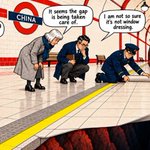
New series: Mind the Gap.
On the London Underground, a voice reminds you to mind the gap between the platform and the train. China has a gap of its own, between what it reports and what's actually happening.
Each post measures one of these gaps, with every source linked.
Part 1 is on debt. Officially it's 68% of GDP, but the IMF's full count is 127%.
Last year China added more than $6 of debt for every $1 of new output.
Please mind the gap 👇
michaelnicoletos.substack.co…
#China


We're going through the largest technological transformation since the discovery of electricity.
We are only in the 2nd inning, and we are debating whether this is a bubble or if it’s over.
Are we serious?
#AI

We tend to treat these as separate stories. Bitcoin. Stablecoins. Tokenization. AI. AI agents.
Look at them together and a different picture appears.
The dollar is already onchain. More than $300 billion of stablecoins moved $11 trillion last year, and stocks, bonds and funds are starting to follow.
At the same time, AI agents are learning to do work on their own. They will need to pay for things at any hour, often in amounts too small for a card. Money that moves like software is built for exactly that.
Seventeen years of building the pieces without the picture on the box. I think they are starting to fit.
Link:michaelnicoletos.substack.co…
#AI #AIagents #Blockchain #Tokenization #Stablecoins #RWA #USD #Banking #Payments #Bitcoin

Interesting parallel, but the legal context is quite different and matters for investors.
Cyprus’s legal system is rooted in English common law (as a former British colony).
This generally provides stronger contractual and investor protections, including respect for the principle of precedent and limits on unilateral changes to contracts.
By contrast, both Greece and France follow civil-law systems based on the French model. During Greece’s 2012 debt restructuring, the newly issued bonds were placed under English law specifically because investors refused to buy debt governed by Greek law. France’s government bonds are issued under French law.
While the Cyprus capital-controls episode is still worth studying, Cyprus may not be the most relevant reference point for how markets would view similar measures in France.
#France #Debt #Spending #Banks #ECB #Macron #Lagarde #LePen #Crisis #PSI #Greece #Cyprus #UKlaw #Frenchlaw #French

The statement by the European Commission on the capital controls imposed by the Republic of Cyprus (March 18, 2013) is a highly recommended reading if you want to anticipate what might next happen in #France:
"The Commission takes note of temporary restrictions on the free movement of capital, including capital controls, imposed by the Republic of Cyprus as part of a series of measures to prevent the significant risk of uncontrollable outflow of deposits which would lead to the collapse of the credit institutions and to the immediate risk of complete destabilisation of the financial system of Cyprus.
As guardian of the Treaties and to safeguard the integrity of the single market, the Commission made a preliminary assessment of the Cypriot law and relevant decree under the rules on the free movement of capital set out in Articles 63 et seq. of the Treaty on the Functioning of the European Union.
Member States may introduce restrictions on capital movement, including capital controls, in certain circumstances and under strict conditions on grounds of public policy or public security. In accordance with the case law of the European Court of Justice, measures may also be introduced for overriding reasons of general public interest.
Such exception to the principle of the free movement of capital must be interpreted very strictly and be non-discriminatory, suitable, proportionate and applied for the shortest possible period.
In current circumstances, the stability of financial markets and the banking system in Cyprus constitutes a matter of overriding public interest and public policy justifying the imposition of temporary restrictions on capital movements.
Such restrictions may include bank holidays, limits on withdrawals, freezing of assets, prohibition of terminating fixed term deposits, prohibition on certain payment orders, restrictions in using credit/ debit/prepaid cards, restrictions on other banking operations as well as execution of certain transactions subject to the approval of the Central Bank and other measures."
ht #RussellNapier
europeanlawmonitor.org/lates…
Things are only going to get worse in France.


So the buyers will be holding a gold token which is backed by physical gold.
Here’s the catch.
Who’s holding the physical gold on the buyer’s behalf? The Chinese Government in a Chinese bank! Good luck.


Michael Nicoletos retweeted

Great job here by the peerless @izakaminska explaining the importance nuance involved in the events unfolding in Poland

Newbies to the Polish political drama need to understand how language is being misused (by both sides) to further their respective crusades.
To the uninitiated, “restoring the rule of law” probably sounds like a noble objective. The framing makes it sound as though the previous government (despite being called the Law and Justice party) ruled without any regard for law and justice. Perhaps, even, that it abused its power by oppressing dissidents or confiscating assets. Who knows.
Tusk’s accusation of “lawlessness” is even more sensational and misleading. In ordinary language, the term conjures up images of a mafia state, or worse, a failed state where it’s every man for himself.
But no reasonable person assessing the period during which PiS was in power could honestly suggest that this was the case. Poland was not lawless in any ordinary understanding of the word.
The sleight of hand lies in taking a specific legal and constitutional dispute and repackaging it as a sweeping indictment of an entire government. The accusation derives its legitimacy from genuine controversies over the rule of law, but its political force comes from the much broader and more sinister meaning that the phrase carries in everyday language.
At the heart of the dispute is the question of whether Polish constitutional law can take precedence over EU law in areas where the EU maintains that its law has primacy, alongside controversies surrounding judicial independence. These are major legal questions, but they are a far cry from the impression of generalised lawlessness that Tusk’s rhetoric invites.
“Restoring the rule of law” is an exceptionally effective piece of political messaging. It allows Tusk to present his government as the force restoring legality, while casting his opponents as people who governed outside the law.
Yet, powerful states such as the US and China have long asserted their sovereignty against international legal constraints they consider unacceptable. The EU may be a distinct legal order whose treaties Poland voluntarily accepted, but the broader question of where national sovereignty ends and supranational authority begins is hardly unique to Poland.
Of course, the ultimate source of the consternation lies in PiS’ judicial reforms during its time in power. Yes, breaking established procedures to pack supposedly independent courts with your own appointees is not a good look. But it becomes a little more understandable when you consider the historical context that Western media so often leave out when reporting on the story.
Poland never underwent a comprehensive “lustration” of its judiciary after the fall of communism. The transition involved compromises that allowed considerable institutional continuity, with elements of the old judicial establishment, its professional networks and institutional culture surviving into the new democratic order.
This is crucial because PiS did not regard itself as politicising an otherwise independent judiciary. Its contention was precisely the opposite: that the judiciary was already politicised, having never been sufficiently disentangled from the structures and networks inherited from the communist era.
From that perspective, its reforms were intended to dismantle an entrenched establishment rather than create one. The opposition and the EU regarded those same interventions as an assault on judicial independence.
Tusk and his allies have often challenged the relevance of the judiciary’s communist-era legacy by pointing out that most judges from that period are no longer serving. But this misses the substance of the argument. The concern is not necessarily about the survival of individual communist-era judges, but about the professional networks, institutional culture and entrenched structures that may have outlived them. The continuum.
Nothing happening in Europe is a surprise.
Not the contraction. Not the politics. Not the gas prices.
It's the result of a decade of policy made far from reality.
And why did Lagarde is leaving the ECB early? In hard times, leaders see the job through.

On October 22nd the headlines said the market fell. About two thirds of S&P 500 stocks went up.
That one day is the entire #AI #bubble debate. Dalio says bubble. Griffin says bubbles. Blackstone, BlackRock and Jensen Huang say we are not building fast enough.
Same companies. Same balance sheets. Opposite conclusions. Short answer: "bubble" is too small a word.
Full paper, free 👇
Link: substack.com/@mnicoletos/not…


Can’t wait!!

I'm excited to share something new with y'all...
I had a fun chat with @SantiagoAuFund at the Collective event on Sea Island a few weeks ago -- while milkshakes were present, we did not discuss his iconic Dollar Milkshake theory at all.
Link to the full conversation is below!
Michael Nicoletos retweeted

China's gov't has been buying $2.5b/day in equity ETFs since July to try and prop up market after AI slump. What's wild is China typically only sees about $218m/day in ETF flows = the govt is 10x the average. It would be like if the US Treasury bought $100b/day in ETFs here. Great note on the 'natty team' today from @RebeccaSin_SK @JackiWang17 on BI ETF<GO>.
