Opilione, Araneae and Ecdysozoan animals. Seoul National Univ. [email protected]
Joined December 2017
- Tweets514
- Following386
- Followers315
- Likes2.5K
Dongyoung Kim retweeted
I feel deeply honored and grateful to @BiologoLeonelM, Martín Ramírez and Jimmy Cabra for naming Josa abeli in my honor, one of the 75 new species described in their monumental monograph. Congratulations to Leonel on his outstanding work, dedication and talent!
Dongyoung Kim retweeted
Spanish below:
I am incredibly happy to share our recently published taxonomic revision of the spider genus Josa, which represents the first part of my Ph.D. dissertation!
Dongyoung Kim retweeted
1/3
Remember our #Magnificent8?
8 mysterious lineages related to animals, known only from environmental DNA. 🧬
We suspected they were just the tip of the iceberg, hiding many more "unknown unknowns".
Our new preprint suggests we were right. 🧵
👉bit.ly/3TUYowB
One of the most-viewed PNAS articles in the last week is “Nudibranch color diversity shares a common physical basis in guanine photonic structure ‘pixels’.” Explore the article here: ow.ly/1vJ350YyTr0
For more trending articles, visit ow.ly/JPO350YyTqZ.

ALT (A) Phylogenetic tree containing 14 nudibranch species from the clades Doridacea and Cladobranchia. (B–G) Digital microscope images showing structurally colored granules in H. tryoni, skirt (B), H. bullockii mantle (C), C. annae skirt (D), C. willani mantle (E), S. neapolitana ceras (F), B. stephanieae ceras (G). (Scale bar, 50 µm, Middle column; 200 µm, Right column.)

Dongyoung Kim retweeted
🚨 It's finally out! 🚨
A new bizarre harvestman from Eocene Baltic amber, named Balticolasma wunderlichi!
This wonderful little guy was quite the challenge to work on as I don't do inverts that often...
Dongyoung Kim retweeted
A pictograph at Barrier Canyon in the central Utah desert, depicting an anthropomorph with bug eyes and antennae. 2000 BCE-500 CE, United States of America.
Dongyoung Kim retweeted
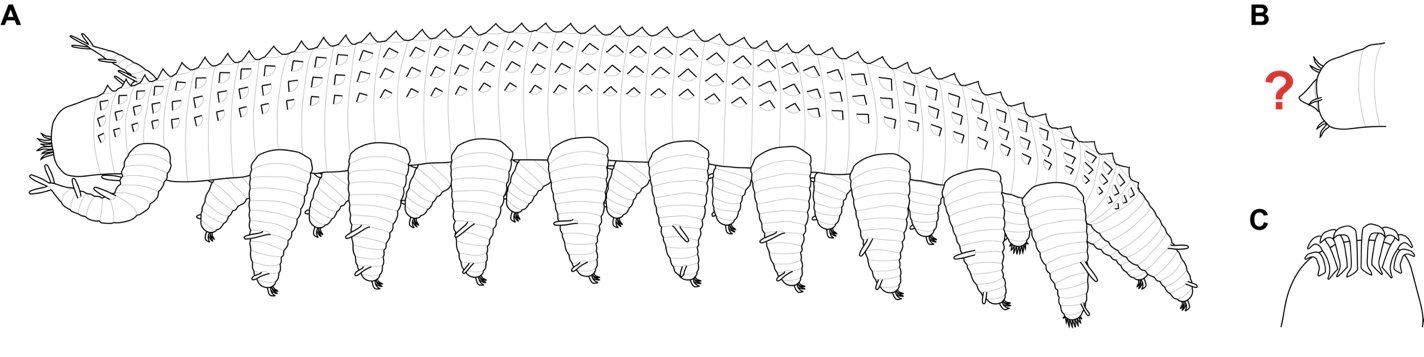
Mapalo & Ortega-Hernández (2026-02 preprint) (open access)
「カンブリア紀中期の巨視的な緩歩動物の祖先」
A middle Cambrian macroscopic tardigrade ancestor
カンブリア紀中期のバージェス頁岩の葉足動物Aysheaia pedunculataを,ステム緩歩動物(クマムシ類)として支持!!
Dongyoung Kim retweeted
[新作] 黒スケ・白スケだけじゃない! 8地点のスケーリーフットを用いた集団ゲノム解析でインド洋深海熱水域をつなぐ「海流」と隔てる「断層」を解明した論文が @CurrentBiology 誌に掲載! スケーリーは20~40万年をかけて、南から北へ分散したと推定。
タダで読めるリンク: authors.elsevier.com/c/1mbW7…
Dongyoung Kim retweeted
Huge fossil bonanza preserves 512-million-year-old ecosystem | New Scientist share.google/J59I0VqHL4xNIEK…
Dongyoung Kim retweeted
Serra Silva & Telford (2026-01 preprint, bioRxiv)(オープンアクセス open access)
「螺旋動物の門間の関係は解決可能か?」
Are interphylum spiralian relationships resolvable?
螺旋動物Spiraliaの新たなゲノム系統学的研究!
A new phylogenomic study of Spiralia!
Dongyoung Kim retweeted
More than 400 million years ago, during the Silurian Period, an evolutionary event led to the later emergence of spiders’ spinnerets—the abdominal organs that make silk—according to new @ScienceAdvances research. scim.ag/45VBkAp
Dongyoung Kim retweeted
📱Is the origin of animals comparable to the origin of the smartphones? Yes! See our new review in @embojournal where we show how important it was the new "Operating System" (animalOS)for animals to evolve! with @ricard_sole Nick and Elena @the_prbb @CSIC @CSICdivulga
Dongyoung Kim retweeted
Rossi et al. (2026, 1月 Jan., Science Advances) (open access)
「骨片の独立起源により、海綿動物の進化史の古生物学的および分子的証拠が調和される」
Independent origins of spicules reconcile paleontological and molecular evidence of sponge evolutionary history
出版!
Now published!
Dongyoung Kim retweeted
The Fokker–Planck equation is a partial differential equation that describes how the probability distribution of a random system evolves over time under both deterministic forces and random noise. It is the population-level counterpart of stochastic differential equations such as Langevin dynamics, translating individual random paths into smooth probability flows. In probability theory, it is used to study diffusion processes, stationary distributions, and long-term behavior of stochastic systems. In machine learning, the Fokker–Planck equation underlies diffusion models, stochastic gradient methods, and sampling algorithms, helping explain how noisy updates explore complex loss landscapes and generate data. In real life, it models phenomena such as heat flow, stock price fluctuations, chemical reactions, and biological movement, providing a powerful framework for predicting how uncertainty spreads and settles over time.
The math:
If Xₜ follows
dXₜ = b(Xₜ)dt + σ dWₜ
then its density ρₜ satisfies
∂ₜρ = −∇·(bρ) + (σ²/2)Δρ.
Dongyoung Kim retweeted
Sequencing by Expansion (SBX) — a novel, high-throughput single-molecule sequencing technology biorxiv.org/content/10.1101/…
Dongyoung Kim retweeted
Somatic and germline mutational processes across the tree of life biorxiv.org/content/10.64898… #biorxiv_genomic
Dongyoung Kim retweeted
Nature research paper: An integrated view of the structure and function of the human 4D nucleome
go.nature.com/4j0axIx
Dongyoung Kim retweeted
New paper out! mapress.com/zt/article/view/…
We revise South American triaenonychids formerly placed in Ceratomontia and propose the new genus Maurymontia, honoring Emilio Maury.
Three new species described, incl. M. grismadoi.
Happy New Year! 🎉
Dongyoung Kim retweeted
Generating three-dimensional genome structures with a variational quantum algorithm biorxiv.org/content/10.1101/…