

Research Economist @NorgesBank. PhD @UABBarcelona. From Verona, Italy. Views are my own.
Oslo, Norway
Joined September 2020
- Tweets315
- Following460
- Followers928
- Likes418





🥁New Working Paper Alert
"When Monetary Policy Bites: State-Level Evidence on Wages", with Knut Are Aastveit, Jonas Höltz and @GNatvik.
How does monetary policy affect wages—and does the effect depend on how tight labor markets are?
Paper: norges-bank.no/contentassets…
Nicolò Maffei-Faccioli retweeted

Thrilled to share that I have two papers in the May issue of QE. Different papers, but related through the oil market; one on the shale supply, and one via the financial markets. Thanks to my fantastic co-authors: Knut Are Aastveit, @tsgundersen, Yoosoon Chang and Jamie Cross


Nicolò Maffei-Faccioli retweeted

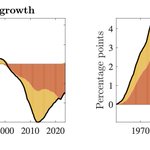
The transatlantic divide in labour’s share of income
@DBergholt, @francescofurla8, @nmaffeifaccioli @NorgesBank, Evi Pappa @uc3m @EconomicsUc3m
ow.ly/zQIh50Z62nL

Nicolò Maffei-Faccioli retweeted

On the @greg_ip point:
🥁New Working Paper Alert🥁
Why has the European labor income share evolved differently than in the US? A new paper with @DBergholt @nmaffeifaccioli and Evi Pappa explores the "Transatlantic Divide" in labor share dynamics from 1960–2023. #EconTwitter 1/N


Labor's share of output (nonfarm business) fell to 54.1% in the first quarter, the lowest since records begin going back to 1947. "not so good news for society and our politics" - @KrishnaRSGuha

Nicolò Maffei-Faccioli retweeted
Prof. @nmaffeifaccioli and I are super happy to be @SantAnnaPisa for our annual course on Empirical Macroeconomics. Nicolo’ teaches econometrics of SVAR models while I teach applications (Phillips curve, inflation surge, hysteresis, inequality, labor share, immigration). Pisa 🥰


Nicolò Maffei-Faccioli retweeted

This project would not have been possible without the guidance of my supervisor, @FraRavazzolo. I also thank the editor and the two anonymous referees. Finally, I am grateful for the assistance I received from @francescofurla8 and @nmaffeifaccioli
🥁 Working paper update 🥁 #econtwitter
"Divergent Perceptions, Divergent Pay: Inflation and the Gender Wage Gap"
with @LovisaReiche
Link: norges-bank.no/en/news-event…
We establish a new link between inflation dynamics and the evolution of the gender wage gap.
We formalize this mechanism within a two-agent New Keynesian search-and-matching model with imperfect information in which women’s pessimistic beliefs about underlying shocks generate their differential response to inflation.
Nicolò Maffei-Faccioli retweeted

Forthcoming in AEJ: Macroeconomics: "What Drives the Recent Surge in Inflation? The Historical Decomposition Roller Coaster" by Drago Bergholt, Fabio Canova, Francesco Furlanetto, Nicolò Maffei-Faccioli, and Pål Ulvedal. aeaweb.org/articles?id=10.12…

Working paper alert 🥁 #econtwitter
"Divergent Perceptions, Divergent Pay: Inflation and the Gender Wage Gap" with @LovisaReiche
Link here: ora.ox.ac.uk/objects/uuid:c0…
We establish a new link between inflation dynamics and the gender wage gap.
We document two facts:
Fact 2: Women interpret inflation as a signal of deteriorating conditions in the labor market, while men perceive mild improvement.
These divergent beliefs reduce women’s willingness to negotiate, slowing their nominal wage growth relative to men’s.