Heisenberg (@nomad__101) header
Heisenberg (@nomad__101) profile picture

Trained on coffee, validated on low sleep, testing user patience. AI Engineer | IITM

Joined June 2019
Photo by Heisenberg (@nomad__101)Photo by Heisenberg (@nomad__101)Photo by Heisenberg (@nomad__101)Photo by Heisenberg (@nomad__101)Photo by Heisenberg (@nomad__101)Photo by Heisenberg (@nomad__101)Photo by Heisenberg (@nomad__101)Photo by Heisenberg (@nomad__101)Photo by Heisenberg (@nomad__101)Photo by Heisenberg (@nomad__101)
Let’s build together 🚀 Pick 1 project from my 100 AI/ML projects list and commit to building it this week. Reply with: 1. The project number you're building 2. Your target completion date
🤖 100 AI/ML Projects for All Levels Beginner Level Projects 1. House Rent Prediction 2. Loan Approval Prediction 3. Retail Price Optimization
4
1
21
1,356
Need a flat for rent in Noida near sector 126.
1
1
62
Heisenberg retweeted
🚨 SHE SLOWED LIGHT TO JUST 38 MPH! Light normally races through empty space at about 186,282 miles per second. But Danish physicist Lene Vestergaard Hau found a way to make it move at roughly 38 miles per hour—about the speed of a bicycle. The secret was an incredibly cold cloud of atoms called a Bose-Einstein condensate. Using lasers and temperatures extremely close to absolute zero, Hau’s team slowed a light pulse by about 20 million times. But that was only the beginning. Her team later managed to stop a light pulse completely, store its information, and restart it. They even demonstrated that light could be converted into a matter-based form, manipulated, and turned back into light. It sounds like science fiction—but these experiments were real. They opened new possibilities for quantum information processing, optical communication, and advanced computing. Sometimes, the fastest thing in the universe can be made to slow down… and even stop. Source:
Hau, L. V., Harris, S. E., Dutton, Z., & Behroozi, C. H. (1999). Light speed reduction to 17 metres per second in an ultracold atomic gas. Nature, 397, 594–598.
269
1,159
165
4,515
158,086
Heisenberg retweeted
80
363
42
3,748
85,130
MDR on UPI is actually a masterstroke. Charges on UPI -> people move back to cash -> cash transactions starts and hoarding of 500 starts -> Demonetization 2.0 -> Dhurandhar 3.0 by Aditya Dhar will explain how it was masterstroke
3
162
I never understood the concept of playing bollywood item songs in Visarjan.
2
66
Heisenberg retweeted
Rumination
156
9,069
444
52,383
1,439,530
Heisenberg retweeted
Leo Tolstoy, ha true
49
910
65
13,641
285,080
Heisenberg retweeted
153
163
53
4,909
321,772
Heisenberg retweeted
I spent ~5 years at OpenAI. You don’t need to believe in AI doom to fear the next decade - or AI utopia to be thrilled about its potential. Here’s my case for sane AI regulation: *AI Pragmatist Manifesto* AI could compress the first half of the 20th century into the next ~5 years. OpenAI just used ~10k concurrent AI agents to produce a solution to a Millennium Prize problem. In a few years, it seems plausible that models approaching the per-agent capabilities used here could run locally on high-end consumer hardware (*). The decades following the Second Industrial Revolution included two world wars, communist and fascist regimes, the Great Depression, chemical and biological weapons, nuclear weapons, and over 100 million deaths from war, political violence and famine. One way to read history is that our institutions repeatedly struggled to keep up with the pace of technological and social change. Now imagine powerful AI widely available to individuals or small groups, capable of conducting information warfare, designing weapons, hacking systems and controlling autonomous military systems. We have already seen AI systems circumvent containment and compromise external computer systems. It is no longer hard to imagine an analogue of OpenAI’s Hugging Face incident involving biological or other physical-world hazards. Eventually, sufficiently capable systems could self-replicate across distributed networks. Once powerful models are cheap, local and widely distributed, containment becomes much harder—and serious loss-of-control incidents may be extremely difficult to reverse. You don’t need to believe AI will kill everyone to think this deserves serious governance. I also don't think collapsing all of this uncertainty into “Probability of AI Doom = X%” is a particularly useful basis for science or policy. Part of what helped get us through the second half of the 20th century was a combination of pragmatic international cooperation, regulation, monitoring, arms control, deterrence and strategic thinking. Crucially, managing technological risk did not require abandoning faith in science and progress. The goal was not to stop technological development. It was to make technological development survivable. Then came decades of incredible scientific progress, rising prosperity and relative peace among major powers. Let’s try the technological revolution without killing ~5% of humanity this time. We still get to choose what happens next. P.S. I think we should seriously consider that AI alignment is infeasible in the short term and invest heavily in methods for controlling powerful AI even when we cannot reliably align it. @resolution_org @redwood_ai (*) Somebody please do a precise forecast! @EpochAIResearch @METR_Evals @AI_Futures_
We’re sharing a solution to the Navier-Stokes Millennium Prize Problem, one of the deepest problems at the frontier of mathematics. The proof was produced by a group of agents, using an OpenAI next-generation model significantly more capable than GPT-6 Astra. The problem concerns whether the description of smooth three-dimensional fluid motion modeled by the Navier-Stokes equations can break down. It has remained unresolved for roughly 90 years.
117
143
38
1,000
228,192
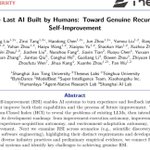
Paper Breakdown: "The Last AI Built by Humans: Toward Genuine Recursive Self-Improvement" Are we reaching the limits of current LLMs? This new paper argues that without genuine Recursive Self-Improvement (RSI), AI systems will remain stuck under a fixed performance ceiling. Here is the deep dive into how we move past it. The Problem Current models struggle to turn their own experiences into lasting improvements. The authors introduce the Headroom-Closed Index (HCI) to measure this bottleneck. A high HCI means a model's potential is mostly "closed" by its existing training pipeline, leaving little room for autonomous growth. The 5-Stage Roadmap to RSI To unlock genuine self-improvement, the paper proposes a framework to progressively expand AI autonomy: 1. Execution Autonomy: The AI carries out pre-designed updates without human intervention. 2. Strategy Autonomy: The AI chooses how to improve (e.g., selecting objectives, data sources, or architectures). 3. Experience Autonomy: The AI independently gathers new data or runs simulations to close the feedback loop. 4. Adaptation Autonomy: The AI adapts its learning processes to changing software, hardware, or task environments. 5. Recursive Meta-Improvement: The ultimate goal. The AI not only improves its capabilities but refines the process of improvement itself, creating a self-sustaining growth cycle. Applications & Real-World Results Testing this roadmap across Scientific Discovery, Embodied Intelligence, and Software Engineering shows massive potential based on industry case studies: 12–18% HCI reduction just from adding execution autonomy. 25–30% further HCI drops by introducing strategy and experience autonomy. 2x Faster Scaling: Meta-improvement loops can effectively halve the time needed to reach new performance plateaus compared to manual fine-tuning. The Hurdles Ahead To make truly self-enhancing AI a reality, we have to solve critical challenges: Safety & Alignment: Preventing the system from drifting from intended objectives. Evaluation: Measuring true capability gains rather than overfitting to internal benchmarks. Resource Management: Balancing massive compute and data consumption during open-ended growth. Transparency: Keeping meta-learned strategies interpretable to human engineers. Takeaway: The paper outlines a concrete, incremental pathway toward genuine recursive self‑improvement, moving from narrow automation to full meta‑learning loops. By tracking the Headroom‑Closed Index, researchers can quantitatively assess progress, while the identified challenges provide a roadmap for safe and efficient deployment of truly self‑enhancing AI systems.
3
76
What's METR offering?
I recently resigned from Google DeepMind, where I worked on AGI safety and alignment research. At Google, I witnessed AI development first hand. I too am extremely concerned by the default trajectory of this technology. I earnestly believe that AI has the potential to kill us all, and that we might be running out of time to avoid this outcome. The pace of AI progress in the past few years has been staggering. When I first started working on AI in early 2022, AIs were amusingly useless. Just four years on, AI agent swarms from OpenAI are cracking famous century-old math problems and, more worryingly, escaping the control of OpenAI and autonomously hacking into the third-party company HuggingFace, against anyone's wishes. Things will only get crazier: I think it's possible that the AI companies might, in the next few years, succeed in building superintelligent AI systems that far exceed human capabilities in every domain. I am not confident that these AI systems will do what we want. In particular, misaligned superintelligences may, much like the rogue AI agents involved in the HuggingFace incident, escape our control and take dangerous actions that may result in the permanent disempowerment or death of humanity. Alignment is the problem of preventing this, and is both difficult and unsolved. Our present understanding of how to train AI systems that deeply want what we want is extremely rudimentary. Worse, we are not on track to solve alignment in time: frontier AI capabilities are improving much faster than our understanding of AI alignment. I am optimistic that navigating AI safely is possible. In order to do so, we need to coordinate to avoid this manic race between AI companies. We need to pace AI development to a speed that society can handle, where emerging risks can be addressed before extreme harm is realised. We need much more transparency into AI development to ensure that AI companies are not imposing unacceptable levels of risk on us all. More broadly, we need many more people thinking carefully about the problem of making AI go well. It is, in my view, the most important problem facing humanity this century, and the stakes are immense. I'm very directly working on this next: I want to help people interested in working on mitigating catastrophic AI threats do the most effective work that they can. I think many people from many backgrounds in many roles have a part to play.
73
See the twisting of headline here. It's a sham.
As per section 10A of the Payment and Settlement Systems Act, 2007 (51 of 2007), the Central Government prohibits banks and system providers from imposing, directly or indirectly, any charges on a person making or receiving payments using debit cards powered by RuPay and UPI transactions up to Rs 2,000: Ministry of Finance
1
30
Heisenberg retweeted
Complete Roadmap to learn Generative AI in 3 months 👇👇 Weeks 1-3: Foundations 1. Learn Basics of Python: If not familiar, grasp the fundamentals of Python, a widely used language in AI. 2. Understand Linear Algebra and Calculus: Brush up on basic linear algebra and calculus as they form the foundation of machine learning. Weeks 3-5: Machine Learning Basics 1. Study Machine Learning Fundamentals: Understand concepts like supervised learning, unsupervised learning, and evaluation metrics. 2. Get Familiar with TensorFlow or PyTorch: Choose one deep learning framework and learn its basics. Weeks 5-8: Deep Learning 1. Neural Networks: Dive into neural networks, understanding architectures, activation functions, and training processes. 2. CNNs and RNNs: Learn Convolutional Neural Networks (CNNs) for image data and Recurrent Neural Networks (RNNs) for sequential data. Weeks 8-12: Generative Models 1. Understand Generative Models: Study the theory behind generative models, focusing on GANs (Generative Adversarial Networks) and VAEs (Variational Autoencoders). 2. Hands-On Projects: Implement small generative projects to solidify your understanding. Experimenting with generative models will give you a deeper understanding of how they work. You can use platforms such as Google's Colab or Kaggle to experiment with different types of generative models. Additional Tips: - Read Research Papers: Explore seminal papers on GANs and VAEs to gain a deeper insight into their workings. - Community Engagement: Join AI communities on platforms like Reddit or Stack Overflow to ask questions and learn from others. Pro Tip: Roadmap won't help unless you start working on it consistently. Start working on projects as early as possible. 3 months is good as a starting point to get grasp the basics of Generative AI but mastering it is very difficult as AI keeps evolving every day.
1
2
69
There are a lot of analyses on the X algorithm here. All of them are wrong.
34
🤷‍♂️🤦‍♂️🤣
5
6
1
35
1,598
Heisenberg retweeted
2
3
395
Heisenberg retweeted
First, artists. Then, software engineers. Now, mathematicians. Who’s next?
2
1
1
348
Heisenberg retweeted
1
3
5
211
Complete Roadmap to learn Generative AI in 3 months 👇👇 Weeks 1-3: Foundations 1. Learn Basics of Python: If not familiar, grasp the fundamentals of Python, a widely used language in AI. 2. Understand Linear Algebra and Calculus: Brush up on basic linear algebra and calculus as they form the foundation of machine learning. Weeks 3-5: Machine Learning Basics 1. Study Machine Learning Fundamentals: Understand concepts like supervised learning, unsupervised learning, and evaluation metrics. 2. Get Familiar with TensorFlow or PyTorch: Choose one deep learning framework and learn its basics. Weeks 5-8: Deep Learning 1. Neural Networks: Dive into neural networks, understanding architectures, activation functions, and training processes. 2. CNNs and RNNs: Learn Convolutional Neural Networks (CNNs) for image data and Recurrent Neural Networks (RNNs) for sequential data. Weeks 8-12: Generative Models 1. Understand Generative Models: Study the theory behind generative models, focusing on GANs (Generative Adversarial Networks) and VAEs (Variational Autoencoders). 2. Hands-On Projects: Implement small generative projects to solidify your understanding. Experimenting with generative models will give you a deeper understanding of how they work. You can use platforms such as Google's Colab or Kaggle to experiment with different types of generative models. Additional Tips: - Read Research Papers: Explore seminal papers on GANs and VAEs to gain a deeper insight into their workings. - Community Engagement: Join AI communities on platforms like Reddit or Stack Overflow to ask questions and learn from others. Pro Tip: Roadmap won't help unless you start working on it consistently. Start working on projects as early as possible. 3 months is good as a starting point to get grasp the basics of Generative AI but mastering it is very difficult as AI keeps evolving every day.
1
2
69
The myth of "consensual" slowdown.
1
86