

asst prof @UCBerkeley psychology | 🔬@ohlab_nus 🌐https://teapaw.org/t.co/3EFmtBUKHT
Berkeley, CA
Joined June 2009
- Tweets2.7K
- Following560
- Followers2.5K
- Likes10.3K





Pinned Tweet
I'm delighted to announce that I'll be joining @UCBerkeley Psychology as an assistant professor in Fall 2026 🐻💙🐻💛
Deep thanks to my students and colleagues at @NUSingapore for four formative years, and to the advisors, family, and friends who've supported me throughout.
New paper accepted at J Neurosci:
"Physiological Representation of Social Evaluation," led by Anqi Mao @AngelaAnqiMao @ohlab_nus @NUSingapore.
Preprint: osf.io/preprints/osf/yrxc8


We validated these patterns: New faces were generated along the modeled directions, and shown to new people, which elicited the predicted responses, but only when people were making social judgments, rather than purely perceptual ones.
Patterns captured sth socially meaningful.

Personal notes:
(1) This is the first paper first-authored by a student of mine. Immensely proud of @AngelaAnqiMao for carrying it through.
(2) I've admired J Neurosci ever since I can remember. My younger self wouldn't believe he would publish there as the senior author one day.
Dan Oh (DongWon) | 오동원 retweeted

🚨 New paper in @NatureComms: (annoyingly) using college students to study cross-cultural effects underestimates the size of cultural differences. More education predicts more Westernization. Income & status don't. w/ Cindel White. 1/


Dan Oh (DongWon) | 오동원 retweeted

We’re recruiting a full-time lab manager to join the Shared Minds Lab at USC! This will be a great opportunity for someone who wants to get hands-on experience with research before starting a PhD program in psychology or neuroscience. More below:

Dan Oh (DongWon) | 오동원 retweeted

"If certain traits feel linked together in your own self-concept, do those same links appear when you judge other people? The answer was a clear yes." - @ohdanieldw ow.ly/2jjM50ZbRg2

ALT A woman with braided hair looks observantly at the profile of a woman seated in front of her on a bus or train.
Dan Oh (DongWon) | 오동원 retweeted

ALT A woman with braided hair looks observantly at the profile of a woman seated in front of her on a bus or train.

Finally out--first paper from my own shop: journals.sagepub.com/doi/10.…
Finding = How traits hang together in your own personality predicts how you see them hanging together in others (🇸🇬 + 🇺🇸 samples, preregistered).
Here's more to come!


Now in press at SPPS. Ruled out perceiver effects, stereotypical trait structure, assumed similarity; tested generalizability; and added longitudinal data. Kudos to coauthors @finneazmoner, Natasha Tan, and others.
First paper as PI!
Latest preprint: osf.io/preprints/psyarxiv/xr…
I'll be recruiting PhD students and a postdoc to join the lab at Berkeley.
Interests:
• continuous person perception in interactive contexts
• biases in impression management
• social perception in digital spaces
Get in touch if there's overlap.
Excited for this next chapter!


Dan Oh (DongWon) | 오동원 retweeted

Really grateful for the support from Besample. Excited to keep working on this project!

“Don’t judge a book by its cover,” the saying goes, and, being rational people, we like to believe we follow it.
But in reality, we make snap judgments (quite literally, face-value ones) all the time. A single glance at someone’s face can affect whether we trust them, approach them, or keep our distance. These rapid first impressions influence everyday decisions and social interactions (Olivola et al., 2014).
One mechanism behind this is known as "emotion overgeneralization:" people unconsciously extend subtle emotional cues into stable personality judgments. For example, faces that structurally resemble happy expressions are seen as more trustworthy, even when no emotion is explicitly displayed (Zebrowitz, 2017). In fact, among various facial cues, this resemblance to happiness is a particularly strong predictor of perceived trustworthiness (Jaeger & Jones, 2022).
But how universal is this effect? Most of the existing evidence comes from Western samples, where emotional expression is frequent, encouraged, and socially informative. Emotional norms, however, differ across cultures. While a smile may signal friendliness or intelligence in some countries, in others, it can be interpreted as foolishness or misplaced informality (Krys et al., 2014). In East Asian societies such as China and Japan, emotional restraint is much more common than emotional expression (Heine et al., 1999; Rychlowska et al., 2015).
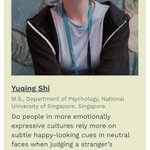
What if emotion overgeneralization depends on how frequently and consistently emotional cues co-occur with relevant social outcomes? If so, can its strength vary systematically across cultures? This is the question Yuqing Shi (@syuuqing), a Ph.D. student at the National University of Singapore working with Dr. DongWon Oh (@dongwon_oh), is addressing in her dissertation.
Growing up in China, Yuqing observed how differently smiles are interpreted depending on context. In Chinese culture, there is a saying, “喜怒不形于色”— do not display joy or anger on one’s face. These cultural scripts emphasizing emotional restraint contrast sharply with contemporary U.S. norms that equate smiling with warmth and trustworthiness.
Yuqing combines large-scale surveys with computational facial analysis. Participants from multiple countries rate the trustworthiness of neutral faces, while deep-learning algorithms quantify how closely those faces resemble happiness-related expressions. She then examines how individual and societal norms around emotional expressivity relate to the tendency to overgeneralize emotion cues into trust judgments.
If first impressions are indeed culturally learned rather than universal, this has broad implications — not only for everyday social interaction, but for global collaboration, hiring, diplomacy, and even AI systems trained on culturally biased facial data.
Yuqing is a Besample Dissertation Grant finalist, and we are excited to support research that asks whether something as automatic as face perception is universal or culturally constructed.
#PhDResearch #PhDGrant #CrossCulturalResearch #GlobalResearch #BesampleDissertationGrant #Besample
