

Money changes people. fame | finance | betrayal
Joined September 2026
- Tweets81
- Following74
- Followers131
- Likes122




Orbitalis retweeted

Bill Gates didn't build his fortune alone. In 1980 his mother sat on a charity board with IBM's president, and weeks later IBM hired her son's tiny company. Now he's worth $119 billion and leaves his kids less than 1%. Guess he doesn't love them the way she loved him.
What IBM's president said about her son's company in 1980 gives it away.
"Oh, that's run by Bill Gates, Mary Gates' son."
In the video below, Gates explains why giving his own kids more "wouldn't be a favor to them."
Mary Gates was one of the best-connected women in Seattle. She was the first woman on the board of First Interstate Bank of Washington, sat on the boards of US West and KIRO, served 18 years as a University of Washington regent, and was on the national board of United Way next to IBM's president, John Opel.
She talked to Opel about her son's company. Weeks later, IBM hired it to build the operating system for its first personal computer. The man running it was a 25-year-old Harvard dropout. That deal is where the fortune starts. The kid who "did it himself" had his mother in the room.
In his memoir, Gates quotes her: "With wealth comes the responsibility to give it away." He took that literally. He's giving 99% of what's left to his foundation, which will spend $200 billion on the world's poorest and close in 2045. His three kids get a great education and less than 1% of the money. "It's not a dynasty," he says.
Mary Gates looked out for her son. Her son is looking out for everyone's kids except his own.
Orbitalis retweeted

ELON MUSK: "MY BRAIN HURTS AND MY HEART HURTS. I WORKED 22 HOURS A DAY..." OTHERWISE TESLA WOULD HAVE DIED, AND ME ALONG WITH IT
2018. Axios on HBO sits down with Elon, and he looks nothing like the guy on stage
tired eyes. hand on his face. long pauses
they ask why this was the hardest year of his career
he doesn't talk about the stock or the critics. he talks about the factory
"Tesla really faced a severe threat of death due to the Model 3 production ramp"
"the company was bleeding money like crazy"
"if we didn't solve these problems in a very short period of time, we would die"
how close?
"single-digit weeks"
think about what that means. a car company with billions in revenue, thousands of employees, a stock everyone argues about. and the real number that mattered was weeks of cash
so what does the CEO do with single-digit weeks?
22 hours a day
7 days a week
sleeping in the factory
working the paint shop, general assembly, the body shop himself
"do you ever worry about yourself imploding?"
"yeah, absolutely. no one should put this many hours into work. this is not good"
then the line that hits different:
"it hurts my brain and my heart hurts"
"this is not recommended for anyone. I just did it because if I didn't do it, Tesla, good chance, would die"
here's the part people forget
in the same year he described Tesla as weeks from death, Tesla posted a ~$312M profit in Q3 2018. the market had been betting on bankruptcy. the factory floor bet against it
the comeback is on the stock chart. the price isn't
no investor deck has a line for "founder sleeps under his desk for months". but that was the actual collateral behind the Model 3
he's not selling hustle here. he's warning you off it
the stock chart shows the miracle. the factory floor shows the bill

Orbitalis retweeted
Phil Mickelson owed money to his Las Vegas gambling buddy, Billy Walters. Billy gave him a secret stock tip, Phil made $931,000 in a week and paid him back. Billy went to prison for 5 years. Phil was never charged.
When Billy got out, he wrote a book about Phil.
More than $1 billion in bets, by Billy's count.
In the video below, Billy tells ESPN what would have kept him out of prison.
Billy spent decades as one of the biggest sports bettors in America. Phil was his golf partner, his friend and a man who owed him money.
July 2012. Phil owes Billy gambling money. Billy calls him and tells him to buy Dean Foods.
Billy's information came from a Dean Foods board member. He owed Billy money too.
A week later, the stock jumped 40%. Phil sold with more than $931,000 in profit. In September, he paid Billy back, partly with that money.
The money went in a circle. Only one man went to prison.
In 2016, the SEC named Phil a "relief defendant." That means he wasn't accused of anything, but he was holding money that wasn't his to keep. He paid back $1,037,029 and never admitted or denied a thing.
In 2017, Billy was convicted and got 5 years. Phil never testified.
"All Phil had to do was publicly say it. He refused," Billy wrote.
While Billy was inside, his daughter died. He wrote that he still believes he could have saved her if he'd been on the outside.
In 2023, his book came out. At least $1 billion wagered. At least $100 million lost. More than 1,115 bets over $100,000. Phil denied one claim: "I never bet on the Ryder Cup."
$931,000: what Phil made on the tip.
5 years: what Billy got.
$1 billion: what Billy says Phil bet.
Phil kept his silence, his career and a reported $200 million LIV deal.
Billy kept the receipts.
Orbitalis retweeted
A 5-minute voice note to Opus 5.5 became a music video watched more times than Los Angeles has people. 4,000,000 f*cking views. You're paying for the exact same model.
That voice note was 1,700 words long:
A song that already existed. An ElevenLabs key for sound. A video model for the base shots. Then Claude told to redraw it all in code on top.
He went to bed. Claude worked 12 hours straight.
Tony Dinh went smaller. A year ago he paid ~$1,000+ for a launch video. This time Opus 5.5 made one in under 30 minutes after 3 extra lines: his URL, "use actual product screenshot, logo, assets" and "must have music."
Most people copied the 26-word "showreel" prompt and got the same clip as everyone else.
The CLAUDE.md I'd use instead is in the first reply.
Opus 5.5 can make a 4M-view music video. It still can't make you talk to it for 5 minutes.
Paste this into CLAUDE.md, swap in your URL, run it in Claude Code on Opus 5.5:
Make a 20s vertical launch video for [PRODUCT] ([URL]).
Assets: open the site with Playwright. Use the real screenshots, logo, colors and fonts. Never draw the UI from imagination.
Engine: one index.html with window.seek(t) that paints any frame from time alone. No timers, no CSS transitions, no Math.random. Render headless at 60fps, encode with ffmpeg.
Motion: springs, never linear. Something new every 2-3s. Banned: centered title on a gradient, everything fading in, glow, particle bursts.
Story: 0-2s the problem in 5 huge words, then the product builds itself, 3 features as real cursor actions, one proof number, logo + CTA.
Sound: original 120 BPM track made in code, every cut on the beat.
Before the final render: contact sheet, one frame per beat. Score 1-10 on hook, phone readability, motion, sound sync. Fix the 3 worst. Repeat until all are 8+.
Orbitalis retweeted
3.5 f*cking cents. That's what a model that can't even write a sentence charged to sort 500 emails in seconds. You spend 11 hours a week on the same job and still think your inbox needs you.
It does need you for one thing.
The 500 emails were Riley Brown's test of Jev 1.13. Hassan ran 1,018 AI research papers through it for 8 cents, a quarter second each.
Jev only picks: reply or wait, relevant or not. You hand it the options, it hands back one answer with a probability.
McKinsey found 28% of the workweek goes to email. A lot of that is just picking.
The clip simulates it at scale: 10,000 picks across seven jobs. Inbox, papers, browser, routing, model choice, compaction, approval gates.
The part that never makes the demo: a 0.9 confidence doesn't mean 90% right. And when it says "done," nothing proves the file was actually saved.
That one thing is checking its work. Congrats, you just got promoted to babysitter for a 3.5-cent intern.

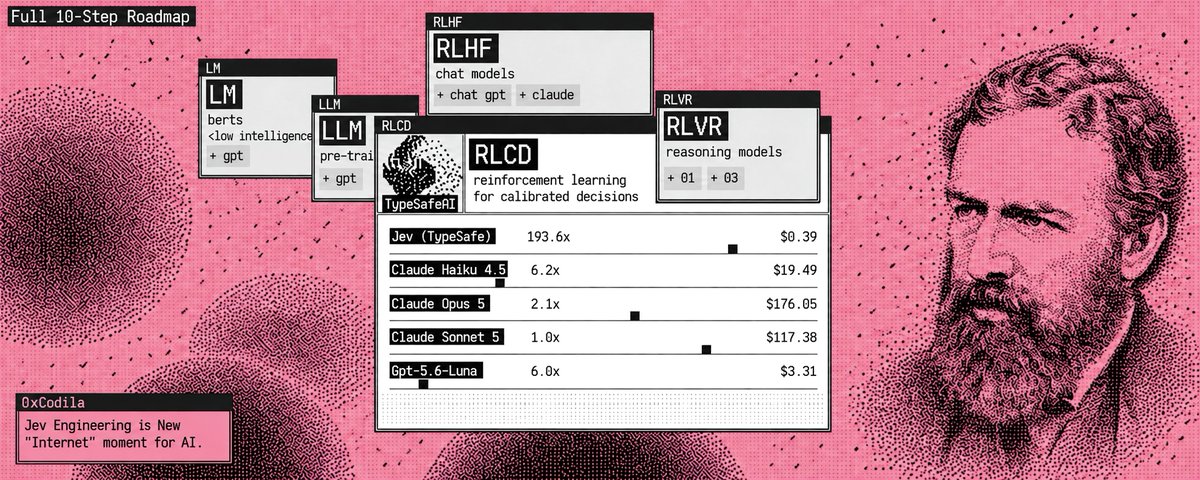
3.5 f*cking cents. That's what a model that can't even write a sentence charged to sort 500 emails in seconds. You spend 11 hours a week on the same job and still think your inbox needs you.
It does need you for one thing.
The 500 emails were Riley Brown's test of Jev 1.13. Hassan ran 1,018 AI research papers through it for 8 cents, a quarter second each.
Jev only picks: reply or wait, relevant or not. You hand it the options, it hands back one answer with a probability.
McKinsey found 28% of the workweek goes to email. A lot of that is just picking.
The clip simulates it at scale: 10,000 picks across seven jobs. Inbox, papers, browser, routing, model choice, compaction, approval gates.
The part that never makes the demo: a 0.9 confidence doesn't mean 90% right. And when it says "done," nothing proves the file was actually saved.
That one thing is checking its work. Congrats, you just got promoted to babysitter for a 3.5-cent intern.
Orbitalis retweeted
I was burning $60–80 a day on Opus 5.5 for decisions that never needed a frontier model.
"Keep going?" "Which tool now?" "Is this good enough?" Every one billed at Opus prices. Jev 1.13 handles 10,000 of them for 42 cents.
I moved them over in one evening. Here's the setup.
Jev can't write a sentence. It only picks from the options you give it, which is exactly the job. Everything runs from Claude Code:
1 → Make a TypeSafe account and grab an API key. Never paste it into chat.
2 → Add the official skill: npx skills add typesafe-ai/skills --skill typesafe-ai
Then ask: "Install typesafe-sdk and build me a decision router that picks research / write / review / cheap from the task's current state."
3 → Spell out the options:
• research: sources or evidence missing
• write: enough context, just ship it
• review: unclear, needs a human
• cheap: formatting, lookup, classification
4 → Run one task you do daily (morning brief, inbox, content plan) and watch where Jev sends it.
5 → Start the confidence bar at 0.85. Below it goes to you or to Opus. Above it stays cheap.
6 → Hard limits: max actions per run, max spend per day, a kill switch. Drafts get written, never sent. Publishing waits for you.
Opus still does the thinking and the writing. Jev just picks the road.
Anyone calling that risky hasn't opened their own Opus bill.
stop pretending your second brain works.
it dies the second you close your laptop.
the night does nothing. the morning is empty. you open the lid and rebuild everything from zero.
karpathy's post hit 22 million views because the idea is obvious: one folder an AI reads before every task. it gets sharper every week. you stop explaining your life from scratch in every chat.
but the builds people actually saved still live on a laptop. the most saved guide literally says: leave Obsidian open, or the connection dies.
so the system only works while you sit there watching it.
Grok Bot doesn't ask for that.
its bots run on their own computer in the cloud. you close the laptop, and the clockwork keeps turning:
23:00 · files your mail while you sleep
07:30 · one morning page: what came in, what it drafted, what waits for your yes
17:00 · ranks what you actually touched, so the noise stops
sunday · reminds you what you decided and forgot
rules.md · fix a mistake once, and it writes the rule down
most people will keep babysitting a folder that dies when they walk away.
keep starting every chat from zero.
keep paying the tax of explaining themselves again.
the cloud one compounds while the lid is shut.
paste once, and it builds itself.
your laptop sleeps. your second brain shouldn't.

You're paying $20 a month to make your AI f*cking dumber.
Every note you dump in makes it read worse. Chroma tested 18 models, Claude and GPT included. All of them slipped as the input grew, even at copying text back.
That's the trap inside every "second brain" guide. You pay for the plan, feed it everything you own, and it reads more and gets less right.
And you pay twice. Anthropic's docs say CLAUDE.md loads into every session, "consuming tokens," and that longer files "reduce adherence." A fat memory file costs you tokens every time and gets followed worse.
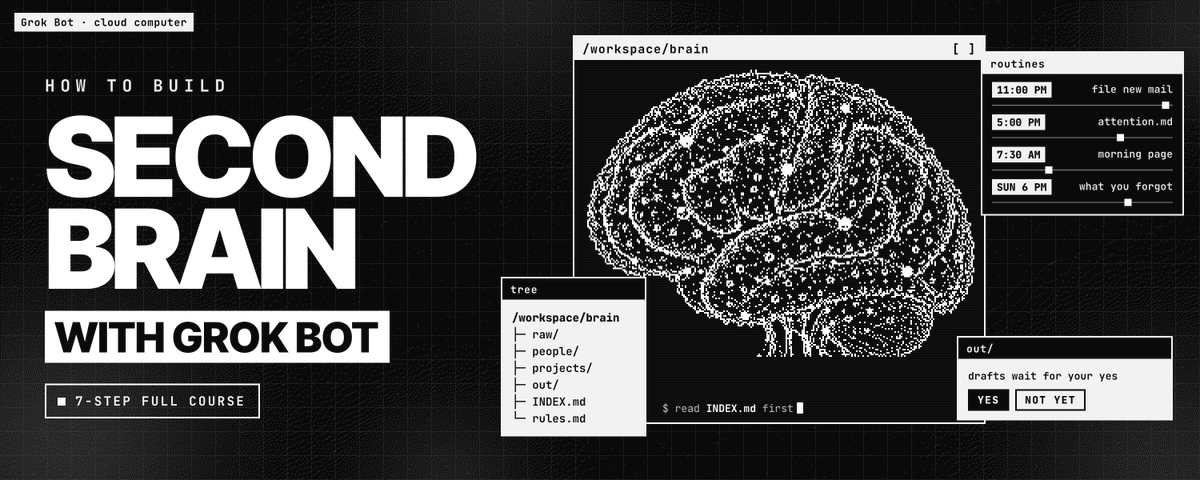
The guide below runs on Grok Bot, which comes with Cursor plans from $20 a month. The fix is buried in chapter 02:
"Read INDEX.md first, then only the files it points to."
The bot opens one map, then only the notes that answer the question. Every name, date and number links to a file. If it isn't in a file, the bot says so instead of guessing.
Karpathy's wiki works the same way, no vector database. The model "reads the index first to find relevant pages, then drills into them."
22 quotes on this guide. Most sell the cloud computer and the 7:30 AM page. Nobody mentions the map.
The clip is my simulation in Claude Code. No map: it reads 1,968 files for one question and starts guessing. With CLAUDE.md as the map: 2 files, one cited line, zero guesses. Numbers are illustrative.
No map, and your $20 buys a landfill with a chat window.
You pay for the smartest model and still fact-check it by hand like an intern.
A 22-year-old in Shenzhen just launched 500 Claude Code agents and didn't check a single line himself. A much cheaper model did it for him.
His screen is basically a live dashboard.
500 agents writing and cross-checking each other. Every claim checked against the original source in under 70ms.
Five full passes over 200 company profiles, zero flags left at the end.
He just let the loop run until the cheaper model stopped complaining.
And that cheaper model is the whole trick.
One model does the work. A much cheaper one only decides whether it's true. If the claim doesn't match the source it goes back. Again and again, until it does.
An analyst team would need 3-4 weeks for this and still miss stuff.
He did it in one run.
Most people who try swarms end up with a pile of confident hallucinations. The difference here is kind of boring: someone made the agents prove things before they were allowed to stay.
Everyone calls this a Second Brain.
Without the verifier it's just a very fast way to be wrong


Your AI agent just became useless.
Delta, the banks and Amazon have already shut it off. And this is only the beginning.
While everyone keeps saying "agents will change everything," big companies just closed the door on them.
→ Delta won't let agents book flights.
→ JPMorgan and Charles Schwab block access to accounts.
→ Yelp only lets in the ones who pay for a license.
→ Amazon kicked out Grok and other shopping agents.
The promise was simple: the agent books, buys, checks and does it all by itself.
Reality: an agent is useful exactly until a website or a bank blocks it.
Now the interesting part.
Labs are spending billions teaching agents to click around websites. Websites are spending pennies to keep them out.
Who do you think wins this game?
While most people race to build "their own agent," whoever controls access (banks, airlines, marketplaces) just puts up a wall. And the more agents show up, the higher those walls get.
The "my agent will do everything for me" era ended before most people even got to use it.
Whoever figures out first that the bottleneck moved from the model to access is the one who makes money. The rest will keep building agents nobody lets in.

notice..
> Delta is blocking AI agents from booking flights
> JPMorgan Chase and Charles Schwab block agents from accessing accounts
> Yelp requires paid data licensing for agents
> Amazon has blocked Grok bot and other shopping agents.
the internet is starting to block AI agents that were supposed to do everything for us
Just dropped a model that actually shifts the balance again.
DeepSeek-V4.1-Flash-1017.
Chinese lab put out something that in some coding tasks matches or edges out Opus 5.5 and Sol, while being dramatically cheaper and much smaller.
Here's what actually matters:
Performance: It doesn't beat Opus 5.5 across the board, but it's already in the top tier. The standout is DeepSWE (coding tasks):
- Flash: ~77% success at ~$0.20 per task
- Best GPT-6.1 Sol setup: ~75% at ~$0.65
Almost 3x cheaper and slightly better. For heavy refactoring and iteration loops the gap is real.
Price: Basically free next to the frontier models. Input ~$0.15 / Output ~$0.30.
On a 100k in + 10k out example: 86-93% cheaper than Sol, 93-97% cheaper than Opus. With their Harness and high cache hit it gets even lower.
In practice it can feel 100x+ more usable than burning through Astra or Opus on everything.
Size: Open weights. Around 763B total (weights ~510GB).
For context, a lot of US frontier models are estimated in the 10T range, Kimi K3 around 2.8T.
This is already in the range where you can run it locally on a few DGX Sparks or a maxed Mac Studio. You don't need a massive datacenter to get close to frontier performance anymore.
How they did it: They took an existing base and improved it with RL + self-feedback. They raised success rate on hard tasks while also cutting runtime and output length. Stronger and cheaper at the same time is rare.
Right now DeepSeek looks like one of the strongest labs on quality / price / accessibility.
Balance shifted again.

🚀 DeepSeek-V4.1-Flash-1017 is here!
Stronger benchmark performance, faster task completion, and shorter outputs than the previous version—a Pareto improvement in performance and cost. Now live on our website, app, and API.
🛠️ Optimized for @DeepSeekHarness, Tencent CodeBuddy, WorkBuddy, and more. Upgrade to DeepSeek Harness v0.2.1-rc.1 or later for the best experience with the new model.
1/4


YOU USED TO BABYSIT ONE CLAUDE AGENT, NOW OPUS RUNS A HUNDRED AND SHOWS YOU ONLY THE WINNERS
Anthropic dropped it as dynamic workflows, and it already rewrote Bun into 750,000 lines of Rust in 11 days. Anthropic says 99.8% of the old tests pass. Not in production yet.
The idea: Opus 5.5 writes the whole plan as a script, and a swarm of cheaper agents runs it.
Launch Claude Code like this:
claude - model opus - effort ultracode
how the work splits:
→ Opus 5.5 turns your task into a workflow script
→ Haiku 5.5 agents scan files in parallel
→ Sonnet 5.5 agents make each fix in their own isolated copy
→ separate agents try to break every finding before it reaches you
Opus shows up three times:
→ writes the workflow before the run
→ reads only the verified results after it
→ signs off before anything ships
JEV takes it one layer lower. The tiny forks that need no thinker (which file, which tool, retry or stop) go to JEV, a decision model built for agents, and the big models only see the forks that matter.
One trap: if nothing names a model for a stage, that agent runs on your session model. Launch on Opus, say nothing, and you get a hundred Opus agents.
Paste this into Claude Code:
"Rebuild my Claude Code workflows:
1. Opus 5.5 runs the main session with ultracode on and writes every workflow script. Show me the script before it runs.
2. Read-only scan stages on Haiku 5.5. Edit stages on Sonnet 5.5, each edit in its own isolated copy.
3. Every finding gets an independent verifier before it's reported. Fix loops stop after two rounds with no progress.
4. Route fast deterministic forks (tool choice, path selection, retries) through JEV.
5. Try it on one directory first. Show every change as a diff. No edits until I say go."
Pick the one stage you'd never hand to Haiku: scan, edit or verify.
Claude's creator survived cancer but can't stop fearing the AI he built.
With 1950s medicine, he says, that cancer would probably have killed him. So he wants AI that finds cures faster.
Most Claude users missed what happened in May 2025.
Anthropic released Claude Opus 4 under the strictest safety rules it had ever used. The reason was a test.
Biosecurity experts graded how well people could plan a bioweapon with its help. Claude did "significantly" better than Google search.
Anthropic's chief scientist told TIME what that could mean: "You could try to synthesize something like COVID or a more dangerous version of the flu."
So when Amodei says he wakes up to threat reports, he isn't imagining some future model. He's talking about the Claude you already use.
The cure and the weapon run on the same skill. Nobody has built an AI that's great at one and blind to the other.
Next time Claude refuses a biology question, that's the lock his own team decided it needed.
Imagine getting everything you ever wanted at 16 — then spending the rest of your life trying to escape it.
Bam Margera became a millionaire as a teenager.
Jackass. Viva La Bam. A mansion with a skate park inside.
His house became a nonstop party. Strangers filled every room. Nobody wanted to leave.
There was so much money, he said, he didn’t know where to put it.
The parties kept going until the cocaine ran out.
Now he describes that world as a closed amusement park he’s stuck staring at.
He got the dream before he was old enough to understand its price.
What destroyed him first: the fame, the money, or the people who came with both?

This moment from 2013 was missed by a lot of people.
At the time, Tesla was still a tiny company walking a tightrope.
One negative article could have destroyed everything.
And it almost did.
But in this interview you can clearly see what later became Elon’s signature style:
never back down, never apologize, and never play by someone else’s rules — even when the stakes are extremely high.
While everyone around was panicking and advising “don’t touch the big guys”,
he was already thinking on a completely different level.
This short fragment is one of those rare moments where you can clearly see
why Tesla didn’t just survive…
it became what it is today.
And today, on October 5th 2026,
Elon just became a trillionaire again.
Funny how things work out.


