

I'm Rain | | Alpha Content | ⛓️ 🦅
Metaverse
Joined May 2022
- Tweets166K
- Following11.6K
- Followers115K
- Likes27K





Rain retweeted
$BTC ETFs finally broke their 2-week outflow streak with $301M in net inflows.
But the weekly total hides a much less bullish picture.
Investors poured in $1.08B during the first 3 days, then pulled out $774M as Bitcoin slipped toward $80K.
That’s roughly 72% of the early inflows reversed in just 2 sessions.
What caught my attention is DWF Labs’ research: ETF outflows accompanied 7 of Bitcoin’s 8 major sell-offs since launch.
I think we’re seeing a different kind of institutional demand than many expected.
ETF access hasn’t necessarily created a reliable pool of dip buyers.
If ETF investors are selling alongside the market rather than absorbing volatility, how much downside protection can we realistically expect from institutional adoption?

Rain retweeted
$BTC is back below $80K, but I think the bigger risk isn’t the price drop itself.
Bitcoin fell nearly 2% as Asian tech stocks weakened and traders reduced exposure ahead of Wednesday’s Fed decision.
Three things stand out to me:
• Brent remains around $114 despite a 2% pullback.
• South Korea’s Kospi fell 1%, extending weakness in the AI trade.
• BTC needs to reclaim $82.5K, the support level it lost last week.
Expensive energy keeps inflation risks elevated, while weaker tech stocks signal declining appetite for risk.
That leaves crypto vulnerable to a hawkish Fed, even if rates stay unchanged.
I’m watching the Fed’s December guidance more closely than Wednesday’s decision itself.
Can Bitcoin reclaim $82.5K without a recovery in tech sentiment?

Rain retweeted
$BTC losing $80K is concerning, but the liquidation data tells a bigger story.
$837M in positions were wiped out in 24 hours, with longs accounting for 82.8% of the damage.
Bitcoin and Ethereum alone saw $414M in liquidations, over 93% of which came from longs.
To me, this looks like a leveraged market being forced to reset rather than evidence of selling pressure alone.
But there’s another concern: BTC is now trading below the estimated average acquisition price of corporate Bitcoin treasuries.
With total crypto market cap just ~1% above its October low, I’m watching $77.9K support and whether BTC can reclaim $83K before the Fed decision.
Will this leverage flush create room for a healthier recovery, or is spot demand too weak to absorb the next wave of selling?

Rain retweeted
$BTC might be facing a bigger threat from oil than from anything happening onchain.
Brent hit $115.84, its highest level in five months, as tensions in the Middle East escalated.
Meanwhile:
• Nasdaq fell 2.6%.
• Crypto market cap dropped 3.74% to $2.76T.
• WTI climbed above $100.
What concerns me is the inflation angle.
Higher energy prices could make it harder for the Fed to ease monetary policy, keeping pressure on liquidity and risk assets.
But there’s an interesting divergence: physical Brent prices have fallen from ~$135 to ~$118 this month, suggesting part of the futures rally may reflect geopolitical risk rather than immediate supply shortages.
With the Fed decision on October 28 and major tech earnings approaching, I’m watching oil as closely as Bitcoin.
If oil stays above $115, can $BTC recover on its own?

Rain retweeted
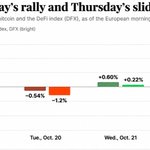
DeFi is taking almost twice the hit of the broader crypto market.
While $BTC dropped nearly 3%, CoinDesk’s DeFi index fell 5.6%, compared with a 3.2% decline in its broader CD80 index.
The derivatives data makes this more interesting.
$UNI open interest dropped 10.17%, far faster than the token’s price. $NEAR showed a similar pattern, with OI down 8.83%.
That suggests traders are actively closing positions rather than simply holding through the selloff.
Meanwhile, crypto derivatives volume surged 19% to $226.6B, with liquidations reaching $431M.
My concern is whether traders are reducing exposure to the sector more aggressively than to crypto overall.
If this is primarily deleveraging, the selling could eventually exhaust itself. But continued relative weakness would be a more concerning signal.
Is DeFi simply absorbing the sharpest part of a market-wide reset?

Rain retweeted
$BTC lost its $85K breakout attempt, and the timing is worth paying attention to.
Bitcoin slipped nearly 3% toward $81.5K as Tesla’s Q3 capex missed expectations ($4.73B vs $7.96B forecast) and South Korea’s KOSPI fell 3.5%.
But the technical setup concerns me more.
BTC rejected $84,840, keeping its pattern of lower highs intact.
Meanwhile, Bitcoin open interest recently reached $55.95B, up 4.5% in 24 hours.
To me, that’s a fragile combination: rising leverage, weakening risk appetite and a failed resistance test.
I’m watching $80K–$81.5K as the key support zone.
Holding it could keep the recovery alive, but reclaiming $84.8K is what would start changing my bias.
Will spot buyers defend support, or will leveraged positions turn another rejection into a deeper correction?

Rain retweeted
$BTC ETFs pulled in $1.08B over three days.
Bullish, but still not convinced the bigger trend has changed yet.
Here’s why.
During Bitcoin’s three major rallies since 2024, ETFs averaged roughly $235M in daily inflows.
Since July, that average has been just $86M, despite BTC gaining 39%.
And days with $500M+ inflows have become much less frequent.
To me, the latest $1B is encouraging, but consistency matters more than a few strong sessions.
I’d want to see sustained demand above $200M/day before treating ETF flows as confirmation of another major rally.
Are institutions rebuilding positions, or are we overestimating what three days of inflows can tell us?

Rain retweeted
Grayscale made easier to move $BTC, $ETH, $SOL and $XRP into traditional investment products.
But there’s a catch.
Direct crypto-to-share conversions require substantial capital: roughly $365K for BTC, $257K for XRP and $80K for SOL.
Plus intermediary fees and potential tax implications.
I see this as a useful step for institutional integration, but not necessarily a bullish catalyst.
Moving existing holdings into investment products doesn’t automatically create fresh demand.
Will this move attract new capital?

Introducing in-kind investing at Grayscale: contribute eligible digital assets directly in exchange for shares of a Grayscale product.
Benefits for investors include:
- Reduced burden of self-custody
- Potentially lower execution costs
- Incorporation into conventional portfolio management
In-kind is now available for 10 Grayscale products:
- Grayscale Avalanche Staking ETF ($GAVA)
- Grayscale Bitcoin Mini Trust ETF ($BTC)
- Grayscale Chainlink Trust ETF ($GLNK)
- Grayscale Ethereum Staking Mini ETF ($ETH)
- Grayscale Dogecoin Trust ETF ($GDOG)
- Grayscale Hyperliquid Staking ETF ($HYPG)
- Grayscale Solana Staking ETF ($GSOL)
- Grayscale Sui Staking ETF ($GSUI)
- Grayscale XRP Trust ETF ($GXRP)
- The Zcash ETF ($ZCSH)
Learn more about in-kind: grayscale.com/campaign/in-ki…


Rain retweeted
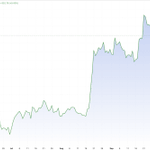
$ZEC is up 12.5% today, but I’m more interested in where the bounce is happening.
After three consecutive red weeks, Zcash found buyers around $1,088 and is now trading near $1,272.
That’s a meaningful reaction from support, especially with the NU7 upgrade approaching on November 6, targeting a reduction in block confirmation times from 75 to 25 seconds.
But $1,375 is the level I’d watch next.
Reclaiming it would strengthen the recovery case. Rejection there could leave this looking like another relief rally after September’s $1,695 peak.
ZEC is still up roughly 148% YTD, so the bigger trend matters.
Is this the start of another leg higher, or just a bounce before sellers return?

Rain retweeted
$BTC at $83.4K, and I’m not convinced the next stop is $100K just yet.
The daily structure is improving, but there’s still work to do.
$80K–$82K has held as support, while $84K is the first level bulls need to reclaim.
Above that, $87.2K is the real test. A confirmed breakout could open the path toward $100K.
ETF inflows are returning, but Tuesday’s $23.2M is hardly enough to confirm a major shift in demand.
And with Brent above $110, inflation and Treasury yields remain risks.
My bias stays cautiously bullish above $80K, but I want to see volume behind the move.
Is $87.2K the beginning of a new leg higher, or where this recovery runs out of buyers?

Rain retweeted

Really appreciate it Eddy, means a lot coming from you. Wouldn't it be cool if the wallet supported zcash too…? 😉

The best new private stablecoin wallet right now is @alcove_wallet. Nothing else is close.
- insanely fast (seconds, even for a cross-chain transfer)
- comically cheap (I'm seeing $0.38 on a $10k deposit)
- easy mobile UI, anybody can use
I think it's the next gen leader.
Rain retweeted
The AI selloff is becoming a broader test of risk appetite, and I think $BTC deserves attention here.
South Korea’s KOSPI dropped nearly 4%, while data center company Elice plunged around 30% on its IPO debut.
Two signals suggesting investors are becoming less willing to pay a premium for future AI growth.
What interests me is the potential impact on $BTC.
When investors reduce exposure to risk assets, crypto often gets caught in the same selling pressure.
But Bitcoin doesn’t necessarily have to follow tech stocks lower.
I’d watch whether BTC can show relative strength as AI-related equities struggle, especially if the selloff spreads to other markets.
If the AI selloff continues, will Bitcoin hold its ground?

Rain retweeted
One thing I’ve learned about VIP programs in crypto?
The benefits matter, but understanding what actually drives your status matters just as much.
Last time, I explored @MEXC’s VVIP cashback benefits. This time, I checked my updated M-Score.
Currently sitting at 989 points in the Elite tier, with all five categories rated Good.
What caught my attention is how the new breakdown covers trading, assets, security, activity, and account tenure.
I like that it goes beyond showing a VIP badge and actually gives me a clearer picture of where I stand and what I can improve.
For me, that makes the whole system more useful.
Now I'm curious about yours.
What's your M-Score, and which category is your strongest? Drop yours below 👇


I’ve always found the term “VIP” slightly weird in crypto.
On the vast majority of exchanges, $100K in assets or $1M+ in 30D volume is a pretty common starting point.
The new VVIP structure by @MEXC completely change this traditional paradigm.
Everyone starts with an initial 350 M-Score and Standard status, without a specified asset balance or trading-volume requirement.
And after that??
M-Score is tied to capital or volume, sure, but security setup and daily activity also contribute.
So instead of: trade a lot → become VIP
it’s closer to: enter first → build your score → unlock higher tiers depending on your platform usage.
Standard already includes things like member vouchers and, under the Global/APAC Card promo, 4% cashback capped at 100 USDT/month.
If you make it to Elite, you can get up to 10% cashback with your MEXC Card, capped at 800 USDT a month.
🔗 Check your M-Score and current benefits on the VVIP page: mexc.com/user/m-score
⚠️ Digital assets and futures involve risk. Benefits and eligibility are subject to applicable conditions.

Rain retweeted
Crypto added $840B in market cap last quarter.
But the rally may have been running on leverage, not broad-based demand.
Q3 data shows a clear divergence:
• Total market cap: +39.6% to $2.96T
• $ETH: +71% vs. $BTC: +42.7%
• Average daily trading volume: -8.6%
• Top 10 CEX spot volume: -14.2%
• Perpetual futures open interest: +40.6%, above $100B
Prices rose as spot activity weakened and leverage expanded.
That doesn’t prove the rally was unsustainable, but it suggests positioning was growing faster than underlying demand.
October’s correction and nearly $1B in liquidations on October 15 make the imbalance worth watching.
Can crypto build another sustainable leg higher without spot demand catching up to leverage?

Rain retweeted
$MSTR is approaching a golden cross, but its historical record deserves a closer look.
The last two signals preceded rallies of 717% and 1,774%.
$BTC has gained nearly 5% since its own September crossover, while Strategy holds around $69.8B in Bitcoin.
Yet across 19 golden crosses since 1999, the stock was higher one year later only 10 times, with a median return of just 3.3%.
I’m still very cautious about treating a technical signal as confirmation of another major rally.
Is $MSTR gearing up for another breakout?
Or are traders putting too much weight on a pattern that has delivered mixed results?

Rain retweeted
The next upgrade of $ETH could significantly boost L1 performance.
But there are risks worth watching.
Glamsterdam is scheduled for October 26 on the Hoodi testnet, with the gas limit rising to 200M.
Two major improvements:
• ePBS separates block building from proposing, reducing reliance on intermediaries.
• Block Access Lists enable more efficient transaction verification.
But testing on Sepolia also revealed a vulnerability in the block auction process.
I think Ethereum’s challenge is improving throughput without compromising network security.
Mainnet activation remains unconfirmed.
Can Ethereum deliver meaningful L1 scaling while keeping its increasingly complex infrastructure secure?

Rain retweeted
Bitcoin is bounced back from another flash crash.
But I’m more concerned about what happens when traditional markets reopen.
$BTC briefly dropped from $81,600 to $80,750 before recovering toward $82K.
$ETH also slipped to $2,360, while XRP struggled around $1.30.
The broader crypto market remains near $2.73T, with Bitcoin dominance at 60%.
What concerns me is the timing.
Hotter US CPI and PPI readings have already pressured risk assets, while last week’s equity correction adds uncertainty heading into Monday.
Honestly, I wouldn’t mistake a quick recovery for renewed buying conviction.
If equities face another selloff, can Bitcoin defend the $80K level, or will crypto simply amplify the volatility?


Rain retweeted
Zcash is gaining attention as a potential alternative to Bitcoin.
Personally, I think the quantum security narrative needs a closer look.
$ZEC recently jumped around 10%, while trader Ansem has floated a $10K price target, implying a valuation near $170B.
His thesis is that privacy and post-quantum readiness could eventually make ZEC attractive as a store of value.
But there’s an important distinction.
Zcash isn’t quantum-resistant yet, and roughly 70% of its circulating supply still sits in transparent addresses.
Devs are targeting an initial rollout of quantum-resistant signatures in January 2027.
The roadmap is more interesting than the price prediction for me.
Will investors wait for Zcash to prove its quantum security?
