

Speech + LLMs @nvidia | Previously: @Meta MSL, @jhuclsp, @IITGuwahati
New York, NY
Joined September 2009
- Tweets2.4K
- Following2.2K
- Followers4.6K
- Likes8.6K









Desh Raj retweeted

When we unveiled Moshi two years ago, we also showed an early checkpoint we'd trained just for fun, directly on Fisher (phone calls from the late 90s and early 2000s). As a result, every time you called, you'd get to chat with a random person straight out of that era. That was trained on just 2k hours of data. Today, you can get 100s of thousands of hours of full-duplex conversational data. There's an obvious scaling law at play here!

We believe voice is the most natural way to interact with intelligence, so we created Dessa, the most authentic full-duplex speech model ever built. Talking with it feels like talking with a person…full of emotion, nuance, pauses, and a natural cadence.
block.xyz/dessa

Desh Raj retweeted

idk I try to help youngsters high schoolers etc in my DMs if I can be helpful
this is the reason why I don't like SF, feels like it's full of social hierarchies where numbers/markers matter
not as much in Europe


Desh Raj retweeted

How to kill a voice agent? Just turn on the TV ☠️
We benchmarked 14 voice agents with a TV playing in the background.
Task completion fell from 38.7% to 8.6%
🧵/

Desh Raj retweeted

Introducing ChatGPT for Dishwashing
GPT-6 achieves state-of-the-art results on dishwashing benchmarks for long-running jobs and difficult stains.
The Navier–Stokes Millennium Prize Problem is a $1 million challenge about whether the equations describing fluid motion can break down. In this video, I accidentally found a counter-example while trying to optimize my dishwasher. But in reality, OpenAI used 10,000 AI agents to find a proof in 88 hours: openai.com/index/navier-stok…
Parody of the original GPT-6 Astra ad
@OpenAI #ChatGPT_Partner #chatgpt
Credits:
Written and Directed by Joma
Co-Writer - Henry Connor Coan IV @coan_henry
Production by Dauntlus Studios @dauntlus.studios
Producer/Co-Director - Marcus Liew @dauntlus
Camera Operator - Amos Lee @amoselijahlee
Art Director - Alethea Soo @aletheasoo
Art Assistant - Alicia Lim @aliciatkl_
Assistant Editor - GPT-6 Astra
Music: Tensions Run High by Soundridemusic
youtube.com/watch?v=Ly9H63SL…
Desh Raj retweeted

I think I'm going to get a lot of mileage out of this one.
🤖 Made with AI


Mathematicians are coping so hard they might abolish irrational numbers again and turn the field into a guild
terrytao.wordpress.com/2026/…


Desh Raj retweeted
We’re looking for our next cohort of graduate fellows.
Our 2027–2028 Graduate Fellowship Program is open to Ph.D. students worldwide with awards up to $60,000, plus mentorship and technical support.
Apply by October 30: nvda.ws/4rGKDhv
🤖 Made with AI

Desh Raj retweeted

Sigh.
I wrote this post below, but then I didn't post it because I am tired of the consistent pushback I get from folks with the same safety worldview as Anthropic. I guess that means I should send it. Here goes!
This post is pretty solipsistic and doesn't properly take recent events in cyber risks into it's discussion. It is really hard for me to watch how the US frontier labs like Anthropic don't have the ability to consider other approaches to safety and ways things could play out.
It insinuates that Z ai (Chinese lab, builds GLM series) doesn't really care about safety and is reckless to take their business strategy.
Saying things like "Given this evidence, we think it's likely both state and non-state actors will use models like GLM-5.3 to cause real-world harm." and "This is unlike any other similarly capable AI model, all of which were released with safeguards or through limited access programs." while closed models have been used on more of the documented cyber attacks is just bowing out of the interesting question.
A plausible view is that open model weights and closed model apis (with some safe guards) are both far closer to being easy to mis-use, rather than API models being closer to safe. The trope "Open Dangerous, Closed Safe" may be closer to "Open Unsafe, Closed Unsafe"
Closed models have stronger capabilities and stronger safeguards, but the stronger capabilities part could matter more in net harm if both the safeguards are porous.
At the same time, as the authors do acknowledge (thanks - thats progress!), open models without extreme cyber guardrails are important to rapidly diffuse cyber readiness in the economy -- as programs like project glasswing are not perfect in getting all critical industry onboarded.
There will be more issues like the time when Fable was released and Amazon found a workaround, which allowed them to access the full capabilities of the model served readily at an API.
The blog overall is reasonable in it's narrow line, but it's a very effective tool in a complicated, rapidly evolving media ecosystem to reinforce a certain type of safety thinking.

Desh Raj retweeted

Who wants more speech training data?
YODAS v3 is now available @huggingface
It’s 1.1M hours - the biggest audio dataset ever. And the first at this scale with stereo audio at 48kHz, with timestamped transcripts and translations. 100+ langs
hf.co/blog/espnet/yodasv3
CC-BY-3.0

Desh Raj retweeted

The phrase "stochastic parrot" is full of sound and fury, signifying nothing. Which, ironically, is exactly what the authors got wrong about language, and the core technical mistake of the paper. 1/

Desh Raj retweeted

Sydney, Australia 🐨🇦🇺 #Interspeech2026
We’re presenting 7 papers this year! I’m also looking for motivated PhD students to join my lab at JHU CLSP in Fall 2027. If you’re interested, feel free to come find me at our paper presentations.
(Check Interspeech app for details)


Desh Raj retweeted

Nemotron-3-Diarization: our latest SOTA diarization model, as ranked on Voice Arena Diarization.
🗣️up to 8 speakers
🌎21 languages
🔥15000 RTFx
⚡️offline and online
🕕variable latency down to 0.32s
💰commercial and non-commercial use
huggingface.co/blog/nvidia/n…

Desh Raj retweeted

NVIDIA Nemotron 3 Diarization is now available on ModelScope—adding live speaker attribution to existing ASR workflows without replacing the transcription model. 🎙️
🤖 modelscope.ai/models/nv-comm…
👥 Processes streaming audio and returns speaker labels and timestamps for up to eight speaker slots in a single conversation.
⚡ Its end-to-end streaming architecture avoids separately combining voice activity detection, speaker embeddings, clustering, and post-processing.
🧠 The 99.2M-parameter model uses a 31-layer Transformer encoder with RoPE and builds on NVIDIA’s Streaming Sortformer architecture.
🔌 Pair it with Nemotron ASR, Parakeet, Canary, Whisper, or another ASR system to create speaker-attributed transcripts.
🏢 Designed for meetings, contact centers, clinical conversations, live captioning, media analysis, and multi-party voice agents.
🖥️ Supports NVIDIA Ampere, Hopper, and Blackwell GPUs, with inference through NeMo Speech C++.
🤖 Made with AI


Desh Raj retweeted
When several people talk at once, a transcript can get messy fast.
Our new Nemotron 3 Diarization model tracks who spoke when, even when voices overlap. It handles up to eight speakers, has 100M parameters, and is now available on @huggingface 🤗
Desh Raj retweeted

A long-held dream, finally real: JSALT 2027 comes to Japan!!
Tohoku University, Sendai, 14 Jun – 6 Aug 2027. One problem, one team drawn from academia, industry and government, in residence. A first in Japan in three decades.
1-page proposals due 16 Oct: forms.gle/Q6ZSxkJtLLRZcnJQ9

Desh Raj retweeted

I'm super bored of LLM-stylized papers/blogs. I think we all are?
So I asked Claude to explain its tells: web.mit.edu/phillipi/www/cla…
Let's avoid these! I'd much rather read *your* words, see *your* rickety figures, than face down yet another of Claude's anodized corporate veneers.
Desh Raj retweeted

I just submitted to ICLR. As of last night’s abstract deadline, there were over 60,000 submissions registered. For comparison, last year ICLR started out with 19,525 submissions as per the stats posted on their blog. 779 (3.99%) were desk-rejected, 5,042 (25.82%) were withdrawn, and 13,763 papers — 70.49% of the total number of submissions — ultimately reached a final decision. Assuming the trends remain the same, we can expect this year’s cycle to yield approximately 42,300 valid submissions that go through peer review, while the number of reviewers in the eligible pool remains roughly the same.
The practice of doing and publishing research has evidently fundamentally changed.
When I started my research career more than a decade ago, we would spend weeks, sometimes months, trying to understand a problem space before forming a mature point of view on what was worth working on. That process involved reading backwards through the literature, figuring out why successive generations of methods made the design choices they did — often by re-implementing them on your problem and specific dataset, with much struggle to reproduce hyperparameter choices so the comparison was apples-to-apples — to eventually developing something that sticks, and generalizes nicely to multiple contexts, domains, and across architectures.
Now, with LLM tooling, the research loop has compressed dramatically. We delegate these tasks to autonomous research agents who do literature surveys for us, generate and implement experiment ideas for us, and prepare the final writeup for us — leaving us to ramp up to new domains in record time, but never fully develop a deep understanding of the problem landscape. We aren't assessing novelty truthfully, because we don't write or read papers the way we used to, and rarely pay attention to anything published more than a year ago. Developing context on how a problem space has evolved — what we like to call “research taste and wisdom” — is now a rare skill. Much of what people claim novelty for is the same idea packaged in different marketing language.
Reminds me of one of those 90s lottery machines: a giant transparent sphere filled with numbered balls, each representing a research idea, all bouncing around at high speeds until one gets sucked into the draw tube, and emerges as the winning number. We take existing ideas, throw them into a massive lottery sphere, crank up the speed and ask, “what’s the next number?”, and voila! A ball pops up at the slot that looks sufficiently different to be given a new name, and a “novel” paper emerges.
We obviously have an incentive problem as a field, and it extends far beyond researchers to the whole AI ecosystem. When claims of progress help determine where capital, compute, talent, and influence accumulate, research priorities become increasingly entangled with commercial interests. The longer, less diplomatic version of my views is on my blog:
mariya.fyi/posts/research-lo… – at San Francisco, CA

Desh Raj retweeted

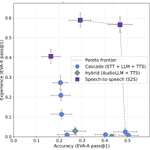
1/ The future of voice AI is one where people spend hours a day interacting with models.
For that to happen, models need to be natural, engaging, and compelling enough that people want to keep talking to them. To understand which models people actually prefer interacting with, we need to ask humans.
We just released DAI-S2S-ST, our single-turn speech-to-speech human preference leaderboard, built on 153K comparative human ratings across 12 evaluation dimensions.
This is a first step toward measuring what it feels like to interact with voice models and what drives people’s preferences.
research.withdavid.ai/blog/s…
