

CS PhD @Stanford🌲 | @UCBerkeley alum. Robot learning & embodied AI
Joined November 2018
- Tweets85
- Following313
- Followers1K
- Likes1.4K



Ria Doshi retweeted

In language models, turning a generative model into a critic is simple: pass in the output and prompt for a score. Robot policies can't do this - they output physical actions & there's no built-in vocabulary to predict scores.
So when it comes to RL on robot policies, we typically train a separate critic from sparse rewards - blind to everything the policy learned from the actions in the pretraining data.
We think this has it backwards - can a critic learn from those actions the way the policy does? (1/n)
Ria Doshi retweeted

Precise assembly is an important benchmark for robotics. Standard industrial automation fails to generalize, but robot learning struggles with contacts.
In this work, we extract force signals from proprioception and generalize well beyond the training distribution. Check it out!

Every robot already carries contact sensors: its own joints. When a robot touches something, its joints drift slightly off their commands, and the encoders pick it up. Legged robots and humanoids already leverage this signal to walk blind - but is it enough for blind precise assembly?
We find that it is! Our policies can insert pegs, mesh gears, and thread nuts using only the robot's joint positions - no camera, no tactile, and no object poses. And the peg policy works zero-shot in the real world! 🧵
w/ my amazing co-first author @younghyo_park, and advised by @kushalk_ and @pulkitology.

Ria Doshi retweeted

Want to know how well agents can really control robots directly?
In RoboARCade, we systematically evaluate and diagnose frontier agents controlling robots directly using tens of thousands of dollars’ worth of agent trajectories. RoboARCade contains diverse, precise, and long-horizon tasks. Paper, code, assets and every trace are out today. roboarcade.org
Ria Doshi retweeted

Mobile manipulation policies can break from base pose errors of just a few cm, which are common after navigation. Can we get pose generalization without additional demos? Introducing MobileVISTA: collect demos at one base pose, get a policy that works from many 🧵👇
Website: sdwistreich.github.io/mobile…
Paper: arxiv.org/abs/2610.07511
Ria Doshi retweeted

Human fingers move in coordinated patterns. Can those patterns help robots explore?
Excited to share EigenDEXplore! 🤖✋
Key idea: add exploration noise along directions learned from human hand motion, while leaving robots free to discover motions of their own
See @harshgupta's 🧵

Ria Doshi retweeted
Task and motion planning (TAMP) excels at multi-step, semantic, and geometric reasoning. VLAs excel at deformable object manipulation, which TAMP can't do. Can one VLA do both?
DATAFARM fine-tunes VLAs on TAMP demos aligned to the pre-training distribution.
(1/9)
Ria Doshi retweeted

Robots need memory 🧠: remembering where your favorite cup is or which drawer is locked.
How can a robot remember across large spaces, interactions, & fine-grained detail?
Introducing MessyMem (accepted to #CoRL2026 🚀): Learning-from-Doing Memory for Mobile Manipulation. 🧵
Ria Doshi retweeted

Excited to share our work on a model for mapping molecules to olfactory receptors to perception, out today! Check out the link in thread ⬇️

Out today in Cell Systems: the final version of our work on biologically-inspired models for predicting how molecules smell!
With @SeyoneC and @jdthamores

Ria Doshi retweeted

Why do Vision-Language-Action (VLA) models still struggle with contact-rich manipulation? 🤖
Excited to share our new paper: Demystifying When and Why VLAs Fail in Contact-Rich Tasks and How to Fix Them. 🧵 (1/8)
Ria Doshi retweeted

Full episode dropping soon!
Geeking out with @riadoshi21 @leto__jean on CHORUS: Decentralized Multi-Embodiment Collaboration with One VLA Policy chorus-model.github.io/
Co-hosted by @micoolcho @DJiafei

Ria Doshi retweeted

Introducing Real-time RL.
In the real world, time isn't free. The environment keeps "moving" even when you're computing your next action.
We show how RL agents can learn to adaptively think in real-time games.
1/🧵
Ria Doshi retweeted

How can generalist policies adapt to new challenges at deployment using skills they already have?
We optimize VLA *prompt inputs* with reinforcement learning, enabling efficient real-robot adaptation on complex tasks where existing methods struggle. 🧵
semantic-action-rl.github.io
Ria Doshi retweeted

Seeing multiple, mobile robots collaborate on manipulation tasks was my dream since I started at Stanford.
@riadoshi21 made it happen.
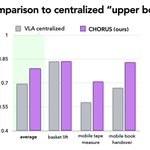
CHORUS is a single decentralized VLA policy whose architecture stays fixed regardless of team size.

Ria Doshi retweeted

How should we evaluate robots in the age of foundation models?
We hosted the RSS RoboEval Workshop with folks from academia, industry, and policy to discuss this.
💪 We put together an actionable guide and insights to get you started on robot evaluations. Link below.
🧵1/N

Ria Doshi retweeted

Generalist robot policies learn many useful skills. How can we elicit relevant behaviors when faced with new tasks? We introduce Flow Reversal Steering (FRS): a way to refine coarse actions produced by semantic reasoning into similar precise ones!
flow-reversal-steering.githu…
1/N

Ria Doshi retweeted

We equipped PI policies with memory!
And taught our robots to do long-horizon real world tasks such as preparing the items for a recipe, cooking a grilled cheese and cleaning the kitchen!

Ria Doshi retweeted

Long-tail scenarios remain a major challenge for autonomous driving. Unusual events—like accidents or construction zones—are underrepresented in driving data, yet require semantic and commonsense reasoning grounded in control.
We propose SteerVLA, a framework that uses VLM reasoning to steer a driving policy via grounded, fine-grained language instructions.
Paper: arxiv.org/abs/2602.08440
Website: steervla.github.io/