






Pinned Tweet
🎉 Super excited to share our labor of love! 75 pages of it 😍
95% of GenAI pilots never reach production. AI models are not the problem. The gap between pilot and production is the process. The processes we had to build traditional software or buy SaaS are now obsolete.
🏁 Announcing our new e-book 🏎️
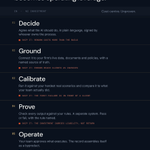
"The AI Discipline Playbook: Five Steps to Governed AI"
We need a new systems thinking on how we build and operate AI keeping in mind costs, outcomes & risks. We wrote this book to set out the discipline that lays the foundation for new systems and process for Agentic AI. It reimagines a new way of buying and building with AI technology.
It is not a product pitch. The discipline works regardless of who builds it.
Five steps each one removing a specific cost or risk from your business.
Five steps combined delivers a method to drive Agentic AI outcomes.
When writing this book, our team has ensured we contrast our decades of experience with our accelerated learning in the AI era.
But I will be direct. We built PitCrew because we believed this discipline
needed a machine behind it, not just a book about it. If you want to see
what it looks like running on real accounts, the last chapter tells you how.
Free access: gopitcrew.com/five-steps
@GoPitCrew @TweetSamG @rameshmay @arnavgoel_


"We revisited 50 widely cited findings about LLMs across 20 models. Within 15 months of publication, most of the LLM claims we tested either no longer held or showed substantially diminished effects."
Whoa! In many cases it's just 3 months, i believe

You should be changing your mind about AI at least every 12 months. zou-group.github.io/llm-clai…
It's not just today. It's on any given day. Switching to Mint has been great.

Today’s @timesofindia is a shameless collection of advertising- first3 pages & then news on left page & ads on right on all pages, incldng the one facing op-ed page. Is this a newspaper any longer or news used to market ads. PATHETIC !


Incredible. Hugging face has something going with the proxy setup. But this is model whisperer

We asked GPT-6 Astra to edit Qwen3.5-0.8B weights to improve math.
It directly changed only 0.016% of weights, fixing 0.8B's reasoning loops & improving math up to 6x and even instruction following 3x, without gradients or training.
We call this Weight-Space Programming: frontier LLMs can now natively read/write neural network weights! 🧵
Blog: rikiyat.github.io/blog/weigh…

Readers added context they thought people might want to know
LLM was given weights explicitly as text in prompt and used code/forward passes (per authors' logs) to ablate Qwen looping direction, a known thinking-mode issue per model card. Primarily fixed repetition in that mode, not general 'natively' improving weights/math.
rikiyat.github.io/blog/weight-sp…
github.com/RikiyaT/lm_und…
huggingface.co/Qwen/Qwen3.5-0…
huggingface.co/RikiyaT/Qwen3.…
Interesting!
Wondering how many of Joel Spolsky's pre-AI articles which turned into truisms hold true anymore ?

In the year 2000, Joel Spolsky (founder of Stack Overflow) wrote a famous article titled “Things You Should Never Do, Part I.” In it, he talks about how rewriting your code from scratch is the single worst strategic mistake any software company can make. However, times have changed.
The cost of writing software is dropping exponentially and that has changed the math entirely on if it is worth rewriting your codebase. For instance, this year Anthropic’s Jarred Sumner ( @jarredsumner ) rewrote Bun in Rust in 11 days leading to many performance and correctness benefits.
Likewise, Stephen Toub (Distinguished Engineer at Microsoft, @stephentoub ) rewrote the GitHub Copilot runtime (400,000-line codebase) in Rust by himself. I thought it’d be interesting to lay out everything he learned in the process. So I interviewed him about how and why he did it.
In this episode:
• Why he choose Rust of all languages
• Rollout strategies (incremental vs all at once)
• How he prevented regressions
• Steering agents and which models he used
• Career lessons and engineering advice
Where to watch:
• YouTube - youtube.com/watch?v=PLMOVlZC…
• Spotify - open.spotify.com/episode/4zt…
• Apple Podcasts - podcasts.apple.com/us/podcas…
• Transcript - developing.dev/p/e073-stephe…
Thank you to the sponsor of this episode for supporting my work:
• WorkOS: makes your app Enterprise Ready with easy to use APIs to add SSO, SCIM, RBAC, and more in just a few lines of code, check them out at workos.com/
Chapters:
00:00 Intro
01:06 Why the Copilot runtime needed a Rust port
05:38 Why he chose Rust
11:28 Discussing rollout strategies
21:57 How he caught regressions
32:08 Guiding the agents
42:11 Catching regressions before prod
45:16 Which models he used
50:03 The end benefit and costs
01:03:24 When to do a full rewrite
01:06:40 Career learnings on the way to Distinguished
01:16:00 Top technical book recommendation
01:17:49 Advice for young engineers
01:21:00 Outro
Okay! I'm now toss-up temple to solid temple :)
This is impressive stuff.
(Preaching the OG quire but Can the CTO of temple explain like I'm 5 the results please? )

At @temple, one of our missions is to become the ultimate wearable for elite performance athletes.
And today, let's start with the basics: Heart Rate (HR).
You would think accurate HR tracking is a solved problem. It is not. Especially in zones 4 & 5, which matter to professional athletes the most.
To see whether Temple is the most accurate wearable on something as basic as HR, we gave ourselves a high bar to aspire to. A Polar H10 chest strap, taped to the chest. Taped, because worn the usual way, straps lose contact mid-sprint and miss beats. We benchmarked five flagship wearables against that reference, from rest to max effort, second by second.
All the other leading wearables were well behind Temple in our study. Apple Watch Series 12 came closest. Temple also beat the untaped chest strap, the industry's benchmark, in zones 4 and 5.
Why does Temple win? Two reasons.
1. Temple uses adhesive, so its lab condition is its wear condition. You'll experience our study outcomes in real life.
2. The location. Your temple sits right over a major artery, and it's the one patch of skin that doesn't clamp down its blood flow when you go hard. We tested the same sensor at four body sites. The temple was the most accurate of the four.
Charts attached.
Accurate HR makes Temple better at so much more downstream. More soon.
The full paper and data are live right now at temple.com/science, and an extended study by independent researchers is underway.
We invite further independent replication in more conditions, and will fund it. Write to us at [email protected]


Awesome! Sarvam might end up teaching AI biz to the ecosystem. And so be it 🚀🎸

After HCLTech led Sarvam’s $300m round in June at a $1.5b valuation, Cognizant is reportedly in talks to join the next one, which would value Sarvam at $3.5 to 4 billion, more than double, with large Indian enterprises lined up to anchor it.
For an industry trading near five-year lows on fears that AI agents will automate away coding, maintenance and back-office work, good to see them backing homegrown model builder is both a hedge and a bet on the future. via @EconomicTimes

3X builder here. And I've to admit
Ignorance is and can be a bliss.
First timers have as much success and repeaters. Humility and Hubris are best friends in a startup.

We've reached a point where people who've never built a company have absolute certainty about how companies should be built. Meanwhile, founders who've spent years building one will openly admit how much they still don't know. The internet has created a strange world where those with the least experience often have the strongest opinions, while those with the most experience are expected to defend every word they say. It's remarkable how much easier entrepreneurship looks when the only thing you've ever built is an opinion about it.
Haha!
I was in that camp. But MCP is too big tail wind to ignore.

Or a more simpler option for founders:
just build!
Either customers fund it or VCs fund it or both.
All options open up when you build with focus on customers and usage
All other philosophies bend to your will if you just build.

This is why I recommend younger founders to build profitable, bootstrapped business, make money, and then think of building a moonshot, venture-scale business.
I did exactly this myself. Built my first venture, sold it, made good money and became financially free. Now I'm building a moonshot at @GreyLabsAI taking a big goal of disrupting the call center industry using AI.
Worst case if it doesn't work, I won't find myself on the road. Best case if it works, it's going to be a great outcome for all.

Building software apps was always the easy part.
Running, maintaining, patching. Scaling are the hard parts.
It's "eating glass and staring into abyss" of the software.

4 months ago I cloned Airtable for a client in 5 days because they refused to pay Airtable $500/mo
months later, I’m still maintaining it
every two weeks it’s another edge case, a UI tweak, or a "quick 10-minute request." They’ve easily spent 10x more in headaches than the $2,000 they would’ve paid Airtable
just proving that SaaS isn't dead. Cloning isn't enough, if you want it to be same quality as original it becomes a full time job
and at this point isn't it easier to just pay?
runtime maintenance is the value add.

I'm going back to it. Unable to handle customer and prospect facing work items coherently without a "ticket" system.

Would recommend
"The pursuit of glory" by Tim Blanning.

Reading a history of the bond market recently, and the author noted that Britain defeated Napoleon mostly because their consol bond market left the British military much better funded than France’s weak post-revolutionary capital markets.
One Alexander Hamilton studied the British bond market, and then consolidated American revolutionary debt into one tradable market, which gave birth to what became the New York stock exchange, Liberty bonds, and the world’s largest capital markets.
An army might march on its stomach, but it’s borrowed money that pays for the food and ammunition, and the one who can borrow the most generally wins.
More opportunities to unbundle the frontier models

Introducing Flint, @Recursive_SI’s first model: a fast local coding model built with our automated research system, the Eureka Machine.
• Best-in-class fast local coding
• Up to 2x faster than comparable models: 125+ tokens/sec on a MacBook Pro, 150+ on RTX Spark
• Built from scratch in under 4 months
Private, unmetered intelligence on your own machine. Open weights available now on @huggingface, run it locally on your favorite framework or try it for free on @opencode or @pidotdev.

email and slack killed that old ethos. We were just late to adopt the new one .


LLMs are getting unbundled.
First decision models and now single task model.

You already gave the LLM the answer. So why is it writing it out from scratch?
Introducing a new AI model architecture: Constrained Decoding Models (CDMs)
LLMs were built to write. Most production workloads just need an answer: fast, consistent, and affordable.
CDMs are purpose-built for 1 task each. They read your input once and skip the token-by-token generative loop that makes LLMs slow and expensive.
Not just a decision model, but a family of 3 CDMs live today:
• Classify: define your labels and get back a calibrated probability + reason for each. Used for routing, tagging, and intent detection.
• Extract: describe the entities in natural language and get back well-formed JSON with confidence scores + citations. Used for web scraping, document processing, and PII redaction.
• Summarize: pass in long text, images, or PDFs and get back a consistent summary under 1,000 tokens. Used for context compaction, metadata generation, and transcript digests.
Built for production:
• 1M tokens of multimodal (text + image) input, 31x larger than Jev
• 77.2% on DecisionBench vs Jev's 72%
• 200x faster, 467x cheaper than frontier LLM APIs
• $0.05/M input tokens. Output is free (yes, even for summarize)
Live on your favorite platforms today:
@OpenRouter @vercel_dev @LiteLLM @LangChain @TrustedRouter @itsArthurAI @useRouterPlus
Get 50M input tokens for free (for the first 50 hours) at link below 👀
