

The web data platform for AI agents and LLMs
Joined September 2023
- Tweets98
- Following0
- Followers344
- Likes373




Spider 🕷️ retweeted

Goated web data APIs for AI agents:
1. Context(@getcontextdev) - context.dev - personal favourite
2. Browserbase(@browserbase) - browserbase.com
3. Firecrawl(@firecrawl) - firecrawl.dev
4. Linkup(@Linkup_platform) - linkup.so
5. TinyFish(@Tiny_Fish) - tinyfish.ai
6. Scrapfly - scrapfly.io
7. Jina(@jinaAI_) - jina.ai
8. Spider(@spider_rust) - spider.cloud
Bookmark it for later.
Spider 🕷️ retweeted

Friendly reminder @spider_rust should be part of your stack.
Mogs firecrawl these days not just in speed but on quality and is pay as you go.

Spider 🕷️ retweeted

Building a scraping stack from scratch.
Here's what we actually use across hundreds of outbound campaigns:
Instantly Data Scraper — directories.
When you need to pull from G2, Capterra, industry lists. Fast. No code.
Playwright + Claude Code — custom sites.
Anything with a weird structure or login wall. Claude writes the scraper. You run it.
Firecrawl — full site crawls.
When you need everything on a domain. Pricing pages, case studies, team pages. 10 minutes, not 10 hours.
Jina / Spider.cloud — scale.
10K+ pages. LLM-ready output. This is where most teams underinvest.
Browserbase — agentic browsing.
For flows a static scraper can't handle. Session persistence. Works where everything else breaks.
BrightData — bot-protected sites.
Yes it costs more. Yes it's worth it. LinkedIn. Amazon. Anything that actively fights you.
Finding the directories is one thing, understanding the use case and framing is another thing.
A company listed on a niche directory already told you something.
They chose to be found. They're actively positioning in that category. They want buyers to discover them. That's not a cold lead anymore.
Apollo gives you a list of people who fit a description.
Directories give you a list of people who took action.
Those are not the same signal.
Most funded teams spend 3 weeks debating which database to use.
Then overpay for ZoomInfo since that’s what they did at their last company.
The teams booking meetings on day one?
They scraped intent from niche directories before anyone else thought to.
A client recently funded their Series A. Board wanted a consistent pipeline in 90 days.
We skipped the generic Apollo list.
Scraped 5,600 schools from vertical-specific directories.
Matched them against relevant signals.
Sent 7,000 emails. Booked 55 meetings in 31 days.
Same offer. Same copy.
Different list quality.
The scraping stack matters.
But knowing where to point it matters more.
Directories are intent. Treat them that way.

Spider 🕷️ retweeted

Dify v1.8.0 is live.
This release makes it easier to refine prompts, fix code, and manage workflows.
Refine or repair right inside LLM and Code nodes with an agent.
Prompt and Code
- Prompt Optimization: use {{last_run}} with your ideal outputs to quickly refine prompts and keep iterations under control.
- Code Fix: auto repair captures {{current_code}} and {{error_message}} to generate corrected versions so you spend less time on manual debugging.
- Version Management: every optimization and fix is saved as a version so you can compare and roll back any time.
Workflow and agent upgrades
- Multi model credentials: configure and switch between multiple keys for the same provider or a custom model.
- MCP with OAuth: connect to MCP servers with OAuth, including token expiry control and callback allowlists.
- Default values for workflow variables: all start node variable types now support defaults for faster setup
- Agent node token usage: track token usage in agent nodes for better monitoring and optimization.
Navigation and experience
- Knowledge base sorting: sort documents by status for smoother management.
- Extensible goto anything commands: a new architecture for faster navigation across projects.
Plus performance, security, and infra improvements across the board.
Full changelog: github.com/langgenius/dify/r…
Happy building!
Spider 🕷️ retweeted

For the first time, you can vibe-code any AI agent.
Meet Chai.new — Computer Human AI by Langbase ☕
🔹Prompt: "make an agent that…"
🔹Sip: chai builds any AI agent
🔹Ship: every agent gets a UI 🤯
Like your on-demand AI Engineer.
What will you s(h)ip today?
Spider 🕷️ retweeted

This is how I use LLM to scrape 99% of websites
Many people didn't realise you can build agentic scraper to:
1. Handle Authentication, Human verification, Captcha
2. Handle pagination & complex UI interactions
3. Adaptive as website structure change
4. Scrape large set of data
What used to take hours now can be automated in mins; Here I show case how do you automate a scraping job on Upwork where people are paying $50~$80 per hour;
0:00 Intro
1:54 Methods overview
4:52 Web Scraper agent using @firecrawl @spider_rust @JinaAI_
8:37 Handle website auth & captcha using @AgentQL
20:27 AI buy tickets @MultiOn_AI
If you have any further question or want to get deep dive into the code example in the video, you can join my community where I post tips weekly: link.agent.rocks/1BBC0Tp

Spider 🕷️ retweeted

4/ Spider Web Scraper & Crawler component: A great tool for scraping and crawling webpages using @spider_rust .
Spider 🕷️ retweeted
🕷️ Spider @spider_rust can be used as a built-in tool in #Dify Workflow or as an LLM-callable tool in Agent.
It allows fast and affordable web scraping and crawling when your AI applications need real-time web data for context.
🎬: Watch the video demo below:

Use the fastest LLM-friendly open source crawler on one of the fastest growing open source LLM-app development platforms: @dify_ai
(the jargon is just as crazy as spiders speed)
(and almost the same speed as our contributors, thanks @WilliamEspegren for the integration).
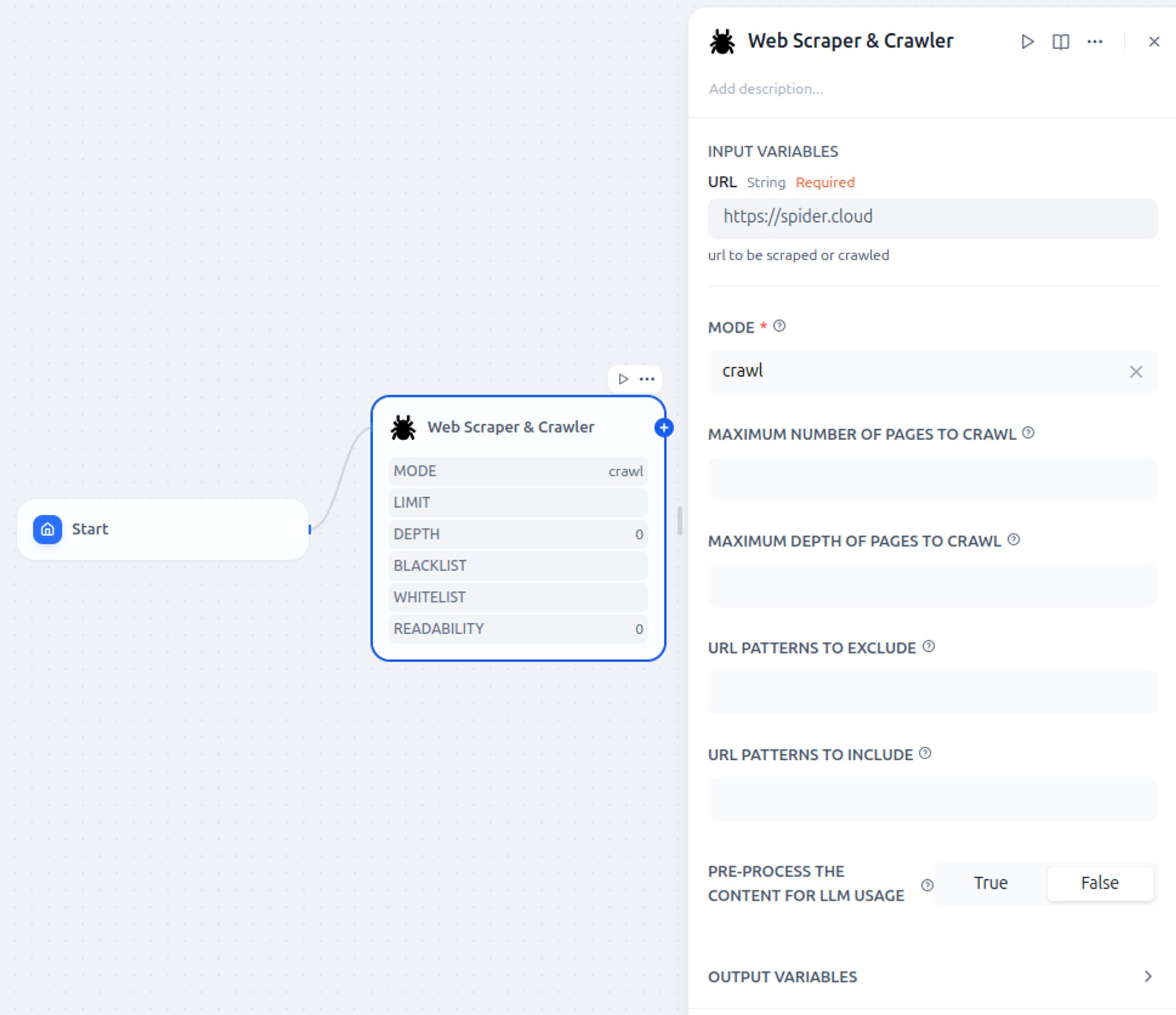
ALT A user interface for a "Spider" using the Diffy dashboard. The tool allows for crawling and scraping web data. The section on the right are settings and input fields, where users can configure: - URL (Required) to be scraped or crawled (example given is "https://spider.cloud") - Mode (e.g., "crawl") - Maximum Number of Pages to Crawl - Maximum Depth of Pages to Crawl - URL Patterns to Exclude - URL Patterns to Include - Pre-process the Content for LLM Usage (with True/False options) The interface is designed for automation and scraping tasks over the web, enabling the user to extract or analyze data from websites.
Spider 🕷️ retweeted

@spider_rust is the best crawling tool i have used. I had a complicated project where i needed to paste url and get the website whole website data. Spider cloud does it in an instant

Spider 🕷️ retweeted

🚨Announcing The Prompt Report🚨
A 76-page survey of 1,500+ prompting papers, analyzing EVERY prompting technique, Agents, & GenAI
Led by @learnprompting, and folks from @OpenAI, @Microsoft, & @UofMaryland
Here’s what we found & the 58 prompting techniques you should know👇🧵

Spider 🕷️ retweeted

PGVECTOR IS NOW FASTER THAN PINECONE. And 75% cheaper thanks to a new open-source extension – introducing pgvectorscale.
🐘 What is pgvectorscale?
Pgvectorscale is an open-source PostgreSQL extension that builds on pgvector, enabling greater performance and scalability (keep reading for the actual numbers).
By using pgvector and pgvectorscale, developers can build more scalable AI applications, benefiting from higher-performance embedding search and cost-efficient storage.
📈 How does it perform?
On our benchmark of 50 million Cohere embeddings (768 dimensions each), PostgreSQL with pgvector and pgvectorscale achieves 28x lower p95 latency and 16x higher query throughput compared to Pinecone for approximate nearest neighbor queries at 99 % recall, all at 75 % less cost when self-hosted on AWS EC2.
We also tested it against Pinecone’s p2 high performance index, see the blog post at the end of this post for full results (spoiler: It’s just as impressive).
🤔 Why did we build pgvectorscale?
Our team at @timescaledb built pgvectorscale to make PostgreSQL a better database for AI and to challenge the notion that PostgreSQL and pgvector are not performant for vector workloads.
⚙️How does it achieve such good performance?
Pgvectorscale brings specialized data-structures and algorithms for large-scale vector search and storage to PostgreSQL as an extension, including: (1) StreamingDiskANN – a high-performance, cost-efficient vector search index for pgvector data inspired by research at Microsoft, and (2) Statistical Binary Quantization (SBQ), developed by Timescale’s own researchers to improve upon standard binary quantization techniques.
These innovations help PostgreSQL deliver comparable and often superior performance than specialized vector databases like Pinecone. 👏 Big shoutout to @cevianNY and @sql_johnpruitt, two senior staff engineers at Timescale, who worked on these technical breakthroughs.
🧑💻 Sounds exciting! How can I get started?
Pgvectorscale is open-source under the PostgreSQL license, and free to use on any PostgreSQL database. You can find installation instructions on the pgvectorscale GitHub repository (see end of post). It’s also available on any database service in Timescale’s PostgreSQL cloud platform.
📚Learn more
[1] Pgvectorscale explainer blog: tsdb.co/avtharvectorscale
[2] Pgvectorscale github repo: github.com/timescale/pgvecto…
Share this post with your followers to let them know about pgvectorscale and comment your reactions and questions.

Spider 🕷️ retweeted

Excite to announce: Mistral AI Fine-tuning API
- serverless fine-tuning on La Plateforme
- fast & cost-efficient using LoRA adapters
- easy deployment
Also, open-source library for fine-tuning on your own servers:
github.com/mistralai/mistral…
Blog: mistral.ai/news/customizatio…

Spider 🕷️ retweeted

AI Builders' Favorite Tools: A Hive Mind Survey Summary
I recently asked AI builders about their favorite go-to libraries and frameworks for AI projects. Here is a summary of the first ~63 replies, categorized.
Agent Frameworks:
• AgentOpsAI: This tool simplifies the debugging and monitoring of agent operations, making it easier to read through prompts and visualize spend. (@AlexReibman)
• AgentForge: Designed for rapid iteration of cognitive architectures with support for multiple LLM APIs per prompt and easy VectorDB implementation via ChromaDB. (@JohnSmith4Reel)
• crewAIInc: A flexible and powerful framework for enabling multi-agent task completion with support for any OpenAI API-compatible endpoints. (@whoabuddydev, @as_cybersamurai)
• craftgen: Offers flexibility with its actor model and event-driven architecture, making human-in-the-loop workflows easy. (@Necmttn)
• Lyzr: An agent framework mentioned for its capabilities in building multi-agent systems. (@theAIsailor)
• Policy Synth: An open-source multiscale AI agent library. (@robertbjarnason)
• GraphAI: Used for data flow programming to build genetic apps, enabling LLMs to generate genetic applications. (@snakajima)
Libraries for Data Management and Vector Databases:
• Pinecone: Used for vector databases and praised for its serverless capabilities. (@EricBDelisle, @jjacky, @theAIsailor)
• ChromaDB: Integrated with AgentForge for easy VectorDB implementation. (@JohnSmith4Reel)
• Redis, Qdrant, Postgres: Commonly mentioned databases for AI projects. (@who_mansu)
• Greenhouse ECS: An ECS server framework built to be programmable by LLMs. (@EricBDelisle)
Web and UI Frameworks:
• Streamlit: Popular for creating web apps quickly from ideas, making it a go-to tool for many. (@josephs_tez, @SaidAitmbarek, @theAIsailor, @hTrapVader)
• Gradio: Useful for creating a UI in a few lines of Python, often used to showcase work in team meetings. (@AI_NewsWaltz)
• Wordware: Not a traditional framework but appreciated for building AI agents quickly and easily, even for less technical users. (@unable0_)
• PreactJS: Used for front-end application interfaces.
• NodeJS: Often paired with PreactJS for front-end development.
Language Models and NLP Tools:
• GPT-4o and other OpenAI tools: Widely used for their robust performance in various AI applications. (@TheHamedMP, @SaidAitmbarek, @theAIsailor)
• Langchain and Llama Index: Common starting points for fast iterations in AI projects. (@TheHamedMP, @topmass)
• DeepgramAI and AssemblyAI: Mentioned for their NLP capabilities. (@traviscorrigan)
• Instruct: A lightweight library for structured outputs with LLMs. (@who_mansu, @HamzaFarhan)
• Litellm: Another library for structured outputs with LLMs, often used alongside Instruct. (@who_mansu, @yoheinakajima)
• DSPy: Highlighted for its power and versatility in AI projects. (@mysticaltech)
• Magentic: A thin layer over LLM providers to simplify structured outputs and function calling. (@MichaelNStruwig, @jackmpcollins)
• Openrouter: Offers multiple language models under the OpenAI API definition for easy experimentation.
• Funcchain: An integration of Langchain with simpler typing and usage. (@akatzzzzz)
Developer Tools and Platforms:
• Replit: Favored as an IDE for its versatility and integration with various tools. (@theAIsailor)
• Deno: Used in the craftgen tool for its code interpreter capabilities. (@Necmttn)
• Imprompt: Highlighted for its ease of use in generative AI projects. (@jeffrschneider)
• Vapi_AI, usebland, vocodehq, retellai: New tools currently being explored. (@traviscorrigan)
• Hacknote: Recently added a feature called reactor creator, simplifying prompt writing and model selection. (@dbqsun)
Evaluation and Testing:
• LangSmith: Used for evaluation, debugging, and testing of LLM applications. (@as_cybersamurai)
• Promptfoo: A testing framework to evaluate prompts and iterate on LLMs faster. (@Yossi_Dahan_)
• Ragas: Used for evaluation in building RAG applications. (@AI_NewsWaltz)
Miscellaneous Tools:
• NATS / Socket IO / Redis: Used for messaging and caching in AI applications. (@EricBDelisle)
• Tailwinds: A CSS framework used alongside NodeJS and PreactJS for front-end development. (@EricBDelisle)
• BBScript: Acts as the glue between data, frontend, and backend. (@EricBDelisle)
• Obsidian: A personal knowledge management tool that integrates with OpenAI APIs. (@BrianAndrenMA)
• Convokit: An NLP toolkit from Cornell for conversational analysis.
• Google Cloud's Vertex AI: Mentioned for its multimodal embedding model. (@jjacky)
• PEFT: A tool used frequently for various AI projects. (@actualrealyorth)
• Blacksmith: Provides fine-grained automation for agents and flow generation. (@MoMe36806866)
• Trafilatura: Useful for processing web data, mentioned for its utility in LLM projects. (@TommyFalkowski)
*Summarized by GPT-4o - sorry if it missed any!
Of course this isn't a comprehensive list of great tools - but hopefully you find some interesting thing ones you didn't know of - and you now know someone you can ping about it :)

AI builders, #hivemind survey time!
What are your current favorite go-to libraries and frameworks for your AI projects? The ones you couldn’t live without!
Add name, short desc, and why below. 👇
Will summarize first 100~200 replies into an article ✍️

Spider 🕷️ retweeted

Tune in to @Scobleizer's latest podcast to find out how Groq makes your AI run faster than OpenAI's best, what our CEO's favorite programming language is, how to get hired at Groq, and more!
hubs.la/Q02ych120


Spider 🕷️ retweeted

Rust based crawler Spider is next level for crawling & scraping sites. So fast.
Their cloud offering is also so easy to use. Good stuff.
github.com/spider-rs/spider


