

Tracking the companies and technologies behind the AI buildout. Research informed by company interviews, site visits, analysts, and industry experts.
Joined June 2024
- Tweets1.8K
- Following103
- Followers4.4K
- Likes718
[Taiwan’s Weekly Standout #1]
Each week, we spotlight a standout Taiwan-listed company and explore what its story reveals about the AI and semiconductor supply chain.
PCB drilling equipment maker Ofuna Technology (4577 TT) rose 37.3% between the Oct. 16 and Oct. 22 closes, including a 10% gain on Oct. 22.
Ofuna sells mechanical and laser drilling equipment and provides laser drilling services for PCB and IC substrate manufacturers. Its business spans equipment purchases and the processing work manufacturers outsource.
September revenue rose 55.2% from a year earlier, bringing growth for the first nine months to 50.4%. The company attributed September’s increase primarily to higher equipment production and sales.
The supply-chain backdrop connects with our Oct. 19 weekly roundup. DIGITIMES reported that lead times for ESI’s laser drilling systems, part of MKS ($MKSI), exceeded 18 months as substrate makers expanded capacity for AI chips.
Higher substrate layer counts require more rounds of drilling and other processing steps. Expanding output therefore depends on both equipment availability and processing capacity.
At the TPCA Show held last week, Ofuna’s lineup included substrate drilling equipment and CO₂/UV laser drilling services.
Its revenue figures show equipment activity picking up. The next questions are how much growth is coming from high-end substrates, and whether drilling-service utilization is rising alongside equipment sales.

Cadence, which makes software for designing chips, has introduced Maestro, a family of AI models that customers can run in their own data centers.
The portfolio includes NVIDIA Nemotron models and can be further trained on customers’ proprietary designs. Cadence’s engineering tools evaluate the outputs against design requirements and feed the results back into training.
Cadence says initial workflow tests showed up to 30% better quality of results and up to five times greater token efficiency than a general-purpose model. The first Maestro models are available to select early-access customers in Q4 2026.
Our read: keeping proprietary chip designs in-house could lower a practical barrier to AI adoption. Pairing the models with engineering tools also gives customers a way to assess their output against specific design constraints. For Cadence, that creates an opportunity to sell AI capabilities built around the tools chipmakers already use.


Meta has outlined plans to raise about $95 billion in equity to help fund its AI buildout.
It has launched roughly $35 billion in common-stock and mandatory convertible preferred offerings. A separate $60 billion share-sale program could begin in Q1 2027, after its nonvoting Class C shares start trading. That program has yet to be established, and cash from the common-stock forward sales would arrive when those agreements settle.
NVIDIA, AMD and Broadcom have expressed interest in buying up to $5 billion of the common stock combined. Those indications are nonbinding.
Our read: if those investments go ahead, chipmakers would be helping finance the AI spending that supports demand for their own products. Meta would gain funding for expansion, while existing shareholders would face dilution.


Bloom Energy makes fuel-cell systems that generate electricity on-site for customers including AI data centers.
The company reported $249 million in Q3 consolidated net income, but operations used $27 million in cash as working-capital needs grew.
Contract assets, revenue recognized ahead of billing, accounted for a $430 million drag on operating cash flow. Receivables and inventories also absorbed cash, partly offset by deferred revenue and customer deposits.
CFO Simon Edwards said Bloom is focused on reaching billing milestones and collecting cash as the business scales.
Our read: billing and collection speed will help determine how much cash Bloom needs to support further growth. A larger contract-asset balance can be manageable if earlier work keeps turning into invoices and payments. Slower conversion would leave more cash tied up, even as reported profits rise.
Bloom ended the quarter with about $2.5 billion in cash, cash equivalents and restricted cash.
investor.bloomenergy.com/pre…

Nvidia targets 2.5x substrate capacity for its products over three years. Its Oct. 21 announcement shows how that supply is expected to arrive in stages.
“Immediate” refers to the Oct. 21 announcement. The later dates are targets. Product mix, customer qualification and actual shipments will determine how much usable supply each expansion delivers.
nvidianews.nvidia.com/news/n…

[SEMICON TAIWAN 2026 #1]
We spoke with Marketech (6196 TT) at SEMICON Taiwan.
Its customers include TSMC ($TSM), Micron ($MU), and ASML ($ASML). The company supplies semiconductor equipment and provides fab engineering services, with Q3 2026 revenue up 91.1% year over year.
In the video, we discussed customer demand, highlighting its work with Mennens on cleanroom cranes for ASML, and its collaboration with Vertiv ($VRT) on building a data center in Taiwan.
For the broader outlook through 2027, read our report: xitter.cf/statementdog/status/21…


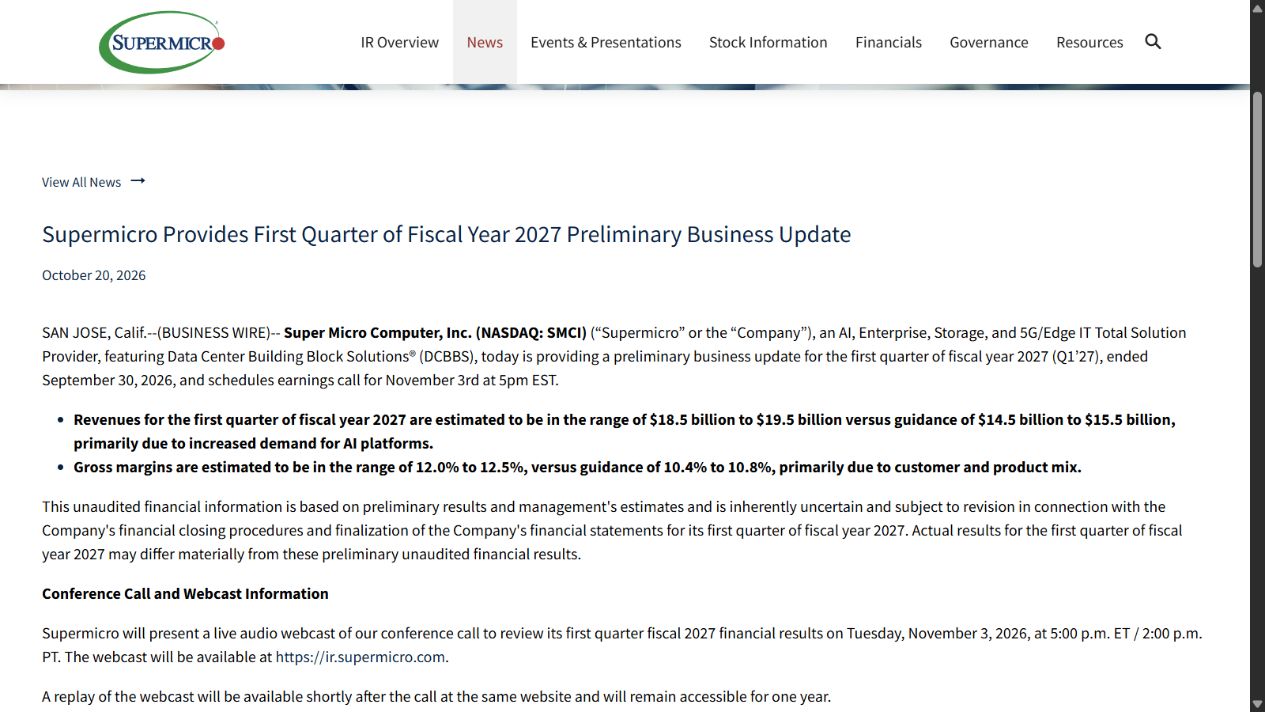
Supermicro now expects fiscal Q1 2027 revenue of $18.5–19.5 billion, well above its original guidance of $14.5–15.5 billion. The company cited stronger demand for AI platforms.
Gross margin is expected to reach 12.0%–12.5%, above the 10.4%–10.8% previously forecast. Supermicro attributed the improvement to customer and product mix.
The figures for the quarter ended Sept. 30 are preliminary and unaudited. Full results are due Nov. 3.
ir.supermicro.com/news/news-…
3M says it is doubling internal capacity for its Expanded Beam Optical (EBO) connectors as it deploys the technology with Microsoft and AWS, according to its Oct. 20 earnings presentation.
Its contactless design is intended to make fiber connections less sensitive to dust. The company has launched ferrules for 12- and 16-fiber connections.
3M is also conducting proof-of-concept work with four additional hyperscalers. The presentation does not disclose absolute capacity, a completion date for the expansion or volume commitments from those four companies.
d1io3yog0oux5.cloudfront.net…

SpaceX’s Super Intelligence (SI) revenue nearly tripled from Q2 to $7.56B in Q3. The segment swung from a $1.26B operating loss to a $431M profit.
SpaceX credited newly activated cloud service agreements, stronger Grok adoption and the Cursor acquisition. SI includes cloud services, software and advertising. Cursor contributed $608M to consolidated revenue from its Aug. 14 closing through Sept. 30.
SI accounted for $16.44B of SpaceX’s $19.6B in Q3 capital spending. Nameplate compute capacity reached 1.7 GW at September-end.
Musk expects to add 10 GW of compute in 2027, bringing the total to roughly 13 GW by year-end. SpaceX is also targeting an additional 20 GW of power and cooling capacity that year to stay ahead of GPU deployments.
CFO Bret Johnsen said new compute investments pay back in under a year at current prices. Musk said six months could be possible in 2027, but stopped short of promising it.
Musk also projected company-wide ARR of $500B to $1T by end-2027, measured as the annualized revenue run rate at that point.
ir.spacex.com/events/event-d…


TSMC plans to start using High-NA EUV in 2030, when it expects the technology to be mature, C.C. Wei said on the company’s Oct. 15 earnings call.
Asked whether adopting it later than rivals would put TSMC at a disadvantage, Wei said new tools must offer advanced technology at a reasonable cost and be mature enough for mass production.
TSMC is also working with ASML on 12-inch photomasks, targeting 2031. Wei expects High-NA to be cost-effective enough for mass production at that point.
investor.tsmc.com/english/en…

ASML’s customers are adding capacity at existing fabs by upgrading the lithography systems already in place.
Its Installed Base Management business, which includes services and field options, generated €3.3 billion in Q3 revenue, nearly €400 million above guidance. ASML attributed the beat mainly to strong demand for EUV and DUV productivity upgrades.
CFO Roger Dassen said high-margin contributions from the business helped ASML’s overall gross margin come in above guidance at 57.5%. The company expects Installed Base Management revenue of about €3.7 billion in Q4.
investor.asml.com/static-fil…
investor.asml.com/static-fil…


TSMC reported Q3 revenue of $46.72 billion, up 16.2% from Q2 and 41.2% year over year, about 2% above the top end of its guidance.
Gross margin was 66.4%, down 1.3 percentage points from Q2 but within its 65–67% guidance range. TSMC attributed the decline mainly to the initial ramp-up of 2nm production. Operating margin was 58.7%, above its 56–58% guidance range.
High-performance computing revenue grew 22% from Q2 and accounted for 68% of total revenue. The 2nm process contributed 8% of wafer revenue, up from 3% in Q2, while 3nm accounted for 33%.
Net income rose 8.0% from Q2 and 68.7% year over year to NT$763.06 billion, or NT$29.43 per share.
pr.tsmc.com/english/news/334…
investor.tsmc.com/english/qu…

Mastering Claude Code
I’d been using Codex on its own. Recently, I added Claude to the mix and found the combination more efficient.
That led me to an earlier livestream. I went through it alongside the current documentation and some follow-up videos, then used AI to help organize my notes.
Here are six points I found useful.
1. Define the goal, the constraints, and what counts as done
Boris recommends giving the model a clear task while leaving it room to choose how to approach it.
Explain the problem, what must stay unchanged, and how you’ll judge the result. Avoid prescribing every step. Add more specific guidance when it keeps getting stuck in the same place.
2. Give Claude a way to check its own work
For code, let it run tests. For a website, let it inspect the page and compare it with the design.
A message saying “done” isn’t enough. Ask for test results, screenshots, or other evidence you can inspect. That helps catch mistakes without leaving every check to you.
3. Keep project context concise and store it according to its purpose
Use CLAUDE.md for project rules that apply across sessions. Auto memory lets Claude retain your preferences, corrections, and other useful context. You can review and edit what’s saved through /memory.
Review both regularly, especially for information that’s outdated or instructions that contradict each other.
Knowledge and workflows needed only for specific tasks can go into skills. Claude can load them when relevant, rather than carrying pages of instructions into every conversation.
4. Use hooks for checks that need to run every time
Writing “check this after every change” in a prompt doesn’t guarantee it will happen.
Claude Code’s hooks can automatically run configured actions at specific events—for example, checking formatting, validating changes, or blocking certain operations. Where a rule can be automated, gradually turn it into a check that runs and produces results you can inspect.
5. Plan complex tasks; handle small changes directly
Explore and plan first when a task spans multiple files, the requirements are unclear, or the codebase is unfamiliar.
A typo or a small, well-defined fix doesn’t need the same process. Match the depth of planning to the uncertainty of the task.
6. Divide parallel work clearly and define how it will be reviewed
Separate sessions can handle research, implementation, and review. Subagents have their own context windows, making them useful for tasks that involve extensive reading or specialized checks.
When several sessions are editing code, give them separate working directories to reduce the risk of overwriting each other’s changes. When you assign a task, specify its scope and what the finished work needs to satisfy.
I’d apply similar principles to research and content work: define the audience and purpose, specify which sources to use, and require numbers to be traceable to those sources. Keep facts separate from interpretation.
After a model update, rerun the same set of real-world tasks. That gives you a way to judge which of your existing instructions are still worth keeping.
Notes based on a July 2026 interview, follow-up videos, and official documentation reviewed through October 8, 2026.


Even rival foundries can team up for AI.
GlobalFoundries will manufacture silicon interposers in New York for TSMC’s CoWoS advanced packaging under a new $2 billion agreement.
gf.com/news-and-events/news/…

Investors are ready for the weekend, but the U.S. jobs report comes first.
Today’s numbers could shift expectations for interest rates and move stocks. So much for a quiet Friday.


