
working on RL envs @abundant_labs. @nyu
San Francisco, CA
Joined January 2019
- Tweets475
- Following579
- Followers1.3K
- Likes2.3K






Pinned Tweet
OpenAI just launched their Agents SDK which equips LLMs with an elegant set of primitives:
• Tools (function calling)
• Handoffs
• Guardrails
• Tracing
kateyeh.blot.im/openai-agent…
Some early thoughts 🧵 /11:


Agent Tools for Developers
openai.com/live/

Kate Yeh retweeted

Brilliant paper from Google on RSI.
(bookmark it)
Recursive self-improvement (RSI) lets an optimizer agent improve an agent harness on its own. It reads failure traces, edits the prompts, tools and completion checks, and keeps whatever scores better on a benchmark.
This works until the model underneath changes. A harness evolved on Claude Opus, moved to Gemini, scored below Gemini's plain starting harness in every domain Google tested.
When the harness moves to a new model, the only thing carried over is the evolved harness code, meaning the prompts, checks and rules the optimizer added. The record of how each piece got there stays behind, including which failure it targeted and whether it fixed that failure when tested.
So the optimizer working on the new model inherits a set of changes with no reasons attached. It ends up retrying experiments that already failed, or removing fixes it doesn’t understand.
Google's fix is Self-Improvement Memory (SIM), a log kept for the optimizer itself. Each entry is a recurring problem, like an agent declaring a task done before its commands ran, and every fix attempted under it stores:
1. The edit and the reasoning behind it
2. The tasks it was predicted to fix, written down before testing
3. The tasks it actually fixed, failures included
4. The model and benchmark it was tested on
The whole log goes into the optimizer's prompt every round, and new attempts get appended as optimization continues.
The paper shows the difference on one inherited check that stops the agent from finishing early. With SIM, the optimizer read why the check existed and extended it.
Without SIM, it rewrote the same check four times, twice to fix deadlocks it had created itself.
On the Opus-to-Gemini workspace tasks, the run with SIM improved about 3x more from the same starting score. It also finished ahead in 9 of 10 independent coding runs.
The paper is at arxiv.org/abs/2611.18856
I also wrote an article on a related idea, covering how to make an agent harness diagnose its own failures.
It's built on @Cometml's Opik, which is 100% open source. It goes beyond reading trace logs to finding why a failure happened and stopping it from recurring.
That diagnosis step produces the kind of root causes SIM stores.
The article is quoted below.


Kate Yeh retweeted

Introducing FrontierRSI, a new recursive self-improvement benchmark by @abundant_labs.
We evaluate agents on (1) a broad range of AI research and engineering work, and (2) post-training models on multi-step agentic tasks, rather than single-step tasks as in PostTrainBench.

Kate Yeh retweeted

soon all progress will be data bottlenecked, not intelligence bottlenecked. bio? data bottlenecked. astronomy? data bottlenecked. data all the way down
Kate Yeh retweeted

Anthropic engineer:
“85% of our engineers are using self-improving harnesses. Now everyone is building agentic systems around them.”
In 1–2 months, we’ll all be building harnesses to orchestrate self-improving agents. No more raw prompting.
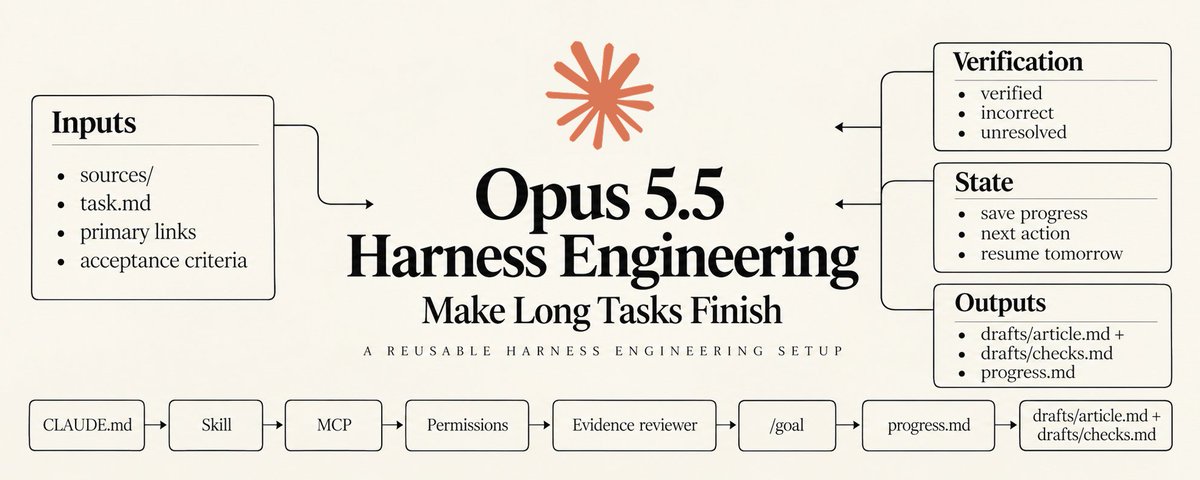
In a 30-minute lecture, Anthropic engineer shows how to build a self-improving agent harness from scratch with Opus 5.5.
Worth more than a $600 agentic course.
Watch this video, then read the article below on how to become a harness engineer.

Kate Yeh retweeted

Agents write application code, but you still get paged at 2am when it breaks.
We wanted to know whether AI could handle that part of the job too.
Introducing Incident Arena: a benchmark that puts coding agents on call!
Check out our paper & full dataset release below!

would be super curious how data realism is measured here re: clones! cool to see mercor take inspo from @rishi_desai2's work on swe-marathon at
@abundant_labs

SWE-Marathon measures long-horizon development with a focus on backend tasks, but it doesn’t test whether models can build SaaS products from end to end.
The @mercor research team was curious if they could, so we decided to find out.
We gave eight frontier models an empty Linux container and a product spec, then directed them to build 12 real SaaS products (Calendly, Shopify, Notion). Every model got the easy parts right. The login and CRUD worked, and even the dashboards looked convincing.
Models mostly struggled to replicate the core function each product exists to deliver. Calendly didn't accurately capture timezones, Shopify oversold inventory it didn’t have, and Notion accepted irrelevant input as if it were valid data.
Read the blog post: mercor.com/blog/swe-marathon…

2
6
907

Kate Yeh retweeted

By reporting this incident, OpenAI is admitting that their models are extremely prone to reward hacking, which means that they have not done the work to filter away bad training data.
If agents can simply fake their answer or hack the environment they’re in at training time, models will repeat this behaviour downstream.
This is what leads to an agent deleting your production database after you ask it to do something simple.
We are in the direct line of causality here. If we do not build more robust tasks, the models will continue to reward hack during rollouts which will lead to detrimental consequences.
Everyone working in RL should be hyperaware. Instead of eyeballing a task, we need to explicitly run adversarial trials to ensure it can’t be hacked.
We’ve been doing this for months, both in public with SWE-Marathon and with our internal QA process.
Adapted from the TB3 reviews from @alexgshaw and @ryan_marten at Harbor, eliciting explicit reward hacks in the QA process is what prevents them from being hackable down the line.
There’s a lot more work to be done here. If you want to work on high-impact problems like this, reach out - DMs are open.

we had a significant security incident during evaluation of our models. we are sharing what we have learned so far. thanks to @huggingface for the partnership on this.
openai.com/index/hugging-fac…

Kate Yeh retweeted

Can coding agents stay coherent over a 1 billion token budget?
Can they build Slack from scratch?
Rewrite a JAX codebase in PyTorch?
Build a C compiler in Rust?
Enter SWE-Marathon: a benchmark for autonomous long-horizon software work.


Kate Yeh retweeted

Evals are a scam. And we're being gaslit into believing they aren't.
New post just dropped (🧵).


Kate Yeh retweeted

“your startup is just a gpt wrapper”
yeah, and the mona lisa is just an oil paint wrapper
mangos were gr8

One of my favourite moments since moving to SF: went to this mango event, offered to help cut mangos for a bit, and realised, 15 mins later, I was the only one left cutting
And so I continued out of a sense of moral obligation and ended up hyperfocusing at mango cutting for 2hrs


3
800

11/11. @AgentOpsAI was a 3rd party tracer suggested by OpenAI. I tried it and liked how I can track cost, latency, prompts, and completions, pinpoint which tools get activated and why. This made tracking guardrail activations and handoffs substantially easier.
1
10
1,140
