





gemini 4 neon seems to be top tier at research, experimentation, and optimization.
google cooked!!!
66
btw we’re building exactly this right now at opensteer.
github.com/steerlabs/openste…


Agent platform of 2027.
This is the end game. This is the blueprint for the one and only application layer software that will exist. Every other software will effectively become databases for this layer, the everything agentic operating system for the million agent swarm to work on top of.
This is obviously the end game vision for the application layer of ChatGPT and Claude. I have reasons to believe that an independent company will own this product layer. But most ADE, "enterprise agent platform", or vertical saas companies, are focused on the wrong things far too narrowly, not technically competent, and do not have the product / technical vision to see this inevitable future.
The correct agent platform that wins will function like the base of a garden, from which customers will plant their unique "seeds" to grow their own plants and trees, managed and evolved by agents, humans, and signals from the sensors of the business. This presents a clearer picture than "factory of a factory" imo.


75
Tim Jang retweeted
Your stealth browser isn't stealthy
I've seen a lot of products, both open source and paid, claiming to have perfect browser fingerprints or bypass all the anti-bots.
If the product is a cloud offering and I see a Windows / macOS User-Agent, I'm immediately skeptical about any stealth claims.
I was going to write a blog post but I'll just yap about it here
im actually cancelling all my alt codex account and moving all of them to claude. No point in using gpt models anymore
1
3
87


disappointing
OpenAI’s release of GPT-6.2 Astra and GPT-6.2 Sol delivers the #2 model in the Artificial Analysis Intelligence Index and most of the Cost per Task Pareto frontier
@OpenAI's GPT-6.2 Astra is priced at $8/$40, 20% below GPT-6 Astra, and cached input drops to $0.40 from $1.00 per million tokens. GPT-6.2 Sol pricing is unchanged from GPT-6.1 Sol, at $2/$10 per million input/output tokens.
Key takeaways:
➤ Second in Intelligence Index: OpenAI now trails only Anthropic’s Claude Fable 5.2 in the Artificial Analysis Intelligence Index. GPT-6.2 Astra jumps 5 points from GPT-6 Astra, overtaking Gemini 4 Carbon (60) and Claude Opus 5.5 (59) at their top effort settings. GPT-6.2 Sol gains 2 points at 57, placing it on par with GPT-6 Astra at ~15% of the Cost per Task.
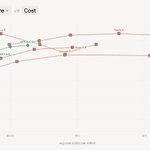
➤ Occupies most of cost and output token frontiers: OpenAI models now occupy most of the Cost per Task Pareto frontier, sharing the frontier with only Anthropic and Meta. OpenAI also dominates the Output Token per Task Pareto Frontier, with Claude Fable 5.2 being the only model from a non-OpenAI lab appearing on the frontier.
➤ Strengths in science and knowledge: OpenAI performs strongly in both of our key science-focused evaluations, leading Terminal-Bench-Science 0.1, covering agentic scientific research workflows, and placing second only to Claude Fable 5.2 in CritPt v2 (hard subset), covering physics reasoning. GPT-6.2 Astra performs below only Claude Fable 5.2 in factual knowledge as measured by AA-Omniscience v1.1 Accuracy, and in HLE-Diamond, a reasoning and knowledge benchmark.
➤ Leading in 3D and robotics: GPT-6.2 Astra leads AA-3D at 1318, with Claude Fable 5.2 at 1271 and GPT-6.2 Sol at 1259. This benchmark measures how well models build interactive 3D experiences, and is rated by human graders. GPT-6.2 also leads AA-Robotics v0.1, our research preview measuring how well language models can understand, plan, and act in the real world. GPT-6.2 Astra and GPT-6.2 Sol scored 79 and 78 respectively, ahead of Claude Fable 5.2 at 75. Our team is hard at work adding more difficult tasks, as OpenAI and Anthropic models can now perform the majority of basic tasks in this initial research preview.
➤ No improvement in Coding Agent Index: GPT-6.2 Astra is flat with GPT-6 Astra, and GPT-6.2 Sol loses 3 points relative to GPT-6.1 Sol in the Artificial Analysis Coding Agent Index (Codex harness at max effort). For Sol, the drop is driven by a 14-point drop in SWE-Atlas-QnA-AA, where the model is more likely than its predecessor to omit key facts in its responses. Cost efficiency however does place several effort levels of GPT-6.2 Astra and Sol on the Pareto frontier for Cost per Task.

43


