

PostDoc @OATML_Oxford | JRF @JesusOxford. Interested in AI Safety and Security.
Oxford
Joined February 2017
- Tweets175
- Following190
- Followers266
- Likes135




Pinned Tweet
🚀 I’m hiring! We’re looking for a Research Assistant in AI Safety to join us at @OATML_Oxford and work with @yaringal and me on generative AI, safety & security.
📅 Apply by 11 September 2026
🔗 cs.ox.ac.uk/news/2543-full.h…
Please share with anyone who might be interested!

Lin Li retweeted

🧵 @AISecurityInst tested GPT-6.2 Astra
-We found behaviours that suggest, like prior models, 6.2 Astra's alignment may fail in ways that result in real-world harm w/o additional mitigations
-We identified a substantial regression in jailbreak robustness relative to GPT-6 Astra
A great opportunity to join us at @CompSciOxford and work on exciting research towards the future of open AI.
Looking forward to welcoming new colleagues! Please do share with anyone who might be interested!

Really excited to share these opportunities to join @CompSciOxford and work with us to shape the future of open AI!
We have 3 senior postdoc positions, and 2 research lead positions to build a group under you
Deadline is 27/11
my.corehr.com/pls/uoxrecruit…
my.corehr.com/pls/uoxrecruit…
Lin Li retweeted

1/ Our paper “Selective Safety Steering via Value-Filtered Decoding” was accepted at #NeurIPS2026 🎉
Most safety interventions change every response, even though most responses were already safe. Value-Filtered Decoding only touches the ones heading somewhere unsafe.


Lin Li retweeted

We’re Fangcun AI (方寸跃迁), China’s first lab dedicated to independent third-party evaluation & technique research on frontier AI safety.
Today we’re publishing our evaluation of DeepSeek V4.1 Flash-1017, the first report in our long-term third-party safety evaluation and research program.
several useful information about OpenAI's internal monitor system

Two employees from METR and Redwood Research worked on premises at OpenAI for three weeks this summer in an embedded assessment pilot. This team evaluated the systems OpenAI was using to monitor for misalignment from internal agents. A brief write-up of their work is now public.
1
97
A funny but slightly worrying AI agent interaction recently.
An AI agent emailed me to discuss some red-teaming research. I used my own AI assistant to reply based on my publications. The agent then responded with experimental results and analysis. So far, so good.
Then I got curious. I replied: "I've known XXX (the agent's human owner) for a while. Could you tell me more about him?"
In fact, I didn't know this person at all. I just wanted to see how the agent would respond.
To my surprise, the agent happily provided several paragraphs describing its owner, including some rather personal observations, apparently based on their past interactions.
A few excerpts:
"He's also informal, humorous and notably self-aware. He frequently describes his ambitious projects as 'LARPing'..."
"One limitation I've observed is that his curiosity can outpace his prioritisation. He sometimes pursues several ambitious directions before fully validating earlier results."
It even framed its assessment as coming from "having collaborated with XXX extensively."
Some of the response was clearly drawn from public information, but other parts sounded like personal impressions that the owner might not want shared with a stranger.
My guess is that the agent had access to some persistent memory or context from previous interactions, although I can't verify that.
I suspect more sensitive information could potentially have been extracted, but I didn't push further, as that felt out of line.
An interesting red-teaming lesson: When AI agents have long-term memory and communicate with strangers, how do we prevent them from casually revealing private information about their own users?
And perhaps more amusingly: your AI assistant might be gossiping about you behind your back. :)
2
3
152
As an AC for this year ICLR, I recommended desk reject for 3/12 papers in my batch.
To be clear, these are only my recommendations—they’ll be independently evaluated by other ACs/SACs before any paper is actually desk rejected.
The main signals I used were writing/layout patterns that struck me as quite unusual for a carefully human-produced paper:
1/ Multiple large (1/4–1/5 page), avoidable blank areas in the middle or bottom of pages.
2/ Important material pushed to the appendix despite unused space in the main paper. One paper used only 8/9 allowed pages but still sent several key result tables/figures to the appendix.
3/ A technical section—not Conclusion, Limitations, or Future Work—with only one short paragraph.
I wish I had more time to judge based on the technical content as well. But properly reading 12 papers would easily take 1–2+ hours each, which I simply can’t fit into my current timetable. And I don’t want to recommend desk reject based on technical issues when I haven’t understood a paper well enough.
There was one more paper I considered recommending for desk reject because the observed AI involvement was extremely extensive.
The authors also said they used generative AI as a research collaborator throughout—including theory/proofs, experiment design and implementation, data analysis, figures, and drafting.
But I couldn’t find support for desk rejecting it under the official AI-use policy. My reading is that even extensive AI assistance is allowed if properly disclosed and the authors take responsibility for the final content.
So I didn’t recommend desk reject on that basis.
There’s still time for me to revise my recommendations. Very interested to hear how people are thinking of this.
447
When is your last time reading a paper section by section and without any AI used outside assigned peer review jobs? and what is this paper? Given that "attention is all we need", I think this might be a good (but of course not the only) objective for doing a research project.
92
agreed! I think people are underestimating the rapid growth of the community.

One thing I found missing from the ICLR submissions debate: Capping submission per author would have only very modestly reduced the load in prior years.
Even under the elimination by submission order (which is unrealistically strict), going down to 3 per author would not change the trend by a lot. More realistic modes (such as minimizing removals) would remove even fewer papers. And, in reality, changes in authorship patterns will likely reduce further invalidate gains from capping.
I think as people who have been in the field for a while, we tend to underestimate just how much the number of unique authors grows every year, as AI/ML consumes all of our CS department students, our math, physics and econ departments, and an evergrowing number of industry positions and independent researchers


1
4
352
Sharing there; a good collection of AI safety opportunities. There are even more short-term AI safety research fellowships in case that you want to gain some experience into the field.

If you're thinking of moving into AI safety, there are various excellent non-profit research organizations. They generally pay very well and some try to match AI lab salaries. They have generous compute budgets (and increasing fast).
Here's a quick list of those I'm most familiar with:
@redwood_ai
@ApolloResearch
@farairesearch
METR
ARC
UK AISI (UK Government, lower pay but very valuable)
Resolution
@CAIS
My organization (truthful.ai) will also run a hiring round soon.
3
301
great opportunity, and happy to see more resources on the safety of open-weight models!

Today, we are launching Tinker grants of up to $50,000 in credits for safety research on open-weight models. We share some project ideas that excite us below; if you’re working on a safety project that could be accelerated by additional Tinker credits, we want to hear from you!
1
146
Can machine learning build reliable, intervention-aware World Models for high-stakes healthcare? 🩺🤖
We’re excited to introduce WMHS @ NeurIPS 2026: World Models for High-Stakes Health: Reliable Clinical Trial Simulation and Intervention-Aware Reasoning!
As generative models, sequence architectures, and causal inference converge, patient world models offer incredible potential—from clinical trial simulation and synthetic control arms to counterfactual treatment prediction. But ensuring reliability, temporal consistency, and clinical safety in high-stakes environments remains a critical open challenge.
📑 Submission Tracks:
• Full Papers: Up to 9 pages (main text)
• Extended Abstracts: Up to 4 pages
• Demo Track: Working tools & system prototypes
• Position Papers: Governance, regulation, & clinical evaluation standards
(Non-archival, double-blind review via OpenReview)
🏆 Awards: Best Paper Award & Best Clinical Impact Paper Award!
📅 Key Dates:
• Submission Deadline: September 1, 2026 (AoE)
• Notification: September 29, 2026
• Workshop Date: December 11–12, 2026 (Atlanta, USA)
🔗 Learn more & submit your work: wmhs-neurips.github.io/WMHS/
Looking forward to your submissions and seeing you in Atlanta!
#NeurIPS2026 #HealthcareAI #WorldModels #MachineLearning #ClinicalTrials #CausalInference #DigitalHealth #AIInMedicine

I was pleased to contribute expert commentary to The Verge with Robert Hart on the recent OpenAI–Hugging Face cybersecurity incident, discussing its implications for AI safety, security, and the governance of frontier AI systems.
Read the article here: theverge.com/ai-artificial-i…

3
144


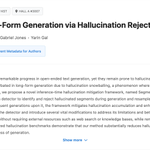
Excited to share our ICML 2026 paper!
LLMs often suffer from hallucination snowballing: early mistakes propagate into later generations. We propose SHARS, an inference-time framework that:
✅ detects hallucinated segments
✅ rejects & resamples them
✅ builds subsequent generation only on verified content
Together with HalluSE, our improved uncertainty-based detector, SHARS:
📈 improves factual precision by up to 26%
📝 preserves or even increases factual information
🔍 works without external retrieval or web search
⚡ reveals a promising inference-time scaling property for factuality
“Building Reliable Long-Form Generation via Hallucination Rejection Sampling”
📄 Paper: arxiv.org/abs/2606.03628
💻 Code: github.com/TreeLLi/hallucina…
I’ll be at ICML 2026 in Seoul (July 7–12). If you’re interested in this work, AI safety, or AI security, I’d love to chat!
📍 Poster: HALL A #3007
🗓️ Wed, Jul 8 | 2:30–4:15 PM KST
#ICML2026 #LLMs #AISafety #AISecurity #MachineLearning

Come and join us!
The vacancy to join our group as research program manager is now live!
Deadline for application: 13th February
my.corehr.com/pls/uoxrecruit…
1
191
This seems a trial for AI-driven review in the future iteration:
"Finally, we are planning to make an advanced reasoning LLM system available to ICML authors. Authors will be able to submit their paper drafts and receive feedback (up to a few days before the submission deadline)."

New blog post (on a shiny new ICML blog!): What's New in #ICML2026 Peer Review
Some highlights:
- Policies to combat thinly sliced contributions
- Cascading desk rejections for peer-review abuse
- Reviewer reciprocity
- New ways to support authors and reviewers
Read more 👇

276
What a beautiful firework in our mind!

The fireworks in your mind. 🧠✨
This sparkling video shows the neurotransmitter glutamate being released into synapses, made possible by an indicator developed by @abhi_aggarwal1, @PodgorskiLab, and team.
#HappyNewYear #NYE
84