




Bagel AI retweeted

90% of product teams can’t answer “what’s your P0?" anymore, and most of them have five agents running while they can’t answer it.
Don’t just take my word for it, ask Thariq Shihipar from the Claude Code team, who said that if you’re juggling a bunch of agents at once, you should slow down, because “most of the stuff you’re doing won't really matter."
He’s right.
Five agents in five tabs feels like a team of ten, and most weeks it’s a team of ten building P3s really, really fast.
The agents will build whatever, they don’t care if it’s stupid, so the hard part of the job moved upstream to picking what’s worth building and being able to say why, and that’s exactly where most PMs suck right now.
Here’s what most PMs do with their agents vs what top PMs do, in the 5 moments that decide your week:
1. Picking the P0
Most PMs pick whoever pinged last, the sales escalation or the CEO’s message at 11pm on Sunday, and call it prioritization. Top PMs pick from evidence: how many accounts hit the problem, in which segment, and what fixing it does to the metric the company runs on, whether that’s ARR, NPS, activation or some custom formula. If you can’t say the evidence in one sentence, what you’ve got is a loud customer.
2. Starting the agents
Spinning up an agent per idea feels free. It isn’t, not even close. Every run lands on your review queue, and review is the one part of the job you can’t run in parallel no matter how many tabs you open, so ten agents just means ten things sitting on your desk by Friday. Top PMs put ONE agent on the P0 and actually watch it, and the spare tabs go to research on the P1. Cap your parallel builds at what you’ll really review this week, and be honest with yourself about that number.
3. Feeding the agent
Most PMs plug in every MCP, every transcript and the whole ticket backlog, type “figure it out" and go get coffee. You’re toast. The agent burns tokens chewing on noise and builds the average of everything it read. Top PMs give it the decision: what we’re building, for which customers, why, and the exact customer words behind it. When we modeled this, 12.3M tokens of raw feedback came down to 904K tokens of validated decisions, so the agent reads less than a tenth of the stuff and all of it matters. One page per P0 with the problem, the accounts, the quotes and the metric, and nothing else gets in.
4. Saying no
Most PMs say “not now" and let the request rot in the backlog, where it comes back to haunt them every planning cycle. Top PMs tell the customer and the AE straight up what’s not happening and show them why. Slow down here, because a clear no with the evidence attached ends the conversation, and the AE stops bugging you about it every Monday.
5. After it ships
The day the last P0 ships, most PMs are already sprinting at the next one and never look back. Top PMs check 30 to 60 days later whether the customers who asked got what they needed, and that’s how they learn which evidence to trust next time.
The replies to Thariq are split. On one side you’ve got the maximalists, who want ten agents running because throughput wins, and on the other side the skeptics, who want everyone back to doing it by hand.
Both wrong.
Neither camp is talking about what the agents are pointed at, and that’s the whole game, so run as many agents as you can actually review and point every single one at something you can defend with evidence.
So pick one thing, know why it’s the one, give it your full attention and let the rest wait, including the CEO’s Sunday night aha moment.
BTW, this is the whole reason we built Bagel AI.
When you’re scaling fast or sitting on hundreds of enterprise accounts, the evidence for your P0 is spread across sales calls, support tickets, chats and threads that no one has time to read. Bagel AI reads all of it, ties it to the metric you run on, and gives you and your agents the validated decision with the evidence attached, then checks 30-60-90 days after it ships whether it worked.
bagel.ai/platform-overview/
Bagel AI retweeted
Half your backlog is dead, and I’m being nice. Feature requests from customers who churned two years ago, the PRD for a version we killed in some planning meeting and never archived, all of it still sitting there looking official, and don’t get me started on the CRM. It’s been fine forever because any PM who’s been on the team more than a few months knows which parts to skip, so we never bother cleaning any of it up.
Now agents are reading it, and they read all of it. There’s a team that cut their human CRM seats from ten-plus down to two, and the bill still went up 83%, because their agents were hitting the CRM way more than people ever did. So the main reader of a lot of systems of record is a machine now, with zero idea which half is dead, and it treats a decision from last March exactly like one from yesterday.
The plug-it-into-everything crowd thinks more context fixes this, and the security folks want to lock agents down with tighter permissions, which, fine, do that too. Neither one touches the actual problem. An agent with perfect access and perfect permissions will still read a dead ticket like it’s gospel, because nobody ever marked it dead.
The fix is boring as hell, and it doesn’t take some six-month cleanup project that everyone quits by week three. I’d give every decision an owner and a date when someone has to look at it again, and if the date passes and nobody’s touched it, the agent treats it as unsure and asks a person before it does anything with it.
The stuff that only lives in someone’s head is way messier, like the call where we changed our minds and the doc still says the old thing. That’s most of what we spend our time on at Bagel AI, and some weeks it feels close and some weeks it kicks our ass.
Bagel AI retweeted
“Where’s the ROI on all this AI spend?" is going to be the biggest f*ckup moment in 2027 product and engineering budget reviews.
Accenture just capped Claude at $29 an employee, and every finance team is about to ask the same thing. Most product and engineering leaders will walk in saying “we ship twice as fast now," which is telling the CFO the factory ran all night without checking if anyone bought what came off the line. Five answers are going to get people in trouble with the CFO:
1. “We ship twice as fast now."
Nice! But the CFO doesn’t pay for speed.
Speed is a cost line until something on the business side moves, and a PR count can’t tell anyone what moved. Before the next build starts, product and eng write one line together naming the metric it should move. No line, no build.
2. “We finally cleaned up our tech debt."
Engineers love (!!!) that sentence. Your CFO just checked their phone.
A cleaner codebase is invisible from finance. Name the feature that shipped because of the cleanup, and what it did for the customers who asked for it.
3. “The team saves 10 hours a week."
Great. Where did the 10 hours go?
If they went into more features nobody asked for, you bought a faster way to fill the roadmap with guesses. Show which customer problems got solved this year that sat in the backlog last year, with the sales calls and support tickets that asked for them attached.
4. “Usage of the new features is up."
Up compared to what? Every launch gets a bump, and your own team clicking around counts too.
This is the one that hurts most, and we see it all the time in the feedback that runs through Bagel AI. A team ships a request, closes the ticket, and nobody checks whether the accounts that asked for it ever touched it. Three months later those accounts ask for the same thing in different words.
Go back 60 to 90 days after launch. Check the metric your business runs on for that segment (retention, NPS, expansion or active users), then check whether the customers who asked are the ones using it. If they aren’t, better you find out than the CFO.
5. “Let’s cap the spend until we figure it out."
Yeah. Good luck with that. A cap shrinks the bill and the output of your best builders with it. Pull your top 10 spenders across product and eng, list what each one shipped last quarter and what it moved, and keep funding the ones with an answer.
Budget season rewards whoever walks in with evidence and results. You still have a quarter to collect and prove it.
So this is the time to ask yourself: which launch or AI rollout from this year would you least want your CFO to ask about?
Bagel AI retweeted
TL;DR: a customer built his own version of Bagel AI, ran it against ours on his own data for three months, and then expanded his contract.
He's exactly the person who should have pulled it off. Deeply technical, early on everything, writes his own tooling instead of buying it. He uses Bagel AI for a line of product I wouldn't have thought of myself. When he told me he'd built a harness to replace us, I took it seriously, because if anyone was going to get there it was him.
He ran both side by side. Same data, same questions, three months.
Then he called and told me he couldn't get close. His accuracy sat nowhere near ours and the evidence his harness produced wasn't clean enough to make a real call on. It kept burning tokens re-reading raw customer data nobody had scoped first. And every new source, every schema change, every bit of drift in his taxonomy landed straight back on his desk. His words were that maintaining it is just a headache.
He expanded Bagel AI instead.
We know that road well, and we know precisely how far you get and precisely where it falls apart. Entity resolution. Evidence standards that hold under someone's revenue number. A model that gets sharper on your data instead of drifting off it. That's years of work, and it's the whole product.
Anyone can stand up a harness this quarter. Very few people want to still be maintaining it next year.
If you're coming to ProductCon San Francisco next week, come find me at the Bagel AI booth and I'll show you how it works. Or grab a coffee slot with me here: calendly.com/ohadbiron/grab-…

Bagel AI retweeted
Four hundred tools on one MCP server costs about 405,000 tokens before anyone asks it a question. Load them on demand and it's 2,500. Most context systems are still being bought on how much they can hold.We all priced context layers like storage.
The hard part turned out to be deciding what not to send. I haven't seen anyone sell that as a line item yet, and I'm not sure how you'd meter it.I think by next summer MCP servers will publish their token cost on the landing page, the way databases publish p99 latency.
Tool count stops being a headline number around the same time.
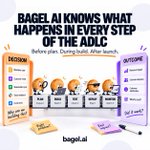
My bet is that the unit is the decision. The agentic development lifecycle has tooling for every stage except the one before the decision, where you work out what's worth building, and the one after it ships, where you find out whether you were right.

Bagel AI retweeted
We had to ask the restaurant for another table.
Last week we co-hosted a dinner in San Francisco with @AutonomyAI and @Brderless, for product and design leaders from Stripe, ServiceNow, Salesforce, Freshworks, BlueVoyant and a handful of other teams. Too many people said "YES" (which is a good problem to have).
The Autonomy crew already wrote up the thing that stood out to them, and I agree with it. Nobody in that room was arguing about whether AI should be touching production code. That debate is finished. What people actually wanted to talk about was what comes before you ship and after it's out there.
When your team can ship much more than it could a year ago, the bottleneck moves. It lands on deciding what's worth building, and most companies have no real system for that. They have a backlog (and a very confident AI agent).
Fewer still have a way to check whether the last thing they shipped did anything at all.
That's the thing we built Bagel for, so this was a good night for me. A room full of product leaders who already know it, comparing notes on how they're solving it.
We're doing another one ahead of ProductCon in early October. Same city, and I'm booking the bigger room this time.


Bagel AI retweeted
Announcing Bagel AI's build-vs-buy benchmarks.
Did you know there are no standard benchmarks for the cost of feedback analysis? So we did it ourselves. We took a sample dataset we created ourselves, to get the benchmark as objectively and professionally as possible, and ran it down both paths, with and without Bagel AI.
The results are mind blowing.
After building the dataset, it weighed 12.3M tokens to analyze in-house. Through Bagel, the same feedback set costs 904K. That's 12X fewer tokens, 92% less, and the raw feedback is still there behind every insight. That gap is extraction at ingestion, which we've been doing since day one.
And yes, this is happening right now, running in production on our customers' feedback and data.
A more specific example, and my favorite: a 45-minute call goes from 10,845 tokens to about 500, still linked to the source. Around 80% of the raw pile carries no product signal at all, which means most teams are paying full freight to process noise.
Think about it. One dedicated engineer to build and maintain it in-house is conservatively $180K a year, fully loaded, and that's before you spend a token on inference. That's the real price of building your own product brain.
There's more.
Full benchmarks, per-source token tables and the cost model are in our data room: bagel.ai/data-room/build-vs-…


Bagel AI retweeted
Two things happening in San Francisco.
September 9, we're hosting a dinner with Autonomy AII and Brderless for product and design leaders. Three courses, wine picked by someone who knows about wine, and a table of people who own the distance between deciding what to build and getting it shipped.
Approval required, and there aren't many seats left.
luma.com/wjm02oc4
September 10, look for me at Lenny's & Friends Summit all day. I'd like to buy you coffee, whatever coffee you want, and you can ask the hard questions while you're at it.
calendly.com/ohadbiron/grab-…
🤖 Made with AI

RT @ohadbiron: I read the new HBR piece by J.P. Eggers, Sarah Ryan and Asha Dinesh twice, and I have thoughts.
THE EXPERIMENT
They gave 3…
Bagel AI retweeted
Whether the context an agent read this morning is still true has no owner at most companies. Correctness has an owner. Usefulness has an owner. Freshness has none, so every agent you run is working off whatever was true last quarter.
Let it sink in
Bagel AI retweeted
Most products sold as a company brain are a search box over documents that were wrong when they were written. Indexing a bad decision faster gets you the same bad decision, in more places, with a citation.
Which is a harder problem than it sounds. Most product leaders are still buying this as a model problem. Swap nothing but the quality of the context and the same agent moves from 3.2 to 5.5 out of 10 across 7,500 test turns. Same weights, same prompt template. The only thing that changed was how clearly things were written down.
The failure modes have names. A fuzzy role gives you goal drift, and two docs that disagree give you rule conflict. Leave a hole in the spec and the agent confidently fills it. A stale tool description gets the wrong tool called perfectly.
The MCP maintainers dropped sessions last month, so every request carries its own context now and tool catalogs ship with a cache TTL. A stale priority no longer sits in one server's memory waiting to be corrected. It gets copied into every call until the TTL runs out.
Meanwhile the decision your agent needs lives in four places. There is the sales call where the customer said it, then a support tag someone invented on a Tuesday, then the Jira ticket summarizing the tag, then a PRD summarizing the ticket. Three are lossy and not one is dated.
So my bet for the next 12 months is that somebody in your org gets handed the job of deciding what is true before the agents read it. By mid-2027 it has a title, probably inside product ops, and whoever takes it shapes what ships more than whoever writes the roadmap.
Bagel AI retweeted
"Company brain" is a category name now. At least eight posts defining it and very few products that pass the test.
I build in this space so take it with salt. If the thing cannot tell me why we shipped what we shipped last quarter, it is a search box with a nicer landing page.
Bagel AI retweeted
We just "launched" Everything by Bagel AI in Times Square. Or did we?
This time, much to my marketing team's disappointment, (Sorry @therealidan) we decided not to buy the billboard. Does that change much?
Does it matter that the sign never existed, that nobody walked past it, that no photographer stood there at the right second? Some people will tell you that's close enough. It isn't. It doesn't land the same. Everyone can tell it's an attempt to stand out, and it never reaches the real thing.
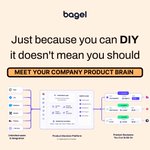
Same thing happens when someone tells me "we built Bagel ourselves." I ask to see it. Sometimes I'm impressed. It looks like the real deal.
But it isn't.
Every team sits on the same raw material: call transcripts, support tickets, feature requests, CRM notes, Slack threads, surveys. Most of it is noise. The real insight is buried in there, so someone builds a pipeline to catch it.
Anthropic ran into this on their own data. Feeding Claude more raw access barely moved accuracy. Structuring the signal before anyone asks a question is what worked. The bottleneck was structure, not access.
That's the part people skip when they build it themselves. Deciding what's signal takes years of tuning, then someone keeps tuning it every time a source changes, a model updates, or a new hire inherits context three other people built by hand. Leave it alone and it drifts back into noise, same as any pipeline nobody's watching.
Bagel already did that tuning, across enough companies that the patterns hold before you feed it your first ticket.
The billboard photo looks real until someone checks. Build vs buy works the same way. You can build something that looks like Bagel. Just know what you're maintaining once the photo's taken.
🤖 Made with AI

Bagel AI retweeted
I started my career building internal enterprise systems at Amdocs.
HR tools, custom workflows, the whole thing. We built everything ourselves because that's what you did. Twenty years later, I'm watching product teams fall into the exact same trap. Except now it takes an hour instead of a quarter, so it feels like progress.
I sat down with the Product-Led Alliance to talk about what I'm seeing across the market. The short version: every team is shipping 10x faster, and most of them have no idea if they're shipping the right things. The new metric isn't impact. It's time to impact.
Same ambition, compressed timeline, much higher stakes on every decision. We talked about context debt, why domain expertise is the PM's only real moat, and why "we fall in love" with the things we build internally even when they stop serving us.
Watch the full session: bagel.ai/blog/the-context-re…
@Nasi_R
@trybagel
Bagel AI retweeted

Personally what I see is post-AI, I cut 99% of my SaaS subscriptions and just built free replacements myself
Now I only pay for AI and servers and storage, but now with rising prices I'm paying more for all of those than before
So my business spending is much more concentrated to a few companies who I pay 10x-100x more per company than before
From ~30 companies that I'd pay $100/mo to 3 companies I pay $10K/mo (roughly)

Bagel AI retweeted

This whole episode is a masterclass. Geoff's take that "your job is to automate your job" hits different when you realize most product teams are still manually stitching together customer signal from 10 different tools.
That Ramp VoC agent demo? That's the future for internal teams with engineering resources to build it from scratch.
For everyone else, that's literally what we do at @trybagel
We already pull from Gong, Salesforce, Zendesk, Jira, Slack and connect it all to revenue impact automatically. No internal build required. MCP and a lot more shipping soon.
The L0-L3 framework applies to product intelligence too. Most teams are at L0: sometimes checking a spreadsheet. We get them to L3: evidence-backed decisions on autopilot.

"My job is to automate my job. That's all of our jobs from now on."
Here's my new episode with @geoffintech (CPO @tryramp) where he shared the best AI-native company playbook I've seen so far, including:
✅ His go-to Claude Code skill to turn ideas into great products
✅ Exclusive demos of AI agents that Ramp built for customer research, data, and coding.
✅ The L0-L3 framework to get every employee to ship production code
Some hot takes from Geoff:
"If you're not in Claude Code, no matter what your role is, you're probably underperforming."
"I still see very high performing PMs who don't get it. That is the biggest danger."
"Management is probably dead. What you should be optimizing for is to become the best builder in the world."
📌 Watch now: youtu.be/RBqT2PHWdBg
Thanks to our sponsors:
@meetgranola - The best AI meeting notes app I've ever used: granola.ai/peter
@Replit: Try Agent 4 to turn ideas to apps in minutes: replit.com/?utm_source=creat…
Bagel AI retweeted
אפשר להתלהב?
לפני חודש וחצי לקחתי על עצמי משימה, לבנות את @trybagel עם קלוד קוד.
אני עובד שם, אז אמרתי לעצמי שווה בשביל האתגר, ההבנה של המורכבות המוצרית וגם בשביל קייס סטאדי שאולי יתפוס.
בקיצור, פרסמתי, אפילו לא שאלתי מה ואיך, וקיבלתי תגובות מאנשים סופר מוכשרים ומוערכים בעולמות ה-AI והקוד ו-1k צפיות במאמר ובשבילי זה וואו, כי הימרתי על 10.
אשים לינק למי שרוצה לקרוא, תודה.

Bagel AI retweeted
לקחתי לעצמי 3 סופ״שים כדי לנסות לבנות בעצמי את המוצר שאני עובד בו ב-Claude Code (ואף אחד לא שילם לי על זה, מה זה אומר על מצבי הנפשי? לעולם לא נדע) והגעתי למלא תובנות.
מוזמנים לקרוא ואשמח לשמוע מה אתם חושבים. מזהיר זה ממש ארוך, מצב שתצטרכו 3 סופ״שים לקרוא את זה: linkedin.com/pulse/i-tried-b…
Bagel AI retweeted

Scaling starts with the right foundation 🧱 Hear from the leaders at @trybagel, @AskDragonfly, and @relienergy on how Google AI & startup support fuels their innovation and growth 🚀
Bagel AI retweeted

10. @trybagel – 6M – Bagel AI is building an AI-powered knowledge management tool for teams, automatically organizing notes, meetings, and project documentation into dynamic, searchable databases, boosting productivity and collaboration.