






Lalitha Sahasranamam :
• Antarmukha-samārādhyā (Name 870):
She is easily realized by those whose minds and senses are turned inward (antarmukha) through spiritual discipline, meditation, and self-control.
• Bahirmukha-sudurlabhā (Name 871):
She is extremely difficult or impossible to attain (sudurlabhā) for those whose minds and senses are focused outward (bahirmukha) on material distractions, sensory indulgence, and external illusions.
----------------
In sanskrit,
Antar = Inner
Bahir = Outer
Hindi word 'Baahar' comes from this.
But, there is also Tamil words:
அந்தரங்கம் (Antarangam)= Inner
பகிரங்கம் (Bahirangam)= outer
From Tamil to Sanskrit or Sanskrit to Tamil?
@naa_ganesan
@yajnadevam
@Anand_Venkatram
Is this right?
Guduvanchery
Etymological Breakdown
• Kudu (கூடு): Translates to "to gather," "nest," or "a place of congregation."
• Anchi / Anju (அஞ்சி / அஞ்சு): Historically means "fear" or can refer to five boundaries, but in local folklore, it is often tied to seeking refuge or a safe gathering place.
• Cheri (சேரி): A classic Old Tamil term meaning "a settlement," "hamlet," or "village cluster" (long before the word acquired different socio-cultural connotations in modern times).
Therefore, literal interpretations of the name point to a "settlement where people gathered safely" or a clustered village ecosystem.
------------
Tamil villages also has the term 'Kandigai' and 'vanam'
Example:
Sooravarikandigai
Tindivanam
@naa_ganesan @Anand_Venkatram
Darknight retweeted
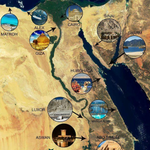
Chakras of the River Nile:
Temples, Tombs and Pyramids : Muladhara to Sahasrara
In esoteric and alchemical views, River Nile symbolizes the kundalini serpent's ascent along the spine. The river's flow represents life energy rising from the root chakra (source at bottom) through oases as energy centers: sacral in fertile curves, solar plexus at the central sun symbol (transformation hub), heart at mid-branches, throat in narrowing paths, third eye in upper visions, to crown at the delta (enlightenment). Occultly, it depicts alchemical transmutation—base earth to divine gold via mercurial waters.
Seven major temple complexes sit along the Nile in strict south-to-north sequence, from the first cataract at Aswan to the Delta where the river meets the Mediterranean.
Ordered by latitude, they map to the seven chakras in exact order: Aswan (root), Kom Ombo (sacral), Karnak (solar plexus), Dendera (heart), Giza (throat), Saqqara (third eye), Heliopolis and the Delta (crown).
----------------
> Root (source): Aswan area, grounding at the Nile's Egyptian entry.
> Sacral (fertile curves): Edfu/Kom Ombo, sites of creation myths.
> Solar Plexus (central sun): Luxor/Karnak, power centers with solar temples.
> Heart (mid-branches): Abydos, temple of resurrection and love. Dendera, Birth of Isis
> Throat (narrowing): Cairo/Giza, hub of expression via pyramids.
>Third Eye (upper visions): Saqqara and Heliopolis, ancient wisdom site.
> Crown (delta): Alexandria/Delta, enlightenment outflow to the sea.
Only the ones who have experimented (both good and bad things) with their lives, become a 'jijnasu'.
'There is sage in a sinner and sinner in a sage'
The Swan (Hamsa) is a mythical bird which seperates milk from water. Likewise, the ability to separate good from bad comes, only if you have sinned.
As Carl jung says, integrating the shadow

Ernakulam is
Iraniyar Kulam / Rishi Naga Kulam
'Iraniyar' is mentioned in 1st Sangam. Iraniyar is Shiva himself. Iraniyar is also mentioned in the sthala Puranam of 'Tiruvottriyur' temple, Chennai Tamilnadu
@naa_ganesan


Archeologists are yet to find real stuff that must be much more older than the present find


Bharathapuzha-Kerala
Major Temples on the Banks of Bharathappuzha:
The river is culturally significant, with many temples explicitly listed in the sources
Key Temples (Directly on Bharathappuzha’s Banks)
>Thiruvilwamala Temple (Vilwadrinatha Temple)
>Thirunavaya Navamukunda Temple
> Vairankode Bhagavathy Temple
> Chamravattam Ayyappa Temple
> Panniyur Sri Varahamurthy Temple
> Thiruvegappura Shiva Temple (near Thrithala region)
> Pattambi West Mutt Guruvayurappan Temple
> Mallur Shiva–Parvathi Temple

River Kaveri and Temples:
Many major temples lie directly on its banks.The river is one of Hinduism’s seven sacred rivers and is revered as Kaveriamma
------------------
Pancharanga Kshetrams (Five Ranganatha Temples)
:These are the most important Vishnu temples along the river
> Srirangapatna – Adi Ranga (Karnataka)
> Shivanasamudra – Madhya Ranga (Karnataka)
> Srirangam – Anthya Ranga (Tamil Nadu)
> Appalarangam (Koviladi), Tiruppernagar (Tamil Nadu)
> Parimala Ranganatha Perumal Temple, Mayiladuthurai (Tamil Nadu).
Some traditions include Sarangapani Temple, Kumbakonam instead of Vatarangam.
-----------------------
Other Important Temple Towns on the Cauvery Belt
> Kumbakonam – Sarangapani Temple, Adi Kumbeswarar Temple
> Thiruvaiyaru – Panchanadeeswarar Temple
> Mayiladuthurai – Mayuranathar Temple, Parimala Ranganathar Temple
> Thanjavur – Brihadeeswarar Temple (near the delta region)
> Bhagamandala – Bhagandeshwara Temple at the Triveni Sangam
Talakaveri Temple at the river’s origin

Illuminated Manuscript, Map of the Nile River with various oases on each as far as Sīdī Maʿrūf from Book on Navigation, Walters Art Museum Ms. W.658, fol.310b
Originally composed in 1525 and dedicated to Sultan Süleyman I ("The Magnificent"), this great work by Piri Reis on navigation was later revised and expanded.


Psychologically speaking,
It is our own 'Remorse' and 'Regret' that end up our lives horrific. You call that 'Kutta Bodham' in malayalam.(The remorse of wrong doings)
If you feel regrets and remorse, you are living in the past. Only a 'Veera' can come out of it. For that, you need 'Atma Bhalam' (The strength of the Atman).
For a veera, there is NO 'Paschatapa'(repentance) nor 'Prayachitta'(atonement).
Which is attained through 'Atma Vidya/Brahma Vidya/Atma Jnanam/Brahma Vidya' (Enquiry of the knowledge of the Brahman)
We see many people ending up their lives (Atma Hatya) due to silly & petty issues of life. The major reason is, it's their EGO. They did not get what they wished for or worked for. So, they end up their lives feeling ashamed and worthless.
The greatest strength of life is to attain 'Atma Bhalam'.
That is what, all the spiritual practices are there for.

Do Tantrikas meet horrific ends?
Ans:
It all depends on what you used your Mantrika power for?
If you used it to trouble a whole lot of people for absolutely no reason, then the likelihood is that it will return to trouble you.
BUT it doesn’t have to be like that.
If you used it to help people out to the extent you could and didn’t try to enslave anything or subjugate any Pretas or Bhootas or whatever… especially if you helped out those spirits and/ or gave them gati or did sadhana to set them on their path, then the entire Universe is your playground and you can go anywhere with a smile on your face.
Ma is aware of everything and She will provide for the sadhaka.
Anything the sadhaka absolutely needs will be given (note I didn’t say the word desired)… and sometimes even what one desires if one wants it badly enough.
The enemies of the Tantrika will meet with problems in their life eventually so why do blah blah rituals to subjugate them… this is where many people get into trouble. I mean if in desperate necessity…. any sadhaka with little bit of Shakti can stop their enemy but sometimes it’s worth seeing what exactly the Universe has in store for you… crisis gives wings to sadhana and one can only fly in the heights after getting forged in the fires of Tapascharya.
The power of Tantra is so immense that an individual can accomplish a lot of good on his or her own.
Joy Ma Tara
People use 'Guilt Tripping' to make you feel ashamed & worthless.
Be immune to that.
--------------------
Guilt tripping is a form of emotional manipulation in which someone uses guilt, blame, or implied obligation to pressure you into doing what they want, often by framing themselves as the victim. It commonly appears in relationships, families, and workplaces and can damage emotional well‑being and boundaries.