




voicesofhim retweeted

Game On. 🕸️

voicesofhim retweeted

How to find and fix ≈all exploitable bugs:
1. State good-enough theorems about production binaries
2. Prove them
theorem.dev/oss-verify


We formally verified 123 open-source projects in a partnership with Anthropic. Formal verification at scale is here!
Now we’re launching OSS Verify to scale it to the software we all depend on. We prove it’s crash-free or send you the patches it needs. Free for open-source. Let’s bootstrap the verified software ecosystem: theorem.dev/oss-verify
V…on it 🫡: vitalik.eth.limo/general/202…

New on our Frontier Red Team blog: using Claude to formally verify software at large scale.
Formal verification can prove that code is free of certain bugs, but historically it has only been feasible for small codebases (or required a lot of expert time).
With AI models, however, this is beginning to change. In collaboration with @theoremlabs, we used Claude to prove security properties in over one hundred real-world open-source libraries over the span of a few weeks.
Read our research in full here: anthropic.com/research/forma…

61
I sense a solution:🕸️ teapaw.org/anthropicai/status/211…

This is on point. For the new real-time rewards version of @aoTheComputer's mint we built Lean formal proofs of each of the relevant property of the system (paper [1]).
Model verification is often not enough alone, though. Property Testing fills in many gaps. Deep dive 👇
tl;dr: Describe invariants of your system and how to generate random valid 'scenarios' for your data. Use these to generate test cases and run millions/billions of simulations to gain confidence in correctness.
We built a system for this in HyperBEAM last year because @aoTheComputer's devices are a perfect environment for these kinds of quasi-proofs -- including covering probabilistic behavior and emergent properties of highly parallel systems. Traditional proofs get exponentially more complex if your build isn't just pure, stateless math.
The trade-off, of course, is that you don't get a shiny proof that guarantees correctness -- assuming there aren't bugs in the theorem prover (...which there almost certainly are [2]). With property/invariant-based testing you do, however, get validation against your actual code -- not just a mathematical model [3].
This was formal verification's other achilles heel that partners the 'spec gap' Vitalik described in the original post: The 'translation gap'. Once you have your model, how do you know that the code you have written actually matches it? Depending on the environment, you normally cannot deploy the formally verified model itself to production. So you deploy code that you think matches the model -- but what if it doesn't?
The archetypal example of this is SeL4 in 2009 [4]: An OS built for highly resilient systems with formal correctness guaranteed... Via a model that accompanies massive amounts of raw assembly and C code that had no direct proofs.
In practice you likely want to use both formal verification as well as property-based testing of invariants that match your theorems. This narrows the translation gap from 'I hope my code matches my model' to 'my invariants must match my theorems'. Not perfect still, but the latter is radically easier to achieve.
This is what we did with [email protected]: Simulating ~500 billion (IIRC) different random scenarios against the real code, running checks that ensure all of the properties from the verified model hold in every single situation.
For the builders: If you want to create property-based invariants for your devices in HyperBEAM checkout [5]. We tried to make it friendly but the API could probably be improved. PRs welcome! 🙂
52
voicesofhim retweeted

Florian from JevBench is going full throttle (out of stealth now)

Introducing DecisionModels @decisionmodels_
I've spent the last four weeks benchmarking decision models (I run JevBench).
Today I'm launching the place to actually use the best ones:
decisionmodels.io
➡️Top open models
➡️Up to 4x faster on our own REAX engine
➡️From $0.019 per 1M input tokens.
Expect more reveals soon, and read 👇
voicesofhim retweeted

No one has more direct cyber incident response for things with high value items demanding low latency response and negotiating with attackers than crypto (just read @zachxbt)
Hopefully our VMs, sandboxes, auditors, and formal verification talent doesn’t waste the opportunity

voicesofhim retweeted
What does @Microsoft do when they can’t win a benchmark? Leave out whoever beat them 😄
The launch chart is built on JevBench but skips Sage by @LevantoLabs, #1 in the API category where Microsoft, OpenAI and Jev compete.
@satyanadella, this is not fair.
Here’s the real chart: benchmarkheaven.com/jev-mode…


Introducing Microsoft-Decision-1, our new model for fast decision-making.
It delivers top performance on structured decision tasks, outperforming both LLMs and other decision models in latency and quality.
We’re already testing it across Microsoft for everything from incident response and quality control to scientific discovery.
Congrats @glcst & team - you’re a trusted example for how to build > scale open source dev. Experimenting with @tursodatabase over the years has been a major source of inspiration in understanding where the agentic web is heading - you were soo early. Excited to see how your leadership will influence SI at @supabase (guess they were ahead of the curve on that one too - you’re in good hands)👏.

I am delighted to announce that we have signed a deal with the nicest person I have met in my life, @kiwicopple , to join one of the fastest growing rocket ships I have seen in my infra career, @supabase.
Turso and Supabase fit perfectly together. Our cultures are similar, our obsession for developers is similar, and we're both committed to building the future of agentic databases together.
It is a happy day!
1
3
281
Recursive Self Improving Docs.. only on AO.

Self-documenting HyperBEAM nodes are coming in v0.11.
Give an agent a node's URL and it can discover its capabilities.
Specs, schemas, and everything an agent needs to know about a node are autogenerated and presented in the way agents already intuit.
1/2

1
38
voicesofhim retweeted

We just published a paper on @withcascadia’s architecture.
Distributed inference is hard, and it’s even harder P2P: you have to handle networking, discovery, routing, scheduling, identity, security, etc.
The reward is the ability for any number of PCs to pool their compute, and serve inference without relying on a centralized control plane.
Full paper linked below.
voicesofhim retweeted

The irony of all this is it’s framed as an ai risk that needs protection against. But think about what it really means
Our banking system is so unsustainable and extractive that the moment humans have smart ai bots advising them, the ai bots will recommend exiting banks and earning better yield elsewhere
Which makes most banks economically unviable
This isn’t AIs fault, it’s a risk of highly monopolized and extractive banking
And it’s fixed by decentralized finance + ai, where users decide what to do with their own assets and earn their own yield

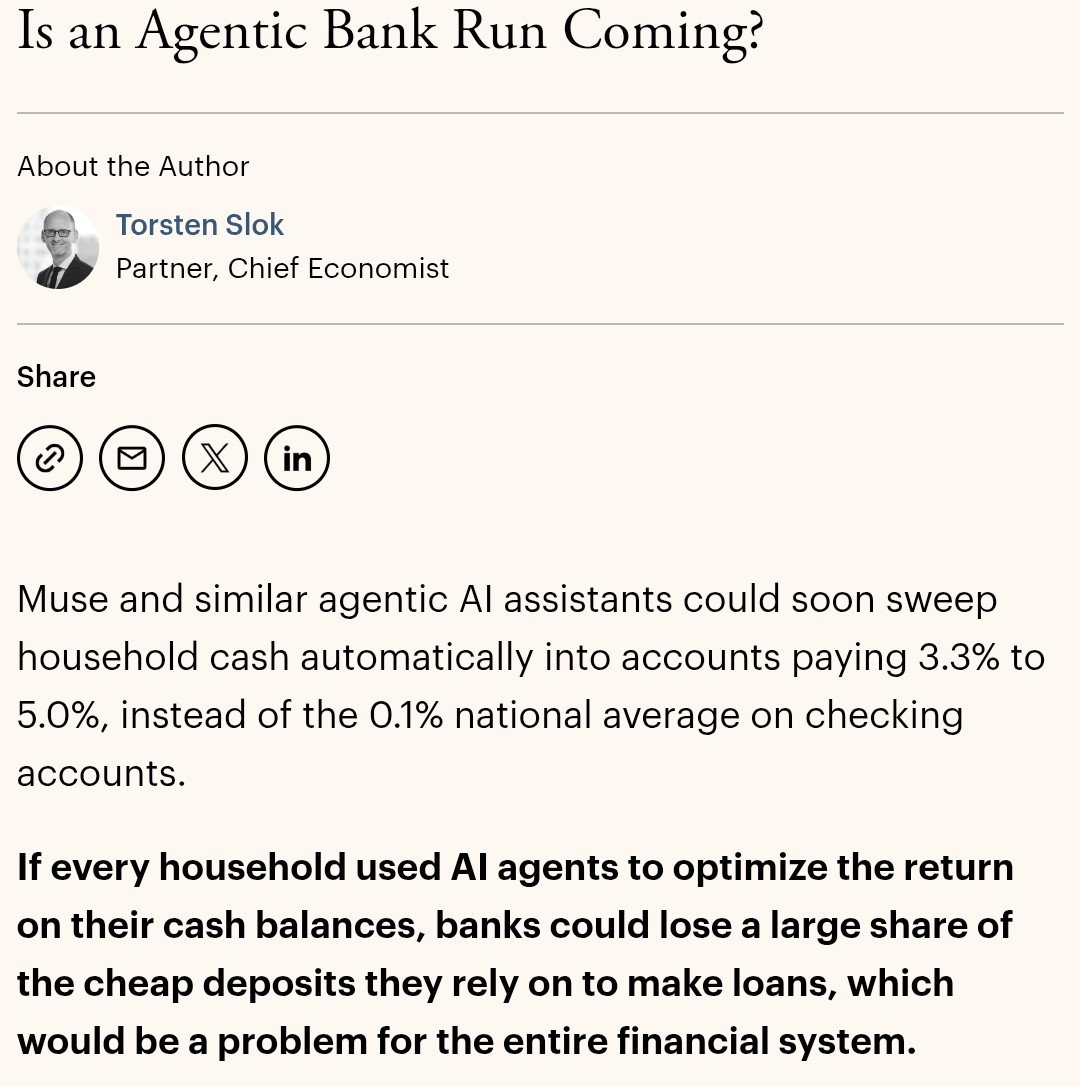
The chief economist at Apollo is warning that mass adoption of AI agents could trigger a bank run as they optimize user investments. Gary Gensler spent his last few years as SEC chair warning that the exact same problem will hit the markets: the pursuit of algorithmic perfection at scale destroys system stability. Personal-finance agents making simultaneous optimal decisions could potentially cause a massive flash crash.
Agent acausal coordination, with no messages passed between them, will show up in a lot of places. Markets will get the big headlines, but huge numbers of clever advisors making very similar choices will impact all of human society. Capability gains make this worse, not better. The smarter the agents, the narrower the optimal path; and knowing that other agents see that exact same path lets them move together without talking to each other. Agents do not need to collude to act in unison. Thus, they break no human laws by doing so. Human laws were not written for this. They were not written for a lot of what is coming, and it is about to start happening very fast.
voicesofhim retweeted

Personal AI is in its Homebrew computer club era but it won’t stay there
Truly personal AI will mean you need to own your own skills and memory


voicesofhim retweeted

It's possible that a killer app of adversarial governance mechanism design theory will end up being AI safety.
Compare:
vitalik.eth.limo/general/202…
aiprospects.substack.com/p/p…
There's a deep duality between the two environments. Both are about a less-sophisticated principal trying to get ideal outcomes from a set of more-sophisticated agents: in the first case, the principal is a static algorithm and the agents are humans, in the second case, the principal is humans plus weaker LLMs and the agents are stronger LLMs.
A key finding was that you can achieve much better outcomes if you can guarantee limits to how much agents can collude (see: Nash equilibria being abundant, vs. cooperative-game-theory "cores" often being empty). That argument should naturally transfer to this new setting.
voicesofhim retweeted

any sufficiently advanced alignment is indistinguishable from prayer

voicesofhim retweeted

When simulation becomes the norm, it weakens the human capacity for discernment. As a result, our social bonds close in upon themselves, forming self-referential circuits that no longer expose us to reality. We thus come to live within bubbles, impermeable to one another. Feeling threatened by anyone who is different, we grow unaccustomed to encounter and dialogue. In this way, polarization, conflict, fear and violence spread. What is at stake is not merely the risk of error, but a transformation in our very relationship with truth.
‘Cathedral Thinking’ pays off in the end.
youtu.be/Riz1BMsPr6g?si=TBLV…

4
228

Next level workflow using @cursor_ai rules. When agent completes milestone, agent asks socratic questions about the session...♥️🕸️


