

asst prof | clinical psychologist | some sort of geneticist | not a neuroscientist | @mghpsychiatry @harvardmed | mixer of metaphors | engagement ≠ endorsement
exploring extraphysic empires
Joined December 2013
- Tweets1.1K
- Following487
- Followers473
- Likes13K





Pinned Tweet
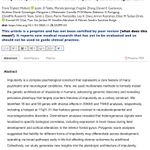
🧬🧠 Check out our latest preprint on the genetics of impulsivity! medrxiv.org/content/10.1101/…
In this paper, we examined ‘lumping’ versus ‘splitting’ models of impulsivity and characterized the shared and unique biology across multiple levels.
A few key findings below! 🧵

Travis Mallard retweeted

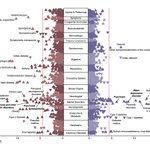
(10/14) Importantly, genome-wide genetic correlation only told part of the story
Using MiXeR, we found extensive shared polygenic architecture with many disorders—even when overall genetic correlation was small or absent

Travis Mallard retweeted
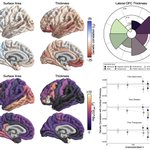
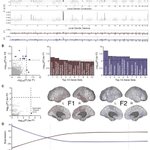
(5/14) We then performed a multivariate GWAS of this cortical expansion factor
This identified:
🧬 48 genomic loci
🧬 30 effector genes
🧬 Multiple novel associations that were not genome-wide significant in any individual imaging phenotype.

Travis Mallard retweeted
Pleased to share our new preprint: "Mapping the genetic architecture of human cortical expansion and its links to neuropsychiatric disorders" biorxiv.org/content/10.64898…

Travis Mallard retweeted

Competing programs shape cortical sensorimotor–association axis development | Nature nature.com/articles/s41586-0…

Travis Mallard retweeted

1/9 🚨 BREAKING OUT OF STEALTH MODE 🚨
Multivariate GWAS in Genomic SEM now runs on a laptop!
New preprint + package update: a closed-form analytic solution makes multivariate GWAS ~800× faster, cutting runtimes from hours on HPC clusters to minutes on a personal computer.
Travis Mallard retweeted

Family-GWAS results were critical in testing the robustness of inferences of natural selection in the recent Akbari/Reich paper.
We're releasing family-GWAS sumstats on 28 phenotypes on thessgac.com/ data portal, using the powerful method we developed in Guan et al.

Travis Mallard retweeted

Our multi-ancestry GWAS of EXTernalizing conditions (ADHD, substance use...) in ~4M people reveals neurodevelopmental risk, drug-repurposing targets, and yields one of the strongest psychiatric polygenic indices yet! 🧬🎉 doi.org/10.64898/2026.02.09.…
Travis Mallard retweeted

Excited to report our study in @NEJM on the discovery of deletions in a long noncoding RNA gene 🧬 (𝘊𝘏𝘈𝘚𝘌𝘙𝘙) as the cause of a newly defined human neurodevelopmental disorder 🧠. 🧵1/10 nejm.org/doi/full/10.1056/NE…

Travis Mallard retweeted

Having referred to it a few times this week, here is a (IMO) slightly more user friendly derivation of the LD-score regression estimator of heritability and its assumptions:
gusevlab.org/projects/hsq/ld…
Travis Mallard retweeted

Our paper (@bogglerapture @damadam, @dmoracze , Siyuan Liu, @wakeworksleep) on sex differences in the genetic architecture of the human brain anatomy is now out in @NatureComms @SpringerNature !
rdcu.be/dTUX1
Please see original post below for details…


(1/9) Do males and females show differences in the genetic architecture of brain anatomy? Our new preprint examining this question is now online, and here is a thread on what we found.
medrxiv.org/content/10.1101/…

Travis Mallard retweeted

It took me SEVEN years to figure out that you can save a ggplot as a vectorized .svg file ggsave("file.svg"). The svg file can be opened on powerpoint and it will be completely vectorized, even text are still recognized as text boxes! No more recreating plots on illustrator!!!!!

Travis Mallard retweeted

Yesterday I wrote a thread about why an infographic circulating was misinformation. I wanted to respond to some comments and questions, offer a new (perhaps more intuitive) calculation (thread)

Travis Mallard retweeted

Excited to share that our new paper in Nature Genetics! Huge thanks to @hailianghuang and @getian107 for supervising this project and to @broadinstitute, @CGM_MGH and @PGCgenetics for supporting the research. rdcu.be/dR0sF
Travis Mallard retweeted

🧠NEW WORK OUT NOW ON THE ARCHITECTURE OF HUMAN CORTICAL FOLDING ! 🧠 in @NeuroCellPress by the one and only @will_snyder98 🤩 wt dream team @petra_vertes @edbullmore & fab collabs. 👀🔗& Will’s 🧵⬇️ teapaw.org/will_snyder98/status/1… cell.com/neuron/fulltext/S08…

Our paper is now out in Neuron! @NeuroCellPress (details from preprint thread below, now with more results and containerized pipeline!) w/ @bogglerapture @edbullmore @petra_vertes and amazing coauthors
cell.com/neuron/fulltext/S08…

Travis Mallard retweeted

Excited to share my 1st-author work from the @arbelharpak Lab!
We examine the accuracy of polygenic score (PGS) predictions across individuals in the UK Biobank. We make 3 observations that expose gaps in our understanding of PGS “portability”.
biorxiv.org/content/10.1101/…
(1/28)

Travis Mallard retweeted

"Here, we present two real-world examples demonstrating that sample overlap and relatedness is not a minor or theoretical concern but an important potential source of bias in PRS studies."
Ellis et al. AJHG
cell.com/ajhg/abstract/S0002…
Travis Mallard retweeted

Introducing real-time PRS-CS! Excited to share our new preprint with @getian107. Optimized for healthcare settings, rtPRS-CS ensures patients receive the most up-to-date genetic risk prediction by dynamically updating PRS weights using streaming data. 1/7
medrxiv.org/content/10.1101/…

Travis Mallard retweeted
Our paper is now available in @NatMentHealth! 🤩

[1/6] Preprint 🚨“Do the genetic and phenotypic factor structures of psychopathology differ?” “What factors better capture comorbidity and shared etiology across disorders?” “How do factor polygenic scores predict brain & biobehavioral outcomes?“ medrxiv.org/content/10.1101/…

Travis Mallard retweeted

‼️ Paper alert ‼️
"Deciphering the functional specialization of whole-brain spatiomolecular gradients in the adult brain" now published in PNAS!!
How is brain function organized? Regions vs. gradients? Geodesic vs geometric? We add to the debate!
pnas.org/doi/10.1073/pnas.22…
1/

Travis Mallard retweeted

New out in Nature!!
With age, women can lose one X chromosome in their leukocytes.
What’s the cause/consequence?
How does it differ from the loss of the Y chromosome in men?
nature.com/articles/s41586-0…
@broadinstitute @FinnGen_FI @FIMM_UH @theNCI @Cambridge_Uni
