




Walter retweeted

Excellent, short article by one of the GOATs.
wsj.com/opinion/theres-no-su…

Walter retweeted

people are starting to realize.
there *are* no moats left. the only true moat in existence was intelligence, and now that's out of the equation.

Normies still believe AI-related extinction risk is just sci-fi/hype/marketing. But look at AI progress vs expectations 1-2 years ago and we are way ahead of schedule. I think most continue underestimating exponential improvement.
From 2015: waitbutwhy.com/2015/01/artif…

Walter retweeted

I was the main counterparty for airline puts before/during the 9/11 attacks (I was in the World Trade Center building for lunch the day before); they were buying puts in $UAL and American Airlines for weeks before the attacks. Brokers would call me and ask for a bid, I sold some, they seemed rich, then richer, then they just kept coming. When someone is buying a dollar bill for $1.01, you think, "sucker." When someone pays you $1.05 for a dollar, you think this is free money; when someone pays you $5 for $1, you bury your face in research, study the trade and you're very worried; when someone pays you $10 for $1, you know you're dead, but it just has not happened yet (and this is after I already got my ass kicked in Enron). The morning of 9/11, I would have blown out hard and would have had to fire about 60 or 70 people; the market didn't open, so that saved my firm. We didn't know there were 4 planes in the air, it could have been 4000 planes for all I knew so I told all of my traders to go home. My office was at the Cboe so I assumed it was also a target, and our lives were in danger. I was very worried that my NYC guys were dead (they were ok). I had no idea what to expect the next few days. When the market did open, I was down massively, but not blown out. The markets were so wide and the trading was so good we were net profitable by early November, a stunning turn of events. Stories about money feel gross when some people lost everything; I'm very sympathetic to the people who went through unimaginable hardship and I feel like me talking about trading is so small and petty in juxtaposition to the seriousness of true loss that many thousands of people experienced.


Walter retweeted

An internal version of Astra, @OpenAI’s next major model family, solved 10 major open problems in mathematics, quantum complexity, and theoretical computer science.
We believe it will be a major step for scientific reasoning. openai.com/index/ten-advance…


Walter retweeted

Momentum factor (blue) and Nasdaq (red) during the Dotcom bubble
🟩 As the bubble is forming (green) momentum is winning.
🟨🟥It takes a hit exactly when the Nasdaq tops (yellow), but keeps winning during the years long actual crash (red).
🟦When the Nasdaq rebounds, Momentum starts falling.
So it was a great strategy overall to hold during the bubble and its aftermath, with momentum crashes when the index changes direction, both on top and at the bottom.
Both momentum crashes were comparably mild as compared to the post GFC rebound momentum crash.

Walter retweeted

TLDR: leveraged ETFs are an accident waiting to happen (soon).
Welcome to the end of quite a week. Risk history buffs "celebrated" the 10 year anniversary of Brexit on 6/24, a day when, a decade ago, the SX5E plunged by 8% and the Euro fell by 2% on the same day. The incoming correlations suggested it "could not happen, it would not happen", to borrow from Ace Rothstein in Casino.
But the real action is not in global macro but in single stocks, and specifically, chips and memory and the leveraged ETFs built on top of them. There's an accident waiting to happen here. Not a bear market, but an extreme one to three day move forthcoming.
In 2017, as the SPX experienced a 50 year low in realized volatility, the inverse VIX complex got larger and larger...there was a story about Capstone CIO Paul Britton having to tell a cab driver, excited that he'd found a winning stock pick, that the XIV was not actually a company. The story (clipped below) underscored just how over-consumed this short vol trade was by folks who just think that "number go up".
Today's equivalent of the XIV is not capitalizing on an undersupply of realized vol, but on an undersupply of memory. One might ask, "what are these companies?"
$MUU $SNXX $SOXL $KORU ...they are funds that own a single stock with an inconceivable trading strategy that gets much larger on the way up.
Memory is indeed undersupplied. That is, people have short memories. Or, more bluntly, they never learn. The KORU is a 3xer on the KOSPI Index with nearly 2bln in AuM. This "company" had a 36% down move on Tuesday. Its 10d realized vol is 300.
As Kevin Warsh takes the helm at the Fed, there is some complaining that he's not making his "reaction function" more transparent. Well, the RF for these leveraged ETFs could not be more specific. We know exactly what they need to do - and yesterday, MUU and SNXX had to buy right around 2bln and 1.8bln of MU and SNDK, respectively. It's value investing flipped upside down.
MUU starts today long 18bln of Micron, SNXX long 13bln of SNDK. Don't forget the SOXL which is long 90bln of SOXX. 7709 HK Equity is long 28bln of SK Hynix.
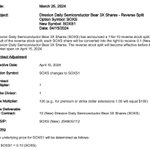
The regulators need to be watched as well. Below, a clip from a story yday from the top regulator in South Korea who expresses regret about the Frankenstein that has been unleashed. I would argue that the leveraged ETF providers in the US are vulnerable to litigation. Below a snapshot of the table from the SNXX prospectus. It shows the standard matrix of simulated performance of the lev product versus the underlying at different vol levels.
It is beyond ridiculous and deceitful to include 10 realized vol in this table. You know what assets are currently 10 vol? The TLT. It's daily moves have generally been around 30-80bps a day for the last month. Sandisk regularly has moves well north of 10% on a single day.
The realized vol table for the 2x on SNDK should start at 50 and run to 150. It looks much different - that is, much worse - when you do that.
tradretfs.com/hubfs/SNXX/SUM…


Walter retweeted
Poorly paraphrasing a locked account, the problem with buying things like Sk Square because they're at a discount is that when there's good news the degens buy Sk Hynix and the cheap bastards you're in Sk Square with sell because it's too expensive. Maybe works longer-term but then you might need to hold through the down cycle.
Walter retweeted

BETA-ARBITRAGE RETURNS AND STOCK MARKET BUBBLES
Beta arbitrage, or “betting against beta,” is a strategy that invests with leverage in low-beta stocks and hedges the resulting beta risk with a smaller short position in high-beta stocks. Andrea Frazzini and Lasse Heje Pedersen (2013) have written about this strategy extensively.
When beta arbitrage loses money is an interesting question. There are two main environments in which beta arbitrage produces losses. The first is when banking balance-sheet constraints become more binding and money gets unexpectedly “tighter.” In those situations, the stock market declines, and low-beta stocks decline more than their ex-ante betas would suggest.
The second loss scenario for beta arbitrage is a rapidly inflating stock market bubble. In a rapidly inflating stock market bubble, the market goes up, and the high-beta stocks go up even more than their ex-ante betas would suggest.
Why is that? As investors abandon present-value discipline, sideline investors rush in, and the market attains extreme overvaluation (bubble steps 4, 5, and 6), the bubble stocks begin driving the whole market. This bubble inflation, in turn, causes the bubble stocks’ returns to be high and their already high betas to increase further. The beta-arbitrage strategy that hedges non-bubble-stock longs with bubble-stock shorts loses money in this process.
We can also invert the process. If the beta-arbitrage strategy has recently lost money in an up market, the probability of a bubble is higher, ceteris paribus. The graphs below from AQR’s site, augmented with some SPLV and SPHB ETF returns, show clearly how the beta-arbitrage, or BAB, strategy lost a ton of money during the late-1990s telecom-media-technology bubble.
So far, we are not seeing similar extreme beta-arbitrage losses in the current bull market, making it, in my subjective opinion, less likely that we are deep into bubble territory yet. (A caveat: I just half-assed the last couple of months of returns from ETFs. Better data will come with their next update.)


THE LIFE CYCLE OF A BUBBLE
1. A genuine advancement creates real productivity gains. A real technological or economic improvement increases productivity and leads to genuine revenue and earnings growth.
2. Stock prices leak into reported profitability. Rising stock prices improve reported earnings, financing conditions, collateral values, and perceived business performance.
3. Reported profitability drives real investment. Companies increase hiring, capital spending, construction, expansion, and speculative investment because of their own or their customers’ reported profitability.
4. Bubble beliefs and abandonment of present-value discipline. Investors stop focusing on discounted cash flows and begin relying on continuing gains from the greater fool theory, believing they can sell later at a higher price.
5. Inflows from sideline investors. Previously cautious investors enter the market in large numbers. New money from existing and new investors participation drive prices higher.
6. Extreme overvaluation. Prices rise far above historical normal multiples of reported fundamentals, even ignoring the fact that reported fundamentals have been driven by rising stock prices.
7. Issuance. Companies take advantage of high valuations through IPOs, secondary offerings, stock-based acquisitions, SPACs, and insider selling.
8. Exhaustion of inflows. The flow of new investors starts shrinking while existing investors approach their risk and leverage limits. Volatility and dispersion grow and gains become less uniform across stocks.
9. Earnings disappointments from slowing price appreciation. As stock prices stop rising rapidly, the earlier boost from higher valuations into earnings weakens or reverses. Companies begin missing expectations.
10. Stock-price collapse with high volatility. Confidence in both the fundamental growth and in the greater fool theory break down and prices fall sharply. Volatility rises further as leverage unwinds.
11. Bear-market rallies and progressively greater exhaustion. Bargain hunters and frustrated latecomers repeatedly buy the dips, creating violent temporary rallies that fail. Markets make lower highs and lower lows.
12. Capitulation, abandonment, and normalization. Bubble participants eventually give up in disgust or exhaustion. Volatility falls, valuations normalize, and the market returns to more ordinary behavior.
Walter retweeted
Fama-French short-term reversal performance has really deteriorated as a factor and recently flipped.
Long last month's top decile winners has now turned into a winning strategy, long last month's worst decile losers has been a losing strategy since the 80s.
The surge in top decile winners might be an exuberant anomaly? It also happened just before the dotcom crash.


