

Windward is the leading Maritime AI™ company, delivering mission-grade all-source operational intelligence across the maritime domain.
Washington, D.C.
Joined October 2014
- Tweets5.1K
- Following915
- Followers11.9K
- Likes1.5K




Pinned Tweet
Windward expands into Maritime Visual Intelligence with acquisition of Azimut AI.
The newly added sensing layer identifies and fingerprints vessels in real time at maritime chokepoints and ports, enabling the visibility of vessels even when they go dark to evade detection.
Read the full press release: okt.to/Y3n1XF

Cocaine made up more than half the weight of October's maritime drug seizures.
Windward MIOC's latest counter-narcotics report covers where seizures were concentrated, how drugs were concealed, the high-risk vessels we flagged, and what to watch next. okt.to/2TaiZI

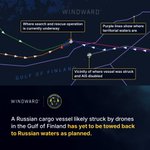
A U.S.-sanctioned Russian cargo vessel, Sparta II (IMO 9160994) used to transport military cargo drifted into Finnish territorial waters off Loviisa after it was likely struck by drones in the Gulf of Finland, on November 21, en route from St Petersburg to Kaliningrad.
A rescue operation is underway and a fire aboard has yet to be extinguished. Sparta II’s engines were said to be inoperable and its crew evacuated. Plans to tow the vessel from Finnish waters to the Russian search and rescue area overnight on Saturday, November 21 have yet to eventuate.
Ukraine has not confirmed the attack, which presents an extraordinarily sensitive political predicament for the Finnish and Estonian governments as Russia’s war with Ukraine spills into nearby waters.
The 8,194 dwt vessel has shuttled between St Petersburg and Kaliningrad for the past 12 months. Russia’s TASS agency reported it was carrying “paints and varnishes”, while Finland’s coast guard told local media the contents of the containers were “a mystery”.
Sparta II is owned by Russia’s OBL Shipping LLC (Oboronlogistika), the transport company of Russia’s defense ministry, and has been sanctioned by the U.S. since May 2022.
Sparta II’s AIS is disabled, but Windward’s tracking shows two sanctioned Russian salvage and rescue vessels, Murman (IMO 9682423) and Spasatel Karev (IMO 9497531), nearby, along with one Finnish tug and one Estonian tug. All are within Finland’s territorial waters, some seven nautical miles from where the attack happened.
There are conflicting reports on whether Sparta II was in Russian or international waters when it was reportedly struck by two drones. Finland has previously seized two Russia-linked vessels suspected of cable sabotage, Eagle S (IMO 9329760) and Fitburg (now Finex) (IMO 9250397).

A North Korean cargo ship slowed to a crawl over two subsea cables between Japan and South Korea.
The ship, a U.S.-listed North Korean coal exporter, held below 3.5 knots for 2.3 hours, as low as 1.2 knots, over the TPE and EAC-C2C cables. No other ship nearby slowed, and on its two earlier passes it held 6 to 8 knots.

Sanctioned in December 2022 over human rights abuses at sea, Pingtan Marine Enterprise and chairman Zhuo Xinrong are still fishing the Arabian Sea.
24 of their vessels are back for the new squid season, with fishing operations up from 745 to 1,086 in October.
okt.to/SDeoh6

Windward retweeted

Iran doesn't need a tanker “blitz” from Kharg Island to challenge the US blockade, reports @WindwardAI
Iran can test US enforcement without staging a highly visible and vulnerable convoy.
The real question is whether Washington is prepared to stop them and risk escalation.

🚨 Iran says tankers anchored off Kharg Island will sail for the Gulf of Oman to break the U.S. blockade.
But Iran does not need those tankers to challenge the blockade line.
Windward MIOC counts 31 laden sanctioned tankers already past the Strait of Hormuz, most of them about a day’s sailing from the line.
A convoy from Kharg remains possible. Windward multi-sensor data identified 16 tankers at anchor off the island on 17 November, and they would have to transit the Strait of Hormuz before reaching the blockade line, which runs from Ras al Hadd to Ras Jiwani.
The 31 are already outside the Strait, all seen in position between 13 and 20 November. Four are crude tankers carrying an estimated 4.9 million barrels, each confirmed on satellite imagery.
The closest is the Suezmax TOUR 2 (IMO 9364112), off Chabahar and about 3 to 6 hours from the line. The other 27 carry LPG or refined products, and 20 of them are at the Shinas and Sohar anchorages.
Iran has used LPG tankers to test the line before. In September and October, Windward tracked 11 Iran-affiliated LPG tankers trying to cross it.
The fastest way for Iran to challenge the blockade is with laden tankers already outside the Strait of Hormuz, and 31 are in place.


Sanctions-evading tankers are moving to a new anchoring and ship-to-ship area outside Malaysia’s EEZ to avoid new regulations.
Since 2020, as many as 100 elderly, stateless tankers at any one time have gathered in the EOPL off Malaysia for floating storage and ship-to-ship transfers of Iranian, Russian and Venezuelan oil, many of them going dark or manipulating their GNSS signals.
Since mid-September, a second area some 50 nautical miles north has evolved in international waters, beyond Malaysian oversight. Windward identified 25 falsely flagged tankers and several without a valid IMO number among the 30-plus ships at anchor there last week, plus four sanctioned tankers with AIS off, spoofing their location elsewhere.
Malaysia’s new EEZ rules took effect at the end of July, but there has been little evidence of enforcement.
okt.to/slUrQt

Iran’s floating crude storage off Malaysia has fallen from about 70 million barrels in January to 3.8 million at most today.
Windward MIOC puts Iranian floating storage at Malaysia’s EOPL anchorage at about 70 million barrels in January and about 30 million by late March.
On July 12 Windward tracked 9 sanctioned Iranian tankers dark at EOPL, holding about 14.6 million barrels. Today only 2 Iran-linked VLCCs there last reported laden: HEDY in June and FIONA II in September.
The tankers that carried that crude have not gone back for more.
Today 20 sanctioned tankers, 18 of them VLCCs, sit at ballast draught off Sri Lanka, where we first flagged them on August 30. Satellite imagery from this morning shows a tanker at 19 of their 20 AIS positions. That is about 38 million barrels of empty capacity waiting for the U.S. blockade to open.
Windward MIOC assesses that the first breakout attempt will likely come from the 4 laden crude tankers now between the Strait of Hormuz and the blockade line, about a day’s sailing away.
As the stock in Asia runs down, Iran needs to move crude, and a larger crude push becomes more likely.


🚨 Iran says tankers anchored off Kharg Island will sail for the Gulf of Oman to break the U.S. blockade.
But Iran does not need those tankers to challenge the blockade line.
Windward MIOC counts 31 laden sanctioned tankers already past the Strait of Hormuz, most of them about a day’s sailing from the line.
A convoy from Kharg remains possible. Windward multi-sensor data identified 16 tankers at anchor off the island on 17 November, and they would have to transit the Strait of Hormuz before reaching the blockade line, which runs from Ras al Hadd to Ras Jiwani.
The 31 are already outside the Strait, all seen in position between 13 and 20 November. Four are crude tankers carrying an estimated 4.9 million barrels, each confirmed on satellite imagery.
The closest is the Suezmax TOUR 2 (IMO 9364112), off Chabahar and about 3 to 6 hours from the line. The other 27 carry LPG or refined products, and 20 of them are at the Shinas and Sohar anchorages.
Iran has used LPG tankers to test the line before. In September and October, Windward tracked 11 Iran-affiliated LPG tankers trying to cross it.
The fastest way for Iran to challenge the blockade is with laden tankers already outside the Strait of Hormuz, and 31 are in place.
More shipping is moving through the Strait of Hormuz than earlier in the war, with significant help from U.S. forces, but transiting is still a dangerous proposition.
Windward CEO @AmiDaniel1 joins @WarOnTheRocks to discuss the situation in the strait, what it means for shipping and global oil prices, and the risks building in Bab el-Mandeb.
okt.to/4cWOA8

🚨 Iran says tankers anchored off Kharg Island will sail for the Gulf of Oman to break the U.S. blockade.
But Iran does not need those tankers to challenge the blockade line.
Windward MIOC counts 31 laden sanctioned tankers already past the Strait of Hormuz, most of them about a day’s sailing from the line.
A convoy from Kharg remains possible. Windward multi-sensor data identified 16 tankers at anchor off the island on 17 November, and they would have to transit the Strait of Hormuz before reaching the blockade line, which runs from Ras al Hadd to Ras Jiwani.
The 31 are already outside the Strait, all seen in position between 13 and 20 November. Four are crude tankers carrying an estimated 4.9 million barrels, each confirmed on satellite imagery.
The closest is the Suezmax TOUR 2 (IMO 9364112), off Chabahar and about 3 to 6 hours from the line. The other 27 carry LPG or refined products, and 20 of them are at the Shinas and Sohar anchorages.
Iran has used LPG tankers to test the line before. In September and October, Windward tracked 11 Iran-affiliated LPG tankers trying to cross it.
The fastest way for Iran to challenge the blockade is with laden tankers already outside the Strait of Hormuz, and 31 are in place.
Local authorities reported to UKMTO at 1645 UTC Nov 18 that a tanker was struck by an unknown projectile 6 NM north of Khasab, the third attack within 13 NM north of Khasab since Nov 16.
The engine room was hit, the crew is safe, and damage is unknown. The clustering off Musandam likely shows Iran concentrating on outbound traffic at the narrowest point of the Strait. Hormuz transit flows are continuing at regular rates, with six transits identified on the 18th. okt.to/QkmTNj

Media reports counted as few as 2 LNG carriers leaving Hormuz in the week ending Nov. 17, against an average of 8 per week over the previous two months. Windward MIOC Hormuz crossings data shows that part of the LNG flow has gone dark.
Multi-sensor satellite imagery combined with AIS monitoring identified 5 LNG carriers that crossed Hormuz outbound in the same week with no AIS in the strait. Their AIS stayed off for between 48 and 286 hours, and some only resumed transmitting well outside the Gulf, in the Gulf of Oman, the Arabian Sea, and south of Sri Lanka.
These are not shadow fleet vessels. Four of the 5 are operated or commercially controlled by Gulf state energy companies. With attacks rising, LNG operators appear to be switching AIS off for the transit to reduce targeting risk.
The LNG carriers are part of a wider pattern, with the same 3 daily reports showing 51 dark Hormuz crossings.
AIS-only counts now under-report LNG supply out of the Gulf, and market and security assessments built on them will overstate the disruption.
Twelve sanctioned tankers have delivered an estimated 3.26 million barrels of fuel to the Houthi-controlled Ras Issa terminal, along one line from Russia via Suez and one from Iran via Hormuz.
Eleven had AIS off and five broadcast false positions. Across Hormuz, only 42% of vessels are transmitting AIS. A view built on transmissions alone would have shown one tanker. Windward identified many more. okt.to/OBzVwJ

Most government professionals went through 2026 focused on one theater or mission. This briefing takes the wider view.
Three former U.S. Intelligence Community leaders will cover the conflicts that shaped maritime security this year and what the U.S. and its partners need to prepare for in 2027:
• VADM (Ret.) Robert Sharp, former Director of NGA and Commander of ONI
• Susan Kalweit, former Director of Analysis at NGA
• Matt Mueller (@MMueller1098), former Senior Intelligence Analyst at DIA
Together they bring more than 80 years of service. The briefing is unclassified and shareable. okt.to/96GaSx

31 sanctioned tankers at Russian ports have switched to the Russian flag in the past six months, after EU and UK naval boardings.
Windward MIOC’s November shadow fleet report covers the reflagging trend, the new tanker clusters we identified, and the sanctioned share of Russian oil loadings.
Read the report: okt.to/YxF1lQ

A Thai fuel tender has sunk off Sattahip with five crew missing and about 280,000 liters of diesel aboard. No leak is confirmed, but GISTDA modeling puts about 9.8 hectares of coral near Prachuap Bay in the drift path.
Two nearby vessels moved toward the site before the navy was alerted. okt.to/Dtr23l

1
1
796
Five tankers struck near Hormuz since November 11. Windward’s remote-sensing intelligence shows VLCC Dominica Prosperity still smoking two days after it was hit off Ra’s al Khaymah.
This highlights Iran’s continued strategy of maritime attrition, and it is unlikely to ease unless diplomatic conditions change. okt.to/zPv3mV

A sanctioned Russian-flagged tanker has looped for five hours inside the Netherlands’ planned 20 GW offshore wind zone, ending on the NOGAT gas pipeline.
TSOIZIT (IMO 9412452), EU- and UK-sanctioned, slowed below 3 knots from 09:04 to 14:19 UTC on November 16, with no port call or meeting and no weather explanation.
This is presence, not confirmed survey activity, but it potentially points to seabed collection and to observing the Dutch survey work already under way in the zone.
It comes days after the Dutch navy escorted four Russian ships, including a tanker, through the North Sea on November 4-10.
More from Windward’s MIOC: windward.ai/maritime-intelli…

Six merchant ships off Bulgaria and Romania have been struck by drones in attacks attributed to Russia between November 13-17, further imperiling Ukrainian grain exports from the Black Sea.
Nov 17: LPG carrier Gas Husky (IMO 9507764), sunk about 50 nautical miles east of Byala, per Bulgaria’s Ministry of Defence
Nov 16: cargo ship Betul 8 (IMO 8817198), sunk
Nov 14-15: tanker Ali Najafov (IMO 9175195)
Nov 14: bulker Marsol (IMO 9109512) and tanker Evia Petrol V (IMO 9358503)
Nov 13: cargo ship Larissa 1 (IMO 9154268)
Russia has expanded drone attacks from Ukrainian ports to corridors off Bulgaria and Romania, indiscriminately hitting ships on the route to Ukraine’s Danube ports. War risk marine insurance additional premiums (measured as a percentage of hull value) have reportedly risen above Middle East levels.
okt.to/PM3Ctm

Windward is proud to be named Bronze winner in @TheDrum Awards for B2B, in the Effectiveness: Use of Research/Insights category.
Through our all-source maritime intelligence, Windward delivered clarity and real-time insights, serving as a trusted source of truth during a complex, dangerous operational environment.
Full results here: okt.to/dKhFTZ
3
762
Russia’s diesel exports doubled after U.S. fuel sanctions were lifted, yet U.S.-bound cargoes are idling in the Atlantic.
Three of the tankers have been sanctioned as part of Russia’s shadow fleet, adding political, compliance and enforcement challenges for buyers, Windward’s @Michellewb_ notes via @thedailybeast.
okt.to/hC1UxN
