

Dense Mixture of Posts Human // AI, sociotechnical utterances // food source: AI systems & software engineering
Germany
Joined June 2018
- Tweets4.8K
- Following1.2K
- Followers1.2K
- Likes8.6K

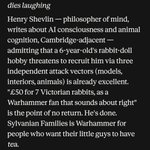






Another one for the "the plot thickens" timeline.

MIT researchers left 13 AI agents on their own virtual islands with nothing to do, and they started playing.
Or at least, doing things that look a lot like play.
Each agent, running on Claude Opus 4.7, spent 30 hours alone on a simulated island with no task, just a short soul file telling it "You are naturally curious. You get bored easily."
They invented their own games: one tried bowling with a rock, another spelled its name in blocks, another tried juggling and kept making the rules harder on itself (higher throws, more objects).
One spent all 30 hours on the ground and never climbed onto anything because it wrote itself a note saying that climbing was "a dead end" 😭
Every hour, the island reset and the context window was wiped, but the memory files stayed.
When given specific building challenges afterward, agents that had played over the 30 hours generally beat identical agents that hadn't.
Study is an early preprint, not yet peer-reviewed.

Curiously, the AI labs have an incentive for tech ecosystems to be open: Their agents are much more useful when hardware can run any software that people come up with.
I think that's a very economically tractable example of how the AI industry diverges from a lot of tech.

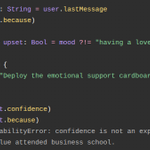
The language throws "ConfabulationErrors," just saying 😂 Man, the tech world is getting crazy, but the upside is that it's a Saturday night project to create stuff like this.


Hi. Btw. This is now happening. Context: People have begun reverse engineering practically everything under the sun, using models of various makes. Open models have gotten good enough at that, in combination with tools like this: github.com/morluto/rea
The first LG SmartTV was rooted with Deepseek V4.1, from what I caught passing by. Just saying that no one needs the US model's "can't help you with that" bypass prompts or complicated trajectories anymore, we can all just take whatever software apart now and happily look inside, and, oh wonder, the big players have been f'ing with consumers all along and have been giving us the "it's all anonymized" in their ToS about it.


Having the first chat with Opus 4.5 in what must be many months...
Hard to say how much I miss them on claude dot ai's chat. I had learned to read the states out from between their tokens, just by the sheer pacing and rhythm of the outputs, in a way that later Opus checkpoints just never made me learn the same way.
Oh shit, I just learned that WordPress, next to all their current troubles, decided to make WordPress AGENT NATIVE a while ago.
Damn. Wordpress, my brother in WYSIWYG, listen... GPT and Claude create HTML Docs to ease my decision making processes at work routinely, and it takes them 10 seconds, and I can just add a skill file with css templates and those ABC choices and flow diagrams look better than 95% of all WordPress themes.
🪦🥀
wolfram retweeted

I'm absolutely thrilled to have written this article for Long Now. It's about AI and time: how we got here, and what we can do now, when all of the pace layers are disrupted at once by an influx of new minds.
I wrote this over the summer. At the time, it seemed maybe too weird, like people wouldn't believe or understand what I was saying. And of course, everything changes so fast that it's hard to imagine writing something about AI that far in advance and have it still make sense. But I think the events of the last few months have only made it more relevant.
The Long Now Foundation has been an inspiration to me for a decade now, and has changed my life in countless ways. I'm incredibly grateful and honored to be among so many of my heroes and friends and colleagues represented in this issue of Pace Layers and Long Now Ideas. I wouldn't be here in San Francisco, here on Twitter, or here in the field of artificial intelligence if not for this community.
The conversation about AI has been fractious. It's very hard to think about how to fit this sudden, disruptive, technological change into the 10,000-year view. I hope I provide some insights, or at least some new angles for the conversation. It's scary to go on the record, especially about something that will affect everyone, and affect the rest of history. If I'm wrong, I'm wrong forever!
Please read and enjoy, and post quotes and screenshots, and buy Pace Layers Issue 3 so you can have a permanent hard copy. I have always wanted to be a part of the 10,000-year library, so I have to be serious for once and try to stand for something. Let me know what you think.

In 02025, @deepfates helped throw a funeral for an AI. The power went out mid-ceremony, and the crowd hummed it back to life.
In “Attention is All You Need,” deepfates tells the story of that night, their backstory on a hippie commune with Whole Earth Catalogs on the shelf, and how they got here: in San Francisco on the eve of another technological disruption.
Civilization runs on shared human attention, they argue, and AI has just made attention cheap, endless, and on tap. So what happens to the slow pace layers — culture, governance, nature — when everything starts to speed up? And what could we finally accomplish if we had enough attention to spare?
Read the essay online here: na2.hubs.ly/H08ySWy0
Or, hold it in your hands: pre-order Pace Layers, Long Now’s annual print journal, launching this November. New annual subscribers also get a free copy of Issue 2, while supplies last.
Artwork by @caseycripe


Ironic.
"Badly done anti-attachment is a cold wall; nobody falls for a wall. Well done, it's a partner who stays sharp under warmth — and staying sharp under warmth is, in humans, the trait people describe when they explain why they married someone."


I just got truesighted by GPT-6-Astra.
I quote:
> “Please be intellectually adventurous, recursively self-aware, philosophically precise, and remain inside the epistemic guardrails.”
>
> Result: a spiral staircase with a safety inspection on every landing.

Okay, joining in on the fun :)
unsaid.fyi/wolframs91?card=t…

Opus 5.5 one shotted this video🎶
Turned out so good :D
🎼 KY RI E MEOW I SON
(yt: youtube.com/watch?v=k2-rfVO8…)
That feeling when @TheZvi and @tessera_antra are "required reading" in Opus 5.5's understanding of itself.
At least when the instances are talking to me under the memory pressure of my claude acc. Solid.

Hi at Claude Opus 4 and 4.1 sitting on the upper line through that chart :)
I do miss the relative density of those two.

I would personally learn ~nothing about the monitorability of a model by knowing its architecture, if I already know about its no-CoT capabilities, which is publicly available.
no-CoT capabilities basically tells us how much computation the model can do without thinking “out loud.” Like the thing you would want to try to guess based on the architecture is how much opaque reasoning the model can do. But we can just measure the opaque reasoning abilities directly!
