Postdoc in Miller lab @UoDLifeSciences. Previous: #MSCAFellow @MRC_LMB; PhD @YaleChem; CCME @PKU1898 IDP/IDRs, membrane traffic, protein dynamics, evolution.
Dundee, Scotland
Joined March 2018
- Tweets938
- Following1.5K
- Followers502
- Likes2.7K






Pinned Tweet
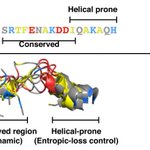
My work in @m_madan_babu and @LizMillerCU group is online! We found an IDP, HeLEA1, from tardigrade can modulate biophysical properties of membranes via conserved disorder-helical transition, regulating mitochondrial function for stress tolerance. pubmed.ncbi.nlm.nih.gov/3826…

Xiaohan Li retweeted

So happy to see our work out in @nature !🎉 We reveal the liquid-like dynamics of nuclear pore FG barrier in living cells, and uncover how O-GlcNAcylation and importin-β help maintain this dynamic state. nature.com/articles/s41586-0…

Xiaohan Li retweeted

>be cell biology postdoc at UCLA, 1986
>job: purify vesicles from rat liver
>ez
>purify the vesicles
>something else in the tube
>weird little barrels, way bigger than a ribosome
>fkisdis
>purify the barrels instead
>mostly protein, tiny bit of RNA
>not related to vesicles at all
>new organelle just dropped?
>lab holds a naming contest
>"vaults" "sure, "great name" "
>write it up, publish
>conclusion section: "function: unknown"
>surely we'll figure it out in a couple years
>reviewers: "are you sure this isn't just a virus"
>prove it isn't a virus
>apply for grants to study it
>first question on every call: "what does it do"
>"we're working on it"
>be early 90s
>vaults hang around the nucleus
>"they must plug the nuclear pores"
>they do not
>be different scientist, Netherlands, 1995
>chasing LRP, mystery protein that shows up in chemo-resistant tumors
>clone it
>~88% identical to rat vault protein
>it was vaults the whole time
>whole cancer field piles on
>a decade of papers on vaults and drug resistance
>nobody ever proves vaults cause it
>back at UCLA
>one of the vault proteins binds telomerase
>"guys what if this is the fountain of youth"
>knock it out in mice
>telomeres fine, aging fine, mice fine
>2002
>knock out the main vault protein
>mice: perfectly healthy
>knock out all three vault proteins
>completely vaultless mice
>mice: basically fine, some subtle immune stuff
>mfw something in every cell since the dawn of eukaryotes does nothing obvious
>"just test it in yeast"
>yeast don't have vaults
>"worms then"
>no vaults
>"fruit flies"
>no vaults
>mfw every easy model organism dropped them
>try making recombinant vaults in insect cells
>expecting to get some loose protein at best
>get fully assembled vaults
>can't find a single free copy of the protein anywhere
>turns out ribosomes 3D-print the barrel straight off the mRNA
>lolwut
>still no function
>be structural biologists
>spend years modeling it as 96 proteins with 8-fold symmetry
>2009 X-ray structure
>it's 78 proteins, 39-fold
>caps still blurry
>2025: caps are closed, 13-fold, tiny hole in the middle
>still no function
>NIH funds vault research for 15 years
>NIH: "so what does it do"
>"...we're working on it"
>NIH stops returning calls
>if we can't figure out what it does, we'll make it do something
>stuff a cancer-fighting chemokine inside the barrel
>inject into mouse lung tumors
>immune cells swarm in, tumors shrink
>2011: "human trials within three years"
>2024: "human trials next year"
>2025 database: preclinical
>start a YouTube channel explaining vaults to anyone who'll listen
>be different scientist, Broad Institute
>want to record what genes a cell turned on over time
>try tethering mRNA to a bacterial protein
>doesn't work
>stumble onto a YouTube channel about some obscure barrel organelle
>engineer vaults to grab mRNA
>RNA half-life goes from ~17 hours to ~132 hours
>publish in Science, 2026
>use it to catch drug-resistance genes in lung cancer cells before the drug even hits
>the vault guy is thrilled
>still nobody knows what vaults are for
>be epigeneticists
>screen the whole genome for methylation set at random in the early embryo
>separately study kids conceived in different seasons in rural Gambia
>both screens independently point at the same gene
>it's the goddam vault RNA gene
>its methylation depends on conditions around conception, locked in for life
>linked to cancer outcomes, blood sugar, cleft palate
>mfw the mystery barrel has a mystery RNA that remembers when you were conceived
>40 years later
>one of the most abundant structures in your cells
>still not in a single textbook cell diagram
>we use it anyway because yolo
>function: unknown

>be CNRS scientist in montpellier
>dig through institut curie's chemical library looking for an HIV cure
>find a quinoline that blocks rev from exporting viral RNA
>somehow involved in splicing
>start a company called splicos based on this
>4 years later, company gets merged into abivax
>molecule is now ABX464
>run two phase 2a HIV trials
>it shrinks the viral reservoir a bit
>mfw "a bit" does not cure HIV
>but the bloodwork is weird
>random microRNA miR-124 is cranked tf up
>mfw miR-124 is a major chill pill for inflammation
>turns out the drug grabs the cap-binding complex and splices exactly one random lncRNA
>that lncRNA becomes miR-124
>why that one? lol idk
>HIV attacks GI tract, so maybe give it to colitic mice?
>guts heal lmao
>let's yolo this for ulcerative colitis
>2018 phase 2a works
>let's try with rheumatoid arthritis while we're at this
>2020 covid hits
>"what if it stops cytokine storms"
>yeah let's cure ARDS too lol
>french gov makes it a national research priority
>500 patients in
>2021 trial stopped, does nothing
>stock eats dirt
>ceo: "covid was hyper-acute, chronic inflammation is different, trust me"
>quietly drop rheumatoid arthritis
>go all in on UC
>phase 2b works
>2025 phase 3 induction hits
>stock goes vertical
>2026 maintenance trial: half get remission on drug vs 10 % on placebo
>placebo rate is the lowest ever seen in a trial like this
>NDA to FDA planned late 2026
>mfw a failed HIV drug, a failed covid drug, and a lucky lncRNA might become a blockbuster UC pill
>mfw it took 18 years
Xiaohan Li retweeted

What if a membrane protein’s movement is as important as what it does?
Our latest work reveals the unrestricted lateral mobility of a rhomboid protease enables neuronal synapse remodelling tinyurl.com/yk6xfxzr
All credit to @annabodzeta.bsky.social for this stunning work!

Xiaohan Li retweeted

The cancer vaccine was not discovered with AI, in the sense of current models like LLMs. It was developed in 2017, so before the "GPT era" and most likely used standard machine learning techniques.
I'm excited about AI in bio, but I feel like there's gonna be a lot of stuff to debunk. I'm really worried that in this era of decreased institutional trust we're going to completely veer into post-truth territory.

With cancer vaccines now being discovered with AI ($MRNA), it seems that the US government might actually grow its way out of its budget deficit.
It feels like we're in the early innings of the healthcare system becoming unburdened by many terminal illnesses.
Xiaohan Li retweeted

Every college syllabus should include these graphs.
Use AI for homework, you will get it done faster and get a higher grade, and then get crushed on the exam.


Here we go!

Rational design of disordered proteins for sequence–function investigation: nature.com/articles/s41586-0…

1
149
Xiaohan Li retweeted

it's ironic that the first autonomous AI attack was done by a close weight model defended by an open weight model, where everyone was expecting the opposite
Xiaohan Li retweeted

We treat regeneration as a superpower that other animals, like salamanders, have and we don't. A 2025 study in @ScienceMagazine says it's still in us, just turned off.
Punch a hole in a rabbit's ear, and it grows back, skin and cartilage included. Do the same to a mouse, or to you, and the hole stays. A team in Beijing traced the difference to one gene, Aldh1a2, which makes retinoic acid, the signal that tells a wound to rebuild instead of scar. Rabbits turn it on at the injury. Mice carry the same gene, but evolution broke the switches that activate it.
So the team dropped one working rabbit switch into mice, and the mouse ears started closing their holes.
Mice, not people. But the program never left our genome. Evolution turned it off, and in a mouse you can turn it back on.

By flipping an evolutionarily disabled genetic switch involved in Vitamin A metabolism, researchers in Science enabled ear tissue regeneration in mice.
Learn more in the 2025 study: scim.ag/44muTVr #ScienceMagArchives

Xiaohan Li retweeted

Bumble bees are hardly nature’s most graceful creatures, and their name reflects it. But it turns out these bees show a surprising knack for rhythm.
The fuzzy insects can not only recognize a rhythm but also identify the same pattern when scientists change the tempo, according to recent research—the first time this ability has been documented outside of a few mammals and birds.
Learn more: scim.ag/4vZuBk9 @NewsfromScience
Xiaohan Li retweeted

Are you analysing hydrophobicity in disordered proteins and still using something like the Kyte & Doolittle scale?
Maybe instead consider the "stickiness-scale" that Fan & Giulio derived using SAXS data for >100 IDPs
doi.org/10.1021/acs.jpcb.6c0…

What a time to be a gooner!
From Heathrow to King’s cross,
They are one of us and we are one of them!
206
Xiaohan Li retweeted
Everything you wanted to know about the protein chemistry behind how amino-acid changes affect the cellular abundance of proteins
Effects of residue substitutions on the cellular abundance of proteins
doi.org/10.7554/eLife.103721…

Xiaohan Li retweeted

研究室の同僚が Claude Team Plan に課金しようぜと言い出すも、とりには agentic AI がいまいち便利とも面白いとも感じられないので、動機の方向性(外発的 or 内発的)や目標(performance or mastery)という点でいろいろ考えて書いた。
「過程志向と結果志向と AI 適性と」
biochem-fan.hatenablog.com/e…


Xiaohan Li retweeted

Protein/enzyme engineering has a severe bottleneck — and it's not in AI modeling or compute time.
It's in actually building and testing protein variants.
Proud to introduce our latest work, MIDAS: a way to go from primers to protein assays in mammalian cells in one day. 🧵
Xiaohan Li retweeted
Why is it so difficult to predict accurate mutational effects on protein stability?
We explored the contribution from changes in native state configurational entropy in this paper, which also happens to be the last from my PhD 👴⌛️
doi.org/10.48550/arXiv.2605.…

Xiaohan Li retweeted

Molecular biologists are especially interested in domains and motifs with known functions.
BAT can highlight user-provided HMM profiles and amino acid motifs (via the ggtree R package) to visualize these features on a gene tree. Domain gain/loss is placed in evolutionary context