
#AI engineer; #novelist; author of #TheKingAndTheSage #InOurOwnImage & #CyberRepublic; 🇬🇧🇬🇷
Earth
Joined September 2009
- Tweets3.4K
- Following570
- Followers2.3K
- Likes3.2K





Pinned Tweet
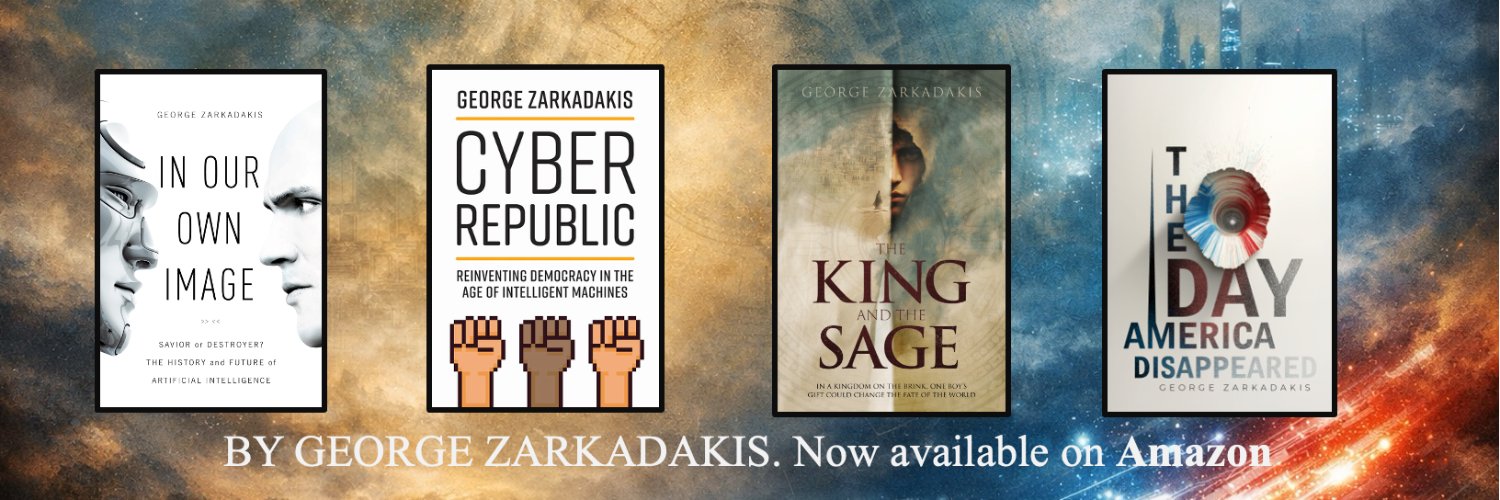
My new book "The Day America Disappeared" is now available on Amazon: a.co/d/0byZdyf2
"The Day America Disappeared" is a daring collection of twelve short stories that travel across centuries, continents, and imagined futures—where technology, myth, and human obsession collide.
From medieval Samarkand to a ruined Earth in the year 2525, from Byzantine Constantinople to the Mexican desert, these stories explore ambition, grief, power, and survival in worlds that feel both strange and unsettlingly familiar. A visitor from Venus disrupts suburban life with impossible inventions. A social-media influencer is drawn into a death cult intent on reshaping the planet. Genetically engineered animals fight for freedom, while a reckless prank unleashes texts that mutate reality itself.
Artists chase lost masterpieces, revolutionaries remember vanished nations, and machines glimpse truths humans were never meant to know. Whether probing artificial intelligence, environmental collapse, political violence, or the persistence of love beyond death, each story offers a sharp, imaginative lens on what it means to be human at the edge of change.
Bold, haunting, and darkly playful, "The Day America Disappeared" is a speculative journey through the fragile architectures—technological, social, and emotional—on which our worlds are built, and how easily they can unravel.
Now available on Amazon: a.co/d/0byZdyf2

My interview on @hist_uncensored by @bianca_nobilo where we discuss the history of AI and what the Hugging Face incident can tell us about the threat of extinction by AI superintelligence...
youtube.com/watch?v=hqMPkB2n…
2
105

Wha I like about this video clip is that it summarizes how the public feels about AI.
Expect these feelings to reflect into politics as young unemployed graduates start voting for extremists on the far ends of the political spectrum...
109
My novel “The Island Survival Guide” was inspired by the sufferings of the Greek Romaniote Jews in WWII. Find out more at georgezarkadakis.com
@archeohistories

Long before Ashkenazi or Sephardic Jews ever set foot in Greece, a distinct Jewish community had already been living there for over 2,000 years, speaking their own Greek dialect and following customs found nowhere else in the Jewish world.
The Romaniote Jews trace their presence in Greece back to the Hellenistic era, predating both the later Sephardic arrivals after the 1492 expulsion from Spain and any Ashkenazi migration. Their spiritual and cultural center for centuries was Ioannina, a city in northwestern Greece, where they developed their own liturgical traditions, synagogue architecture, and even their own Judeo-Greek language. On March 25, 1944, the Nazis deported nearly the entire Jewish population of Ioannina, over 1,800 people, to Auschwitz, and only a small fraction survived. Today, the community numbers only a few dozen people, and the centuries-old Kahal Kadosh Yashan synagogue still stands, maintained largely for memory as much as for regular worship.
It's one of the oldest continuously documented Jewish communities in Europe, and also one of the most fragile survivors of the Holocaust's near-total destruction of an entire distinct culture.
There's something haunting about a 2,000-year-old tradition now surviving through just a handful of people and a carefully preserved building. The Romaniote community developed their own distinct Hebrew and Greek liturgical poetry tradition that survives nowhere else in the Jewish world today.
#archaeohistories

124
Watching @elonmusk at @TheEconomist I realized a common fallacy that befalls AI engineers. We equate humanity to intelligence and surmise that by increasing intelligence we can deliver a better future. We are mistaken. Humanity is mostly emotions. The backlash to AI is imminent.
1
94
A short film based on my story "Point Nemo" from my book "The Day America Disappeared". It tells the story of future synthetic animals called zooids trying to escape human persecution.
Get my bookd on Amazon: a.co/d/06dceRF7
90

A great overview of 2,200 years of uninterrupted Roman history, from the founding of Rome to the Fall of Constantinople by @lexfridman interviewing historian Anthony Kaldellis.
#Byzantium #NovaRoma #Constantinople #Greece #Rome

Here's my conversation with Anthony Kaldellis about the deep history of the Roman Empire in the west and the east (the Byzantine Empire). This was a truly fascinating conversation with a lot of wisdom for the modern world and for the future of human civilization. The Roman state lasted over 2,200 years. If we want to understand human nature, the modern world, and how humanity can flourish, it is valuable to study history, especially the history of why societies survive and why they collapse.
It's here on X in full and is up everywhere else (see comment).
Timestamps:
0:00 - Episode highlight
1:24 - Introduction
1:51 - The Roman Empire and the Byzantine Empire
5:49 - 2,200 Years of Roman History
26:12 - Power, violence, and civil war
47:27 - Edict of Caracalla
1:00:23 - Crisis of the Third Century
1:14:52 - Constantine and the new Roman Empire
1:26:53 - Christianity in the Roman Empire
1:52:21 - Fall of the Western Roman Empire
2:05:17 - Eunuchs, Taxes, and Power
2:30:24 - Emperor Justinian and wars of conquest
2:47:26 - The Arab conquests
3:07:01 - Why the Roman empire survived so long
3:33:08 - Lessons from history
178
Everyone says AGI is just a matter of bigger models and more compute.
I disagree.
Human-level AGI won’t emerge from conventional computers because intelligence isn’t enough. Genuine creativity requires consciousness—and without creativity, there is no true AGI.
My latest paper makes the case.
#AI #AGI #Consciousness
revistas.unsta.edu.ar/index.…
49
What if disease isn’t simply something to eliminate, but a breakdown in the complex cooperation that sustains life?
As breakthroughs in genetics, epigenetics, and AI reshape medicine, we need to move from reactive healthcare to proactive health management—focusing on prevention, adaptation, and long-term resilience.
READ MY ARTICLE @diplocourier for a provocative rethink of disease, treatment, and the future of health. 👇
diplomaticourier.com/posts/r…

53
Sagrada Familia, inspired by a bookseller and reimagined by a devout architect, has been 144 years in the making.... yesterday His Holiness the Pope led a beautiful, uplifting mass to celebrate the completion of the Jesus Christ tower, the tallest of 18 in the temple... enjoy...

This is a timely intervention by @FLI_org . It has become rather clear what the hyperscalers do: promise to replace human labor with AI so that companies "reduce cost", establish adoption and an oligopoly of 2-3 providers at most, then jack up their prices to - finally - make a profit. And let governments and society to pick up the tab for massive unemployment and destitution.
We must not allow AI to replace humans. AI should augment humans and make the more productive and better off.

We're on a bad path with AI.
But it's not too late to change course.
This is how we ensure a flourishing, human-led future, with people empowered - rather than replaced - by AI:
60
In my article @HuffPost I suggest that tech bros and associated gurus proclaiming the arrival of "General Artificial Intelligence" lack basic understanding of the philosophy behind computer science....
huffpost.com/entry/will-mach…

45
Greece has fully reconstructed the medieval palace of the last Eastern Roman Imperial family in Mystras, Peloponnese - not far from the ancient city of Sparta. This is where Constantine XI Paleologus, the last emperor, was crowned on 23 January 1449. Oral tradition has it that he was not crowned with the official imperial crown but with a garland of thorns, for he was about to bear - like Christ - the suffering of the last days of the greatest empire the world has ever known...


1
97
