

Archetype-Research Under the radar: 1. Small-caps 2. Datacenter supply chains 3. Undercovered companies
Plugged In
Joined September 2021
- Tweets3.9K
- Following295
- Followers11.7K
- Likes2.2K

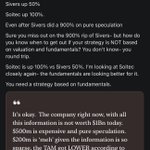




I pose a simple question to stimulate some dialogue and holy fuck its like I poked a hornets nest.
Bro comes at me with "What happened to real businessmen? Who are all these stock traders?"
Can we please just have discussion and not get so personal. You suggested they could sell the broadcasting assets (that make a loss currently) for 300-400m? They are on book value at 169m after being impaired every single year.
I asked- How many units EV/EBITDA does EVC need to be discounted to fairly account for its customer concentration risk- where most of its yearly growth (looking at yearly growth mr Roach)- came from.
I'm looking at the revenue drivers that lead to the growth in the business- the UNAMED Hong Kong gaming company. How is the unamed Hong Kong customer doing that accounts for 35% growth? Is that something that interests you?
Instead I should look at a trendline of revenue growth an extrapolate that into infinity?

God forbid you have a different opinion to the consensus 😂

is $EVC cheap or just optically cheap?
LFTO at EV/EBITDA 10- little customer concentration.
EVC at 7. massive customer concentration. And stalled growth.
AppLovin at EV/EBITDA 16. Makes sense.
At EVC 7x multiple. If a big customer stops spend you get a 30-40% gap down,
If they land a new customer it gaps up 30-40%.
Management still don't want to dispose their broadcasting assets- but they're wasting their focus on a non-core part of the business.
Looks fairly valued compared to their competitors. The valuation seems to account for the customer concentration risk and the growth volatility...
is $EVC cheap or just optically cheap?
LFTO at EV/EBITDA 10- little customer concentration.
EVC at 7. massive customer concentration. And stalled growth.
AppLovin at EV/EBITDA 16. Makes sense.
At EVC 7x multiple. If a big customer stops spend you get a 30-40% gap down,
If they land a new customer it gaps up 30-40%.
Management still don't want to dispose their broadcasting assets- but they're wasting their focus on a non-core part of the business.
Looks fairly valued compared to their competitors. The valuation seems to account for the customer concentration risk and the growth volatility...


And then who do you think is going to buy them out? Who wants more compute?
Yeah, you guessed it

Pretty much.
As of the past few weeks, debt markets have almost entirely shut off access to money for any company that doesn’t have substantial revenue independent of AI data centers.
SpaceX closed $40B of debt for GPUs, but we’re investment grade and have Starlink & launch revenue.
That means the 200+ neoclouds are going to see guppy-level death and consolidation. Some will make it through, but not many.
Am I being a schizo to think that this could be a Chinese government ploy to reduce profits going to Western Labs because the western Lab frontier models are becoming insanely powerful and China can't keep up so instead they try and reduce funding to Western Labs (by bringing inference costs down so much)?

IMO, today was another DeepSeek moment
Every 2nd/3rd tier inference provider now has a model and a recipe that can generate 90%+ margins on their compute
DeepSeek is also promising future model support and optimizations
This creates a huge incentive for inference providers to serve, as well as push their customers to use more DeepSeek models and utilize the DeepInfer inference framework
DeepSeek gets proliferation and entrenchment, while the inference providers get to make 90% margins

Most of you didn’t even see my first post on it teapaw.org/blinklebloop/status/21…
Okay so I didn't understand how DeepSeek benefits from this, or what their incentive here was because then how do they fund the training of their next model? Through more equity?
but founder Liang Wenfeng said its this:
DeepSeek believes it can still make money because it can run its models more cheaply than competitors (these 'inference providers' I guess?)
In a reported May 20, 2026 investor meeting, founder Liang Wenfeng made three arguments:
1- DeepSeek can operate its own models at exceptionally low costs. He argued that even with free access to its models, competitors would struggle to match DeepSeek's production economics.
2- DeepSeek can therefore charge for its API without needing to monopolize the technology. Many customers will still find it easier or cheaper to pay DeepSeek than to run the model themselves.
3- DeepSeek doesn't need to maximize profits. Liang reportedly described targeting roughly a ten-month payback on inference hardware rather than extracting the highest possible price from customers.
He explicitly argued that third-party deployment would struggle to compete with DeepSeek's costs, so open-sourcing would not necessarily undermine API revenue.
I don't know about DeepSeek's strategy-because Western Labs will probably price-gouge temporarily (until compeition just brings inference cost down) to fund the training of the NEXT BEST model while deepseek is still raising from equity?
then you have a situation where western frontier labs have super good models compared to legacy, (but cheap), deepseek models.
You probably don't need super super intelligent models to do most basic inference tasks though...

Okay so I didn't understand how DeepSeek benefits from this, or what their incentive here was because then how do they fund the training of their next model? Through more equity?
but founder Liang Wenfeng said its this:
DeepSeek believes it can still make money because it can run its models more cheaply than competitors (these 'inference providers' I guess?)
In a reported May 20, 2026 investor meeting, founder Liang Wenfeng made three arguments:
1- DeepSeek can operate its own models at exceptionally low costs. He argued that even with free access to its models, competitors would struggle to match DeepSeek's production economics.
2- DeepSeek can therefore charge for its API without needing to monopolize the technology. Many customers will still find it easier or cheaper to pay DeepSeek than to run the model themselves.
3- DeepSeek doesn't need to maximize profits. Liang reportedly described targeting roughly a ten-month payback on inference hardware rather than extracting the highest possible price from customers.
He explicitly argued that third-party deployment would struggle to compete with DeepSeek's costs, so open-sourcing would not necessarily undermine API revenue.
I don't know about DeepSeek's strategy-because Western Labs will probably price-gouge temporarily (until compeition just brings inference cost down) to fund the training of the NEXT BEST model while deepseek is still raising from equity?
then you have a situation where western frontier labs have super good models compared to legacy, (but cheap), deepseek models.
You probably don't need super super intelligent models to do most basic inference tasks though...
IMO, today was another DeepSeek moment
Every 2nd/3rd tier inference provider now has a model and a recipe that can generate 90%+ margins on their compute
DeepSeek is also promising future model support and optimizations
This creates a huge incentive for inference providers to serve, as well as push their customers to use more DeepSeek models and utilize the DeepInfer inference framework
DeepSeek gets proliferation and entrenchment, while the inference providers get to make 90% margins
Wow. $NVDA
> Substrate agreements with IBIDEN, Samsung Electro-Mechanics and Unimicron Technology Corporation will, in aggregate, drive a 2.5x increase in capacity over the next three years.
> Amkor plans to increase its advanced packaging capacity by more than 300% by the end of 2028.
> KYEC will build new facilities in the U.S., supported by a $1.1 billion capacity reservation advance from NVIDIA.
> SPIL is targeting to increase its optical-engine capacity for co-packaged optics by 15x by mid-2027, with aims for another doubling by the end of 2028.
