
john liu retweeted
The plot below shows 100 years of the S&P 500 capital gains corrected for inflation using the M2 money supply (credit to @TheChartmeister). Your trough to peak gains corrected for inflation over the 45 years starting in 1981 are 3% annualized. Let's assume that we eventually commplete the round trip back to a Case Shiller P/E from its current value 43 (peak) back to the 1981 trough of 6, how long would it take to achieve this using exclusively GDP growth of 2.5%? I will attach a poll for this answer.
Of course, this does not include taxes (too variable to guestimate), fees (higher than you think), and dividends (which are now 1.1%).

john liu retweeted

老美的资本利得税真不是说着玩玩的
很多人以为,只要在美股账户里攒够千万美元,人生就彻底没有烦恼了。
但一位 55 岁的硅谷资深员工在被公司裁员后,晒出自己高达 1300 万美元的资产求助时,道出的却是另一个维度的真实焦虑。
他的总资产约有 1300 万美元:其中包括 215 万美元的房产(两套公寓,一套全款还清,另一套尚有 51 万美元低息房贷),以及经纪账户里高达 1092 万美元的美股股票。他和妻子没有子女,全家每年开销大约 25 万美元,从纯数学角度看,这笔钱早已足够安稳退休。
但他却陷入了极度的恐慌,甚至睡不着觉。
原因在于极其危险的“持仓集中度”:他将近 69% 的股票仓位全部压在了区区 5 只巨头身上——357 万美元的苹果(AAPL)、195 万美元的谷歌(GOOGL)、89 万美元的亚马逊(AMZN)、49 万美元的奈飞(NFLX),以及部分微软和万事达卡。由于这些股票是他多年来拿公司薪酬和早期低位买入死拿至今的,每一只的浮盈都在 95% 以上,持仓成本几乎接近于零。
这种结构直接把他卡在了一副“黄金手铐”里:
如果不调仓,把整个后半生的身家维系在几家估值处于历史高位的科技巨头身上,一旦遭遇行业黑天鹅,他的净资产可能在几个月内蒸发数百万美元;
但如果要卖出换成防守型的宽基指数或国债,联邦资本利得税加上加州高昂的州税会瞬间吃掉 30% 以上的利润,意味着他要在当年一次性向税务局上缴超过 200 万美元的现金税单。
高净值投资者在熊市来临前最大的痛点,往往不是没赚到钱,而是在暴跌风险与天价税单之间进退维谷。
在专业人士的讨论中,为他梳理了成熟资本市场处理“超高浮盈集中持仓”的标准工具箱:
一是通过顶级财富管理机构参与私募“互换基金(Exchange Fund)”,将高浮盈单一股票与全市场各类资产池互换,在完全不触发当期资本利得税的情况下实现组合分散;
二是设立慈善剩余信托(CRT)或在应税账户中按批次定向卖出,结合每年生活费配额拉长五年到十年逐步平滑套现。
从不顾一切向前冲的“财富积累期”,切换到保住胜利果实的“资产守成期”,重新审视集中度风险并敬畏税务成本,是每一个美股长跑者终将面对的成年礼。


john liu retweeted

I'm not buying here but my view on BRK.b right now is some might view it as attractive due to its extreme underperformance in 2025. From May 2, 2025 (day before Buffett announced retirement as CEO) through end of 2025, $VOO returned about 20%, $BRK.B was down about 8%. That appears to have been an extreme overreaction to a CEO transition that had been planned for at least a decade. Nobody knew much about Abel, but my view was it was extremely unlikely Buffett & Munger would make a mistake on perhaps their most important decision. I think the move your seeing is people realizing Abel is well-suited for his role and could be to Berkshire what Tim Cook was to $aapl. The fact Abel has shown a willingness to buy back shares more aggressively is a positive in my view. There are companies like $AZO who have been great investments due to an aggressive buyback policy and I think (hope!) this is true for Berkshire going forward. My two cents
john liu retweeted

Why is everyone still buying $BRK.B at nearly $580? I'm genuinely curious.
I understand the appeal. In a market where investors are increasingly uncomfortable (or scared..you can say that too I guess) with expensive technology stocks, AI valuations and concentration risk, Berkshire looks like a natural place to park capital.
You get insurance, railroads, utilities, manufacturing, consumer businesses, a substantial equity portfolio and a ton of cash and Treasury bills.
And Greg Abel is showing a greater willingness to deploy capital.
Berkshire repurchased approximately $9.6B of its own shares in Q3 and another $2B in October.
I also think investors are increasingly comfortable with the management transition. Buffett may no longer be CEO, but Berkshire's underlying culture and capital allocation philosophy haven't suddenly disappeared.
So I understand why people want to own it.
But here's where I'm struggling.
Berkshire's Q3 operating earnings declined 6% YoY to approximately $12.7B.
GEICO's pretax underwriting earnings fell roughly 45%.
Some of its consumer and retail businesses are experiencing weaker demand.
McLane is under pressure, and I'm still trying to understand what normalized returns on the OxyChem acquisition will look like.
Meanwhile, BNSF and BHE are performing reasonably well, and the balance sheet remains exceptional.
It's a mixed operating picture, not some extraordinary acceleration in underlying earnings.
What makes the valuation particularly interesting is that Berkshire is now trading around $580, compared with the roughly $400 level where I found the investment considerably more compelling.
That's a 45% increase.
Has the intrinsic value of Berkshire increased by 45% over that period? I'm not convinced.
I understand that the market is assigning a premium to Berkshire's liquidity, resilience and ability to capitalize on a market dislocation.
But that optionality isn't free.
That huge cash pile is already part of the balance sheet. The insurance float is valuable, but it isn't free equity capital. And a collection of wonderful businesses doesn't automatically justify any purchase price.
I actually WANT to own Berkshire during the next major market panic. And I am still owning it at this very moment.
The irony is that the more investors buy Berkshire as a safe haven, the less attractive its entry price becomes.
I'm not bearish on the business. I'm just having a harder time getting excited about the stock at this valuation.
Am I missing something? Are investors primarily buying Berkshire for its intrinsic value, its defensive characteristics, or simply because they don't know where else to put their money?
I'd genuinely like to hear the other side of this argument.
john liu retweeted

看完封神2的蓝精灵 ,在看这AI制作的封神!
从头爽到尾,勃勃生机都要溢出屏幕了!
还是那些既没有文化也没有品味的影视圈,还是早点完蛋的好!
AI短剧:《封神之战北海》
北海万妖叩关,商军全线溃败!
镇守北海的巨人镇将临阵觉醒,手握琵琶撼山海,一人扛起大商北境防线。
仙门冷眼旁观,妖族百万压境,封神榜的宿命在此撕裂。
是沦为封神棋子任人摆布,还是打破天道枷锁,以凡躯巨人之身,逆伐漫天神佛!
🤖 Made with AI


john liu retweeted

Jensen Huang: "How could I be targeted by Chinese sex spy?"
Also Jensen Huang for the past four years:
john liu retweeted

I truly believe $V is one of the best companies in the world.
I love the business that it makes up 18% of my portfolio currently.
One of the easiest things to mess up as an investor, is misjudging how strong an advantage a business actually has. But with Visa, I feel more confident about their advantage, than almost any other business on the planet.
The scale, banking network and familiarity brings in is second to none, even Mastercard (which is also a freakishly good business).
A business that anytime it drops, I don't worry. I am grateful to get the chance to add more.
In my opinion, it’s a no brainer buy anytime it is even slightly undervalued. Do your own research.

john liu retweeted

SK Inc. (yes, there is another layer)
SK Inc. is the ultimate holding company and they own a 32.2% stake in SK Square
SK Inc.'s NAV discount currently sits at 54.5% (pre treasury share calculation) vs. SK Square which is now at 39%.
This is less of a "pure-play" on SK Hynix since it holds a number of other positions but equally interesting here
Oh, and wait till they find out you can own both SK Hynix AND Anthropic through the same stock...

john liu retweeted

An activist fund just went after one of the most undervalued holding companies in Korea, and I think it makes the case for SK Square even stronger.
Align Partners disclosed a ~1.5% stake in SK Inc., the holding company at the top of the SK group, and the stock closed up 11.8% on the news. Their argument is simple. SK Inc. owns roughly 100T won worth of stakes in other companies, yet the market values the entire thing at just 24.9T won. That's a ~75% discount, roughly 1x 2027 earnings, which makes it the cheapest stock in the KOSPI 200.
That gap is what's called a holding company discount. A company that mostly owns shares in other companies trades for far less than those shares are actually worth, and Korea is full of them.
Now here's where it gets interesting. SK Inc. owns 32.2% of SK Square, and SK Square owns 20% of SK hynix, rising to about 20.7% once hynix cancels the shares it bought back. So if you buy SK Inc., you're buying a discount sitting on top of another discount.
And what's Align's main proof that these gaps can actually close? SK Square itself. Once SK Square tied management pay to closing its discount, the gap shrank from 61.4% to 45.2%. Today it still trades at about 45% below the value of what it owns, and the company is targeting 30% by 2028. Simple math says going from ~47% to 30% at a flat NAV would mean roughly 32% upside, before SK hynix earns a single extra dollar.
In other words, the activist isn't just betting on SK Inc. It's pointing at SK Square as the playbook that already works.
To be fair, the bear case is real. There are two holding layers, tax on every hop, and the Chey family controls the whole chain with little reason to unwind it. The Korea discount has also outlasted plenty of activists before, so these gaps can stay open for years.
But the direction is clear, and the next test is SK hynix's Q3 results on October 28, plus how much cash it plans to return to shareholders. I own SK Square, and I'm not going anywhere.
Follow me @m0xt_ for more updates and market insights.
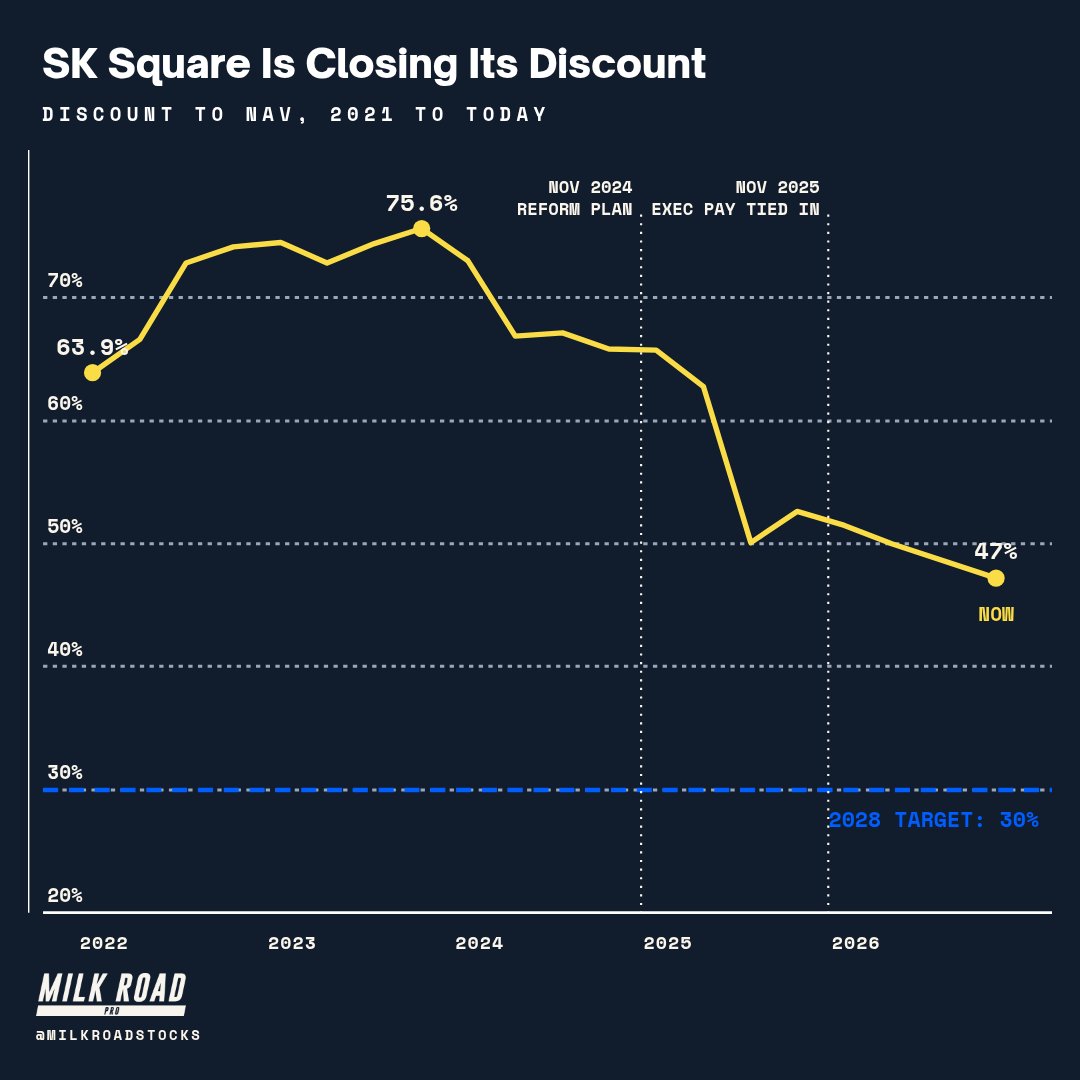
ALT SK Square discount to NAV since 2021: peak 75.6% in 2023, about 47% now, 2028 target 30%.

🇰🇷 SK SURGES 13%. ELLIOTT ENTERS THE STORY.
Funds linked to Elliott hold ~1.5% of SK Inc.
SK trades at a 75% discount to NAV.
SK → SK Square → SK hynix.
Two layers of holding-company discounts.
The market is suddenly pricing in the possibility of shareholder activism.
Can Elliott turn hidden value into actual shareholder returns?
#SK #SKHynix #KoreaStocks $SKHY
naver.me/5ajWrREu


john liu retweeted

Very thought-provoking argument by Louis-Vincent Gave @gave_vincent, co-founder and CEO of Gavekal (one of the most respected macro research firms on China).
His argument - which is correct - is that one of the The biggest problem for Western governments today (be it France, the UK, the US) is the rapidly rising cost of funding their debt.
He says that governments have 3 broad ways to get it under control:
1) Austerity, cutting spending massively, which basically no politician wants to do because it makes you massively unpopular
2) Specific to the US, they could dramatically reduce AI data center spending, which soaks up a huge share of the world’s capital and pushes up borrowing costs for everyone, governments included. Not good either since it kills the AI boom.
3) Or, they can go back to embracing China, which he calls "the one deflationary force in the world today." He says it's by far the easiest path, and policymakers always take the easiest path.
Louis-Vincent argues that's exactly what Mark Carney (“the least dumb of the western leaders today,” in Gave’s words) did when he opened Canada to Chinese cars: it's a cheap and easy way to fight inflation, and to reduce the cost of funding Canada’s debt in the process.
It's fairly ironic when you think about it: you can actually find plenty of quotes by Western officials castigating China for "exporting deflation" (like Klaas Knot from the European Central Bank here: en.protothema.gr/2024/12/30/…). Louis-Vincent’s argument is basically that, sooner or later, folks in Western finance ministries are going to look at bond yields, then at the inflation numbers, then at all those speeches about China exporting deflation, and go like: "wait a minute..." 😏
Full video of Louis-Vincent’s interview here: youtube.com/watch?v=kT_cV_Wa…
john liu retweeted

P.s. the original is a 14 page pdf. Happy to send it individually as X does not allow uploading documents. Please give me a DM in that case.
john liu retweeted
Last week I said I'd take a proper look at $BRK.B before making up my mind. The work is done, and I'd genuinely like your pushback.
My sum-of-the-parts valuation (balance sheet 30 Sep 2026) comes to $445 per B share. At $571 the stock trades about 28% above that. Put differently: the market pays ~23x normalised earnings for the operating businesses, where I use ~15x on average.
The part I find most interesting is the bridge to Chris Bloomstran's valuation ($570 at year-end 2025). We largely agree on earnings power. The gap is mainly in two choices:
1. Float. I deduct the $178.5 bn in full; he treats it as equity. Together with deferred tax that is ~$106 per share.
2. Multiples. He pays ~19.8x for BNSF, BHE and MSR, I pay 15.6x. That's another ~$43.
With his treatment of float and tax but my multiples, I get ~$551. So whether Berkshire looks expensive depends more on how you view float than on the operating businesses.
What matters more in the end is how fast intrinsic value grows. The operating businesses grow slowly, so a lot rests on putting ~$357bn of cash to work at better returns. I realistically expect 8–9% a year from here. Fine, but a bit below what I'm looking for, so I'm considering trimming Berkshire with 20-40%.


In the coming week, I will devote quite some time to make up my mind about $BRK.B. It’s hard for me to criticise the company, as doing so feels like implicitly letting my role model Buffett down. But my gut feeling is giving me signals that Berkshire at $570 is quite richly valued. Especially since their more recent capital allocation decision (Oxychem, Pilot, Bending Spoons) are hard for me to get really excited about (in fact: perhaps the opposite is true). As always happy to hear pushback and/or input before doing the work. Will share the outcome when done of course.
john liu retweeted

Should get at least halved from here. Net Debt to op income essentially doubled as well. FCF ex Russia doesn’t cover current dividends, so the dividend will be cut by 20-30 %.
john liu retweeted

At ¥5,269, Japan Tobacco trades on 14.1 times its original 2026 earnings forecast.
Remove the estimated Russian contribution and the multiple rises to approximately 19.9 times earnings.
A 32% collapse in the share price has not necessarily produced an inexpensive tobacco equity.
#JTI #EquityValuation #ValueInvesting #TobaccoVanguard


john liu retweeted
Japan Tobacco traded at almost 21 times forecast earnings before Russia's intervention.
Following the collapse, our full Russian earnings-loss scenario still places the shares at approximately 20 times earnings.
An extraordinary price decline has not yet yproduced an extraordinary valuation.
#JapanTobacco #JTI #ValueInvesting #TobaccoVanguard
john liu retweeted

$UBER
This is the part of the robotaxi debate that actually matters, and it is the part almost nobody prices.
A driverless car earns nothing while it sits. Utilization is the return, demand decides utilization, and Uber owns the demand. That is why the fleets end up plugging into Uber, and why the toll collector with no cars beats the company carrying billions in depreciating hardware.
The endgame was never Uber versus the robotaxis. It is Uber collecting a toll on every single one of them.
