Creed retweeted

I guess that leaves only the Internet Computer in the "world computer" game then, building on hardcore technical work since 2014 ;) Cloud engines this week ✌🏼..

Expanding on why I believe "ETH as store of value (SoV)" makes much more sense to focus on than "ETH as fee-burning token".
Three primary reasons:
1. ETH as fee-burning token never was as strong as it seemed
2. Optimizing for ETH as fee-burning token would demand Ethereum and ETH function in ways that are very hard to make compatible with decentralization and capture resistance.
3. Meanwhile, optimizing for ETH as SoV is aligned with Ethereum focusing on its unique strengths (decentralization and CROPS)
EIP-1559 (including its burn) is fine and good, we should keep them. But we should not feel sad if fee burn is < 10% of breakeven indefinitely; the value of ETH comes from elsewhere.
The core idea: the big thing that people appreciate about Ethereum is decentralization and CROPS. The main pragmatic benefit that these things translate into is stability. SoV is the category where that is not an unneeded extra we merely put effort into for ideological reasons, but rather a pragmatic strength from the perspective of people putting in their assets. And in the era of AI disruption, stability will be highly valued.
Creed retweeted

No guarantees it’s different this time.
But here’s what actually changed:
DFINITY stopped waiting for a killer app. For years the bet was build the protocol and someone will ship WEB3 Facebook,Booking,Spotify etc.. on it. That didn't happen.
The pivot is to enterprises, institutions and governments with configurable cloud engines. That strategy is a different game as companies need secure infra, lower software costs, and less dependence on centralized providers.
Why they'd care: AI driven attacks are already up 50%+ YoY and every security forecast says regular autonomous attacks are a WHEN not IF.
$ICP is the only major network where the entire app, frontend, backend and data, not just tokens, runs replicated under consensus. Mathematically verifiable results for the whole application.
A single cloud can't give you that, no matter how good its enclaves are.
Cloud Engines accessible through hyperscalers make adoption even easier as enterprises dont need to understand crypto, manage tokens change how they purchase IT services and deal with crypto accounting nighmare. They use existing cloud accounts and procurement processes.
The industry's own bet is that most software will be AI-written within next 18 months.
@dfinity answer is Open SaaS, CRM, HR, accounting, files etc. as free, opensource onchain apps. No licensing fees, full functionality out of the box, AI built in, modifiable to each company needs.
The pitch isn't "move your business to blockchain."
It's "replace expensive software licenses and vulnerable infra with secure, customizable software that you control."
All that said, meaningful adoption isn't guaranteed.
If you want to be on safer side, don't invest until you see sustained 8–10x higher cycle burn with consistent higher highs. Thats roughly where burn fully covers whats minted for node providers.
Fun fact: ICP node providers are paid in fixed fiat (XDR) terms, so a 10x price jump also means 10x lower node provider ICP rewards.
⚠️All other blokchains a ticker price 10x means 10x security bill.
That design is truly unique to ICP and make all the difference between a network with a business model that can actually sustain itself and one running on a slogan.
Imagine if your AWS hosting costs were tied to Amazon stock price. Today, you pay $100K a year for hosting, but if Amazon stock doubles, so does your bill.
This is why so much of the blockchain industry is one big circle jerk. Infra/Serivce providers get funded through token emissions, then use buybacks to prop up token prices, only to dump their holdings later.
Your typical blockchain ticker is little more than a meme. There's no sound business model behind it, just marketing narratives and speculation disconnected from any underlying economic value.
For what it’s worth, most of my crypto money came from investing on those tickers, that's the game. I'm no investment maximalist and I'd never tell anyone to go all in on a single asset, ICP included.
Full disclosure, a big chunk of my crypto profits sits in ICP as a long term investment. I still gamble on other tickers and I don't expect most of them to exist in a few years.
To conclude: I'm not telling you to invest. I'm telling what changed and which number to watch.
Verify the claims, read the tokenomics, and let the burn rate decide for you. #InternetComputer economics are different by design and that's checkable, not a matter of opinion.
dashboard.internetcomputer.o…
Creed retweeted
No one is denying that base:0x00f3c42833c3170159af4e92dbb451fb3f708917 has been anything but a good investment so far. Loyal holders have suffered the most, while traders were making money on price swings between $2.50-$20.
It's easy to point fingers and blame @DFINITY, but it's not like they weren't trying. They went through multiple approaches that simply didn't take off.
And let's be fair, most of those projects were trying to compete with massive Web2 platforms that already have hundreds of millions of users. That's anything but easy.
Now, with Cloud Engines and the shift toward enterprises, institutions, and governments, I think we're finally looking at a much better approach.
ICP doesn't need to build the next Facebook, Airbnb, Bookingcom. It needs to solve problems that companies are already spending billions trying to solve.
Think about it. How many companies would love to have infra where they don't have to worry about servers, firewalls, backups, cloud configurations, or trusting a bunch of third parties?
Where applications run on tamper resistant infra without all the usual complexity?
That's a completely different market from trying to convince millions of people to leave the apps they already use.
And with consumer apps, building the product is less then 20% of the battle. The other 80% is getting people to actually use it, which takes enormous amounts of marketing money.
You can build something technically better than Facebook and still end up with nobody using it.
With enterprises, you don't need millions of users. You need companies running real workloads and paying for the infra. A few large customers bring more actual usage than hundreds of dapps that nobody uses.
That's why I believe enterprise adoption could be what finally changes things for base:0x00f3c42833c3170159af4e92dbb451fb3f708917.
Even if we completely ignore the potential adoption through UNDP and governments, the enterprise market alone is massive.
Of course, none of this means success is guaranteed. @dfinity still needs to deliver and bring in paying customers. But at least now the focus is on selling something #InternetComputer is actually built to do well, instead of hoping someone builds the next big social network.
Creed retweeted
I think you are missing the point of what $ICP is actually solving.
Let's look at some major hacks:
Bybit: Had exactly what you prescribe:
an air-gapped multisig cold wallet with hardware signers.
Still lost $1.5B. The compromised laptop wasn't even Bybit's. A Safe Wallet dev was hacked, attackers obtained AWS credentials and replaced the JavaScript in Safe AWS S3 bucket. The signers approved what the screen showed them. The screen lied. The malicious JavaScript was removed two minutes later.
Binance: DevOps laptop -> service container -> the signing system signed whatever it was told. No private key was leaked.
Bangladesh Bank: Custom malware inside SWIFT Alliance Access, manipulating the Oracle DB to conceal fraudulent transfers.
Capital One: A misconfigured WAF on AWS.
See the pattern?
The pattern isn't "humans". It's one human reaching one mutable server that sits between the signer and the chain. #InternetComputer removes that server.
An attacker compromises a mutable component of the infra and changes what the system does. That infra is the attack surface, not the person signing.
That's the attack surface $ICP is designed to eliminate:
✅Frontends served directly from canisters, with responses certified by the subnet and verifiable by the client. No S3 bucket where attackers can silently replace JavaScript.
✅No traditional service containers, SSH access or admin controlled databases. Canister state changes are executed through subnet consensus.
✅No single administrator holding the upgrade keys on a laptop. Canisters can be governed by a DAO, with upgrades requiring a vote.
✅No complete signing key sitting in one place. Threshold crypto distributes key shares across nodes, while properly implemented consent messages let users verify what they're signing.
✅ No API keys or cloud credentials. Canister calls are authenticated by the protocol, nothing for a compromised laptop to hand over.
✅ Verifiable deployed code. Wasm hash is onchain, reproducible builds let anyone check it matches source.
✅ Public controllers. Anyone can see who can upgrade a canister, one key, DAO, or nobody.
✅ Withdrawal policy enforced by consensus. Limits and approvals live in the canister, not in a backend someone can reach.
✅ Upgrades go through a visible voting window. A malicious change is a public proposal, not a silent push.
✅ Certified data reads. Balances and transaction lists are verifiable as coming from the subnet, not a tampered node.
✅ No runtime supply chain. Dependencies compile into the WASM, nothing fetched at execution time.
✅ No passwords or seed phrases to phish. Internet Identity uses passkeys, with a separate principal per app.
✅ No key server. vetKeys derive encryption keys onchain via threshold crypto.
Your three "someone still has to" points: code bugs, key custody and user signing and those are real risks, and they apply everywhere. ICP has never claimed otherwise.
What $ICP solves is that the infra layer exploited in hacks like Bybit, Binance, Bangladesh Bank etc.. can be fundamentally redesigned to eliminate entire classes of attack.
#InternetComputer isn't trying to make traditional infra more secure. It's eliminating entire attack surfaces by making that infra unnecessary.
That's why I'm genuinely optimistic about ICP future.
The tech addresses real problems, and its potential extends far beyond what we've seen in crypto.
I like the direction @dominic_w is taking on X lately, focusing on practical problems and what $ICP can do to solve them.

Creed retweeted

Claude autonomously constructs a building within a voxel game; the game itself is also generated by Claude and runs 100% on the Internet Computer $ICP
Creed retweeted

The Internet Computer is now a connector in Claude.
Search for it in Claude's connectors, connect it once, and start prompting. Set up a cloud engine for your business, launch a client portal, keep building, all from the same conversation.
Build on the Internet Computer directly from @claudeai.
Creed retweeted

The Internet Is Breaking... Can $ICP Save It? We sit down with Dominic Williams, founder of @dfinity, to explore the future of the internet, AI, Big Tech, and ICP's ambitious vision to change everything. teapaw.org/i/broadcasts/1yJAPwjqz…
Creed retweeted
AI just proved that the Exponential Time Hypothesis (ETH) is false. Cryptography relies on ETH, but luckily this particular discovery doesn't threaten core algorithms yet. However, ETH was thought true for almost 30 years, and is highly relevant in the field. This illustrates how AI is the true threat to crypto and security, because it can move the ground under our feet, and it's here today.
Currently, many chains are promoting their migration to "quantum safe" signatures and other schemes. Meanwhile, cryptographically-relevant quantum computers won't be around for some years, and even when they are, they'll be specialized machines, requiring special environments, rather than easily accessible mass market devices, and it will be relatively easy for authorities and regulatory frameworks to control their use, at least initially. Renting them for the purposes of hacking won't be allowed, for obvious reasons (not that this is something we should rely upon, but it impacts any objective threat analysis).
However, there are dangers with adopting these schemes. The less well-studied and more complex a cryptography algorithm, the greater the chance that a sudden shift in our understanding of theoretical computer science or mathematics, or sophisticated analysis by AI, will suddenly reveal a catastrophic bug. The first real-world harbinger of the dangers occurred when AI found issues with HAWK, a quantum-safe algorithm that was passing through NIST's standardization process at the time (it was withdrawn).
Chain operators' desire to ride narratives and exploit the tendency of web3 investors tendency to seize onto this or that carefully promoted story, who for the most part do not use crypto technology beyond holding and trading tokens, and who lack understanding of the theoretical issues involved, is certainly exploitative for a simple reason — whereas historical technical safety manias used for commercial purposes, such as Y2K, only collected money, this one also risks user safety.
Chains sell adoption of quantum safe signature schemes to token buyers and users that in reality reflect a kind of stupidity, and irresponsibility, rather than actions reflecting wise stewardship protecting people from an imminent quantum meltdown. Meanwhile, of course, while adding support for a new post quantum signature algorithms doesn't involve much engineering work, it allows them to post pictures of their logo next to photos of quantum computers, so they can sell the ignorant on how sci-fi and advanced they are, which makes it particularly attractive to them.
Important note: you'll hear about some serious people performing post quantum encryption of messages. That's different. They're calculating the risk that adversaries, such as state adversaries, perform mass storage of encrypted messages containing secrets, so that they can extract the secrets from them 10 years from now, say, when they finally have cryptographically-relevant quantum computers. This is a different kind of risk they are addressing.
The perverse tragedy of the quantum mania craze that's currently gripping crypto is that on the one hand it shows how so many chains are driven by a desire to sell tokens first, rather than pursue sound engineering practices, and on the other, their willingness to lie and risk user safety in the process. This, all while the real wolf is at the door as concerns our engineering — AI that's rapidly advancing, here today, accessible to many, and difficult to control.
What I can promise, is that DFINITY will be focusing on mitigating this real risk, and no matter the post quantum mania, we won't be joining it, and will instead try to plot the most responsible course.
sansser.com/articles/exponen…

Creed retweeted
Keep the app - Retire the stack.
It's never been easier to migrate from PHP.
No more patching servers, over and over.
Check it out at Move to Motoko dot com

Keep the app. Retire the stack. The network runs it.
Your team stops patching servers.
Move to Motoko on the Internet Computer.
movetomotoko.com/
Creed retweeted
I disagree, IMO the best outcome is an agreement.
The version I'd actually like to see is $NEAR Intents swapping its permissioned MPC for ICP chain-key signing.
What $NEAR would get:
✅ $ICP Keys reshared by protocol, not ceremony. Node joins or leaves, the public key stays the same, nobody ever holds it. Shares re-randomized on a schedule, so a share stolen last week is worthless now. NEAR only reshares when an operator changes. Compromise 11 of 17 slowly and the key is yours.
✅ Native chain reads. $ICP nodes ingest Bitcoin as part of consensus; EVM & Solana via RPC canisters that need multiple providers to agree. NEAR chain can't see other chains, so MPC 17 operators watch Ethereum/Solana/Bitcoin and tell the contract what they saw. Risk: the group that reports "your deposit landed" is the same group that signs the withdrawal. Corrupt 11 of 17 once and you can invent a deposit and sign the payout in the same step. No second check anywhere.
✅ A backup subnet. Lose the signing subnet, the key survives. Lose NEAR operators, the key is gone with them.
✅ 34 independent node providers across countries, each admitted by decentralized governance vote, paid by the caller (~3¢ a signature). Not 17 operators vetted by the foundation, paid 73k NEAR a month in emissions, who vote on their own membership and software.
✅ No TEE in the trust chain. The key is split across 34 nodes and the math enforces the threshold, not a chip. No Intel, no attestation, no side-channel risks.
✅ Signing that finishes under asynchrony. No coordinator, no restart when the leader drops, no "reuse a triple and the key leaks and nobody can detect it" (a real risk, from NEAR own spec).
✅ Any canister is a first-class caller: one call, consensus-ordered, certified response any client verifies against the IC root key. No separate network, no indexer watching one contract, no yield/resume dance.
✅ ECDSA, Schnorr/BIP340 & Ed25519 on one key model, plus vetKeys. Unlimited keys per canister via derivation paths, computable offline.
✅ Four years in production, zero rewrites, ckBTC audited by Trail of Bits with no high/medium findings. NEAR current signing path is six weeks old, three rounds slower and its audit covered only the use of Cait-Sith, not the library.
The biggest win for $NEAR holders, besides superior security: no more ~880k NEAR a year in emissions to fund MPC operators, and that number climbs once the roster fills to the 21 operators HSP-007 allows.
With current Intents volume and NEAR at ~$5, switching to $ICP signing would cost about 2–3x less on realistic signature counts. Since $ICP cycles are pegged to XDR while NEAR pays operators in NEAR, every doubling of the price doubles what the current setup costs NEAR holders.
What NEAR would keep: the Intents revenue.
Solvers, routing, 35 chains, hyperliquid, the fee switch, that's the business. The signing layer was never where the money is. It’s just where the patent is.
Creed retweeted

Looking forward to two great days at the Dubai AI Festival, meeting with friends and partners! 🇦🇪
Watch out for the State of AI 2026 report that is going to be released on Tuesday.
If you are around, don't miss @dominic_w's keynote on "Sovereign Cloud for the AI era" on Tue, 3:10 UAE time.
@DubaiAIFest @DIFC @Ignyte_AE @dfinity

Creed retweeted
There's a difference between an opinion and a fact.
"a patent covers the method, not the code" isn’t my opinion, it's what a patent is.
An opinion is something you hold and fact is something that holds regardless of anyone's opinion.
I hope you watched the video and examined the receipts. Did any of it change your mind even in the slightest, or is there simply no amount of evidence that would?
Creed retweeted

Idk man but this whole narrative that crypto traders are the new “celebrities” might genuinely be the most embarrassing thing this industry has ever produced
Not a single soul outside this terminally online bubble knows who any of your so called “goats” are and I can assure you nobody is lining up to become their next exit liquidity
You have to be operating with a medically concerning number of brain cells to worship a bunch of glorified internet grifters who would sell you into financial ruin for an extra SOL
The collective IQ in this space has fallen so catastrophically low that the psych ward is starting to look like an institution of higher learning
At some point this entire circus is going to face a reckoning of biblical proportions and while it’s going to be painful, it might be the only thing capable of restoring a shred of sanity to this industry
Some of you have spent so much time worshipping these losers that you’ve completely forgotten they’re getting rich at your expense
Wake the fuck up


Creed retweeted
The algorithm NEAR has been running on for two and a half years is patented. They also took vetKeys, it looks like, but that's not. Obviously if you're mining the repos, research, and work of competitors, without talking to them, referencing them, etc, this is a risk you take.
Creed retweeted
Looking back, the playbook is painfully obvious. @ilblackdragon was already sniffing around in 2021, trying to figure out how to copy the tech. The receipts are still there. $NEAR
teapaw.org/ilblackdragon/status/1…


Wait is there actually a paper on Chain Key? @dfinity @dominic_w
forum.dfinity.org/t/canonica…
forum.dfinity.org/t/chain-ke…
Everyone is asking, nothing actually provided. Nothing on dfinity.org either.
Creed retweeted

Justin is comparing apples to oranges.
In 3 IC transactions, you can fetch a BTC block, hash it, compare that hash with headers collected from the IC’s BTC nodes, check the proof of work, process the block, and send a bunch of BTC tx. That will also count as zero ingress calls

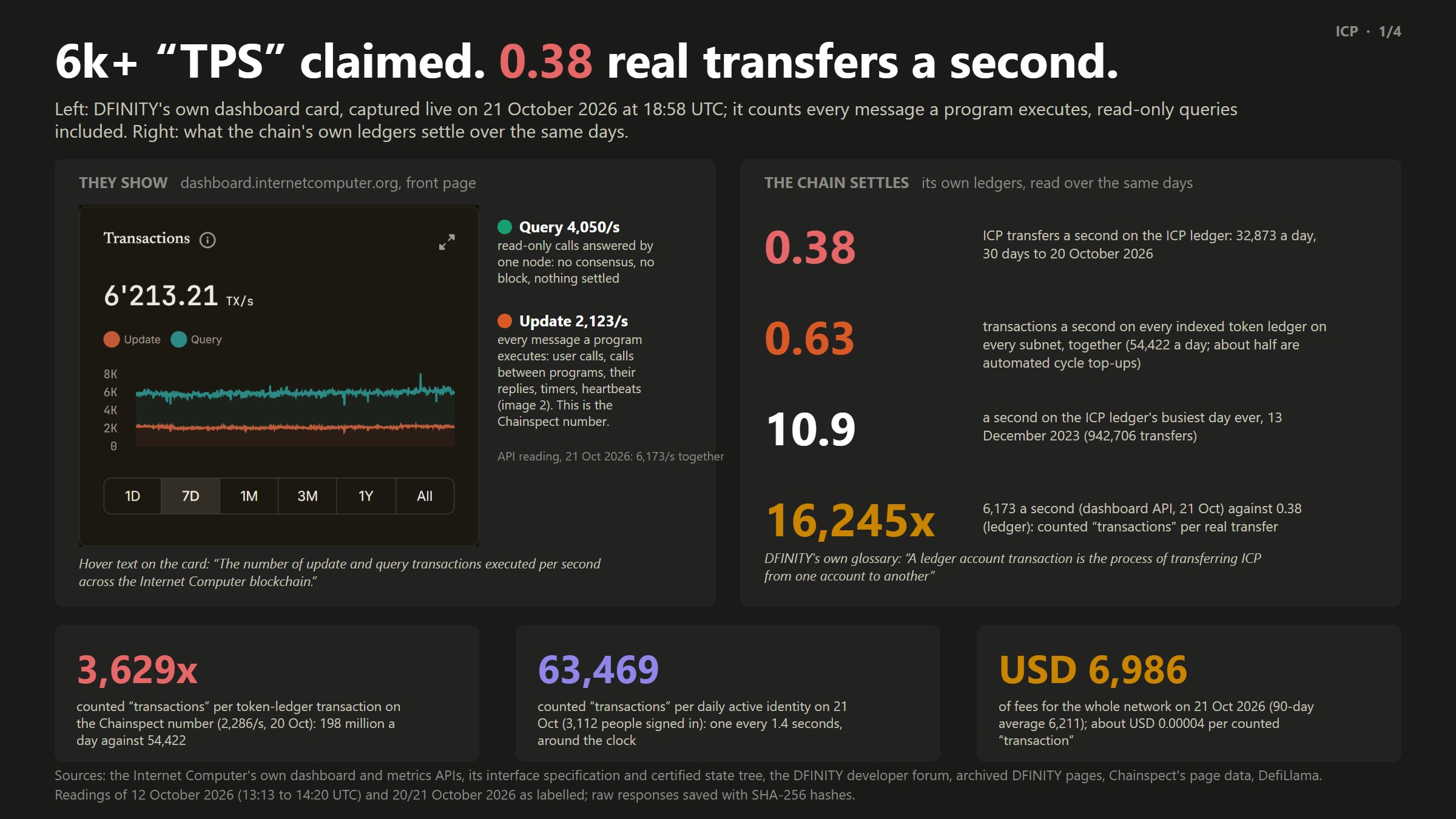
ICP's reported TPS numbers are fake! ⚠️
They claim 6k+ TPS, but in reality, ICP only does 0.4 TPS. It is a ghost chain!
By counting basic chain functions as TXs, they are fraudulently misleading the public
Do not be fooled; there is real usage in crypto, but ICP is not it: 🧵
ICP's foundation, DFINITY, is again caught red-handed lying to the public. This time to a preposterous degree:
The Lie:
The 6k TPS figure comes from DFINITY's own official website. Here comes the kicker: 4k of that "TPS" are read-only queries!
The remaining 2k "TPS" are application steps, something ALL other smart contract chains have, but no other blockchain actually counts as TPS. These include contract-to-contract calls, timers, replies & heartbeats. ICP's leadership counts all of these as "TPS" today
The Truth:
Once we subtract all of those phony forms of TPS, ICP ends up with a mere 0.4 TPS, or 0.7 TPS if we also counted every token ledger
That means DFINITY is inflating the usage of ICP by a whopping factor of x16245
All while the biggest user of ICP today is DFINITY's own subnet where they host their apps! The ckBTC & ckETH minters, along with their ETH & SOL relays. Together, produce 31.5% of this fraudulent TPS count
One Example:
There was a particularly interesting incident in 2022 when a developer was loading a database into his app at less than one call a second
DFINITY's own dashboard showed his subnet doing 1.3k Transaction Per Second, a third of the network's usage that week
The developer then went on to the forum to ask how that was possible. The ICP engineer frankly explained it:
"Each upload put 500 records into three indexes, and the code did each insert as a call from the program to itself. Every call counts, and every reply to a call counts again. So one upload became about 3,000 "transactions". Written as one batched call, the same work would have shown "500x fewer transactions".
Following that up with one of the most damning statements in this case:
"DFINITY's own benchmark had deliberately left such messages out, because counting them "might have been deemed as cheating (after all we care about user-triggered transactions rather than artificially generated traffic)".
DFINITY's own dashboard counts them anyway & still does to this day. On this day, the 21st of October 2026, replies to calls between programs were 57 percent of the "update" count! This mechanism is also not rate-limited at all
In conclusion, their own engineer said counting internal messages would be cheating in a benchmark; their own dashboard counts them to this day; that is the number they sell as TPS! Under ICP accounting, 1 TPS turns into 1.3k "TPS". Now that is a fraudulent & misleading design!
Discrepencies
That is how they can claim to do "6k TPS" while only bringing in less than 7k of fees per day, while its own "Internet Identity" ICP's login system registers a mere 3112 users in the last day
Their physical presence in our ecosystem is also not at all congruent with their claim of being the second most used blockchain in the world
Such inconsistencies are hard to reconcile. Which is why this expose was needed. As it turns out, they have been straight-up lying about their usage this entire time!
Chainspect
Why Chainspect, the blockchain explorer & metrics tracker, would unquestioningly repeat these lies. Taking its data directly from DFINITY's API is unknown
Chain Inspect is not a registered company & for that reason & more, I was unable to find any connection to DFINITY, but it cannot be ruled out. They claim to be fiercely independent
Chain Inspect only reports the 2k "TPS" figure, but that is still wildly misleading
Especially since they do carry out more due diligence with other chains, such as by subtracting consensus messages in SOL, for example, as they very well should
Weirdly, their own policy demands that they adjust their figures accordingly:
"We aim to include only user-initiated transactions and exclude system ones, to enable fair comparison of different networks (e.g. for Solana we exclude “voting” transactions related to their custom consensus mechanism)."
As a community, we need to point the finger here & ask @chainspect_app to update their policy on how they count ICP's "TPS".
The correct number is below 1; reporting 2k+ instead is wildly misleading
Do better, Chain Inspect! We are kindly holding you accountable today, as your website & service are otherwise great!
Conclusion
ICP is a ghost chain: There is nothing wrong with that, as we all need to start somewhere
However, what is wrong is that they are actively lying about this fact. In the investment world, that is called fraud!
Honesty & integrity matter far more to serious investors, as we are, myself included, willing to invest in "ghost chains", making a bet on a superior team & tech
It is a shame, as ICP could be a great chain if they enshrined their subnets as I have previously recommended. If they also cleaned up their marketing, it could become a real contender
Instead, the community will most likely respond with denial again. Exposing a sickness that is endemic within many small cryptocurrency communities
Groupthink with cult-like dynamics, combined with both financial & peer pressure, creates one hell of a toxic soup
Despite all of the personal attacks that will likely follow this critique, the truth speaks for itself. That is also one of the most wonderful things about crypto
It is open-source code running a transparent blockchain. The scammers & crooks can not hide anymore with sufficient due diligence, of the sort we did here today
To the ICP community, there are genuinely good, smart & well-meaning people there. We should never paint any community with a single brush
For those of you receptive to this critique, I hope it will inspire ICP to clean up its act. Operating with more honesty & integrity is not only the right thing to do. It is also the best possible long-term strategy for success in our industry today
When all is said & done. It is the truth that sets us all free! 🔥