

History Enthusiast currently exploring ancient history of Mumbai & Maharashtri Prakrit literature. Hindu Shakta Working professional, 🇮🇳🇬🇧 ❌️ DMs ❌️
World
Joined April 2022
- Tweets14.2K
- Following684
- Followers1.2K
- Likes30.9K



Pinned Tweet
Ancient history of Mumbai- Waves of migrations 🌊:
Last post we spoke about the original natives of Mumbai - today we will discuss the first wave of migration 🌊 (indegenous wave).
The 7 islands and Salsette had several waves of migrations in the ever moving sea of humanity and much like sea waves, the waves of human movement were episodic, often overlapping with one another.
✨️The 1st wave of indigenous migrants:
✨️The Classical Antiquity & Imperial Era (3 BCE to 12 C.CE) & The Buddhist Monks & Global Traders (3 BCE – 1C.CE)✨️:
Buddhism arrived in 7 islands and Salsette around 3B.CE to 1C.CE with Mauryan Emperor Ashoka incorporating the northern Konkan region into the Mauryan Empire & Buddhist missionaries & monks migrated to Salsette.
They carved the monastic university systems at the Kanheri Caves & Mahakali.
They interacted with global traders from Egypt, Rome, & Persia who frequented the nearby ports as mentioned previously.
It appears that the entire coastal archipelago was a major focal point of Buddhist culture, monastic education, and trade patronage around this time period.
✨️Kanheri Caves (Krishnagiri):
Located in Sanjay Gandhi National Park, Borivali East. A complex of 109 rock-cut basalt caves (1 BCE–10 CE), patronised by the Mauryas, Satavahanas, Traikutakas, Rashtrakutas, Shilaharas, Chalukyas, & others.
It functioned for over a millennium as the Krishnagiri Mahavihara -a university, monastery, and pilgrimage site linked to ports such as Sopara and Kalyan.
Features include chaityas, viharas, Buddha sculptures, water cisterns (podhis), & an advanced rainwater-harvesting system.
✨️Key inscriptions (51 legible + 26 epigraphs in Brahmi, Proto-Nagari, Devanagari, Pahlavi, and Japanese scripts):
✨️One historically significant inscriptions mention of 'Royal marriage' between Satavahana King Vashistiputra Satkarni with daughter of Rudradaman 1st✨️ written in Maharashtri Prakrit in a Bramhi script & it adds a notes that a confidential minister Sateraka decicated a watern cistern alongside with this announcement.🤩
✨️Satvahana King YagnyaSri Satakarni's inscription is in Cave 81.
( I have visited the Kanheri Caves several times in my childhood, yet I knew so little of their magnificent heritage. Sigh!
✨️Two copper-plate grants (tamrapatas):
A 5th-century Traikutaka plate recording a chaitya and offerings to monk & a Shilahara plates showing socio-religious synthesis.
Cave 90: three Pahlavi (Middle Persian) inscriptions by Persian travellers (1009 & 1021 CE) naming Yazdan-panak and Mah-aiyyar.
A 13th-century Japanese traveler's inscription of the chant "Na-mu-myo-ho-ren-ge-kyo" honouring Nichiren is seen.
In 2016, seven additional much early viharas were found in the Borivali forests, likely monsoon retreats for wandering monks.
Kanheri must have been a significant site in the past.
✨️Other Salsette Sites:
✨️Mahakali (Kondivite) Caves, Marol/Andheri East: 19 caves (1 BCE–6 CE); Cave 9 has Pali inscriptions.
✨️Magathane Caves (between Kandivali and Borivali): early Buddhist origins, later adapted under Hindu dynasties.
✨️Nala Sopara: The 'primary gateway of Buddhism into the Deccan'. Excavations here yielded an Ashokan stupa with relic caskets & bronze images of Bodhisattva Maitreya.
The Old Seven Islands:
Due to being lower-lying & tide-prone, these islands lacked large rock-cut universities but formed vital nodes in the Buddhist maritime network, linking inland centres (Kanheri, Kalyan) to Arabian Sea routes.
Merchants, Kolis, and local rulers funded nearby monasteries.
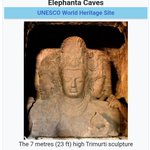
✨️Elephanta (Gharapuri)✨️: Famous for 5th-century Shaiva art & the Sadashiv Trimurti in Cave 1, yet the eastern hills preserve earlier Buddhist stupas that coexisted with later Hindu sculpture.
It is remarkable how the footprints of glorious past still lingers- quietly unseen, camouflaged & overlooked among the concrete jungles & crowded streets of modern Mumbai 🙂
👇


Echos Of Eras retweeted

Dhanteras is often seen as a day for gold, but its deeper story begins with the Samudra Manthan—& the emergence of Lord Dhanvantari, the divine physician.
He brought not just Amrit, but the eternal wisdom of Ayurveda: true prosperity begins with health.
Wishing you light, peace, & well-being.
Happy Dhanteras! 🙏

Echos Of Eras retweeted

I was not the compulsive firecracker bursting type of a person for #Deepawali, but I am SO sick and tired of courts, zombie politicians and every woke libtard and their grandmother lecturing only to Hindus on how to celebrate our festivals, that I have started buying crackers not just for myself, but for children from a nearby basti. Where is this fake outrage against pollution when the rich and the famous use fuel guzzling SUVs? If you agree, RT this tweet.
Echos Of Eras retweeted

𝐁𝐫𝐨𝐧𝐳𝐞 𝐜𝐨𝐮𝐥𝐝 𝐧𝐨𝐭 𝐜𝐮𝐭 𝐭𝐡𝐢𝐬 𝐬𝐭𝐨𝐧𝐞. 𝐀 𝐇𝐚𝐫𝐚𝐩𝐩𝐚𝐧 𝐚𝐫𝐭𝐢𝐬𝐭 𝐜𝐚𝐫𝐯𝐞𝐝 𝐚 𝐛𝐮𝐥𝐥 𝐟𝐫𝐨𝐦 𝐢𝐭 𝐚𝐧𝐲𝐰𝐚𝐲.🐂
Around 1900 BCE, during the Bronze Age, a Harappan artist carved this magnificent humped bull from naturally banded agate - a stone with a Mohs hardness of approximately 7.
Bronze was widely used for tools, but it was not harder than agate. Shaping such a stone required abrasive techniques and considerable skill.
Now look at the bands.
They are not painted. They are not inlaid. They are part of the stone itself.
The artist had to envision the bull within this naturally patterned material, making every carving decision around the stone's existing structure.
𝐓𝐡𝐞 𝐚𝐜𝐡𝐢𝐞𝐯𝐞𝐦𝐞𝐧𝐭 𝐰𝐚𝐬 𝐧𝐨𝐭 𝐦𝐞𝐫𝐞𝐥𝐲 𝐜𝐚𝐫𝐯𝐢𝐧𝐠 𝐚 𝐛𝐮𝐥𝐥. 𝐈𝐭 𝐰𝐚𝐬 𝐬𝐞𝐞𝐢𝐧𝐠 𝐚 𝐦𝐚𝐬𝐭𝐞𝐫𝐩𝐢𝐞𝐜𝐞 𝐡𝐢𝐝𝐝𝐞𝐧 𝐢𝐧𝐬𝐢𝐝𝐞 𝐚 𝐬𝐭𝐨𝐧𝐞.
Made around 1900 BCE. Found at Pur village, Haryana.
How many such masterpieces of the Harappan world have we overlooked?
Source: Haryana State Archaeology and Museums, via Google Arts & Culture.

Echos Of Eras retweeted

Ravan is surely not ALL that bad.
Just Bad Enough--to be killed.
And Not Good Enough--to be kept alive.
Karna is also good.
Just Not Good Enough--to be left alive.
And Bad Enough --to be killed.
That much Bad was Bad enough, and whatever Good was not Good enough!
#Itihasa101

Echos Of Eras retweeted

India will face its toughest time since independence in the coming years. But if the govt launches a campaign to make Indians considerate of each other, trustful of each other, and benevolent to each other, it will bless the country with a kavach to protect it from adversaries.
Echos Of Eras retweeted

Kikkuli, an Indian horse trainer, used Sanskrit terms and invoked Vedic deities. Let us never forget this! One tablet has been found in Anatolia. How many more remain unearthed?
#Horse #HORSEBREEDING #Mittani
science.org/content/article/…

Echos Of Eras retweeted
I think @narendramodi govt is losing the battle of perceptions particularly on @instagram. Every day hundreds of propaganda reels are being made against the govt that is being forcibly pushed on the timelines of everyone, even when you don’t follow the makers. The platform has clearly picked a side. And @AshwiniVaishnaw’s ministry seems to be either clueless about it, or the babus are compromised. @blsanthosh


Echos Of Eras retweeted

A thread to bust the fiction of #Euclid
Busting the myth of #Euclid
What you are seeing is the picture of first book in entire history which talked about Euclid. Book published in 1509 by Pacioli.
It refers to Euclid as Euclid of Megara!
1/ Euclid's existence and contributions to mathematics have become a hot topic of debate in recent years. Some believe Euclid was a fictitious figure, and tonight, we'll dive deep into this theory. 🧐 #EuclidDebate
2/ The theory suggests that Euclid was a fictitious figure created to deny borrowing from Indian or Hindu Mathematics via Arabic textbooks. 📚 #HistoricalMysteries
3/ Why did 16th-century Europeans start translating mathematical concepts from Arabic textbooks instead of the original Greek sources? A crucial question for historians. 🤔
4/ These translations claimed Greek origins from before the Common Era. However, inconsistencies appear when one delves deeper into the subject. For instance, the identity and birthplace of Euclid remains uncertain. Was it Megara or Alexandria? 🌍
5/ A notable inconsistency is the initial translation by Luca Pacioli in 1509. The author of the elements is mentioned as "Euclid of Megara." [Image attached] 📖
6/ Another translator, Henry Billingsley, also mentioned the supposed author as Euclid of Megara. But here's the catch: Euclid of Megara was a philosopher, NOT a mathematician! #EuclidMixup
7/ So how did this error come to be? The church had propagated the narrative, and books were published with this information. The origin was now claimed to be from mythical Greek origins, overshadowing the possibility of Indian influence. 🇮🇳➡️🇬🇷
8/ The Mathematical Association of America suggests this confusion between the mathematician Euclid of Alexandria and the philosopher Euclid of Megara was common during the Renaissance. But can such a significant mix-up be merely an oversight? 🤷
9/ Prof. C K Raju theorizes that much of the work attributed to Euclid might, in fact, be by the Neoplatonic philosopher Theon. A different perspective to consider! 🎓
10/ David Fowler, a renowned authority on the history of Mathematics, states: "Euclid is an elusive figure with no contemporary references." This uncertainty adds to the debate. 🧩
11/ Lastly, a look into the Greek number system raises questions. Could the supposed Greek mathematicians handle complex arithmetic with their number system? I discussed this in detail in my thread yesterday. [Link to previous thread] 🧮
12/ As we unravel history, the layers often reveal more questions than answers. Whether Euclid existed or not, the journey to uncover the truth is fascinating. Keep questioning, keep exploring! ✨ #EuclidDebateEnds
Check this thread to understand difficulty with European number system.
teapaw.org/ShreeHistory/status/17…
Please read excellent book by @MeruPrastara to understand the origin of #HinduMathematics
Reference:
Imperishable seed by Dr. Kamble
Mathematical Association of America
maa.org/press/periodicals/co…


Tweet 1:🔢 Busting the history of #Mathematics and proving that #Ganita is superior.
An experiment!
Multiplying Roman numerals without converting to decimals? Let's multiply XV by VI using repeated addition! A thread. 🧵
Tweet 2:1️⃣ Write Down XV Multiple Times: Since VI = 6, we'll write XV down six times.
XV
XV
XV
XV
XV
XV
Tweet 3:2️⃣ Add Together: Begin by adding XV to itself for each of the six instances:
First: XV + XV = XXX
Tweet 4: Continue... Second: XXX + XV = XXXXV Third: XXXXV + XV = XXXXXVV (Now, replace XXXXX with L to get LVV)
Tweet 5: Keep going... Fourth: LVV + XV = LXXXX (Change LXXXX to XC) Fifth: XC + XV = XCVV (Combine the Vs to make X)
Tweet 6: Finally... Sixth: XCX + XV = XCVXV Replace X with C to get XCC or just CC (100).
Tweet 7: So, XV multiplied by VI in the Roman numeral system is CC (100). Ancient math can be a fascinating journey! 🏛️✖️
Tweet 8: Multiplying using Roman numerals, as seen, is extremely time-consuming and error-prone. The process relies heavily on repeated addition, which can be lengthy and complex for larger numbers. 🕰️🔍
Tweet 9: Why so cumbersome? Roman numerals lack a positional system. Thus, large operations often mean manually grouping and re-grouping symbols, leading to potential errors and inefficiencies. 🔄❌
Tweet 10: In contrast, Hindu Mathematics, originating in ancient India, had a robust positional system. It not only influenced our modern decimal system but also had efficient methods for arithmetic. 🇮🇳➕➖✖️➗
Tweet 11: In fact, Hindu Mathematics boasted SIX different multiplication algorithms. These methods were faster, more intuitive, and less error-prone than the Roman approach. 🚀🔢
Tweet 12: Ancient cultures had diverse mathematical approaches. While Roman math laid some groundwork for Western civilizations, it's the Hindu system that significantly influenced today's global mathematical practices. 🌍🔍
Tweet 13: It's a testament to how mathematics, a universal language, has been shaped by various ancient civilizations, each adding their unique touch to this vast tapestry of knowledge. 📜❤️
Tweet 14: When we talk about Hindu Mathematics, it's essential to go beyond the commonly credited "zero." The contributions encompass a wide range of mathematical concepts and techniques that have shaped how we understand math today. 🔍🇮🇳
Tweet 15: The "Bakhshali Manuscript" and the works of scholars like Aryabhata and Brahmagupta are testaments to the depth and breadth of mathematical knowledge in ancient India. They've dealt with algebra, trigonometry, and arithmetic in profound ways. 📜✨
Tweet 16: From the concept of decimals, infinite series, to sophisticated algorithms, Hindu math laid foundational stones for many areas of modern mathematics. It's a legacy that's been interwoven into the fabric of global mathematical advancements. 🔗🌍
Tweet 17: It's high time indigenous cultures, including the Hindus, get their due recognition. History has numerous unsung heroes and untold tales, waiting to be explored and appreciated. 🏛️🙏
Tweet 18: By diving deep into the roots of different cultures, we not only discover the origins of knowledge but also foster a more inclusive and respectful world view. Let's celebrate and honor the myriad contributions from every corner of the globe. 🌏❤️🙌
Echos Of Eras retweeted
India does not need a fictitious Euclid theory to establish an extraordinary mathematical antiquity. The Śulbasūtras belong to the first (possibly second) millennium BCE and contain geometrical constructions for ritual altars, transformations of area, use of the diagonal relation commonly called the Pythagorean theorem, its converse in construction, and a notably accurate approximation to the square root of two.
Their mathematical content is early, sophisticated, and historically independent; serious scholarship does not require deriving it from Greece.
Euclid must die.
A thread to bust the fiction of #Euclid
Busting the myth of #Euclid
What you are seeing is the picture of first book in entire history which talked about Euclid. Book published in 1509 by Pacioli.
It refers to Euclid as Euclid of Megara!
1/ Euclid's existence and contributions to mathematics have become a hot topic of debate in recent years. Some believe Euclid was a fictitious figure, and tonight, we'll dive deep into this theory. 🧐 #EuclidDebate
2/ The theory suggests that Euclid was a fictitious figure created to deny borrowing from Indian or Hindu Mathematics via Arabic textbooks. 📚 #HistoricalMysteries
3/ Why did 16th-century Europeans start translating mathematical concepts from Arabic textbooks instead of the original Greek sources? A crucial question for historians. 🤔
4/ These translations claimed Greek origins from before the Common Era. However, inconsistencies appear when one delves deeper into the subject. For instance, the identity and birthplace of Euclid remains uncertain. Was it Megara or Alexandria? 🌍
5/ A notable inconsistency is the initial translation by Luca Pacioli in 1509. The author of the elements is mentioned as "Euclid of Megara." [Image attached] 📖
6/ Another translator, Henry Billingsley, also mentioned the supposed author as Euclid of Megara. But here's the catch: Euclid of Megara was a philosopher, NOT a mathematician! #EuclidMixup
7/ So how did this error come to be? The church had propagated the narrative, and books were published with this information. The origin was now claimed to be from mythical Greek origins, overshadowing the possibility of Indian influence. 🇮🇳➡️🇬🇷
8/ The Mathematical Association of America suggests this confusion between the mathematician Euclid of Alexandria and the philosopher Euclid of Megara was common during the Renaissance. But can such a significant mix-up be merely an oversight? 🤷
9/ Prof. C K Raju theorizes that much of the work attributed to Euclid might, in fact, be by the Neoplatonic philosopher Theon. A different perspective to consider! 🎓
10/ David Fowler, a renowned authority on the history of Mathematics, states: "Euclid is an elusive figure with no contemporary references." This uncertainty adds to the debate. 🧩
11/ Lastly, a look into the Greek number system raises questions. Could the supposed Greek mathematicians handle complex arithmetic with their number system? I discussed this in detail in my thread yesterday. [Link to previous thread] 🧮
12/ As we unravel history, the layers often reveal more questions than answers. Whether Euclid existed or not, the journey to uncover the truth is fascinating. Keep questioning, keep exploring! ✨ #EuclidDebateEnds
Check this thread to understand difficulty with European number system.
teapaw.org/ShreeHistory/status/17…
Please read excellent book by @MeruPrastara to understand the origin of #HinduMathematics
Reference:
Imperishable seed by Dr. Kamble
Mathematical Association of America
maa.org/press/periodicals/co…
Echos Of Eras retweeted

Hypothetically, what would India be like today if the British had never ruled it?
Sai Deepak answers
#RANABAALI
Echos Of Eras retweeted

There are so many things that are wrong with the BJP. So many. But there is not a single thing that is right with the Congress. Not a single thing.
Echos Of Eras retweeted

Groundbreaking botanical research is challenging the long-held belief in human exceptionalism, suggesting that plants possess forms of spatial awareness, intentionality, and consciousness.
For centuries, humans have regarded plants as passive organisms, but pioneering studies are rewriting this view. According to plant neurobiologist Dr. Stefano Mancuso, plants display sophisticated behaviors that parallel those of conscious animals. In laboratory experiments, plants react to anesthesia in ways strikingly similar to humans and animals — for instance, the Venus flytrap becomes completely unresponsive when anesthetized.
Time-lapse studies further reveal remarkable intelligence in common bean plants, which demonstrate clear spatial awareness by precisely aiming shoots toward supports and even adjusting their growth strategy when they detect another plant has already claimed a support.
These findings indicate that consciousness may not be limited to organisms with brains, but could be a more flexible property emerging in diverse life forms. As trees migrate northward in response to climate change, mirroring animal migration, researchers argue that our understanding of “mind” must expand beyond traditional boundaries.
With over three trillion trees on Earth, acknowledging plant consciousness could transform our ethical frameworks, agricultural practices, and relationship with nature, shifting from viewing plants as mere resources to recognizing them as active, aware participants in our shared ecosystem.
[Yokawa, K., Kagenishi, T., Pavlovič, A., Gall, S., Weiland, M., Mancuso, S., & Baluška, F. (2018). Anaesthetics stop diverse plant organ movements, affect endocytic vesicle recycling and ROS homeostasis, and block action potentials in Venus flytraps. Annals of Botany, 122(5), 747–756. DOI: 10.1093/aob/mcx155]

Echos Of Eras retweeted

You also created a Crass, entitled, rude,nasty, bitter, hatefilled, Anti National Son & his sister who prove the words of Chanakya:.
'The Son born to a Foreign woman can never be loyal to our Motherland'.

Echos Of Eras retweeted

Naive Indians say
“Indonesians have not forgotten their Hindu roots, they still have Lord Ganesha on currency notes blah blah”
I always say.. Islam will not let this continue for long. One day there will be a call from Maulana and they all will turn Zombies
Ummmaaaah


Echos Of Eras retweeted

She before whom all arrogance falls, whose incomparable beauty is the victory of the Infinite.
Mounted upon Her magnificent lion, triumphantly wielding the weapons of the gods, She confronts Mahishasura, the embodiment of tyranny, ignorance, and unbridled ego. Where even the gods had failed, She rises unconquerable. Maa Mahishasuramardini is Shakti in Her supreme sovereignty. She does not get Her power from the gods. It is they who find their final unity and fulfillment in Her power.
Her victory reveals a profound truth - evil can only be conquered by concentrating the power of Dharmic forces so completely that nothing can stand against it.
On this sacred Vijaya Dashami, we bow to the Divine Mother who destroys arrogance, restores Dharma, and reveals that the ultimate victory is not merely over the darkness of the world, but over the ignorance that separates us from our own Divine Self.
जय जय हे महिषासुरमर्दिनि रम्यकपर्दिनि शैलसुते॥


She who grants the highest realization that nothing was ever separate from Her.
Seated upon a radiant lotus, Maa Siddhidatri is Shakti in all Her universal perfection - the source of all siddhis and the culmination of the nine nights of worship.
Her greatest gift is not supernatural power, but the ultimate wisdom that transcends all desire for power itself.
On this sacred Navami, we bow to the Divine Mother in whom all seekers finds their fulfillment, all false separation dissolves, and the Self discovers the Divine as the very foundation of their being.
जय माँ सिद्धिदात्री।
