
Assistant Professor @UCIEducation Interested in [foundations/history/philosophy/equity] of ed tech, ed data science, and learning sciences
Joined August 2019
- Tweets1.3K
- Following1.2K
- Followers993
- Likes1.7K
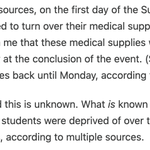





“They think the way you toughen kids up is to get them to clean a bathroom, and the way you get them to learn is to power through it as quickly as possible,” Professor Willingham said, adding, “These are naïve theories of psychology.”
The New York Times article on Alpha School is long. I admittedly did not read all of it, but I am glad I skimmed through the end to see the mic drop ending by @DTWillingham:
nytimes.com/2026/10/23/us/al…

In other words, I don't know enough about the Timeback software to understand. The website is not helpful.
But what about the content? If you tell me two schools are using Khan Academy, I can assume they are exposed to similar content. If you tell me two schools are using Claude, they could get exposure to totally different treatments.
Do you use Timeback the way other Alpha Schools do, or do you load it with Montessori-style content?
Is there any way for independent ed tech researchers to get a demo of Timeback? @C_Hendrick
Will this be impactful at a large scale.* Not sure. Could meaningful ed tech come out of it? I think so, in the sense that Logo is meaningful.
*Ben's smart enough to step outside the grammar of schooling to try to push the needle on this with @recessgg. :) 7/
5. I think this aligns with what @ben_m_somers is trying to do, but I also think he's one of the few people really trying to do this (with grounding in Papert), and many other visions of AI in education will fall flat. 6/
Logo won't work for every kid, but maybe AI could help us explore the space of microworlds for every kid (see dailypapert.com/an-explorati…) in an unprecedented way. 5/

3. So what does all this have to do with AI? I think there's two sides to the Papert story: (a) he had a powerful vision, but (b) it clashed with the grammar of schooling and failed. AI gives us an unprecedented scale to create microworlds of the kind Papert envisioned. 4/
If you don't believe me, you could read @audreywatters' take on Seymour Papert here: hackeducation.com/2013/07/30…. Or you could just heed Audrey's advice: “Read Mindstorms. No, really. I insist. Step away from ed-tech until you've done so.” 3/

2. Seymour Papert had an inspiring vision of ed tech that in my mind (and I think Ben's) stands out. Although he could be called a charismatic (using @morgangames' term) like many other ed tech pioneers, there's something different about his early ideas. 2/
I may not see eye-to-eye with @ben_m_somers on this, but here's where I think he's on to something:
1. I agree with @nirmalpatel_, @AmmarMerhbi, and many others that the history of ed tech keeps repeating itself and we are seeing and will see this with AI as well. BUT... 1/

+1 - My *personal* opinion on AI/EdTech/Education:
People who think "AI will change learning" don't understand that education is a society building enterprise. It has nothing to do with technology! MOOCs only changed life of people who love to learn, and so did Google, and so does AI. But at large, education remains social work.
This is why all waves of edtech feel the same, where tech pushers in control of funding and heavy marketing backing think more about tech and less about the society building role of education. They think about learning as a very targeted achievement rat race thing. It is not inclusive growth, it is me winning while everyone loses. You can see it from their holier than thou attitude. "Technology will solve everything" GTFO, tech salesman
In society, technology is not at the center. Neither AI will be at the center. Human well being will be at the center!

I'm biased but I continue to think the bias-variance tradeoff is a useful way of capturing the debate between direct instruction and discovery learning, and how we can move away from either/or:
journals.sagepub.com/doi/10.…
This is an excellent paper on this, citing research evidence that supports some kind of combination:
sciencedirect.com/science/ar…
I'm sure @geoffreyhinton knows you don't need AI to "draw all the curves for you" and have students "try changing the coefficients [of polynomials] and see how how the curves changes." @Desmos does that. @ddmeyer, maybe you should offer Hinton a tour?

On how well-versed Polson is on the Qur'an, you may have missed his 2026 book (he has quite a few!) "Essays in Grace, Beauty and Self" that talks about the story of Yusuf in the Qur'an, alongside 8 other stories.
amazon.com/dp/B0GXW5D3M8

Wow, this is timely! I was just telling my 4-year old with this verse means the other day. I wasn't sure how to explain an ignorant person's speech, but I used the example of someone speaking nonsense. Not sure what Polson meant here, but AI slop seems like a good contender!
Sure there's some commentary sprinkled alongside the evidence, but I think a lot of critiques about his writing are focused on his personal commentary at the end (and some focused on his data collection methods). But why can't we have a conversation about the data itself?