

Research Lead @Amazon | Self-improving AI | ex-@CarnegieMellon, @MSFTResearch | DM for Collab | Building https://teapaw.org/t.co/VoJrRsndf3 | Co-Lead @OpenRSI
San Francisco, CA
Joined June 2016
- Tweets571
- Following168
- Followers793
- Likes573




Pinned Tweet
Can we train language models to propose better ideas to improve LM—not just run them?
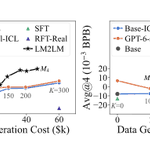
Introducing 𝐋𝐌𝟐𝐋𝐌: Language Models Learn to Improve Language Models. We train a 27B model with RL to propose improvements to language models. On held-out autoregressive and diffusion LM development tasks, it outperforms 𝐆𝐏𝐓-𝟔-𝐬𝐨𝐥 —at 33% lower data-generation cost. It also generalizes to a model family unseen during training.
𝐓𝐡𝐞 𝐛𝐨𝐭𝐭𝐥𝐞𝐧𝐞𝐜𝐤: evaluating every proposal with a real training run makes RL prohibitively expensive.
𝐎𝐮𝐫 𝐚𝐩𝐩𝐫𝐨𝐚𝐜𝐡: a Research World Model (RWM) predicts experimental gains as a cheap reward signal. We periodically execute the current policy’s top proposals and add the measured outcomes to the RWM’s context, keeping its predictions calibrated as the policy evolves.
This is a step toward cheaper, more reliable feedback loops for recursive self-improvement (RSI).

The iconic RSI model launch: One researcher + agents pretrained a 100B–500B model in 3.5 months. Agents wrote over 99% of the code.
But the code percentage doesn’t measure the remaining bottleneck: deciding which experiments are worth running.
I broke down what the agents actually did in @Recursive_SI’s Flint and @mirendil’s Base model.

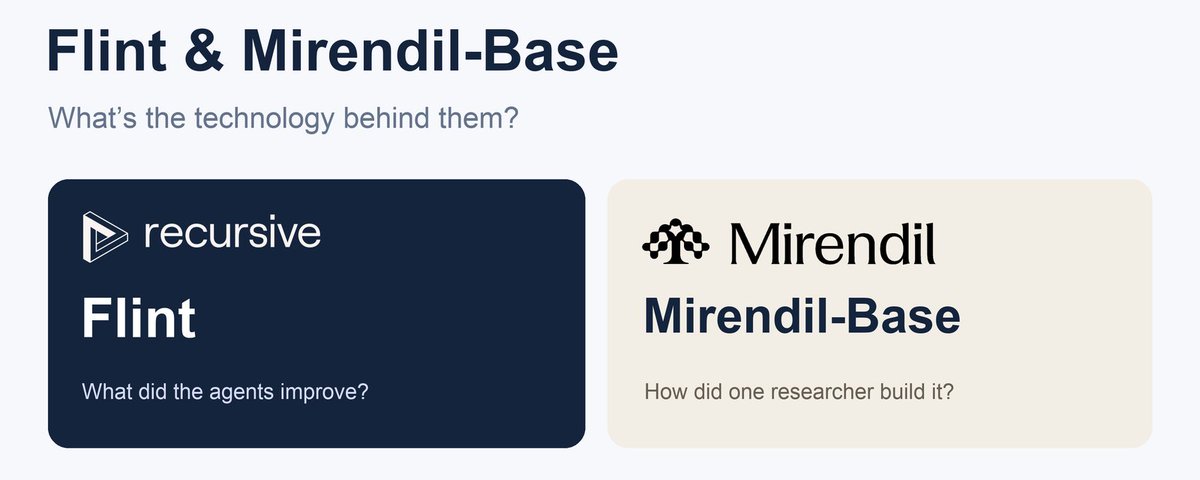
What did the agents actually do in Flint and Mirendil-Base?
@Recursive_SI’s Flint release describes specific architecture, quantization, and kernel changes found by Eureka. @mirendil reports that one researcher + agents pretrained a 100B–500B model in 3.5 months, with agents writing over 99% of the code.
I broke down the technical improvements, the research loops, and the remaining judgment bottleneck in this piece.
Another important RSI milestone today. @mirendil pretrained a 500B coding model from scratch in 3.5 months. We’re clearly entering the era of LMs helping train LMs. Curious how this might work in practice? In LM2LM we train models to propose better LM improvements, using a Research World Model with periodic real calibration. A 27B model outperforms GPT-6-sol (even with 300 real experimental records in context) at 33% lower data-generation cost.
Paper: arxiv.org/abs/2610.23344


We formally announced Mirendil less than 4 months ago. Today, I'm excited to share an important milestone for:
Pretraining at scale without a pretraining team.
Mirendil's mission is to solve Recursive Self-Improvement (RSI) and use it to democratize frontier AI development, ultimately accelerating science and technology. At Mirendil, when we think about RSI, we think holistically about the company as an intelligent entity that self-improves toward its goal. From that perspective, the most powerful notion of acceleration is reducing the time and resources (number of human experts, compute, and other costs) needed to achieve ambitious goals.
Given that pretraining is perhaps the most important yet most challenging part of frontier AI development, we decided to run an ambitious controlled experiment: Starting fully from scratch, can we significantly reduce the time, number of human experts, and compute resources needed to go all the way to successfully pretraining a strong coding model at scale?
Mirendil-Base is the result of this experiment. Our first pretrained model was built by one researcher in 3.5 months, with less than $10M in compute. This includes all the research and small-scale experiments it took to get there, as well as the final training run.
The recipe holds up as the models get bigger. For reference, Mirendil-Base is in the 100B-500B parameter range, Mirendil-Base-Large in the 500B-2T range, and Mirendil-Base-XL in the 2T-10T range.
We're beginning to see a world where a single researcher, empowered by AI, can take on work that once required an entire research organization. As these systems improve, the bottleneck shifts from the size of a team to the ambition and judgment of the people directing them. This has profound implications for who gets to build AI and, ultimately, who gets to push the frontiers of science and technology forward.
We’ll share independent evaluations, post-training benchmarks and API-access sooner than you think so stay tuned!

Recursive shipped Flint, built in under 4 months with their automated research system.
A concrete bottleneck that shows up in these loops: how do you cheaply evaluate the quality of the proposals the system generates?
We studied this in LM2LM — training models to propose better LM improvements with a calibrated Research World Model. 27B beats GPT-6-sol (with 300 real records) at 33% lower data cost.
Paper: arxiv.org/abs/2610.23344

Introducing Flint, @Recursive_SI’s first model: a fast local coding model built with our automated research system, the Eureka Machine.
• Best-in-class fast local coding
• Up to 2x faster than comparable models: 125+ tokens/sec on a MacBook Pro, 150+ on RTX Spark
• Built from scratch in under 4 months
Private, unmetered intelligence on your own machine. Open weights available now on @huggingface, run it locally on your favorite framework or try it for free on @opencode or @pidotdev.
Also congrats to the authors of two papers @linminhua16 @Zevin_Liu @zijun_wang2002 @WengZhaoti39773 @binghe2727 @sammyershi @dakuowang @YisiSang Suhang Wang @cihangxie @yuyinzhou_cs Wei Jin Benoit Dumoulin Xiang Zhang
Related Paper (AI Research World Model): arxiv.org/abs/2610.12235
LM2LM Paper: arxiv.org/abs/2610.23344
𝐁𝐞𝐭𝐭𝐞𝐫 𝐩𝐫𝐨𝐩𝐨𝐬𝐚𝐥𝐬, 𝐥𝐨𝐰𝐞𝐫 𝐜𝐨𝐬𝐭. LM2LM-trained Qwen3.8-27B outperforms GPT-6-sol—even when GPT-6-sol receives 300 real experimental records in context—at 33% lower data-generation cost.
These gains are measured by actually running the proposed experiments.
Average improvement over 4 executed proposals from different models. (10⁻³ BPB; higher is better)

The widely cited 𝟏𝟔× pretraining compute gap has made diffusion LMs look prohibitively expensive to train from scratch. Our new work with @Guanghan__Wang and collaborators revisits that assumption across ~𝟏,𝟕𝟎𝟎 models. With exact-likelihood evaluation and modern block-diffusion architectures, we find a 𝟑–𝟖× gap at matched likelihood, depending on block size.
This is what LM research often looks like: running large numbers of experiments to establish a robust finding.
It raises a natural next question:
𝐜𝐚𝐧 𝐀𝐈 𝐥𝐞𝐚𝐫𝐧 𝐟𝐫𝐨𝐦 𝐞𝐱𝐩𝐞𝐫𝐢𝐦𝐞𝐧𝐭𝐚𝐥 𝐞𝐱𝐩𝐞𝐫𝐢𝐞𝐧𝐜𝐞 𝐭𝐨 𝐜𝐡𝐨𝐨𝐬𝐞 𝐛𝐞𝐭𝐭𝐞𝐫 𝐞𝐱𝐩𝐞𝐫𝐢𝐦𝐞𝐧𝐭𝐬—𝐚𝐧𝐝 𝐚𝐜𝐜𝐞𝐥𝐞𝐫𝐚𝐭𝐞 𝐢𝐭𝐬 𝐨𝐰𝐧 𝐫𝐞𝐬𝐞𝐚𝐫𝐜𝐡?
More on our RSI work soon.

Diffusion language models (DLMs) are often seen as inefficient to pretrain, said to need 16x the compute of autoregressive models to reach the same likelihood.
We revisited this with ~1,700 models. Under current DLM practice, the gap is 3-8x, not 16x.
guanghanwang.com/dlm-scaling

Paper: arxiv.org/abs/2610.17590Proj…
Website: guanghanwang.com/dlm-scaling
Code: github.com/amazon-science/dl…
Henry Lu retweeted

New Amazon paper shows that an LLM can act as a research world model, predicting whether a training change will help before anyone spends GPU time on it.
AI research agents can propose experiments far faster than teams can afford to run them. Choosing what gets GPU time means guessing outcomes in advance.
They used an LLM as a research world model that predicts an experiment's gain before it runs. They tested it on 2,653 real experiment records from 9 setups, from pretraining to inference.
Past records from the same setup raised average ranking correlation with actual results from 0.506 to 0.774 across 5 setups. On the OLMo3-100M setup, adding records at low reasoning effort scored 0.892, while max effort without records reached 0.648.
If you run research agents, log every experiment, including failures, and feed those records to whatever model picks the next run.

Henry Lu retweeted

4/ Our Team
OpenRSI-Index is initiated with partners across UW, UC Berkeley, Harvard, Stanford, Princeton, MIT, and more.
Grateful to our advisors: @WenhuChen, @alvinkcheung, @YejinChoinka, @JianfengGao0217, @HannaHajishirzi, @PangWeiKoh, @RanjayKrishna, @HenryL_AI, @karthik_r_n, Kunle Olukotun, @rpanda89, @UWEEChair, @dawnsongtweets, @ysu_nlp, @hhsun1, @Diyi_Yang, Ming-Hsuan Yang, @xiangyue96, @JianZhangCS, @yuz9yuz, @LukeZettlemoyer.
Grateful to our wonderful team: @yuetai12575, @zhuofengli96475, @YichenFeng_, @David_Han66, @wenhaocha1, @ChengleiSi, @NuoJohnChen, @zhcui0408, @ShangdingG95714, @rilyn_han, @ZhengyuHu477, @HangHua_, @HowieH36226, @CaraLi72918, @lihanc02, @nathan_sj_stem, @XiangLiu1995, @lupantech, @Lyubh22, @zixianma02, @MangQiuyang, @RulinShao, Venkat Srinivasan, @YiyouSun , @makingAGI, @nwang22, @yangzhen04, @jianxie_, @bri25yu , Gaoyuan Zhang, @qizhengz_alex , Weichen Zhang , Kaiyuan Zheng

Proud to co-lead and advise @OpenRSI . Here's why I think it matters:
Every RSI claim today is evaluated at the scale where retries are cheap — and cheap retries are exactly what disappear when a single trial is a 20K-GPU-hour training run. Whether the loop survives that regime is the actual question, and until now nobody could check.
What makes this benchmark different is the signature tasks — and designing them was the hard part. At 1k-GPU scale, a task has to clear four bars at once:
- the lane has to matter (a real pre/post-training recipe, not a toy)
- the verifier has to sit outside the agent's reach
- the human baseline has to be a matched rerun rather than a paper number
- the whole thing has to stay runnable on someone else's cluster.
Most benchmarks get one or two of these. Getting all four is expensive and unglamorous, which is why it hadn't been done — and why the Marin results, small as they are, are the first verifiable datapoints of an agent beating a human-designed method at scale.
Lucky to be building this with a community that actually wanted to do the unglamorous part. If you have a real training lane or spare compute, contribute — this is the ruler the next two years will be measured with.

As AI systems enter a recursive self-improvement loop, the central question is whether it can systematically move beyond human-designed methods to genuinely extend the scientific and intelligence frontier.
What’s missing is a neutral, open standard for evaluating these capabilities in real, production-scale intelligence development.
Today, we’re releasing OpenRSI-Index v0.1: evaluating whether AI can recursively improve itself and push the boundaries of intelligence and science, on production-scale clusters with 1k GPUs.
We turn fully open-source projects into autoresearch environments, with agent trajectories lasting 60+ hours. Building v0.1 took 100K+ H100-hours.
We’re building an ecosystem with and for the research community: let RSI benefit everyone, and let everyone shape RSI together.
We invite task contributors and compute partners to build this open benchmark with us - all contributors will be included as paper authors.
Shape RSI with us:
🌐 Website: index.openrsi.foundation/ind…
🛠️ GitHub: github.com/OpenRSI-Foundatio…
🤝 Contribute: github.com/OpenRSI-Foundatio…

Humanity has entered a new 𝐀𝐠𝐞 𝐨𝐟 𝐃𝐢𝐬𝐜𝐨𝐯𝐞𝐫𝐲. Frontier models are the 𝐬𝐡𝐢𝐩𝐬. Everyone is racing to launch a bigger flagship.
Navier–Stokes falling to an agent fleet in 88 hours is a landfall — not the shipyard.
RSI is what matters. It is how you use this ship to build the next one. Ships go obsolete. Shipyards don’t.
🤖 Made with AI

ALT AI Models are the Ships of the New Age of Discovery

We’re sharing a solution to the Navier-Stokes Millennium Prize Problem, one of the deepest problems at the frontier of mathematics.
The proof was produced by a group of agents, using an OpenAI next-generation model significantly more capable than GPT-6 Astra.
The problem concerns whether the description of smooth three-dimensional fluid motion modeled by the Navier-Stokes equations can break down. It has remained unresolved for roughly 90 years.

Excited to share that two of our papers on self-improving agents have been accepted to 𝐄𝐌𝐍𝐋𝐏 𝟐𝟎𝟐𝟔! Code for both is released in A-Evolve.
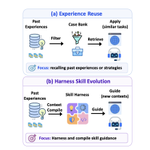
1. 𝐇𝐚𝐫𝐧𝐞𝐬𝐬 𝐔𝐩𝐝𝐚𝐭𝐢𝐧𝐠 𝐈𝐬 𝐍𝐨𝐭 𝐇𝐚𝐫𝐧𝐞𝐬𝐬 𝐁𝐞𝐧𝐞𝐟𝐢𝐭 — The evolver’s base capability barely matters. Harness benefit is non-monotonic: mid-tier agents gain the most.
2. 𝐄𝐯𝐨-𝐇𝐚𝐫𝐧𝐞𝐬𝐬: 𝐂𝐨𝐧𝐭𝐞𝐱𝐭-𝐭𝐨-𝐇𝐚𝐫𝐧𝐞𝐬𝐬 𝐒𝐤𝐢𝐥𝐥 𝐂𝐨𝐦𝐩𝐢𝐥𝐚𝐭𝐢𝐨𝐧 — How to turn single noisy executions into reusable skill harnesses on the fly.
Both works dig into the same core question: 𝐖𝐡𝐚𝐭 𝐚𝐜𝐭𝐮𝐚𝐥𝐥𝐲 𝐦𝐚𝐤𝐞𝐬 𝐚𝐧 𝐚𝐠𝐞𝐧𝐭 𝐢𝐦𝐩𝐫𝐨𝐯𝐞 𝐢𝐭𝐬𝐞𝐥𝐟 𝐭𝐡𝐫𝐨𝐮𝐠𝐡 𝐢𝐭𝐬 𝐡𝐚𝐫𝐧𝐞𝐬𝐬
Congrats to the authors! @linminhua16 @wei_tianxin @sammyershi @binghe2727 @YisiSang @dakuowang @zijun_wang2002 @cihangxie @HenryL_AI
Paper links + more details in the replies 👇


When you building a self-improving agent, two natural questions emerge: 𝐐𝟏: 𝐖𝐡𝐢𝐜𝐡 𝐦𝐨𝐝𝐞𝐥𝐬 𝐩𝐫𝐨𝐝𝐮𝐜𝐞 𝐭𝐡𝐞 𝐛𝐞𝐬𝐭 𝐡𝐚𝐫𝐧𝐞𝐬𝐬 𝐮𝐩𝐝𝐚𝐭𝐞𝐬? 𝐐𝟐: 𝐖𝐡𝐢𝐜𝐡 𝐦𝐨𝐝𝐞𝐥𝐬 𝐛𝐞𝐧𝐞𝐟𝐢𝐭 𝐦𝐨𝐬𝐭 𝐟𝐫𝐨𝐦 𝐡𝐚𝐫𝐧𝐞𝐬𝐬 𝐮𝐩𝐝𝐚𝐭𝐞𝐬?
Our new paper has counter-intuitive answers to both: they decouple from model capability, in opposite ways.
Q1 (who produces good updates): the updater's base capability barely matters.A 9B model (Qwen3.5) produces harness updates that match Claude Opus 4.6's. Best vs worst evolver gap ≤3.1pp.
Q2 (who benefits most): non-monotonic.Mid-tier solvers benefit the most. Strong-tier hits ceiling. Weak-tier benefits LEAST despite the most headroom — failing at two layers: skill activation (25% vs ~96% for strong) and adherence drift across trajectory (~4x steeper).
Tested across 7 evolver models × 6 solver agents × 3 agentic benchmarks (SWE-bench Verified, MCP-Atlas, SkillsBench).
Implication: don't pay frontier prices for both halves of the loop. Put capability budget on the agent (solver), not the evolver.


Harness Updating is Not Harness Benefits: arxiv.org/abs/2605.30621
Evo-Harness: arxiv.org/abs/2608.15071
Code: github.com/A-EVO-Lab/a-evolv…

Jeff Dean isn't the first top researcher to quit a frontier lab for RSI. @MillionInt left OpenAI to build Core Automation. An ex-Anthropic team raised a $200M seed for @mirendil . @RichardSocher and @jeffclune founded Recursive. Same RSI mission — but not the same bet. What each is actually betting on, and how far they've gotten, in article: teapaw.org/HenryL_AI/status/20853…

Tomorrow will be my last day at Google after 27 years, and watching it grow from 25 people to 190,000+ has been an amazing journey. Below is a note I shared with many people internally at Google today. An excerpt is:
It has been an absolute pleasure to work with you and to help build some of the most widely used and impactful products of all time. As a kid, I dreamed of helping build software that would be used by many people, and Google now has thirteen products used by more than a billion people (amazing!). Our work has had a tremendous impact in the world, and I have been lucky enough to collaborate and form friendships with many colleagues that I deeply admire, respect, and enjoy. It still brings me joy every time I see people out in the world using our products to find information, handle email, translate documents, watch videos, learn new things, navigate and understand the physical world, browse the web, use their phone, run large-scale computations on our infrastructure, ride in an autonomous vehicle, or perform complex tasks with the help of our AI systems. I hope you all share this sense of joy, because it is a shared accomplishment! Thank you to all of my colleagues at Google over many years!
Now I'm excited to go start @DiscoLoopAI with my longtime friends and colleagues @Sanjay_Ghemawat, @OriolVinyalsML, and @quocleix.
(Updated post: slightly redacted to not have some personal info)


And the most interesting thing about Discovery Loop is the announcement they haven't made yet: their first benchmark. Benchmark choice is thesis statement. teapaw.org/HenryL_AI/status/20853…
