

an econometrician who studies and teaches macro and investment.
Joined May 2017
- Tweets1.4K
- Following559
- Followers483
- Likes340



It feels like, in The Godfather, Tom Hagen was removed by Michael Corleone because he is not a "wartime consigliere."

Today is my last day as White House Chief of Staff.
Serving President Trump in the White House has been the honor of a lifetime. I’m so proud to have been a part of what we’ve accomplished together from securing our border and cutting taxes to strengthening our economy and putting America First.
More than anything, I’m grateful for the extraordinary people I’ve had the privilege of working alongside. While my role may be changing, my commitment to the President and the mission never will.
JQ retweeted

Thank you, Florin, for sharing this beautiful paper.
What I will remember most about Perry, though, is that he eventually took a different road and the courage it took to do so.
He had a Harvard PhD and a JPE paper. Everything was there for a conventional career in macroeconomics.
Instead, he turned away from mathematical economics and read Bagehot, Hawtrey, Allyn Young, Hicks and Minsky, forgotten traditions of monetary thought that he brought back to life as what he called the money view. He later said he almost did not survive it. Most of his papers were rejected, and Barnard told him his record was not strong enough for tenure. He eventually got it for a book, The Money Interest and the Public Interest, in which he went looking for what he called his intellectual ancestors.
Perry sometimes called himself, too modestly, a historian of economic thought. As Florin says, he remained to me an elegant and deep theorist even when not using mathematics, while now working in a direction orthogonal to most of the profession. I genuinely believe he had far more impact this way, and did more for our understanding of money, than he ever could have on the conventional path.
He also made a choice that would be unusual today, spending much of his time building his synthesis in his money and banking course at Barnard, with his students. The course became a MOOC with close to 200,000 enrollments, and an eye-opener for many.
I was one of them. I signed up while interning at the ECB as a PhD student, without expecting much. I was amazed by how much I learned. It was different from everything I had been taught, and complementary to it. I remember trying to follow the balance sheets of the shadow banking system he drew on the pixelated board, and the eureka moments when he had us look past the institutional details to the same economics of banking and central banking across countries and centuries. I remember him deciphering the euro crisis live.
That course, and the reading that followed, shaped the monetary economist I became. Writing on repo, FX swaps and stablecoins, I have tried to understand shadow banking the way he taught us, as an ecosystem of interlocking balance sheets where heterogeneous institutions together transform liquidity exactly as a bank would. Almost every paper I have written starts with the balance sheets of the model.
As always happens when someone you have learned so much from passes, I wish I had interacted with him more, and had been more explicit about what my work owes him.
Perry found his intellectual ancestors in forgotten books. He is now one of mine, and I will do my best to carry the money view forward.

RIP Perry Mehrling.
An incredibly elegant and deep theorist, especially for all things "money".
This 1993 note is a gem (on the suboptimality of the Friendman rule in Bewley models due to redistributive effects).
(HT @a_auclert who first pointed me to this paper 10+ years ago!)

Treasury Secretary's tantrum against a respected journalist shows that he is emotionally exhausted. It is not surprising, considering the multiple tasks he is facing. The control of the Treasury yield, the Yen exchange rate (to help control Treasury yield), to maintain USD's reserve currency status (which requires a functioning Treasury debt market), and the manipulation of oil prices (to keep inflation from exploding before the mid-term election). The tantrum may mark a crucial turning point for several markets.
So funny

BYD has breached the walls of fortress Japan.
I remember hearing horror stories of trying to sell cars in Japan as a young engineer in GM.
GM did a huge push to sell the Opel branded vehicles in Japan back in the 90’s. They Spent hundred of millions and the first year we sold 1,600 Cars.
After some studies, they determined sales were slow because the steering wheel was on the wrong side of the car.
So we changed the steering wheel location and sales went DOWN.
More studies determined the only reason we had sold 1,600 cars was because some people liked the steering wheel on the opposite side.
JQ retweeted

Tony Feng is a mathematics professor at UC Berkeley, and he tells us:
« In the past, the path to a math Ph.D. cultivated resilience, resourcefulness, critical thinking, and a healthy skepticism (…) but suddenly you can produce a passable Ph.D. thesis with the push of a button. »
Obviously, it is not just in mathematics. Obviously.
Want to write a PhD in sociology, education, computer science, or mechanical engineering? Press of a button.
Let us go back in time. I started university before the web. At the time, you had to go to a physical library to do research. You would wander through the (paper!) journals, find something interesting, and either read it there or make a copy or borrow it.
When I finished my PhD, I had stashes of journal articles, categorized in some way. I had collected them over years. I did not have a search function, and certainly not an AI helper. So you sort of had to memorize the important papers.
Working alone, with little help from your thesis supervisors, was not great. That was an era where the quality of your thesis supervisor mattered a great deal. If they knew the literature of a domain like the back of their hand, they could really direct you to read the proper work. It made a huge difference.
Then we got the web, and search engines. At first, I would just dump a lot of PDFs on my disk and search through them for keywords.
Then we got Google Scholar. What a breakthrough! A full index of the entire scientific literature. It was like having a friend with an encyclopedic knowledge of the literature with you at all times.
At that point, if you were a lone fellow in some corner of the world and somehow had library access to the PDFs, you could reasonably, on your own, pick a topic and find out what people had written about it, not in years, but in days or maybe hours.
All along, the number of people writing PhD theses went up. in the United States it rose from about 36,000 in 1990 to over 58,000 in 2024, while in China it exploded from just a few thousand in the early 1990s to roughly 88,000 per year today.
Then it became much easier to share code, and then data.
Even in the physical world, research became somewhat easier to automate. Drones can fly over a forest, taking pictures. We have robots that can conduct chemical analysis and experiments.
And then, the biggy: we got agentic AI.
I could, today, write a PhD thesis generator. Enter a topic, and a PDF that looks like what would have been accepted for a PhD in 2015 will come out.
Consider that most PhD theses were never good. How often do you rush to read a PhD thesis? The vast majority of them are painful to read. You learn little if anything.
So the bar is not as high as people imagine.
And that’s where we are today.
So people tell me: “Yeah, but to get the PhD, you have to present it live and answer questions.” Yeah. About that. For social reasons, it is highly uncommon for people to fail the oral defense of their thesis. Some people are just terrible at it, naturally. They cannot think well on their feet. They get confused and answer the wrong question.
I was at an oral defense a few months ago. My older colleague kept raving about the extensive review of the literature. He kept saying that he had never seen such a young person produce such an extensive review in so little time. This same colleague is proud to say that he opposes ChatGPT and friends. Would I tell him? No, I kept my mouth shut. I am never rude on purpose.
To sum it up, the very foundation of modern academia has been blown to bits. Not shaken. Wiped out.

I've seen this sentiment from several mathematicians, and it is understandable, but I feel it is also dangerously wrong. I say this because I think mathematicians need to adapt hard and fast, instead of wishing that the disruption from AI will somehow go away.
There is a science to large language models and it predicts that with the linear scaling rate we are seeing now, capabilities will increase over the next 5 years at a similar rate as the last 5 years. To get a sense of what that means, one of the main benchmarks 5 years ago was GSM8K, whose questions you can see for yourself at huggingface.co/datasets/open….
There also seems to be a misconception that frontier labs are emphasizing math right now, and spending a lot on solving open math problems, in order to advertise the intelligence of their models. There was some truth to this 7-10 months ago, but that time has passed and most labs are now focused on coding agents. The continued improvements in math are largely a side effect.
In the past, the path to a math Ph.D. cultivated resilience, resourcefulness, critical thinking, and a healthy skepticism. These qualities are still needed today, perhaps more than ever, but suddenly you can produce a passable Ph.D. thesis with the push of a button. This signals that the field needs to completely overhaul itself, starting now.
My recommendation is that the future role of humans in mathematics, and similar theoretical fields, should be preserving and disseminating knowledge in oral and social forms; written papers will be the domain of AI. Over the coming months I will be involved in workshops that aim to produce more concrete proposals. But people need to come to terms ASAP with the fact that drastic change and compromise are needed to prevent the disenfranchisement of humanity from knowledge work.

If this turns out to be true, then the world will lose not only the oil through Hormuz, but all the oil from the Middle East.

JQ retweeted

#SaudiArabia: crude and refined product exports were at 4.517mbpd in May versus 4.995mbpd in April according to
@JODI_Data
#oott


JQ retweeted

For those in the oil industry, you might wanna flag this strategic and jurisdictional ass-covering.
EIA just published a warning (16 July) that Cushing’s reported inventory may overstate how many barrels are actually usable as stocks approach tank-bottom levels.
If Cushing tightens further and someone asks why prices exploded despite having 18 million reported barrels, the answer is ready:
"Those barrels were technically present but not operationally accessible."
That changes the political framing from:
"The government allowed inventories to become dangerously depleted."
to:
"The market encountered a complex technical storage limitation."
Jurisdictiional angle:
By publishing this now, EIA effectively says:
"Our headline series should not be interpreted as proof that all reported barrels remain available. We have now disclosed the limitation."
If policymakers continue drawing down buffers after this warning, EIA has separated itself from the decision.
This isnt merely the admin covering its ass. Its potentially one bureaucracy protecting itself from another part of government.
#OOTT

Why did the EIA TODAY put out a 1-pager on tank bottoms warning about minimum operating limits "in extreme cases"? Why now????? eia.gov/todayinenergy/detail…


JQ retweeted

Brent crude rose ~$3/bbl between these survey windows, so this would be pretty bullish if none of that was driven by a bounce in net spec positioning.
(need to wait another 45 minutes for CFTC CoT data to be sure they didn't just go hard on WTI)

Money managers reduced their net-length in Brent crude oil futures and options by 547 to 55,087 in the week ending July 7
Long-only positions fell by 367
Short-only positions rose by 180
other reportables net-length fell by 34,183
ICE #oott
When a nation loses its sovereignty, it has to beg the conqueror to use its own wealth.

🇮🇶🇺🇸 Every dollar of Iraq's oil money flows into ONE bank account, and it sits in the United States.
Beirut-based writer Sharmine Narwani, of The Cradle, lays out an arrangement most people, including most Iraqis, have never heard of.
All of Iraq's oil revenues must be deposited into a single account in the US, and every month, Baghdad sends what amounts to an invoice to the Treasury Department explaining what it needs money for.
Washington then decides what Iraq gets.
The delivery method makes it stranger.
With key Iraqi banks under heavy US sanctions, the money arrives as pallets of cash flown in by airplane, a system Narwani says has fueled enormous corruption:
"I can't tell you, Mario, how many Iraqis don't even know about this."
This, she argues, is what strategic control actually looks like, a country's entire oil wealth flowing through a foreign government's approval process, one month at a time.
@snarwani
Many bad things can happen in the real world. The essence of carry trade (including oil short), however, is to ignore that and hope everything will be fine.

Norway oil service lockout takes effect, disrupts offshore drilling
Around 1,000 Norwegian oil service workers were locked out on Saturday morning in an escalation of a labour dispute that is expected to disrupt drilling and some production on the Norwegian continental shelf.
The lockout was declared in response to an ongoing strike by several hundred members of the Safe union and will affect companies including SLB, Halliburton, Subsea 7 , DOF Subsea, Weatherford, DeepOcean and Baker Hughes.
The country's oil and gas output could fall by about 12,000 barrels of oil equivalent per day (boepd) next week due to the strike and the lockout, industry group Offshore Norway said. (Rueters)
Good one. The crash of the Houston-Cushing spread signals the shortage of inventory at Cushing. It took me a while to understand why it also crashed in 2020 Apr when there was too much oil at Cushing. Because back then, Houston had even less space to store oil. Hence, the Houston price crashed more than Cushing.


JQ retweeted

EIA inventory report:
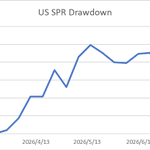
U.S. commercial crude inventories fell by 6 million barrels, while the Strategic Petroleum Reserve declined by a further 9 million barrels to a fresh multi-decade low. Combined, total U.S. crude stockpiles have fallen by around 100 million barrels since late April.
Inventories at Cushing, Oklahoma, the delivery hub for WTI futures, dropped to just 19 million barrels, the lowest level in 12 years and a threshold increasingly associated with operational constraints.
Gasoline and distillate inventories rose by 2 million and 3 million barrels, respectively, supported by robust refinery utilization and softer demand. Four-week average implied gasoline demand fell to the lowest seasonal level in 12 years, excluding the pandemic-affected period in 2020.
Total crude and refined product exports slowed to 12.1 million barrels per day, while U.S. crude production held steady at 13.8 million barrels per day.

JQ retweeted

Notable. Particulary when we are seeing things like this teapaw.org/chigrl/status/20697200…
#Iraq: Basra Oil Company directed operators at West Qurna/2 to suspend pumping entirely and cut production to 50,000 barrels per day effective midnight on June 23, citing the continued absence of available tankers under an ongoing force majeure condition.
According to an internal company document received by Shafaq News, the directive ordered a 100 percent suspension of pumping operations and instructed field operators to store remaining output in on-site tanks. No resumption timeline was specified in the document.
West Qurna/2 is one of Iraq's largest oilfields, located approximately 65 kilometers northwest of Basra in southern Iraq, producing around 460,000 to 480,000 barrels per day and holding an estimated 14 billion barrels of recoverable reserves. The field accounts for nearly 9 percent of Iraq's total crude output.
#oott shafaq.com/en/Economy/Iraq-c…

Shortage of vessels prolongs the shortage of oil.
Oil Tanker Booked in Gulf at 897% of Benchmark Freight Rate
A supertanker has been provisionally booked to transport oil from the Persian Gulf to India at a rate equivalent to almost nine times benchmark freight costs, an eye-watering price that reflects the shortage of available, empty vessels in the area.
The very-large crude carrier, capable of handling about two million barrels of oil, will be supplied by South Korea shipowner Sinokor at 897 Worldscale points, or 897% of the benchmark, according to shipbrokers. That fee ranks as the highest so far this year.
A message from the company received by shipbrokers on Wednesday and seen by Bloomberg News offered VLCCs for the loading of oil from Iraq’s Basrah terminal by June 24. It indicated it would pass through the Strait of Hormuz with the cargo. (Bloomberg)
Maybe because the x algorithm knows that I like reading bullish oil tweets, I seldom come across bearish ones. This is one. It is good to know what bears are thinking.

The timeline is hyperventilating over Middle East proxy wars while Brent quietly bleeds 26.6% to the absolute floor of its range at $77.08.
I have traded this exact structural setup before, and it does not end with a geopolitical supply shock.
It ends EXACTLY like Q3 2015.
Back then, consensus was obsessed with Fed hawkishness while the JCPOA sanctions relief prepared to flush millions of Iranian barrels into a fragile global economy.
Look at the actual mechanics of this new US "temporary waiver" for Iranian crude.
They are actively allowing Iran to clear oil sales in US Dollars.
This is not a diplomatic breakthrough.
It is a SYNTHETIC SPR RELEASE engineered to flood the physical market and crush energy inflation.
In 2015, that identical Iranian supply flush broke the back of the crude market and triggered a violent deflationary bust.
What blew up last time wasn't just oil—it was the entire high-yield credit market, which suddenly found itself choking on toxic, underwater energy debt.
Consensus is currently pricing a hard floor at $77 based on structural deficit fantasies.
The collateral math says those deficits are about to be buried under a massive wave of freshly legalized Iranian supply.
You can keep trying to scalp the daily noise of drone bases and carrier strike groups.
I am already positioned for the 2015 systemic repeat.
Bookmark this for when $BZ breaks $77 and credit managers suddenly remember how fast energy defaults can spiral.


It seems that SPR has a price bottom. Assume XOM pays $7500 today for 100b (unit price $75/b). If the price is $100 a year later, then XOM would have to return 120b (assume a 20% oil rate of interest) to SPR worth $12000. How can XOM accept this deal?
The US pledged to release 172M barrels in a joint global effort on March 11, 2026 to reach into SPR stocks to help mitigate the supply shock from the SOH close.
So far, the US has released ~ 75M barrels from the SPR.
That leaves ~ 97 more barrels.
Vitol buying 500K is miniscule, but it made headlines
The concerning part of this is that neither $CVX or $XOM wanted these barrels