
building the future of investing
Joined January 2026
- Tweets203
- Following398
- Followers100
- Likes162


mehek retweeted

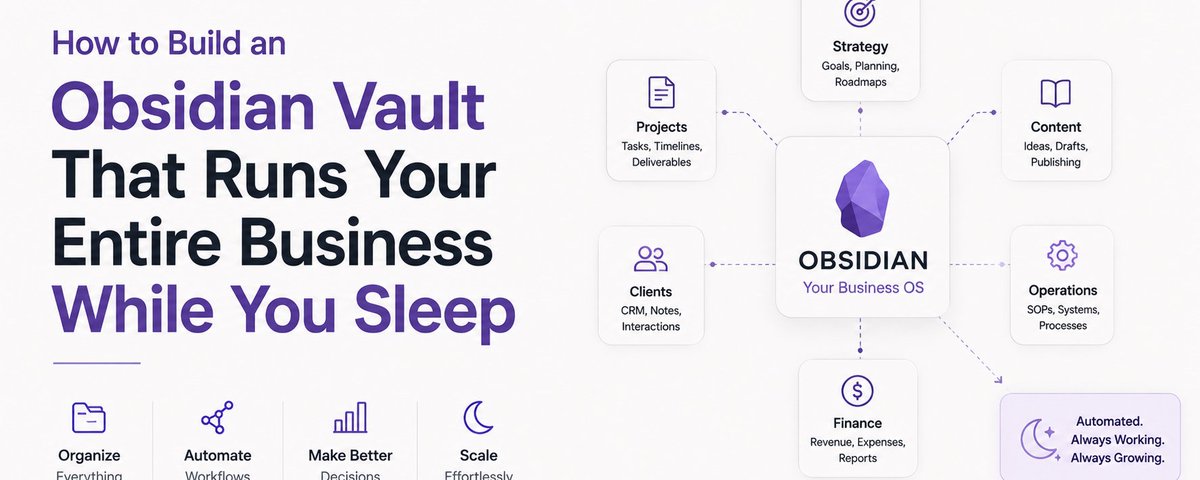
this is how the founder of obsidian actually takes notes in his own app.
most users get this wrong.
barely any folders. heavy internal linking. categories live as properties on the note itself.
article below teaches how to build personal knowledge base. video above is the underrated masterclass.


mehek retweeted

If you were the kid who carried every group project in school, you'll love the AI era.
People let you down. Agents will too. They break, they hallucinate, they do the wrong thing at 3am. The difference is the feedback loop.
When a person drops the ball, you have a conversation, wait a week, and hope it gets better.
When an agent drops the ball, you fix the prompt and it's better in 5 minutes. Same frustration with 100x faster resolution.
Not everyone will love working like this. But a lot of people will.
I really like it.


mehek retweeted

By the end of 2026, I predict token spend will be greater than engineering salaries at early stage startups.




mehek retweeted

얇은 하네스, 두터운 스킬.. AI 생산성 격차의 실제 이유
Garry Tan의 아티클에는 개인적으로 정말 공감가는 내용이 많았어요. 지난번 Claude Code 소스 코드를 저도 비슷한 관점으로 바라봤었거든요.
같은 모델을 사용하면서도 어떤 사람은 2배, 어떤 사람은 100배 더 생산적이죠. 차이는 모델의 지능이 아니예요. 모델을 감싸는 구조, 하네스에 있어요.
비밀은 모델에 있니? 아니요 모델을 감싸는 것에 있어요.
Thin Harness, Fat Skills...
↓
"하네스가 곧 제품입니다"
하네스는 LLM을 실행하는 프로그램입니다. 루프 안에서 모델을 돌리고, 파일을 읽고 쓰며, 컨텍스트를 관리하고, 안전을 담보합니다. 그게 전부예요.
문제는 많은 사람들이 하네스를 두껍게 만든다는 데 있습니다. 40개가 넘는 툴 정의가 컨텍스트 창의 절반을 잡아먹고, 2~5초씩 걸리는 MCP 라운드트립이 쌓이며, REST API 엔드포인트마다 별도의 툴을 붙입니다.
결과는 = 토큰 낭비, 지연, 높은 실패율..
올바른 방향은 반대입니다. 하네스는 얇게 유지하고, 대신 스킬을 두텁게 만들어야 합니다.
↓
이 아키텍처를 이해하기 위한 다섯 가지 개념이 뒤따라 나옵니다.
1. 스킬 파일
스킬 파일은 모델에게 "무엇을"이 아닌 "어떻게"를 가르치는 재사용 가능한 마크다운 문서죠. 중요한 점은 스킬 파일이 메서드 호출처럼 작동한다는 점. 같은 스킬, 같은 절차, 다른 세계.
2. 하네스
얇아야 합니다. 모델을 루프로 돌리고, 파일을 다루고, 컨텍스트를 정리하며, 안전을 지키는 것. 그 이상은 불필요합니다.
3. 리졸버
리졸버는 컨텍스트의 라우팅 테이블입니다. 어떤 작업 유형이 감지되면, 어떤 문서를 먼저 로드할지 결정합니다. 개발자가 프롬프트를 수정하려 할 때, 리졸버가 EVALS.md 를 먼저 불러옵니다.
그 문서에는 정확도가 2% 이상 떨어지면 되돌리라고 적혀 있죠. 개발자는 평가 스위트의 존재조차 몰랐을 수 있지만, 리졸버는 적절한 순간에 올바른 맥락을 가져옵니다.
4. 잠재적 vs. 결정론적
모든 작업 단계는 둘 중 하나에 속합니다. 잠재적 공간은 판단, 해석, 패턴 인식이 이루어지는 곳입니다.
결정론적 공간은 같은 입력이 같은 출력을 보장하는 곳으로, SQL과 컴파일된 코드가 여기에 해당합니다.
가장 흔한 실수는 결정론적 문제를 잠재적 공간에 밀어 넣는 것입니다.
5. 다이어리제이션
Diarization.. 이건 모델이 주제에 관한 모든 것을 읽고 구조화된 프로파일로 압축하는 과정입니다.
SQL 쿼리나 RAG 파이프라인은 이 작업을 대신할 수 없죠.
수십 개의 문서를 실제로 읽고, 모순을 파악하고, 변화를 추적하여 지적 요약을 만들어내는 것.
이것이 AI를 진정한 지식 작업에 활용하는 방법입니다.
↓
"스킬은 영구적인 업그레이드입니다"
그가 AI에게 내린 지시가 있었습니다.
> "일회성 작업은 하지 마세요. 같은 종류의 요청이 반복될 것 같다면, 처음 몇 번은 수동으로 하고 결과를 보여주세요. 승인이 나면 스킬 파일로 만드세요. 자동화가 필요하면 크론으로 등록하세요. 같은 요청을 두 번 받았다면, 실패한 것입니다."
이 지시가 1,000개의 좋아요와 2,500개의 북마크를 받았을 때, 많은 사람들은 프롬프트 엔지니어링 기법으로 이해했죠. 그런데 실제로는 아키텍처 원칙입니다.
작성된 모든 스킬은 시스템의 영구적인 업그레이드입니다. 저하되지 않고, 잊지 않으며, 새벽 3시에도 실행됩니다.
그리고 새로운 모델이 출시될 때마다 모든 스킬이 자동으로 개선됩니다. 결정론적 단계는 완벽히 신뢰할 수 있는 채로 유지되면서, 잠재적 단계의 판단력이 높아지기 때문입니다.
100배 생산성의 비밀은 더 똑똑한 모델이 아닙니다.
두터운 스킬, 얇은 하네스.. 여기에 모든 것을 코드화하는 규율입니다.
시스템은 복리처럼 쌓입니다. 한 번 만들면 영원히 실행됩니다.


mehek retweeted

INSTEAD OF WATCHING NETFLIX TONIGHT.
Spend 1 hour building this.
Obsidian + Claude Code = your own personal JARVIS.
A second brain that captures everything, connects every idea, and thinks alongside you using the most powerful AI model available.
Takes 1 hour to set up.
Works while you sleep.
The people who build this tonight will never work the same way again.
The people who skip it will still be taking scattered notes and losing their best ideas next year wondering why they cannot think clearly.
Your call.
mehek retweeted

🚨BREAKING: Claude can now find your startup's fatal flaw the way Paul Graham does in the first 5 minutes of an interview (for free).
Most founders discover it at month 8. Some never do.
Here are 9 Claude prompts that surface the real problem before you build the wrong thing.
(Save before you hire)


mehek retweeted

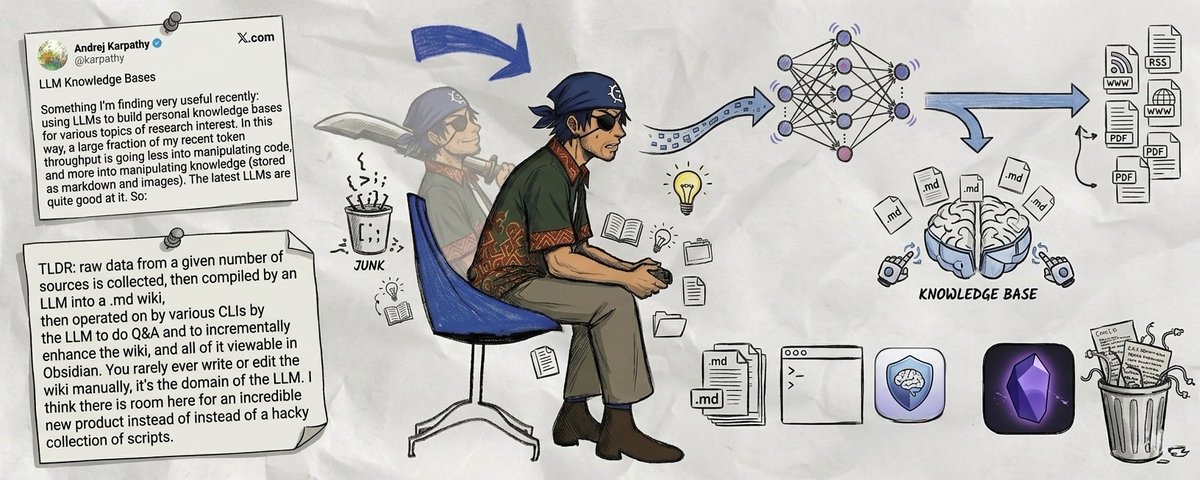
LLM Knowledge Bases
Something I'm finding very useful recently: using LLMs to build personal knowledge bases for various topics of research interest. In this way, a large fraction of my recent token throughput is going less into manipulating code, and more into manipulating knowledge (stored as markdown and images). The latest LLMs are quite good at it. So:
Data ingest:
I index source documents (articles, papers, repos, datasets, images, etc.) into a raw/ directory, then I use an LLM to incrementally "compile" a wiki, which is just a collection of .md files in a directory structure. The wiki includes summaries of all the data in raw/, backlinks, and then it categorizes data into concepts, writes articles for them, and links them all. To convert web articles into .md files I like to use the Obsidian Web Clipper extension, and then I also use a hotkey to download all the related images to local so that my LLM can easily reference them.
IDE:
I use Obsidian as the IDE "frontend" where I can view the raw data, the the compiled wiki, and the derived visualizations. Important to note that the LLM writes and maintains all of the data of the wiki, I rarely touch it directly. I've played with a few Obsidian plugins to render and view data in other ways (e.g. Marp for slides).
Q&A:
Where things get interesting is that once your wiki is big enough (e.g. mine on some recent research is ~100 articles and ~400K words), you can ask your LLM agent all kinds of complex questions against the wiki, and it will go off, research the answers, etc. I thought I had to reach for fancy RAG, but the LLM has been pretty good about auto-maintaining index files and brief summaries of all the documents and it reads all the important related data fairly easily at this ~small scale.
Output:
Instead of getting answers in text/terminal, I like to have it render markdown files for me, or slide shows (Marp format), or matplotlib images, all of which I then view again in Obsidian. You can imagine many other visual output formats depending on the query. Often, I end up "filing" the outputs back into the wiki to enhance it for further queries. So my own explorations and queries always "add up" in the knowledge base.
Linting:
I've run some LLM "health checks" over the wiki to e.g. find inconsistent data, impute missing data (with web searchers), find interesting connections for new article candidates, etc., to incrementally clean up the wiki and enhance its overall data integrity. The LLMs are quite good at suggesting further questions to ask and look into.
Extra tools:
I find myself developing additional tools to process the data, e.g. I vibe coded a small and naive search engine over the wiki, which I both use directly (in a web ui), but more often I want to hand it off to an LLM via CLI as a tool for larger queries.
Further explorations:
As the repo grows, the natural desire is to also think about synthetic data generation + finetuning to have your LLM "know" the data in its weights instead of just context windows.
TLDR: raw data from a given number of sources is collected, then compiled by an LLM into a .md wiki, then operated on by various CLIs by the LLM to do Q&A and to incrementally enhance the wiki, and all of it viewable in Obsidian. You rarely ever write or edit the wiki manually, it's the domain of the LLM. I think there is room here for an incredible new product instead of a hacky collection of scripts.


mehek retweeted

ran 1,500 companies through an AI enrichment pipeline
came out the other side with a projected $7,500 bill per run
changed which model tier we used for 3 of the calls
next run: $147
same output quality. same data. same pipeline.
the entire industry defaults to the most powerful model
available for every single task
this is driving to the mailbox in a Formula 1 car
here's how to actually think about it:
REASONING TASKS
→ Claude Sonnet/Opus — complex analysis, voice matching,
multi-step reasoning. anything where the output quality
directly affects revenue
FORMATTING / EXTRACTION (you already have the data,
you just need it structured)
→ GPT-4.1-mini — $0.40 per million input tokens.
this is the go-to for classification, JSON extraction,
reformatting. replaced GPT-4o entirely. cheaper and better.
→ Claude Haiku 4.5 — $1 per million tokens. same use case
when you need Claude-quality instruction following without
the reasoning overhead
WEB RESEARCH & ENRICHMENT
→ Perplexity sonar — $0.006/call. factual lookups,
news checks, basic research. most enrichment pipeline
calls belong here, not at the tier above it
→ Perplexity sonar-pro — $0.025/call. cross-referencing
multiple sources, financial synthesis, strategic extraction
→ Mistral Medium with web connector — ~$0.03/call.
solid for company enrichment. strategic initiatives,
financials, triggers. 97% cheaper than deep research
for the same quality on standard enrichment tasks
→ sonar-deep-research — $0.75-$1.00/call.
125x more expensive than sonar. use it when you
genuinely need 20+ search multi-hop browsing.
almost never for enrichment pipelines.
SPEED-FIRST INFERENCE
→ Groq — open source models (Llama, Mixtral, Gemma)
at inference speeds closed APIs can't match.
matters when pipeline response time is the bottleneck
OPEN SOURCE
→ Llama 3, Mistral, Qwen, Deepseek R1 — self-hosted.
when data privacy matters, when margins are thin at scale,
or when you need to fine-tune on proprietary data.
the gap between open and closed is closing faster
than most people realize
FRONTIER REASONING
→ GPT o3/o4 — OpenAI's reasoning ceiling.
use when you need it. prohibitive at pipeline scale
→ Grok 3 — xAI's flagship. stronger than most people
give it credit for on reasoning and real-time data.
it's connected to X natively — underutilized for anything
requiring social signal synthesis or market intelligence
the rule is simple:
match model capability to task complexity
most pipeline steps don't need intelligence.
they need reliable formatting at cheap compute.
that's a $0.40/million tokens problem.
not a $15/million tokens problem.
the companies winning on AI infra in 2026
aren't the ones with the best models
they're the ones who know which model to use for which job


mehek retweeted

Caught up with @karpathy for a new @NoPriorsPod: on the phase shift in engineering, AI psychosis, claws, AutoResearch, the opportunity for a SETI-at-Home like movement in AI, the model landscape, and second order effects
02:55 - What Capability Limits Remain?
06:15 - What Mastery of Coding Agents Looks Like
11:16 - Second Order Effects of Coding Agents
15:51 - Why AutoResearch
22:45 - Relevant Skills in the AI Era
28:25 - Model Speciation
32:30 - Collaboration Surfaces for Humans and AI
37:28 - Analysis of Jobs Market Data
48:25 - Open vs. Closed Source Models
53:51 - Autonomous Robotics and Atoms
1:00:59 - MicroGPT and Agentic Education
1:05:40 - End Thoughts

