

The global standard for benchmarking and valuing energy assets.
London, New York, Sydney
Joined March 2020
- Tweets731
- Following377
- Followers2.2K
- Likes646




Once a renewables developer reaches scale, bringing everything in-house can look like the obvious next step.
Mehmet Energin, Chief Commercial Officer at OX2, sees the risk: vertical integration can be a very expensive way of delivering worse results than a specialist partner would.
OX2 keeps mission-critical capabilities in-house and partners where the market offers strong alternatives, including optimisation. That works as long as incentives are aligned: if the asset performs, the partner is rewarded too. If the market shifts and incentives drift apart, the decision changes.
Full episode of Transmission below.
#BESS #Renewables #EnergyStorage #EnergyTrading

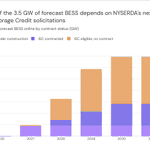
Modo Energy expects 3.5 GW of BESS online in NYISO by 2031, New York's 3 GW storage target plus 465 MW under construction.
Without a contract, a BESS in the Final Decision Period has a 13% historical chance of reaching operation. 75% would be in Zones G to K.

2
2
211
Australia has built batteries faster than any other country per capita. With more batteries competing for the same evening hours, NEM evening prices have more than halved in a year.
That makes solar valuable to batteries too. The two sit on opposite sides of the midday price. When midday prices crash, solar earns less but the battery charges for almost nothing. When midday prices hold up, solar earns more, even if charging costs the battery a bit extra.
In New South Wales this August, one day's midday prices collapsed and the battery earned about three times what the solar did. A week earlier, prices held up and it was the other way round.
Pair them, and one side covers the other as the daily price shape shifts.
#BatteryStorage #Solar #BESS #EnergyMarkets #NEM #Australia
Modo Energy retweeted

Monday was a big day for energy policy nerds.
I finally got through the (dozens of) show cause responses this week at @FERC.
One big takeaway: curtailment.
Four ISOs propose a new class of non-firm transmission service. A data center on it connects with the stipulation that it curtails under certain grid conditions. MISO, NYISO and ISONE would set those conditions with a price threshold: $100/MWh in MISO, $200/MWh in NYISO and $250/MWh in ISONE.
These are not emergency-level prices. MISO’s threshold is the first step of scarcity pricing. Since July 2023, the average MISO hub has been above $100/MWh for 246 hours a year, and the average NYISO zone above $200/MWh for 164.
Most data centers are designed for 99.99% uptime, under an hour of downtime a year. A campus on non-firm service would need on-site generation or storage to keep running through those hours.

Modo Energy retweeted

France: a 2-hour BESS earned an annualised €435k/MW/yr from April to September, when RTE nearly doubled the upward aFRR capacity it buys for the evening peak. Nearly 2 GW of fleet was in place to catch it, most of it built before spring.

ALT Chart: fr buildout 08 map

Five of six grid operators filed final responses to FERC's large load show cause orders by November 16. PJM would fold four studies into one 12-month process.
MISO, NYISO and ISO-NE would curtail non-firm load above $100/MWh, $200/MWh and $250/MWh respectively.

3
4
278

ERCOT: The battery fleet captured 50.3% of its Real-Time TBX opportunity and 77.4% of Day-Ahead in August 2026. Real-Time opportunity nearly doubled from July to $3.85/kW-month, and average battery revenue rose 83% to $1.94/kW-month.

2
2
203
Over the past year, solar farms in Australia's NEM earned about A$26/MWh. That's 60% below the average market price.
The cause is volume. Rooftop and grid-scale solar have boomed over the last decade. When the sun is out, everyone generates at once and midday prices crash.
Batteries change the picture. They charge at midday when power is cheap and sell into the evening, when prices are much higher.
#Solar #BatteryStorage #BESS #EnergyMarkets #NEM #Australia
1
2
315
Modo Energy retweeted
US BESS: China supplied 59% of lithium-ion battery imports in 2025, but switching to non-FEOC suppliers keeps the ITC. A US-made system runs $100/kWh above Chinese supply, and a 30% credit covers up to $125/kWh of that. The credit is worth more than the saving.

ALT Chart: feoc 3 cost waffle
Europe has added roughly 320 GW of renewable capacity in five years. That's about a third of its total renewable fleet, a 50% increase.
The rest of the system hasn't kept pace. Grid and storage are catching up but still behind, and demand has stayed largely flat.
That changes project economics. Mehmet Energin, Chief Commercial Officer at OX2, says the biggest shift is in how the industry understands risk-adjusted value, and that what the market rewards now is different from five years ago.
Full episode of Transmission out now.
#Renewables #EnergyStorage #BESS #EnergyTransition
Standalone solar in Australia's NEM peaked in 2025.
That capacity is now shrinking as existing solar farms retrofit batteries. And 98% of new grid-scale solar in the pipeline comes with a battery attached.
Most of those new projects are hybrids, with the solar and battery sharing one grid connection. The reasons go beyond shifting midday solar into the evening.
#Solar #BatteryStorage #BESS #EnergyStorage #NEM #Australia
2
4
267
Modo Energy retweeted

Global battery production capacity is over 6TWh, production this year will be closer to 3TWh…
Check out my discussion with @edcporter covering the latest across the battery supply chain !
youtube.com/watch?v=oa5QwsrS…
