Promoting #OpenJustice in the English Court of Protection Core team @GillLoomesQuinn @AmandaAPHill @DanielClark132 @KitzingerCelia @DocCMartin

Joined June 2020
Open Justice Court of Protection Project retweeted
BBC News (UK)
@BBCNews6h
Daughter wins £127k claim for caring for mum at home bbc.in/4BsJONK
24
38
4
191
88,022
Open Justice Court of Protection Project retweeted
And if documents are referred to in the course of the hearing, the public should get to read those documents.
1
10
163
2,255
Open Justice Court of Protection Project retweeted
So if evidence is given by way of witness statements in a public hearing, the default position is that the public should be able to read the statements. If submissions are made partly or wholly in writing, the public should get to read the submissions.
1
11
175
2,215
Open Justice Court of Protection Project retweeted
There's good reason for this. It goes back to open justice. Open justice is pretty meaningless unless observers (which includes those who read about the case after the event) aren't in a position to understand what they hear.
2
7
1
171
2,246
Open Justice Court of Protection Project retweeted
Open justice is a fundamental feature of any properly-functioning legal system. If justice can't be seen to be done, there's no reason to trust that it is being done.
1
19
243
2,593
Open Justice Court of Protection Project retweeted
Open Justice Court of Protection Project@OpenJusticeCoPOct 23
NEW BLOG POST By @Kitzingercelia Two non-compliance hearings concerning Finance Deputyship applications: Finding pragmatic ways forward openjusticecourtofprotection… via @OpenJusticeCoP
2
295
Open Justice Court of Protection Project retweeted
If anyone knows a London cab (white) with the payment title JOHNSWHITETAXIH can you PLEASE ask him to contact me urgently. I have left my bag in his taxi. He picked up from the Supreme Court at about 6pm and dropped at Bedford row #londontaxi #blackcab #lostproperty
12
107
4
130
101,444
Open Justice Court of Protection Project retweeted
23 OCTOBER 1991. SHE WAS HIS WIFE. SHE WAS NOT HIS PROPERTY. The day the House of Lords ended the marital rape exemption in English common law. For centuries, English law had tolerated an extraordinary proposition: that a woman, simply by marrying, had given her husband consent to sexual intercourse that she could never withdraw. The idea was famously expressed by the 17th-century jurist Sir Matthew Hale and published in his History of the Pleas of the Crown in 1736. It became known as the marital rape exemption. It rested upon a legal fiction: that marriage itself supplied permanent consent. A woman's refusal could therefore be treated very differently depending upon whether the man assaulting her was her husband. On 23rd October 1991, the House of Lords decisively rejected that doctrine. The case was R v R. A husband had been convicted of attempted rape and assault occasioning actual bodily harm after attacking his estranged wife. He appealed, arguing that a husband could not, in law, be guilty of raping his wife. The legal question before the House of Lords was stark: Could a husband be criminally liable for raping his wife? The Law Lords unanimously answered yes. Lord Keith of Kinkel examined the history of the supposed exemption, including the increasingly narrow exceptions that courts had developed over the preceding decades. The problem was not simply that the law was old. It was that the principle upon which it depended was indefensible. Marriage did not make consent irrevocable. The judges rejected the proposition that a husband possessed a special immunity from the ordinary criminal law of rape. Importantly, Parliament did not pass a new law legalising prosecution on that day. The House of Lords removed a supposed common-law immunity, recognising that it no longer formed part of English law. The ruling was a landmark for England and Wales. Scotland had already rejected the supposed marital exemption in 1989. And it raises an uncomfortable historical question. How many generations of women had lived under a legal system in which marriage was treated as diminishing their right to refuse? A wedding ceremony does not extinguish bodily autonomy. Marriage is not perpetual consent. Thirty-five years ago today, the highest court in the land confirmed a principle that should never have been in doubt. Historical source: R v R [1991] UKHL 12, 23 October 1991.
16
96
11
244
12,642
Open Justice Court of Protection Project retweeted
Open Justice Court of Protection Project@OpenJusticeCoPOct 21
This is a remote hearing to consider P's capacity and, if she lacks capacity, whether it is in her best interests to be "decanted" from her property for the completion of repairs. Email the court to ask for the link
1
226
Open Justice Court of Protection Project retweeted
Open Justice Court of Protection Project@OpenJusticeCoPOct 21
New blog by @JennyKitzinger "I’m glad the judge gave P's 'daughter the interim deputyship – she looked relieved, and the judge’s decision seemed like a pragmatic step to try to ensure that the relevant information is available for the next hearing." openjusticecourtofprotection…
2
2
390
Open Justice Court of Protection Project retweeted
Open Justice Court of Protection Project@OpenJusticeCoPOct 21
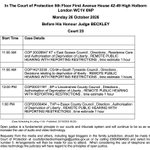
This is a remote hearing you can observe on Thursday 22nd October 2026. To ask for the link, [email protected] cc. to [email protected]. We have some guidance on our homepage: openjusticecourtofprotection…
1
1
193
Open Justice Court of Protection Project retweeted
It may be a good moment for me to observe that the fact that a hearing takes place in private does not in itself render what took place at it confidential.
Today's hearing in the case has been changed to a private case management hearing and no observers are allowed. Submissions are likely tomorrow morning at 10 am. We will advise as we have more information.
2
81
1
608
10,432
Open Justice Court of Protection Project retweeted
I am sitting waiting to log on for a CVP video hearing in a major case, which has been delayed purely because of this serious technical failure by HM Court Service. This is why the system is in a mess. Not because of juries, which this government is still set on attacking in some of the most serious cases to come before the court. If we solved even the basic flaws in the system, like this, the backlog would shrink overnight.
Cloud Video Platform (CVP) is down across large parts of England and Wales since 10am. Many of us today, both as prosecution and defence counsel, can not proceed with trials and other hearings. Our work to clear backlogs is hampered. Please urgently let the CBA know which court has been impacted. On this thread. (DM for which case please to contain sensitive material). With thanks @HMCTSgovuk notice:
15
32
2
73
11,128
Open Justice Court of Protection Project retweeted
⚠️ We’re aware of an issue affecting Cloud Video Platform (CVP), used for some remote hearings. We’re working with our technology partners to restore service. If you’re having difficulty joining a hearing, please contact the court or tribunal dealing with your case. 👇
5
7
6
16
7,622
Open Justice Court of Protection Project retweeted
I despair about Lasting Powers of Attorney. I've lost faith in their value. On the one hand Bad People abuse them with ease and impunity. On the other hand, exercising LPAs (esp in hospital) seems impossibly difficult & I've not got anyone to respect mine What's the point?
5
7
21
1,516
Open Justice Court of Protection Project retweeted
If you want to talk about a real example of Two-Tier law, look no further than the Contempt of Court Act 1981. Imposes immense burdens on professional media organisations, who take great pains to comply with its provisions. Seemingly troubles almost nobody on social media
4
19
1
76
4,899
Open Justice Court of Protection Project retweeted
Over the summer I spent a day at Highbury Magistrates' Court, a looming brutalist structure on the A1 where smart Clerkenwell starts to bleed into the scruffier postcodes of north London. For seven hours in a series of stiflingly overheated courtrooms I watched the wheels of justice in action – or, as one hard-bitten defence solicitor put it, “the meatgrinder”. I was there to try to get a sense of how the government’s proposed reforms to justice system – namely, moving thousands of cases from crown courts into magistrates’ courts in an attempt to deal with a spiralling backlog and unconscionable waiting times – might play out in practice. Since then, the reforms to curtail the right to a jury trial spear-headed by David Lammy under Keir Starmer have been watered down by Andy Burnham, who was a vocal critic of the plans at the time. The concept of judge-only trials has now been scrapped. But the Courts and Tribunals Bill back in the Commons today (13 October) still contains the provision removing the right of many defendants in either-way offences (excluding the most serious offences like murder and rape, but assault, domestic violence, drug offences and burglary) to opt for a trial by jury and empowers the courts to send their case to the magistrates instead. It also increases magistrates’ sentencing powers, from 12 months (up from six months in 2024) to 18 or even 24 months, and could potentially enable them to hear cases where the sentence is up to three years. This means that, despite the fanfare about Burnham and Justice Secretary Alex Norris saving jury trials, the core of Starmer and Lammy’s proposals remain. Under these plans, 25-30,000 cases, some incredibly serious, would move out of crown courts. Government figures suggest this would increase magistrates’ sitting days by 8,500 – 7.5 per cent a year – although experts warn this is an underestimate. To meet the demand, the government would need to increase the number of volunteer magistrates by 10 per cent a year. So what does life currently look like inside a magistrates’ court? Rachel Cunliffe: Magistrates' courts can't fix our justice deadlock newstatesman.com/politics/20…
2
12
19
7,096