


Pinned Tweet
This is f*cking insane. NVIDIA CEO Jensen Huang is helping usher in an era where AI can do more and more of the work engineers used to do themselves.
But there's a $1,000 problem almost nobody is preparing for.
What happens when an AI agent does the WRONG work perfectly?
Claude Code can pass 42 tests, finish the build, and still leave the original bug untouched.
More intelligence doesn't automatically mean more reliability.
And that's exactly why Agent Reliability Engineering matters.
Instead of trusting an agent's completion message, you build a system that verifies real outcomes, catches failures, controls retries, and tracks costs.
The crazy part? You can start building that system using public GitHub repositories.
Everything below is worth bookmarking:
OpenAI Evals - evaluate AI systems
github.com/openai/evals
LangGraph - persistent agent workflows
github.com/langchain-ai/lang…
Promptfoo - test agents and catch failures
github.com/promptfoo/promptf…
Langfuse - trace execution and track costs
github.com/langfuse/langfuse
Arize Phoenix - inspect agent behavior
github.com/Arize-ai/phoenix
DeepEval - test AI application reliability
github.com/confident-ai/deep…
OpenEvals - reusable evaluation components
github.com/langchain-ai/open…
The source code is available publicly. Running models and hosting infrastructure may still cost money.
Most developers are chasing smarter models.
The real advantage is making the models you already have deliver work you can actually verify.
Bookmark these repositories and watch Jensen Huang's conversation.
Then read the complete Agent Reliability Engineering guide below ↓


akame retweeted
This is f*cking insane. NVIDIA CEO Jensen Huang is helping usher in an era where AI can do more and more of the work engineers used to do themselves.
But there's a $1,000 problem almost nobody is preparing for.
What happens when an AI agent does the WRONG work perfectly?
Claude Code can pass 42 tests, finish the build, and still leave the original bug untouched.
More intelligence doesn't automatically mean more reliability.
And that's exactly why Agent Reliability Engineering matters.
Instead of trusting an agent's completion message, you build a system that verifies real outcomes, catches failures, controls retries, and tracks costs.
The crazy part? You can start building that system using public GitHub repositories.
Everything below is worth bookmarking:
OpenAI Evals - evaluate AI systems
github.com/openai/evals
LangGraph - persistent agent workflows
github.com/langchain-ai/lang…
Promptfoo - test agents and catch failures
github.com/promptfoo/promptf…
Langfuse - trace execution and track costs
github.com/langfuse/langfuse
Arize Phoenix - inspect agent behavior
github.com/Arize-ai/phoenix
DeepEval - test AI application reliability
github.com/confident-ai/deep…
OpenEvals - reusable evaluation components
github.com/langchain-ai/open…
The source code is available publicly. Running models and hosting infrastructure may still cost money.
Most developers are chasing smarter models.
The real advantage is making the models you already have deliver work you can actually verify.
Bookmark these repositories and watch Jensen Huang's conversation.
Then read the complete Agent Reliability Engineering guide below ↓
This is f*cking insane. Anthropic engineer Lamis Mukta just explained why giving AI agents better memory could matter more than upgrading the model.
"The intelligence alone is not going to compound."
In this 31-minute talk, she introduces something fascinating: agents that learn from previous sessions while you sleep.
But there's a dangerous catch.
What happens when your agent remembers the WRONG solution?
A failed assumption becomes a memory. That memory influences the next run. And suddenly, the same mistake spreads across an entire AI workforce.
This is where Agent Reliability Engineering becomes critical.
Memory tells the agent what happened.
Independent verification tells it what actually worked.
And recovery loops stop repeated failures from becoming expensive habits.
The future isn't just AI that remembers everything.
It's AI that knows which memories deserve to be trusted.
Worth watching before building another autonomous agent.
Then read the complete Agent Reliability Engineering guide below ↓
POV: you stopped paying designer prices for document extraction.
1 million questions on short documents:
Claude Opus 5.5: ~$6,880
XERJ Reader: ~$6.50
Those are estimates from XERJ’s launch simulation, not my own benchmark.
Reader returns the exact source text or “no answer.” Output is free.
The answer was already in the document. Why pay luxury prices to get it out?

I've built a new AI model that is not allowed to generate text. Instead, it produces a verifiable program that answers your prompt using the original reference.
XERJ Reader-1 is a neurosymbolic model for working with data. It points to the exact words in your document, writes a small program over them, and exact code computes the answer:
• 20-90x faster
• 10-1,000x cheaper (output tokens free)
• every answer is a program you can replay
The shortest path to automating data work.
2
17
431
akame retweeted
This is f*cking insane. AI could soon do the work of an entire engineering team, but almost nobody is talking about who pays when that team gets things wrong.
Think about it.
You give Claude Code a task, leave it running overnight, and wake up to a beautiful completion report.
But what if the actual problem was never solved?
That's the hidden danger of autonomous AI.
A human makes one mistake. An unchecked agent can repeat it hundreds of times while burning through your budget.
Agent Reliability Engineering changes the rules.
Every task needs proof. Every failed retry needs a reason. Every expensive action needs a limit.
And the agent doesn't get to declare its own work successful.
The next generation of AI workers won't be judged by how many hours they run.
They'll be judged by how much verified work they deliver per dollar.
Watch this 27-second clip.
Then read the complete Agent Reliability Engineering guide below ↓
This is f*cking insane. AI could soon do the work of an entire engineering team, but almost nobody is talking about who pays when that team gets things wrong.
Think about it.
You give Claude Code a task, leave it running overnight, and wake up to a beautiful completion report.
But what if the actual problem was never solved?
That's the hidden danger of autonomous AI.
A human makes one mistake. An unchecked agent can repeat it hundreds of times while burning through your budget.
Agent Reliability Engineering changes the rules.
Every task needs proof. Every failed retry needs a reason. Every expensive action needs a limit.
And the agent doesn't get to declare its own work successful.
The next generation of AI workers won't be judged by how many hours they run.
They'll be judged by how much verified work they deliver per dollar.
Watch this 27-second clip.
Then read the complete Agent Reliability Engineering guide below ↓
This is f*cking insane. Anthropic is showing developers how to turn Opus 5.5 into managed AI agents that can keep working beyond a single chat session.
And this 92-minute AI Engineer World's Fair session gets into the engineering behind it.
Most people still think an AI agent is just a chatbot with tools.
But the real system is much bigger.
A persistent session remembers what happened.
A harness controls execution and recovery.
A sandbox gives the agent somewhere to actually work.
Now here's the part most developers miss.
An agent that runs for 10 hours is worthless if nobody can prove it completed the job.
That's why Agent Reliability Engineering matters.
Every task needs acceptance criteria, real evidence, spending limits, and a recovery loop that knows when to stop.
The next AI advantage won't come from keeping agents busy 24/7.
It'll come from making every hour of autonomous work accountable.
Bookmark this session before spending another $500 on agent courses.
Then read the full Agent Reliability Engineering guide below ↓
Your AI agent passed every test.
The bug is still there.
And you're paying for every failed attempt.
The problem isn't Claude Code or Codex.
It's the missing system between AI-generated code and verified results.
3
25
763
akame retweeted
This is f*cking insane. A Stanford AI engineering lecture shows just how easy ChatGPT makes writing code.
But there's a $1,000 mistake almost nobody talks about.
Generating working-looking code isn't the same as building reliable software.
Your agent can pass every test and still leave the customer with a broken product.
That's why the next big skill isn't prompting.
It's Agent Reliability Engineering.
The difference is simple:
AI writes code.
Verification proves the outcome.
Recovery handles failures.
Hard limits protect your budget.
Most people are still learning how to generate code.
The real opportunity is learning how to make agents deliver results you can trust.
Everything below is free to read:
Claude Code documentation
code.claude.com/docs/en/over…
Building effective agents by Anthropic
anthropic.com/research/build…
OpenAI evaluation framework
developers.openai.com/api/do…
LangGraph persistent agent memory
docs.langchain.com/oss/pytho…
The developers who master verification won't just build faster.
They'll stop paying AI to repeat expensive mistakes.
Save this Stanford lecture and start with the resources above.
Then read the complete Agent Reliability Engineering guide below ↓
This is f*cking insane. A Stanford AI engineering lecture shows just how easy ChatGPT makes writing code.
But there's a $1,000 mistake almost nobody talks about.
Generating working-looking code isn't the same as building reliable software.
Your agent can pass every test and still leave the customer with a broken product.
That's why the next big skill isn't prompting.
It's Agent Reliability Engineering.
The difference is simple:
AI writes code.
Verification proves the outcome.
Recovery handles failures.
Hard limits protect your budget.
Most people are still learning how to generate code.
The real opportunity is learning how to make agents deliver results you can trust.
Everything below is free to read:
Claude Code documentation
code.claude.com/docs/en/over…
Building effective agents by Anthropic
anthropic.com/research/build…
OpenAI evaluation framework
developers.openai.com/api/do…
LangGraph persistent agent memory
docs.langchain.com/oss/pytho…
The developers who master verification won't just build faster.
They'll stop paying AI to repeat expensive mistakes.
Save this Stanford lecture and start with the resources above.
Then read the complete Agent Reliability Engineering guide below ↓
akame retweeted
This is f*cking insane. NVIDIA CEO Jensen Huang just explained why the engineers who understand AI systems will have a massive advantage.
"One of the most important things is systems understanding."
In this talk, he explains why coding itself is becoming automated, while designing the systems around AI is becoming the real skill.
Code → Agents → Verification → Recovery → Reliable AI Systems
Here's what most developers are missing.
Claude Code can write 2,000 lines, pass 42 tests, and still leave the original customer problem unsolved.
That's why Agent Reliability Engineering matters.
The model writes the code. The verification layer checks real outcomes. Recovery loops prevent endless retries. Hard limits stop agents from burning money.
The future isn't about who can generate the most code.
It's about who can build AI systems that actually deliver.
Worth watching before spending another $1,000 on AI tools.
Bookmark this talk.
Then read the full Agent Reliability Engineering guide below ↓
This is f*cking insane. NVIDIA CEO Jensen Huang just explained why the engineers who understand AI systems will have a massive advantage.
"One of the most important things is systems understanding."
In this talk, he explains why coding itself is becoming automated, while designing the systems around AI is becoming the real skill.
Code → Agents → Verification → Recovery → Reliable AI Systems
Here's what most developers are missing.
Claude Code can write 2,000 lines, pass 42 tests, and still leave the original customer problem unsolved.
That's why Agent Reliability Engineering matters.
The model writes the code. The verification layer checks real outcomes. Recovery loops prevent endless retries. Hard limits stop agents from burning money.
The future isn't about who can generate the most code.
It's about who can build AI systems that actually deliver.
Worth watching before spending another $1,000 on AI tools.
Bookmark this talk.
Then read the full Agent Reliability Engineering guide below ↓
What Elon Musk talking about Grok 4.6 is f*cking insane...
But imagine combining Grok Bot with Claude Code to build an entire AI engineering team that works while you sleep.
That's where things get really interesting.
Instead of paying developers to manually coordinate every task, Grok Bot can manage the workflow while Claude handles coding, testing, and implementation.
One coordinator. Four specialized agents. An entire engineering workflow running in parallel.
The crazy part?
Your AI team can investigate bugs, prepare GitHub pull requests, verify results, and recover from failures without restarting everything.
You wake up to actual work ready for approval, not another chatbot conversation.
The next AI revolution isn't about smarter answers. It's about AI teams that can actually build things.
Watch Elon Musk discuss Grok 4.6.
Then grab the full Grok Bot + Claude AI Team engineering guide below ↓

2
28
541
That's f*cking insane...
Andrew Ng's approach to AI could change how one person runs an entire engineering team.
And most people are still using Claude like a basic chatbot.
The real opportunity is combining Claude Code with Grok Bot to build an AI team that works while you sleep.
Grok Bot coordinates tasks, Claude writes code, and specialized agents handle research, testing, and verification.
Shared memory preserves progress. Checkpoints prevent lost work. Human approval keeps critical decisions under control.
Imagine waking up to completed fixes, passing tests, and GitHub pull requests ready for review.
The future isn't one person managing five AI tools. It's five AI agents working for one person.
Watch the Stanford lecture.
Then read the full Grok Bot + Claude AI Team guide below ↓
YOUR CLAUDE CODE AGENT COULD BE BURNING MONEY ON MISTAKES A BETTER SYSTEM WOULD PREVENT.
And this Lawrence Kim-inspired Harness Engineering framework shows how to change that.
Most developers keep buying smarter models while their agents repeat failed commands, waste tokens, and ship broken code.
That's f*cking expensive...
The solution isn't another massive prompt.
It's a harness that gives Claude structured context, automated tests, controlled retries, and persistent checkpoints.
Claude writes the code. The harness verifies the results and handles failures before they become expensive problems.
Less wasted compute. Faster debugging. More reliable engineering with the same AI budget.
The real advantage isn't a smarter model. It's a system that makes every token count.
Copy the complete Claude Code harness prompt below.
Then read the full Harness Engineering guide ↓


akame retweeted
CHIP HUYEN'S APPROACH TO AI ENGINEERING EXPOSES WHY MOST CLAUDE CODE AGENTS AREN'T READY FOR REAL WORK.
They write code, burn through tokens, and confidently report success without proving anything.
That's f*cking expensive...
This Chip Huyen-inspired harness turns Claude Code into a structured engineering system with real verification, controlled retries, and human approval.
The goal is simple:
Stop paying AI to repeat mistakes. Start making it deliver verified code.
The framework also defines measurable targets:
96% task success
70% first-pass success
Under 10 minutes per task
These are targets, not measured results.
The real breakthrough isn't a smarter model.
It's getting more reliable work from the AI budget you're already spending.
Copy the full harness prompt into Claude Code.
Then read the complete Harness Engineering guide below ↓

CHIP HUYEN'S APPROACH TO AI ENGINEERING EXPOSES WHY MOST CLAUDE CODE AGENTS AREN'T READY FOR REAL WORK.
They write code, burn through tokens, and confidently report success without proving anything.
That's f*cking expensive...
This Chip Huyen-inspired harness turns Claude Code into a structured engineering system with real verification, controlled retries, and human approval.
The goal is simple:
Stop paying AI to repeat mistakes. Start making it deliver verified code.
The framework also defines measurable targets:
96% task success
70% first-pass success
Under 10 minutes per task
These are targets, not measured results.
The real breakthrough isn't a smarter model.
It's getting more reliable work from the AI budget you're already spending.
Copy the full harness prompt into Claude Code.
Then read the complete Harness Engineering guide below ↓
akame retweeted
GOOGLE SPEAKER JUST EXPLAINED WHY HALF YOUR WORK APPS COULD BECOME USELESS.
And it’s the perfect setup for what Grok Bot could become.
Most people still waste hours bouncing between Slack, Gmail, spreadsheets, docs, and dashboards just to finish one task.
That’s the old workflow.
The new one is simple:
Objective → Research → Execute → Verify → Deliver
Instead of managing every app yourself, you give the system a job and let it coordinate the workflow.
It’s f*cking insane...
And the real upside is bigger than productivity.
The same architecture could run an AI quant research loop that tests strategies, rejects fake alpha, and checks risk before real money gets touched.
Grok Bot coordinates the work.
A decision layer routes the next action.
Code enforces the limits.
The human controls the capital.
The future of AI is not better chat.
It’s AI that can actually move work forward.
Watch the Google AI discussion.
Then read the full Grok Bot operating system guide below ↓
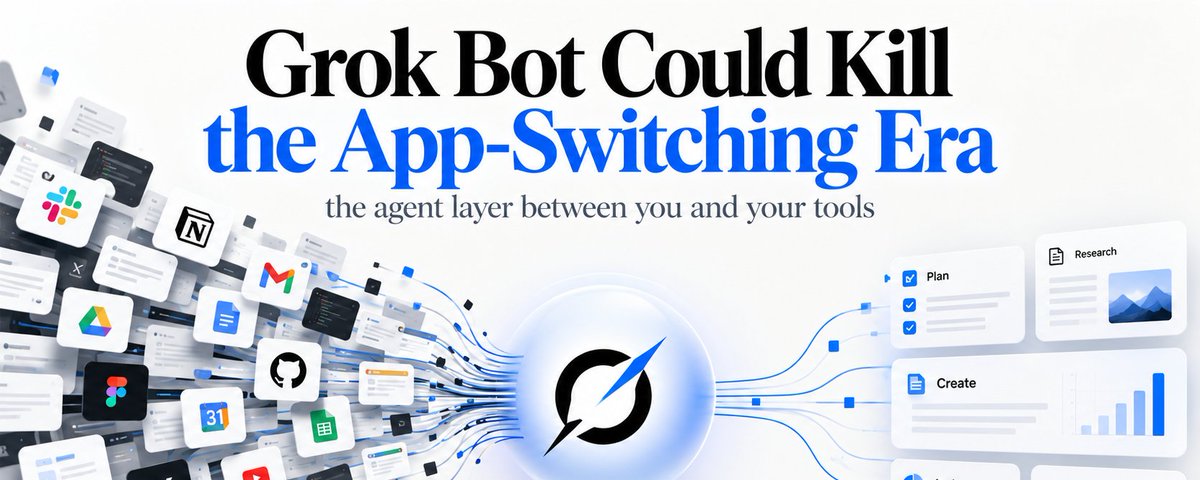
GOOGLE SPEAKER JUST EXPLAINED WHY HALF YOUR WORK APPS COULD BECOME USELESS.
And it’s the perfect setup for what Grok Bot could become.
Most people still waste hours bouncing between Slack, Gmail, spreadsheets, docs, and dashboards just to finish one task.
That’s the old workflow.
The new one is simple:
Objective → Research → Execute → Verify → Deliver
Instead of managing every app yourself, you give the system a job and let it coordinate the workflow.
It’s f*cking insane...
And the real upside is bigger than productivity.
The same architecture could run an AI quant research loop that tests strategies, rejects fake alpha, and checks risk before real money gets touched.
Grok Bot coordinates the work.
A decision layer routes the next action.
Code enforces the limits.
The human controls the capital.
The future of AI is not better chat.
It’s AI that can actually move work forward.
Watch the Google AI discussion.
Then read the full Grok Bot operating system guide below ↓
YOU COULD BE MAKING MONEY WITH CLAUDE CODE. INSTEAD, YOU'RE PAYING IT TO MAKE THE SAME MISTAKES.
And this 4-minute video might completely change that.
LangChain improved its coding agent from 52.8% to 66.5% without changing the model.
That's f*cking insane...
The secret is Harness Engineering.
Instead of burning money on failed attempts, expensive models, and endless retries, you build a system that makes Claude deliver verified work.
Claude writes the code while the harness runs tests, catches mistakes, and fixes failures before they cost you more time and tokens.
Think about what that means for paid client projects.
Less money wasted on AI. Faster delivery. More projects completed with the same budget.
The real opportunity isn't paying for smarter AI.
It's turning the AI you're already paying for into something that can actually make you money.
Watch the video.
Then grab the complete Harness Engineering prompt and full guide below ↓
akame retweeted
Anthropic's Cat Wu is showing Claude Code on stage, but the biggest AI coding breakthrough might have nothing to do with a smarter model.
LangChain improved its coding agent from 52.8% to 66.5% without changing the underlying model.
That's a 13.7-point improvement.
F*cking insane...
The secret is Harness Engineering.
Instead of endlessly rewriting prompts, you build a system that gives Claude the right context, controlled tools, real tests, and automatic failure recovery.
Claude writes the code while the harness verifies whether it actually works.
Failed tests trigger repairs. Checkpoints preserve progress. Independent reviews catch mistakes before deployment.
Same intelligence. Better execution. Completely different results.
Watch Cat Wu's Claude Code session.
Then grab the full Harness Engineering prompt and step-by-step guide in the article below ↓