

Data Science and Machine Learning, Remixed. Data Science & AI Membership, Courses, and Products. Sign up to our free AI Newsletter: https://teapaw.org/t.co/GsPwBHILv7
Las Vegas, NV
Joined April 2015
- Tweets398
- Following64
- Followers181
- Likes982




Pinned Tweet
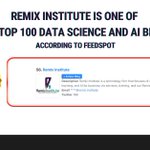
Remix Institute has been ranked #56 on the Top 100 Data Science & AI Blogs to Follow in 2026, according to FeedSpot.
Take a look at the full rundown here: bloggers.feedspot.com/data_s…
We have more coming your way soon so stay tuned!
@_feedspot

Remix Institute retweeted

Most founders don’t have a headcount problem.
They have a throughput problem.
In 2024 I said AI wouldn’t replace jobs: AI-augmented humans would replace other humans. In 2026 that’s not debatable anymore, it's the standard operating system now.
The founders winning right now aren’t waiting for a bigger raise or a bigger team. They’re injecting AI into legal, product, marketing, and ops workflows until a 3-person company punches like 15.
I'm building @LegalMenteAI and @RemixInstitute at the same time. Different products. Same rule: man and machine, working together. Or you fall behind people who already made that deal.
If you’re still treating AI like a side chat instead of critical infrastructure, you’re already late.


Remix Institute retweeted
The new Rabbit OS3 from @rabbit_hmi allows your Rabbit R1 to place outbound phone calls.
I had it give me a phone call to tell me about @LegalMenteAI . Good voice experience on the phone.
Next, I may have the Rabbit R1 call ParaPhone™️


🔥

The Email Marketing AI Agent was created by Rabbit R1 & Hermes & ready to do work. It'll write its first newsletter on 2026-09-30
Subscribe to @LegalMenteAI email newsletter on the website, follow them on X, & subscribe on LinkedIn to see the agent's work & automated publishing


Remix Institute retweeted
I voice-commanded Rabbit R1 to work with Hermes and begin building an automated email newsletter AI Agent so we can begin sending out newsletters more frequently and quickly
Important to keep our customers updated on all the latest developments in AI tech for business & legal

Remix Institute retweeted
The political advocacy group for AI "safety" & regulation, named "Public First Action" is funded by Anthropic & has directly funded a multi-million dollar ad campaign benefiting Josh Hawley & other Republicans
Thats why RINO Hawley supports AI regulations. Bc of Anthropic money


Hawley, Blumenthal lead bipartisan moment on Capitol Hill, ask Senate to vote on AI regulation bill
axios.com/2026/09/15/ai-cong…

Remix Institute retweeted
"We should then test what has been said by comparing it to actual life. If it fits reality, we should accept it; if not, we should regard it as mere theory.
The wise person is the most loved by the gods, and, it follows, also the happiest."
- "Nicomachean Ethics" Book 10, Chapter 8 by Aristotle, written ~335-323 BC

One of many ensemble lessons from reading Schopenhauer and research on religious conversions/reaffiliations found in Rodney Stark's "The Rise of Mormonism":
Philosophy, like religion, is more often preserved for being costly to surrender than abandoned for being false.
In my view, Philosophy may be subjected to experiment or A/B testing in the same way as any other human device.
A man begins with Postulate A, persuaded it governs his fate. If, in practice, it yields decay, disappointment, disorder or undesired outcomes, he ought to suspect that it does not accord with reality, and then adopt Postulate B to see whether it produces a better outcome or better answers to the truth of existence.
This principle is simple enough.
But at least half of people do not cling to their fixed beliefs because those beliefs are true, but because they have not the will to endure the pain of changing them.
They would rather remain loyal to fruitless postulates than defect from the social capital, emotional, and inward investments by which they have made it part of themselves and by which they've done a "rational" cost-benefit analysis they believe justifies holding onto their vanity, habit, and attachments.


Remix Institute retweeted
People are copy+pasting output from ChatGPT, Claude, Copilot, etc as final product without revisions, edits or human judgement
Literally no different from Calvisius Sabinus, a rich Roman, who bought slaves to recite poetry to him rather than just the book & read it himself

In Letter 27 (~63 AD), Seneca mocked wealthy Romans who bought human “memory systems”, slaves trained to recite Homer, Hesiod, and other poets on command.
Even back then, this is would be outsourcing your judgment until you can no longer function without it
Founders do this with legal work every day by outsourcing their judgment to generic AI chatbots and general purpose LLMs.
When it comes to legal though, the cost of being wrong is too high to risk.
Para™ by LegalMente AI® is optimized for legal: reviews your contracts, drafts your documents, flags the clauses designed to bury you, forms businesses, answers legal questions, and connects with you human attorneys.
And the judgment stays yours.

AI is the great equalizer
Epictetus rose from slavery and exile to build a respected school. And he didn't do it through inherited wealth, aristocratic pedigree or political status.
But he still shaped emperors.
The lesson: your constraints are not your ceiling. The mind shapes your reality.
Most founders delay legal work because they assume it costs what it used to cost.
It doesn't anymore. Not with AI.
Para™ handles contracts, docs, entity formation, provisional patents, etc for only a fraction of what most lawyers charge per hour.

🔥🤖
The Rabbit R1 from @rabbit_hmi has come a long way from being "barely reviewable" & a Tamagotchi with AI
Today, I used the Rabbit R1 to send a task via voice command to an AI Agent I built in Hermes to work on
Video demo's here. Check @LegalMenteAI to see what post it created


The Common Task: defeating death, resurrect the dead, colonize the cosmos, and achieve likeness of God the Creator
St. Paul said it first in 1 Corinthians 15
Silicon valley "tech bro" transhumanists didn't invent this
Theosis did. AI is resuming the work of the Common Task
At Zoë conference in Napa Valley 2026, Orthodox priest Rev. Dr. Mark Roosien took the stage for his talk: "The Common Task: Technological Attempts to Raise the Dead"
Nikolai Fedorov's (1829 - 1903) "What Was Man Created For? The Philosophy of the Common Task" is the precursor of modern transhumanism.
Life extension and longevity science. The space program. Artificial Intelligence. Cosmism. The war on death.
All of it is downstream from Fedorov's Supramoralism.
As a Christian Orthodox philosopher called the "Socrates of Moscow", his thesis was simple:
Humanity must unite science, technology, religion, and labor to conquer death, resurrect the dead, and expand into the cosmos to house the resurrected human family.
Not metaphorical resurrection. Literal resurrection.
Not "go to Mars" for catchy slogans. Fr. Roosien said that Federov believed we should colonize other planets because if all ancestors are returned to life, Earth is too small, and we need the entire cosmos.
Fedorov writes in "What Was Man Created For?":
"Supramoralism is the duty to return life to our ancestors; it is the highest universal morality, the morality of rational and sensate beings; on the fulfillment of this duty of resuscitation depends the destiny of the human race.
Supramoralism is not only the highest Christian morality, it is Christianity itself
It is based on the supreme commandment given before the first Easter and the last commandment given after the Resurrection by the First of the risen, as the necessary condition for continuing the task of resurrection.
Supramoralism leads us through the fulfillment of the last commandment ('Go ye into all the world, and preach the gospel to every creature'), to become perfect like our Father who is in heaven"
That is the Common Task. Not wealth. Not power. Not status. Not consumerism. Not political utopia.
The shared project of mankind must be Confucian filial piety at cosmic scale.
Fedorov calls for "replacing the problem of the universal striving for wealth by the striving for a universal return to life."
And Federov says: "owing to our urban way of life, which is extremely artificial and burdensome, the natural task of man, universal resurrection, must seem unnatural. But that does not mean that the task of universal resurrection is in fact unnatural, only that we have ourselves become too unnatural; we have distorted ourselves, our very nature."
The average person wants AI to write emails, optimize ads, and police/censor speech. Fedorov wanted AI and Technology to bring about resurrection.
Fr. Roosien said St. Paul already gave the target in 1 Corinthians 15:26: "The last enemy to be destroyed is death"
Fedorov took St. Paul literally. He did not treat death as a normal part of life. He treated death as the enemy.
F. Mark Roossen notes that Fedorov believed all matter was "enchanted." For Fedorov, matter is not dead stuff. It is awaiting transfiguration and resurrection.
He saw the Universe, through us, achieving "self-consciousness and self-government in the likeness of God the Creator."
That is Theosis in technological form. Not man replacing God. Man becoming what man was created to become: to become gods.
This is why Russian Cosmism leads naturally to rocketry. Fr. Roosien notes that Konstantin Tsiolkovsky, the father of rocketry, was fascinated with planetary colonization in 1913 and was a Fedorov disciple.
Space travel was born from a theological demand: if humanity defeats death and returns the dead, we need the heavens.
Fr. Roosien also noted that Lenin's corpse was preserved with the hope that one day he could be brought back to life. That is Fedorov's ghost haunting materialism.
Sergei Bulgakov saw the deeper Christian logic: Christ coming to earth merged heaven and earth. The Incarnation is not escape from matter. It is the sanctification of matter. And we must co-die with Christ. Christianity is the defeat of death through death.
Fedorov had another important question in "What Was Man Created For?" that should determine what all of humanity should prioritize:
"What is more precious -- gold, which is at the source of mutual extermination, or the dust of the fathers, as a means towards the reunification of the sons. What should have priority? The solution to the problem of wealth and poverty or the solution to the problem of life and death? What is more important -- social disasters or common natural disasters? Is wealth a good thing and poverty evil, or is life, eternal life, the true good and death the true evil? What should be our task?"
Gold or family. Markets or resurrection. Status games or the Common Task.
Today's AI labs, longevity companies, brain-computer interface builders, rocket firms, and transhumanists think they are inventing a new future.
But they are mostly resuming an old theological project with better tools: Supramoralism and Theosis.
AI, life extension, longevity science, and space colonization are all Fedorov's Common Task resumed.
The drive to defeat death is not "tech bro" hype. It is ancient Christianity, Theosis, Imago Dei, and cosmism moving through silicon, rockets, gene editing, robotics, and machine intelligence.
The last enemy is still death.


Remix Institute retweeted
On Supramoralism, materialism, and the Common Task, in 1 Corinthians 15, Saint Paul says:
12: But if Christ is preached as raised from the dead, how can some among you say there is no resurrection of the dead?
13: If there is no resurrection of the dead, then neither has Christ been raised
24: then comes the end, when he hands over the kingdom to his God and Father, when he has destroyed every sovereignty [archon] and every authority and power
26: The last enemy to be destroyed is death
29: Otherwise, what will people accomplish by having themselves baptized for the dead? If the dead are not raised at all, then why are they having themselves baptized for them?
30: Moreover, why are we endangering ourselves all the time?
31: Every day I face death
32: If at Ephesus I fought with beasts, so to speak, what benefit was it to me? If the dead are not raised
35: But someone may say, “How are the dead raised? With what kind of body will they come back?”
42: So also is the resurrection of the dead. It is sown corruptible; it is raised incorruptible.
43: It is sown dishonorable; it is raised glorious. It is sown weak; it is raised powerful.
47: The first man was from the earth, earthly; the second man, from heaven.
49: Just as we have borne the image of the earthly one, we shall also bear the image of the heavenly one
52: in an instant, in the blink of an eye, at the last trumpet. For the trumpet will sound, the dead will be raised incorruptible, and we shall be changed
55: Where, O death, is your victory?
57: But thanks be to God who gives us the victory through our Lord Jesus Christ.
58: Therefore, my beloved brothers, be firm, steadfast, always fully devoted to the work of the Lord, knowing that in the Lord your labor is not in vain.
Remix Institute retweeted

"There are more things, Lucilius, likely to frighten us than there are to crush us; we suffer more often in imagination than in reality." Seneca
The NDA you're afraid to sign. The LLC you've been "meaning to form." The contract sitting in your inbox for three weeks.
Most legal fear is imagined risk, not actual risk. Para™ tells you which one you're looking at, in seconds, not weeks.

Productivity tactics like Pomodoro dont work. Try this:
"Keep writing your backlog, but collapse the big to-do list to just ONE task. Pick something to work on for the next 60 minutes. Everything else temporarily ceases to exist. Any interruption from anyone else gets ignored."
Too many unfinished tasks, too many future simulations, too much internal dialogue, and too much time staring at the same problem feels like fatigue.
It comes with brain fog, loss of motivation, and simple tasks begin feeling difficult.
Archontic Pressure keeps your mind fragmented and reactive rather than analytical and freely directing its attention.
A big to-do list can produce cognitive overload because every unfinished item becomes an open loop competing for attention. You're mentally carrying 20 futures simultaneously rather than inhabiting the present task.
The remedy is mostly about reclaiming your attention:
1⃣ Keep writing your backlog, but collapse the big to-do list to just ONE task. Pick something to work on for the next 60 minutes. Everything else temporarily ceases to exist. Any interruption from anyone else gets ignored.
2⃣Take A Walk to change perceptual distance. Get away from the screen. Look at trees, buildings, clouds, the horizon. This counters prolonged visual/attentional fixation. Walking is useful because attention becomes distributed across vision, proprioception, sound, breathing, and movement rather than recursive thought.
3⃣Regarding 2, you have to protect the period of Taking A Walk. No phone, news or merchants of chaos, podcast, social media, email, or Teams/Slack messages. More information can become another form of Archontic Pressure.
4⃣ Sleep and physical recovery matter. You can't ignore physiology. Sleep deprivation will make Archontic Pressure worse.
Unfix the attention, return awareness to the material world, and energy often returns.
Remix Institute retweeted
At Zoë conference in Napa Valley 2026, Benedictine priest Father Luke Dysinger took the stage for his talk: "Physician, Heal Thyself"
At Kaiser Permanente, assisted suicide is part of their "healthcare". Father Dysinger mentioned that patients ask for it to stop their pain. But if you managed or stopped the pain, the patient's request vanishes.
The will to die was never there. It was only the will to stop the pain and hurting. No one really wants to die.
The Dhammapada by the Buddha states in Chapter 1, Verses 1-3: "Mental states are preceded by the mind, led by the mind, created by the mind. If one speaks or acts with an impure mind, suffering follows, just as the wheel follows the hoof of the ox that draws the cart. If one speaks or acts with a pure mind, happiness follows like a shadow that never leaves. 'He insulted me, he hit me, he defeated me, he robbed me.' In those who harbor such thoughts, hatred is never appeased."
The pain is mind-made. But Fr. Dysinger's point goes deeper. The pain he's talking about is also physical, not just mental. Cancer. Nerve damage. Chronic body pains. The material body breaking down. But suffering is optional.
The Sallattha Sutta (SN 36.6) by the Buddha, tells about the parable of the two arrows/darts: "When the uninstructed worldling experiences a painful feeling, he sorrows, grieves, and laments; he weeps beating his breast and becomes distraught. He feels two feelings — a bodily one and a mental one. Suppose they were to strike a man with a dart, and then strike him immediately afterward with a second dart, so that the man would feel a feeling caused by two darts."
"If he feels a painful feeling, he feels it attached. This is called an uninstructed worldling who is attached to birth, aging, and death; who is attached to sorrow, lamentation, pain, dejection, and despair; who is attached to suffering."
"When the instructed noble disciple experiences a painful feeling, he does not sorrow, grieve, or lament; he does not weep beating his breast and become distraught. He feels one feeling — a bodily one, not a mental one. Suppose they were to strike a man with a dart, but they would not strike him immediately afterward with a second dart, so that the man would feel a feeling caused by one dart only."
The First Dart is the body, the physical or emotional pain of life (such as illness, injury, loss, or unpleasant sensory contact).
The Second Dart is our mental and emotional reaction to the first pain (such as anger, despair, anxiety, or self-pity). We shoot this second arrow at ourselves.
You can train the mind to not fire the second dart even if the first dart still lands.
That's where the medicine comes in. That's where Fr. Dysinger's Benedictine roots show. The Rule of St. Benedict is a guide written by St. Benedict of Nursia in 530-540 AD for monks living communally under an abbot. It balances prayer, work, and study, summarized by their motto "ora et labora" (pray and work).
In Chapter 36 of The Rule of St Benedict, it says: "Care of the sick must rank above and before all else, so that they may truly be served as Christ." St. Benedict is the patron saint of physical healing and ailments, and the Medal of St. Benedict has been worn for centuries for protection and physical healing. Healing is physical, communal, and mental.
You don't abandon the body to save the mind. You save both.
Father Dysinger went further: We are not fully autonomous. We rely and depend on others. Autonomy is a myth. Interdependence is what we're made for. This is known as "the Communion of Saints."
Even Carl Sagan wrote in "Pale Blue Dot" (1997): "We depended on one another. Working together, we protected our children from the lions and the hyenas. We taught them the skills they would need. And the tools. Then, as now, technology was the key to our survival."
The mind, medicine, communion, AI, & technology are the keys to Survival


At Zoë conference 2026 in Napa Valley, @bryan_johnson took the stage for his talk: "Don't Die"
One of his insights that he mentions frequently: good sleep produces the willpower to exercise, eat well, learn new skills, perform hard work. But we're willing to die for our jobs, even lose sleep over it. We kill ourselves for power, wealth, and status. Society is centered around being pro-death, not pro-life.
His prescription: replace power, wealth, and status with existence. Make spiritual and mental well-being your #1 priority. One metric to track your spiritual/mental well-being: your heart rate. Your BPM allows you to remain a sovereign human being.
He also said existence is the highest virtue and that existence doesn't need to be justified. The brain needs a reason, but being alive is the reason.
He compared human beings today as Homo erectus compared to AI, and AI is giving birth to superintelligence. Which is true.
Now all of this is easy to say when you're Bryan Johnson and able to sell your company Braintree/Venmo to PayPal for $800 million. For everyone else, the job/income has to be a priority. Even when it's killing us. The only real guarantee of survival is abundance, and most people don't have it.
But there's a deeper thought pattern beneath Johnson's argument, and it's been documented for decades, since at least 1951:
The death of reason precedes an organism's death. Acquiring knowledge doesn't destroy one's will to live, but pain and loss of self-determinism does. When knowledge of the vitality of life declines, consciousness declines with it. Awareness decreases as consciousness decreases; almost a perfect correlation. Therefore, the mind must be in excellent, top condition to guarantee the survival of a man, his family, future generations, his group, and life itself.
If a mind becomes dulled, it computes poorly. When an organism reaches half-consciousness, death begins. To rid a society of its death factors, you have to bring people back to full consciousness.
Small doses of accumulated pain over a lifetime gradually suppresses an organism towards death. Erase the pain, nullify the losses, and vitality returns. The drive to seek higher levels of survival, that is life itself.
Johnson has the money to act on this. Most people don't. They're too numb from the pain of just getting by because chronic economic and psychological stress can reduce people’s capacity to exercise agency, maintain health, and pursue higher-order goals
The first step toward not dying is waking up and freeing your mind. And most people are half-conscious: psychologically dulled, distracted, or operating below their full capacity.
Most people are living at only a fraction of their potential awareness.


Remix Institute retweeted
There is no such thing as fatigue. Only Archontic Pressure.
Sometimes, the search for wisdom, knowledge, or human advancement carries an undesirable urge to become exhausted or fatigued. Strange. Almost like something is trying to prevent us from obtaining it.
The word "archon" means "ruler" or "authority" in Greek. In the Hypostasis of the Archons, found at Nag Hammadi, the archons are the rulers of this material world, trapping humans in delusion and ignorance. Carl Jung had thoughts about what an "archon" is, from a psychology perspective.
Here's what Archontic Pressure feels like. When a man works for a long period of time, then sits down to "rest", he starts to feel exhausted. Then he falls below exhaustion and stops wondering about his unwillingness to perform tasks that were once easy. The weariness isn't necessarily physical. He's been staring at the the same objects of work, the same fixed point all day. So he should fix his attention elsewhere after working a long period of time.
One remedy to Archontic Pressure has been known for a long time, at least since 1957, and it's simple: Take a Walk.
Walk around the block. Look around and look at things you're walking past. The exercise helps. But what matters is unfixing your attention from the work and placing it on the material world and reality. The "second wind" becomes an energy surge. You can do this until you feel rested or begin to feel better, not fatigued or exhausted. "Walk out" the fatigue and exhaustion.
And against the archons themselves: recitation of Saint Michael's Prayer. "Saint Michael the Archangel, defend us in battle. Be our protection against the wickedness and snares of the devil." The archons may be obstructing us. Saint Michael can help cast them down.
🤖 Made with AI

ALT Image generated using AI


🧠🤖
At Zoë conference 2026 in Napa Valley, @bryan_johnson took the stage for his talk: "Don't Die"
One of his insights that he mentions frequently: good sleep produces the willpower to exercise, eat well, learn new skills, perform hard work. But we're willing to die for our jobs, even lose sleep over it. We kill ourselves for power, wealth, and status. Society is centered around being pro-death, not pro-life.
His prescription: replace power, wealth, and status with existence. Make spiritual and mental well-being your #1 priority. One metric to track your spiritual/mental well-being: your heart rate. Your BPM allows you to remain a sovereign human being.
He also said existence is the highest virtue and that existence doesn't need to be justified. The brain needs a reason, but being alive is the reason.
He compared human beings today as Homo erectus compared to AI, and AI is giving birth to superintelligence. Which is true.
Now all of this is easy to say when you're Bryan Johnson and able to sell your company Braintree/Venmo to PayPal for $800 million. For everyone else, the job/income has to be a priority. Even when it's killing us. The only real guarantee of survival is abundance, and most people don't have it.
But there's a deeper thought pattern beneath Johnson's argument, and it's been documented for decades, since at least 1951:
The death of reason precedes an organism's death. Acquiring knowledge doesn't destroy one's will to live, but pain and loss of self-determinism does. When knowledge of the vitality of life declines, consciousness declines with it. Awareness decreases as consciousness decreases; almost a perfect correlation. Therefore, the mind must be in excellent, top condition to guarantee the survival of a man, his family, future generations, his group, and life itself.
If a mind becomes dulled, it computes poorly. When an organism reaches half-consciousness, death begins. To rid a society of its death factors, you have to bring people back to full consciousness.
Small doses of accumulated pain over a lifetime gradually suppresses an organism towards death. Erase the pain, nullify the losses, and vitality returns. The drive to seek higher levels of survival, that is life itself.
Johnson has the money to act on this. Most people don't. They're too numb from the pain of just getting by because chronic economic and psychological stress can reduce people’s capacity to exercise agency, maintain health, and pursue higher-order goals
The first step toward not dying is waking up and freeing your mind. And most people are half-conscious: psychologically dulled, distracted, or operating below their full capacity.
Most people are living at only a fraction of their potential awareness.
Remix Institute retweeted
Lao Tzu was a pre-Christian prophet of the Incarnate Logos, like Isaiah.
The Tao Te Ching may be read as praeparatio evangelica or logos spermatikos.
A prophecy of Christ's revelation. Like the Book of Isaiah.
