


Michael Fliedner retweeted

Stop telling leadership the AI search report is impossible.
GA4, GSC and Bing already give you enough to build one.
Here's @NickLeRoy's SEO+ layout: searchengineland.com/seo-plu…

Michael Fliedner retweeted

How does Google's AI see your brand? You can check it out for free thanks to @HannsKronenberg new tool: Google Oracle, that asks Google's decision model Gemini Decision 1, what sets it apart, and how it is positioned compared with other brands.
* Assess your own brand through 200 questions
* Evaluate on a research basis
* Check brand rankings across countries
For example: Google is perceived as "Very well known in the US. Linked to publicly known controversies." 😅
Try it out : gpt-insights.de/google-orake…

Michael Fliedner retweeted

5 new open-source agent skills this week for international/multilingual/technical SEO and AI search:
Bing grounding queries export + analysis, schema implementation audits, title/meta gap fill and international llms.txt builds.
All 5 and 13 more:
github.com/rebelytics/one-sk…

Michael Fliedner retweeted

Just published my latest article on Substack 🥳
In it, I talk about an approach I've believed in for a long time - and even more so now with the rise of AI search:
I believe centering real humans in your marketing strategy is the best defense against core updates, spam updates, model updates, and whatever else comes next. It can also help to encourage AI systems to recommend your brand.
Loopholes like self-promotion, inauthentic mentions, and scaled AI content have expiration dates. A real expert's reputation can outlast all of these tactics.
The article covers why, what the evidence shows so far, and how brands can put their own experts at the center of their SEO and AI search strategies.
lilyraynyc.substack.com/p/wh…


Michael Fliedner retweeted

I built a Chrome extension that calculates your CTR from ChatGPT while using the Business Hub.
(All data stays in your browser.)
chromewebstore.google.com/de…

Michael Fliedner retweeted

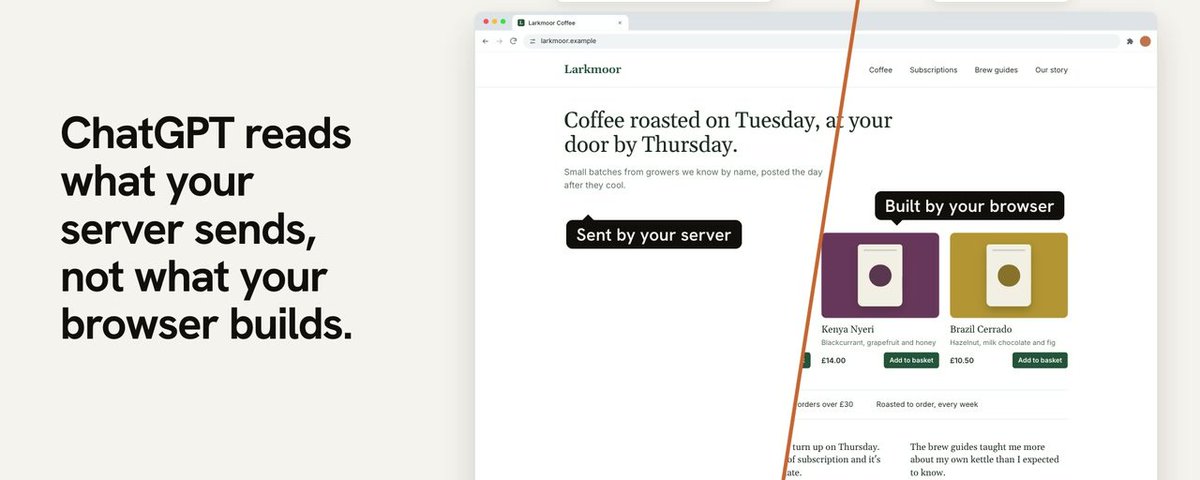
Your website looks perfect in Chrome. But what if ChatGPT can’t see your most important content?
JavaScript could be hiding entire sections of your website from AI crawlers.
I built a free Chrome extension to help you find out. 🦊
Michael Fliedner retweeted

Every SEO knows Google's "200 ranking signals"
We found the list Google actually keeps: 305 sets of ranking signals. 48 apply to a web page, 34 serve generative AI...
Topic authority, hidden gems, RankBrain, Starbow, Libra...
Full list 👇
think.resoneo.com/ranking-si…

Michael Fliedner retweeted

Spannendes Gespräch mit Philipp "Pip" Klöckner @pip_net von @Doppelgaengerio zum Thema Marketing in Zeiten von AI Systemen und GEO
(Komplettes Video: youtube.com/watch?v=VOX1cFH_… )
Michael Fliedner retweeted
For 190 days I checked Google Search Console and Bing Webmaster Tools to understand which LLMs leave a trace.
Here is what I learned:
➡️ Google AI Overviews & AI Mode trigger impressions in both the Search and Generative AI reports within Google Search Console (GSC).
➡️ Gemini does not trigger any impressions in GSC.
➡️ Bing Copilot triggers Citations in the AI Performance report in Bing Webmaster Tools (BWT).
➡️ ChatGPT for logged-out users was using Google in July and August. But it is now using Bing.
No other LLMs triggered a noticeable pattern in either GSC or BWT. Which is surprising, considering Yahoo Scout openly communicated it is based on Bing WebIQ. Also, Perplexity and Grok do not seem to do a lot of Google/Bing scraping.
Since ChatGPT for logged-in users was inconsistent over the whole period, I assume they always used a combination of Google, Bing, and Labrador.
When ChatGPT used Google for non-logged-in users, there was always a GSC spike. Now, the BWT spikes are less reliant. Another indicator that a larger share of grounding is happening via Labrador, ChatGPT's own index.
That chart only shows statistically significant observations.
I ran prompts from IPs in the US and Germany. But GSC traffic on ChatGPT-days also came from the UK and Netherlands.

Michael Fliedner retweeted

How much can AI influence a buying decision?
To figure that out, I analyzed the responses to 13 questions across 200 software buyers from Wynter (disclosure: I'm an investor).
It turns out AI adds a new vendor in 2/3 of the conversations. In other words, software buyers seem very open to considering brands they haven't thought of.
What I take away from that is that making AI Search a success means "general marketing" is important to be top of mind before people are "in the market" and being AI visibility is important because you have a chance to be picked on top of that.
Visibility also matters because buyers use AI a LOT for evaluation: price, features, integration, etc. So, if "the AI" can't find that information about your brand, there is a high chance you drop out in the evaluation process.
All details and more in today's Growth Memo.
Thank you, Wynter!

Michael Fliedner retweeted

One of the best explainers on AI & Search. This is ready to use for all of us to talk to company leaders. Great visuals and explanations that are easy to digest. @TheNextCorner crushed this resource, I'll be using it a ton.
thenextcorner.com/ai-visibil…

Michael Fliedner retweeted

"Category vs. product pages: Which does Google favor?"
Great & insightful study from @lawrencehitches
searchengineland.com/categor…
"I analyzed 14.9 million Google Search clicks across 100 ecommerce sites and found that the median site received two-thirds of its clicks from category pages, despite having roughly nine product pages for every category page.
I also examined more than 12,000 queries where both page types competed for visibility."

Michael Fliedner retweeted
I've been thinking a lot lately about how we can make more out of Direct traffic.
For context, direct is the largest traffic channel for most sites on web - by far.
And yes, it's a kitchen sink of dark channels, logins and drive by visits. But certainly not all of it.
Some of it is also visits from people who saw your ads or heard about you on a Youtube channel.
Why, then, do so few brands optimize for direct visits?
Three ways to make more of those visits:
1. Answer the questions that come after awareness. The visitor might already know your name but still need to understand what you do, who it’s for, and why they should choose you. Put those answers in plain language at the top of the page. Please don't be fancy here.
2. Give visitors a way to evaluate you. Make pricing, product details, customer examples, and comparisons easy to find. Someone who came back to check you out might want to do their homework before talking to sales.
3. Create a next step for people who aren’t ready to buy. A useful tool, guide, or newsletter gives them a reason to stay connected. Place it next to the purchase or demo path so visitors can choose the commitment that fits.

Michael Fliedner retweeted

the latest google change with goto seems to be breaking most industry tools right now. it's diabolicaly clever. Dataforseo explains it better than i can:
dataforseo.com/update/new-go…
Michael Fliedner retweeted
Your website might rank perfectly fine on Google, but ChatGPT could be seeing absolutely nothing.
Here’s why.
Google can render JavaScript. However, ChatGPT, Claude and Perplexity’s live fetchers don’t execute JavaScript.
So if your website relies heavily on client side rendering, there’s a chance these AI systems are only seeing your navigation, footer and cookie banner. Not the actual content.
The annoying part? Everything looks perfectly fine in your browser and Google might even rank the page well.
I built a free tool to help you check this.
JS Rendering Gap Checker
It fetches your page twice:
- As ChatGPT’s live fetcher, without executing JavaScript.
- As a real browser, with JavaScript fully rendered.
It then compares both versions and shows you:
• How much of your content is missing.
• The actual text ChatGPT receives.
• Which headings and content blocks are invisible.
• What you should consider fixing.
I tested an Angular documentation page. The result?
10,098 characters visible in a browser. Zero characters of body text available to the AI fetcher.
That’s a big problem for LLM visibility.
The tool is completely free. No signup or API key required.
Give it a try and see what ChatGPT can actually read from your website.
Take a look 👇
suganthan.com/free-seo-tools…

Michael Fliedner retweeted

If you think GEO is a distraction, this is really going to upset you. Google's filling AI answers with ads to fix slowing search revenue, and organic now competes with those ads for the same few spots. duaneforresterdecodes.substa…
Michael Fliedner retweeted

It seems they all announced today. Google, Bing, OpenAI, and Anthropic. Barry has the details.

Google also announced new AI training controls for 2027, under consideration by the IETF
seroundtable.com/google-ai-t…

Michael Fliedner retweeted

SEO Tip: Connect both the Search Console MCP + Google Ads MCP into Claude.
Then ask "What queries/topics do I allocate a lot of paid spend but have weak organic visibility"
Claude will identify queries + topics where you spend a lot don't show up in organic search

Michael Fliedner retweeted
New controls announced by Bing: "AI Grounding is a separate page-level preference from Microsoft that lets you manage how your content is used to help inform generated responses. Alongside Disallow, which prevents grounding use, Microsoft is introducing a new granular preference: DisallowExtended. This limits grounding use to Microsoft-operated experiences such as AI Mode, AI Overview, Copilot, and Microsoft 365, and excludes grounding services Microsoft provides to third parties,"
Microsoft Bing releases new AI control controls to allow you to specify if you want to allow crawling to train AI models and whether it can be used to generate AI answers and so on.
seroundtable.com/microsoft-b…

Michael Fliedner retweeted
I find it interesting how much of Google's messaging over the past two years has revolved around its "search query growth rate."
(You know, like how every follow-up message in AI Mode can count as another search query 🙄)
But where are the metrics showing that search is actually getting better?
Where's the evidence that AI-generated answers are more accurate and trustworthy than what was there before?
How do we know users are genuinely having a better search experience now with AI, beyond vague claims that "users really like it"?
Do more search queries inherently mean users are having a better experience? What if they're searching more because AI Overviews or AI Mode didn't give them what they needed in the first place?
(Like when navigational searches generate AIOs that point to every URL except the one you're actually looking for, or AI citations that point to URLs that don't contain the information that corresponds to their position in the AI answer)
And what about whether the creators and publishers whose content powers these answers are being treated fairly?
It seems like Google is laser-focused on proving that its AI products are winning the race for users and search volume, while sidestepping these other, existentially important questions.
Despite how many times we ask.

On today’s earnings call, we shared that our YoY Search query growth rate was the highest it’s been in the last five years. Our AI investments are driving increased usage and overall query growth, including commercial queries.
We also shared that we’re now beginning to scale ads in AI Mode to more countries and launching multi-turn ads in the U.S. As always, our approach is deliberate, prioritizing the user experience and engagement first. This approach is what gives us a strong, durable foundation for the future.
Huge thank you to the Googlers building this next era of Search!