

Founder @ Stoggle Capital Management Sharing research and charts not financial advise…
Dallas, TX
Joined May 2012
- Tweets1.6K
- Following1.4K
- Followers435
- Likes50.4K
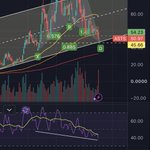





$ASTS
The market sold the wrong headline.
SpaceX's 800 MHz buy doesn't touch AST's AT&T and Verizon deals, and those carriers hold ~1,000 MHz that can run on AST's satellites. If SpaceX becomes a carrier, carriers need a partner.
With buyer demand showing up at the trend line, we opened a position today, if we see the 0.886 ($45.66), we in increase.

2
707
$NU harmonic D tagged on the Monzo panic.
The reason for the selloff is gone: Nu says it's not pursuing Monzo. Stock +6% after hours.
Setup:
• D completed in the $12.27 PRZ 0.786, low $12.13
• Lower rail of the rising channel
• RSI washed to ~30, hidden bullish divergence vs the June low
The business didn't change: Q2 net income $1.1B (+49% YoY), 33% ROE, 139M customers. ~16x earnings.
These are the type of opportunities we like.

2
235
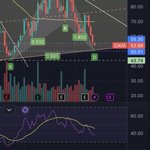
$CAVA — the buy zone is $50–54, and we're in it.
Q2 was clean: revenue +31%, comps +9% on 5.3% traffic, EBITDA +30%, guide reaffirmed. Stock hit $69 on the print.
Now $54. COO bought $432K at $66.52 on Aug 31.
Chart: weekly bullish Gartley
Completing at D. The 0.886 retrace is $50, the 1.852 BC extension lands there too, and the lower channel line sits right on it. Everything from here down to $50 is the completion zone — that's where you scale in, not where you sell.

1
1
396
Stoggle Capital Management retweeted

We are partnering with Palantir to bring trusted AI cloud infrastructure to Palantir’s commercial customers.
Palantir has named Nebius its preferred sovereign AI infrastructure partner.
Nebius compute and inference endpoints will run inside the Palantir enterprise perimeter – giving customers control over their compute, data, and models.
The partnership is based on a shared vision that open models, continually adapted using customers’ own data, can deliver better domain-specific intelligence while improving control and security.
Read the full press release: nebius.com/newsroom/palantir…

It’s official: the market has priced $LULU at max pain. 🍋
Rev miss, comps -9%, guide cut again — the worst print in years. And it dumped to ~$99.
8-year low. ~10x earnings. 7% FCF yield. $10B brand, 55% margins.
Max pain isn’t where you panic. It’s where you pay attention.
$98 line in the sand is our D point multi-year completion.
Burry bought months ago, we are patience and are ready to grab the bottom.

1
166
This is the right take. Capital is flowing; demand is insatiable; the market will continue to create opportunities for people to position themselves accordingly.
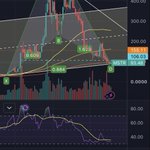
As it always does. We like names that are on sale. We bought $CRM when everyone thought it was dead. And $BABA when there was peak fear in China, or $MSTR when people thought Michael Saylor was doomed.
Finding great companies is step one; buying them near trend support, with fundamentals, is the key to a strong portfolio foundation.
Keep leverage under control.
Let the world's greatest companies work for you with a basis that you can sleep with at night.
Long $NBIS. $WING. $BE. $KTOS.
Watching $ONON and $DECK and $BLDR

Macro has clearly cut high beta AI valuations over the past few months. But I try to stay focused on fundamentals.
If you're curious about my take though:
We're seeing record visibility with
- memory (2031), photonics (2029-2030), etc LTAs
- $NBIS, solana:5aQcoaSyy7fnhvpRHasBUAMH2nL5tTjVrmFw6BeGmoon, etc. massive demand imbalance for compute despite capex spend.
- combined with record projections ( $NVDA 70% growth 2027, $SMCI $60B+ new server orders, etc).
vs.
uncomfortable macro where:
- Warsh said the Fed has "more work to do" if underlying inflation isn't clearly returning to 2%.
- July PCE came in at 3.7% Y/Y
- July jobs report payrolls fell by 23k with unemployment at 4.1%
-10Y Treasury high/ 30Y highest since 2007
- Iran tensions continuing
- Japan Yen weakened to 160/ 2 rate hikes in Korea
And with rate 40/60 in favor of 25BPS near-term hikes.
There's definitely implications on financing + too many third/fourth order effects for me to personally map.
I'm not a macro expert but my take is:
The AI buildout will continue w/ $1.3T+ capex poured upstream expected next year, flowing through many bottlenecks and chokepoints.
While markets chopped off forward valuations and rotated toward currently profitable/defensive companies.
I don't know what's going to happen, especially since rate hike odds are almost a coinflip, and Trump posts can change sentiment overnight.
As long as I don't see indicators of hyperscalers cutting capex or demand wavering.
I'm staying long despite macro volatility, since I want ownership of the names controlling the future of the AI buildout.
And if there's any indicators of better macro climates, high beta are typically the fastest to recover.
2
509


$WING down ~65% from the highs.
What you’re actually buying: 27% operating margins, 16% unit growth, 102 net new stores last quarter, and a royalty stream that doesn’t own the real estate.
Multiple went from ~85x to ~27x. The business didn’t change that much. The consumer did.
Looks like a good set up. Risk reward favorable on the monthly chart.

1
3
711
Stoggle Capital Management retweeted

Introducing Bloom Power Connect.
A new deployment system that reduces onsite power installation time by more than 40% by moving critical electrical integration from the field to the factory.
Pre-connected, pre-wired, and tested before arriving onsite, Power Connect simplifies installation, improves deployment consistency, and helps customers bring new power capacity online faster.
At a time when demand for skilled electrical labor continues to outpace supply, Power Connect helps customers move projects forward with greater certainty.
bloomenergy.com/news/bloom-e…

Stoggle Capital Management retweeted

$NBIS NEBIUS (NBIS): IMPLICATIONS OF PENNSYLVANIA’S DATA CENTER EXECUTIVE ORDER
BOTTOM LINE
The executive order is a direct, moderately negative development for Nebius, but it is not thesis-breaking and should not be interpreted as cancellation of the Pennsylvania project. Nebius is unusually exposed because its Highridge Business Park campus is a wholly owned, 600-acre development designed for 1.2 GW at full buildout, with 260 MW targeted for October 2027, 660 MW for January 2029 and more than 1 GW for November 2029. The 1.2 GW headline capacity is equivalent to 24% of Nebius’s newly raised 5 GW year-end 2026 contracted-power target. The first 260 MW is equivalent to approximately 26% of the company’s stated plan to deploy more than 1 GW per year beginning in 2027.
The primary risk is not an immediate reduction in 2026 revenue or EBITDA. Highridge was not scheduled to become operational until late 2027, and Nebius reiterated its 2026 financial guidance several days before the order. The order principally raises the probability of delays, additional power-procurement costs, more onerous contractual liabilities and lower returns on the 2028-2030 Pennsylvania capacity ramp. The direct 2026 earnings impact should be negligible, the 2027 revenue impact should be limited unless the initial 260 MW is delayed materially, and the more significant exposure lies in 2028-2030 capacity, revenue and free-cash-flow expectations.
Nebius nevertheless appears substantially better positioned than the typical speculative Pennsylvania data center developer. It already owns the site, has secured a dedicated Energy Service Agreement with PPL Electric Utilities, is paying for dedicated infrastructure, operates within a proactive data center zoning overlay, has conducted public engagement, proposes closed-loop cooling, and expects approximately 1,000 construction jobs and 100-150 permanent jobs. These characteristics are closely aligned with the GRID requirements. The order therefore adds meaningful execution risk, but it may also eliminate less advanced competing projects and increase the scarcity value of Highridge if Nebius successfully completes it.
THE MOST IMPORTANT ISSUE IS GRANDFATHERING
The executive order does not retroactively cancel every permit or prohibit projects already in development. The new permitting process applies to permit or authorization applications submitted after August 18, 2026. This distinction is highly relevant for Nebius because the project had already entered development before the order and Nebius had executed a dedicated PPL Energy Service Agreement.
The model Consent Order contains a more flexible “existing permittee” pathway for a project that, by August 18, 2026, had both submitted a DEP permit application and executed a binding Electric Service Agreement or Transmission Security Agreement. Public Pennsylvania DEP records show a Chapter 102 Individual NPDES permit transfer associated with Highridge DC Propco LLC dated May 18, 2026. If Highridge DC Propco is the relevant Nebius project entity, the permit is within the scope of the Nebius campus, and the PPL agreement is binding for purposes of the model language, Highridge appears likely to satisfy the 2 threshold requirements for existing-permittee treatment. That conclusion still requires formal confirmation from Nebius and DEP.
Existing-permittee treatment would be economically important. Under the standard GRID provisions, a developer must procure sufficient incremental capacity to meet peak demand and sufficient incremental energy to match full annual consumption. The existing-permittee addendum instead allows capacity compliance through a binding exclusive capacity contract, PJM’s Reliability Backstop Procurement process, or another arrangement demonstrating that the new load will not impose additional costs on non-cost-causing ratepayers. This is a materially more achievable standard for Nebius given its existing PPL agreement.
However, the project should not be treated as completely grandfathered. A pre-order stormwater permit does not necessarily cover all air, water, construction, transmission, backup-generation and later-phase authorizations required for a 1.2 GW campus. Any new applications submitted after August 18 can bring the relevant project phase into the GRID process. The project’s July 2026 Phase 1 site plan was expressly identified as a draft and not final, indicating that at least some design and land-development work remained. The order also requires all applicable municipal, subdivision and land-development approvals before DEP can issue qualifying permits.
The likely practical outcome is therefore differentiated by phase. The initial 260 MW appears materially more defensible than the full 1.2 GW. The expansion from 260 MW to approximately 600-660 MW likely has a credible pathway but may require additional permits and contractual amendments. The final approximately 540-600 MW should be treated as long-dated development optionality until there is evidence of corresponding transmission infrastructure, project-specific permits, qualifying generation and municipal approvals.
Nebius’s pre-existing zoning is another meaningful advantage. The Highridge property is located within a data center overlay, reducing the probability of a fundamental zoning rejection. Nevertheless, zoning eligibility is not equivalent to completed land-development approval. Local authorities retain leverage over subdivision, traffic, stormwater, building design, emergency services, noise and community-benefit arrangements. Nebius’s local engagement and pre-existing overlay materially lower this risk, but do not eliminate it.
The removal of all data centers from Pennsylvania’s Fast Track program is a negative for schedule certainty, although no reviewed public disclosure confirms that Highridge itself had been accepted into Fast Track. Consequently, the direct impact is best described as the loss of a potential acceleration mechanism rather than the confirmed removal of a benefit already embedded in Nebius’s schedule.
POWER PROCUREMENT IS THE CENTRAL FUNDAMENTAL RISK
Nebius’s PPL agreement is a substantial mitigating factor. The company states that the agreement provides for new infrastructure built exclusively for Highridge and that Nebius will bear the full cost. This is directionally consistent with GRID’s requirement that the data center pay all directly attributable transmission, distribution, dedicated-facility and network-upgrade costs. Nebius is therefore less exposed than developers that have merely reserved load positions or assumed that grid costs would be socialized across utility customers.
The company’s assertion that residential bills will not increase is not, by itself, sufficient for regulatory compliance. The model agreement contemplates an Electric Service Agreement under tariff terms no less stringent than the Pennsylvania PUC’s final large-load model tariff and requires treatment of embedded system costs. PPL and Nebius may therefore need to amend the existing agreement, add financial security, establish minimum billing obligations, provide credit support or accept additional cost-allocation provisions. The impact should be manageable for Nebius, but the existing agreement cannot yet be assumed to satisfy the final GRID standard automatically.
The clean-firm energy requirement is more clearly incremental. GRID requires qualifying in-state clean-firm energy equal to 10% of annual electricity consumption through the beginning of 2030, 14.5% from 2030 through the beginning of 2035 and 32% thereafter. A developer can make an alternative compliance payment for any shortfall, with the payment rate tied to the estimated unsubsidized solar levelized cost published by the US Energy Information Administration.
Nebius’s planned 30-minute battery system does not appear sufficient to satisfy the clean-firm definition. The model agreement generally requires a battery system to provide at least 2 hours of continuous discharge, unless DEP approves another duration. Highridge’s disclosed battery is designed for approximately 30 minutes of backup and redundancy. It may assist with reliability and outage management, but it should not currently be modeled as the project’s GRID-compliant clean-firm resource.
Assuming a 90% load factor, the initial 260 MW phase would consume approximately 2.05 TWh per year and would require approximately 205 GWh of clean-firm energy under the 10% standard. At a fully built 1.2 GW campus, annual consumption would approximate 9.46 TWh. The 14.5% requirement would represent approximately 1.37 TWh annually, while the 32% requirement beginning in 2035 would represent approximately 3.03 TWh annually. These are meaningful procurement volumes.
The alternative payment provides an economic ceiling on this obligation. At 260 MW and a 90% load factor, every $10/MWh of alternative payment rate would cost approximately $2.0M annually. At 1.2 GW, every $10/MWh would cost approximately $13.7M annually under the 14.5% requirement and approximately $30.3M annually under the 32% requirement. The clean-firm requirement is therefore a real operating-cost headwind but is unlikely by itself to destroy the economics of a fully utilized AI cloud campus.
Nebius also has a potential compliance advantage through its partnership with Bloom Energy. The company announced that it plans to deploy behind-the-meter fuel cells, and fuel cells are expressly included among the model’s eligible clean-firm technologies. A Highridge-specific fuel-cell deployment could address some portion of the requirement, provided it meets the incrementality, accreditation, emissions and deliverability standards. This provides a more credible compliance pathway than is available to many developers, although no Highridge deployment has yet been announced.
TIMING IS MORE IMPORTANT THAN THE DIRECT COMPLIANCE COST
The principal economic damage from the order would arise through delay rather than through water monitoring, public meetings or community-benefit spending. AI infrastructure returns are highly sensitive to speed because GPUs generate very high revenue when capacity is scarce, hardware generations turn rapidly, and fixed site and power expenditures produce no return before energization. Nebius reported Q2 AI cloud deals with annual contract value of $20M-$25M per MW and an estimated payback period of 1 year and 10 months. Although these figures should not be mechanically multiplied by gross campus power because PUE, utilization and hardware configuration matter, they demonstrate the unusually high opportunity cost of delaying commercially deployable capacity.
A 3-6 month delay to the initial 260 MW would probably have limited impact on 2027 reported revenue because the site is not scheduled to operate until October 2027, but it would reduce the company’s year-end capacity exit rate and shift a greater portion of revenue into 2028. A 6-12 month delay to the 660 MW target would have a more material effect on 2029 revenue, customer allocation and cash generation. The largest valuation sensitivity is the possibility that the final approximately 540 MW is delayed beyond 2030, relocated or never developed.
This is particularly relevant because Nebius’s valuation increasingly depends on the conversion of “contracted power” into connected, equipped and revenue-producing capacity. The order widens the gap between those categories. A signed land and power commitment remains economically valuable, but Pennsylvania now requires additional evidence of local approval, qualifying generation, cost allocation and legally binding compliance before that power can be monetized. Investors should therefore apply a lower probability and longer duration to the Highridge capacity rather than removing the entire 1.2 GW from the model.
The opportunity cost is partly mitigated because GPUs and customer demand can be redirected to other Nebius locations. The company has expanded across multiple US and international markets and introduced an asset-light model under which partners finance the land, facility, power and hardware while Nebius supplies the cloud platform, architecture and go-to-market capability. This provides a strategic release valve if Pennsylvania capacity is delayed. Nevertheless, large power blocks are not perfectly fungible, and replacing a 260 MW or 660 MW campus on a comparable schedule would be difficult.
BALANCE-SHEET AND FINANCING IMPLICATIONS
Nebius has the financial capacity to absorb ordinary GRID compliance costs. It ended Q2 with approximately $8B of cash, expects more than $9B of customer prepayments during 2026, has more than $40B of customer commitments and stated that prepayments on Q2 transactions covered approximately 50%-60% of associated capital expenditures. These resources materially lower the risk that additional transmission contributions, clean-energy contracts, community payments or monitoring requirements become a liquidity problem.
The more significant financing concern is the model Consent Order’s contingent liability. The template establishes a negotiated civil-penalty range of $25,000-$100,000 per MW of rated capacity per day for violations of the energy obligations. Applied mechanically, this would represent $6.5M-$26M per day at 260 MW and $30M-$120M per day at 1.2 GW. These figures should not be treated as expected cash costs. The template expressly permits project-specific modification, and the final terms are likely to be heavily negotiated. Nevertheless, such potential liabilities can affect project finance, debt covenants, insurance, parent guarantees, power-supplier indemnification and the willingness to commit to a fixed energization schedule.
Nebius’s owner-operator structure is both an advantage and a disadvantage. It avoids much of the landlord-tenant friction faced by merchant data center developers and allows Nebius to integrate facility, power and cloud operations. Conversely, the GRID obligations and penalties would sit more directly with the Nebius project entity. The model also requires applicable tenants, owners and operators to be bound to the Consent Order, makes DEP a third-party beneficiary of relevant contracts and requires disclosure of tenant or major-user identities. This could complicate dedicated-capacity contracts with hyperscalers, particularly if a customer controls a large portion of the campus. Ordinary cloud customers may not constitute “tenants,” and the scope will require legal interpretation.
Nebius’s already-committed site and infrastructure spending is less fungible than GPU spending. If permitting is delayed, land, engineering, interconnection and civil-work capital can sit idle while incurring carrying costs. GPUs intended for Highridge can potentially be assigned to other locations before installation, reducing hardware-stranding risk. The principal return risk is therefore lower site-level IRR and delayed monetization rather than a wholesale impairment of GPU assets.
TAX-INCENTIVE RISK COULD BE FINANCIALLY MATERIAL
The executive order directs Pennsylvania’s Department of Revenue to condition new applications for the state’s Computer Data Center Equipment sales-and-use-tax exemption on GRID compliance. Pennsylvania ordinarily imposes a 6% sales tax, and the exemption covers qualifying servers, networking equipment, cooling systems and other data center equipment. Every $1B of otherwise qualifying purchases represents up to approximately $60M of tax exposure. Given the potential equipment scale of a 1.2 GW AI campus, the total benefit could ultimately be measured in hundreds of millions of dollars.
The order does not automatically eliminate the exemption for Nebius. If Highridge executes a compliant Consent Order and obtains the required certification, the project should retain a pathway to the benefit. Nebius’s design and economic commitments suggest compliance is achievable. The larger risk is that legislative or judicial developments alter the exemption itself, but that is a related Pennsylvania policy risk rather than a direct consequence of this order.
AREAS WHERE NEBIUS IS ALREADY WELL ALIGNED
The workforce standards should be readily achievable. Nebius projects approximately 1,000 construction jobs, 100-150 permanent jobs and a multi-billion-dollar investment. GRID requires at least 200 prevailing-wage construction jobs, 50 qualifying permanent jobs and $250M of cumulative investment. The remaining questions are wage levels, Pennsylvania hiring, apprenticeship participation and the legal form of the commitments rather than the absolute scale of employment or investment.
The environmental standards also appear manageable. Highridge is designed around closed-loop and air-cooled systems, a 30-minute battery system, noise mitigation and public community engagement. GRID’s additional requirements for performance certification, Tier 4-equivalent or zero-emission backup systems, water planning and public air-quality monitoring will add cost and process, but are unlikely to be determinative relative to power procurement and permitting.
Nebius’s Aug. 6 public open house, local education proposals and stated community-benefit program also position it better than developers that assembled projects confidentially. Additional meetings and a formal community-benefit agreement will probably be required, but the project has already begun building the stakeholder infrastructure demanded by the order.
INVESTMENT SCENARIOS
In a favorable outcome, DEP confirms that the project qualifies for existing-permittee treatment, the PPL agreement satisfies or is amended to satisfy the large-load cost-allocation rules, local approvals are completed, and the project-specific Consent Order contains reasonable penalties and cure provisions. The 260 MW October 2027 date is preserved or slips only modestly, while the 660 MW and 1 GW milestones remain broadly intact. In this outcome, the order creates incremental cost but also removes competing Pennsylvania capacity, potentially improving long-term utilization and pricing.
In the base outcome, Phase 1 remains viable but is delayed approximately 3-6 months, the expansion to 660 MW is delayed approximately 6-12 months, and the final buildout is pushed beyond the currently indicated schedule. Nebius procures clean-firm energy or makes alternative payments, revises its PPL agreement, and enters a community-benefit agreement. The 2026 outlook remains unchanged, the effect on 2027 revenue is modest, and the larger estimate reductions occur in 2028-2030.
In the adverse outcome, DEP does not treat the existing permit and PPL agreement as covering the entire project, later phases become subject to the full incremental-energy regime, municipal approvals become contentious, and the project-specific Consent Order remains commercially onerous. The first 260 MW is delayed by more than 12 months and a substantial portion of the later 940 MW is deferred, resized or redirected to other states. Nebius can mitigate the lost capacity through alternative sites and asset-light partnerships, but the company would suffer lower owned-capacity growth, weaker capital efficiency and a higher execution-risk discount.
VALUATION TREATMENT
The full 1.2 GW should not be removed from a Nebius valuation model. The project has too much tangible progress, including land control, a PPL agreement, pre-order permitting activity, applicable zoning and active development, for a cancellation assumption to be reasonable. Conversely, the entire 1.2 GW should no longer receive equivalent probability or timing credit.
A reasonable interim framework is to give high probability to the initial 260 MW, medium probability to the next approximately 400 MW and substantially lower probability to the final approximately 540 MW until Nebius confirms existing-permittee eligibility and provides an updated regulatory schedule. The immediate model adjustment should primarily shift capacity and revenue to later years rather than eliminate demand or reduce 2026 estimates.
The most useful near-term diligence items are formal confirmation that Highridge qualifies for Addendum A, identification of which permits and phases were submitted before August 18, confirmation that the PPL agreement satisfies GRID and PUC requirements, disclosure of the clean-firm procurement strategy, execution of a project-specific Consent Order, completion of local land-development approvals, and reaffirmation or revision of the October 2027 energization target.
FINAL INVESTMENT CONCLUSION
The order is a moderate negative for NBIS’s medium-term capacity conversion and valuation multiple, but a low-impact event for current revenue and 2026 earnings. The central risk is a longer and more expensive path from contracted power to revenue-producing compute. The initial 260 MW appears relatively well protected, while the later expansion phases deserve a larger timing and probability discount.
Nebius is also one of the better-positioned developers to comply. Its dedicated PPL agreement, ability to fund infrastructure, proactive zoning, closed-loop design, large employment commitment, customer prepayments and potential fuel-cell solution materially reduce the probability of project failure. The policy may ultimately strengthen Nebius’s competitive position by eliminating speculative projects that cannot meet similar requirements.
A stock reaction that assumes the entire 1.2 GW campus is lost would be excessive. A reaction that applies no additional execution discount would also be unjustified. The appropriate fundamental treatment is unchanged 2026 estimates, limited 2027 revisions, higher 2028-2030 timing risk, modestly higher project costs and lower probability credit for the final stages of the 1.2 GW buildout.

PENNSYLVANIA DATA CENTER EXECUTIVE ORDER: INVESTMENT COMMITTEE ANALYSIS
EXECUTIVE ASSESSMENT
The Aug. 18, 2026 announcement is materially more consequential than a conventional environmental-policy statement, but materially less absolute than the social-media language implies. Executive Order 2026-05 does not impose a statewide moratorium and does not categorically prohibit AI data centers. It creates a state-controlled gatekeeping regime that uses environmental permitting sequence, legally binding consent orders, municipal land-use approvals, tax-incentive administration, public disclosure and regulatory advocacy to force large data centers into a “committed tenant plus incremental power plus local consent plus enforceable operating obligations” development model. The primary near-term effect should be a reduction in the probability, speed and valuation of speculative Pennsylvania projects rather than a collapse in committed hyperscale construction. The principal strategic winners are projects with identified end users, binding power arrangements, advanced permits, supportive municipalities and well-capitalized sponsors. The principal losers are land aggregators and merchant developers whose valuations depend on confidential site assembly, preliminary utility inquiries, uncommitted power capacity, tax incentives and accelerated permitting.
The most important investment conclusion is that the order should not be interpreted as a broad negative for aggregate US AI infrastructure demand. It is a negative for Pennsylvania-specific development optionality, a potentially significant positive for the scarcity value of already-permitted and deliverable power, and a catalyst for geographic displacement and industry consolidation. Demand that cannot be accommodated in Pennsylvania can migrate to Ohio, West Virginia, Virginia, Maryland or other markets, including locations elsewhere in PJM. Consequently, the order is more likely to change the location, sponsorship, power architecture and timing of capacity than to destroy the underlying demand for AI compute. The transmission mechanism is therefore delay, displacement and concentration rather than fundamental demand destruction.
The order also provides an unusually clear indication that headline data center pipelines are materially overstated. Pennsylvania has received reports of more than 100 proposed facilities, but DEP had permit applications related to only 20 facilities at the effective date, while 14 existing or developing locations held active data center tax-exemption certificates. The administration separately stated that most proposals lacked financing, power access or identified technology tenants, and that only 5 projects had the permits required to begin operating. The discrepancy between announced projects and projects with permitting, power and customer commitments supports a substantial probability haircut to gross utility and developer pipeline figures across the sector.
The hidden economic substance is more severe than the tweet itself. The 33-page model Consent Order and Agreement requires covered projects to match peak demand with incremental capacity, match full annual consumption with incremental energy, document binding and potentially exclusive claims on the supporting resources, bind tenants and future owners to the agreement, accept substantial reporting and environmental obligations, and waive important appeal rights. Violations of the energy obligations can carry a negotiated template penalty ranging from $25,000 to $100,000 per MW of rated capacity per day. At 500 MW, the indicated range would equal $12.5M-$50M per day; at 1 GW, it would equal $25M-$100M per day. The final amount will be project-specific, and enforceability will likely be contested, but the contingent liability is sufficiently large to affect financing, lease documentation, parent guarantees, indemnities and board-level site-selection decisions.
The order is therefore best characterized as a regulatory sorting mechanism. It should eliminate many “paper projects,” raise barriers to entry, improve the relative position of hyperscalers and large infrastructure sponsors, and increase the value of credible power and municipal relationships. It should also raise the Pennsylvania policy-risk premium. In May 2026, the administration described GRID-compliant projects as eligible for Fast Track permitting; less than 3 months later, the executive order removed every data center from Fast Track, including existing participants. That abrupt reversal reduces confidence in future administrative assurances and increases the discount rate applied to Pennsylvania development even for compliant sponsors.
WHAT THE ORDER ACTUALLY DOES
The core permitting regime applies to any data center with peak demand above 25 MW, not merely to facilities marketed as “AI data centers.” At a 90% load factor, 25 MW represents approximately 197 GWh of annual electricity consumption, so the threshold captures hyperscale campuses, large wholesale colocation facilities and many cloud deployments while excluding smaller enterprise and edge facilities. The operative language covers permit or authorization applications submitted after Aug. 18, 2026. It does not expressly cancel previously issued permits or retroactively convert every operating data center into a GRID project.
A covered applicant signing a project-specific Consent Order and Agreement can obtain rolling DEP review. Permit issuance still requires documentation that the project is consistent with the applicable local comprehensive plan and has received all required municipal, zoning, subdivision and land-development approvals. A covered applicant refusing to sign can still submit a project, but DEP cannot begin its review until the local approvals and specified water and wastewater authorizations have been obtained; permits cannot be issued on a rolling basis; and the application is excluded from PAyback and Permit Decision Guarantee protections. The legal document therefore creates a highly disadvantaged non-GRID path rather than literally eliminating every pathway for a non-signatory.
This distinction is important because the governor’s public remarks are broader than the executed text. The remarks described GRID as nonvoluntary and stated that a developer refusing to comply would have “no pathway” to approval. The order itself explicitly specifies how DEP must process applications from developers that have not executed a GRID consent order. The practical result may still be commercially prohibitive because all local and water-related approvals must precede substantive DEP review, but the legal distinction will matter in litigation.
The phrase “approval from the local community” also overstates the formal legal mechanism. The order does not require a public referendum or give every resident an individual veto. It requires consistency with the local comprehensive plan and receipt of all approvals required under applicable municipal law. This meaningfully increases municipal bargaining power and gives local zoning or subdivision denial an additional state-level consequence, but the underlying local decisions remain subject to existing statutory standards and judicial appeal. Pennsylvania law states that Commonwealth agencies shall consider and may rely on comprehensive plans and zoning ordinances when reviewing funding or permitting applications; it does not expressly state that agencies must withhold all state permits whenever a local controversy exists.
Every data center, regardless of the 25 MW threshold, is removed from the PA Permit Fast Track Program and is ineligible for future participation. This is an immediate and relatively durable exercise of executive control over an executive-branch project-management program. Fast Track did not waive underlying environmental standards, but it coordinated agencies and increased schedule visibility. Its removal is economically material because time-to-power and time-to-revenue are critical determinants of AI infrastructure returns. Even a project that ultimately receives every permit can suffer lower IRR, higher interest carry, equipment-obsolescence risk and lost customer demand if regulatory sequencing becomes uncertain.
All agencies under the governor’s jurisdiction are prohibited from entering NDAs related to data center projects. DEP must create a public map showing permitting information for proposed projects known to DEP or DOR. Operating data centers must begin filing annual energy and water reports by July 1, 2027, including parent or major user identity, monthly electricity and natural-gas use, peak usage, water consumption, maximum-day water demand, pollution controls, on-site generation, waste-heat practices and forward consumption projections. These provisions should materially improve investor, utility and municipal visibility into which projects are real.
The NDA prohibition is not universal. It applies to agencies under the governor’s jurisdiction, not automatically to private landowners, private utilities, independent agencies, local governments or private-to-private negotiations. Existing statutory protections for trade secrets and confidential commercial information may also continue to apply. The order therefore reduces secrecy but does not make every commercial term public. Its largest effect will be on developers that previously used confidentiality with state economic-development officials to assemble land, secure permits and market projects before identifying a tenant.
THE CONSENT ORDER IS THE CENTRAL ECONOMIC DOCUMENT
The model Consent Order and Agreement converts policy aspirations into contractual and permit-level obligations. It is structured as a final DEP order entered into voluntarily by the project developer. The developer must agree that the document is legally binding, consent to the incorporation of its requirements into permits, waive challenges to the validity of the agreement, and accept limitations on appeals from later DEP decisions made under it. This structure is designed to address the legal problem that DEP’s environmental statutes do not clearly authorize every workforce, power-procurement or community-benefit condition contained in GRID. By obtaining contractual consent, the administration seeks to make obligations enforceable that might be difficult to impose unilaterally through ordinary rulemaking.
The energy obligation is more demanding than a conventional renewable-energy procurement commitment. A new project must build, bring or buy incremental capacity sufficient to meet its full peak demand and incremental energy sufficient to meet its full annual electricity consumption. The resources generally must be located within the same PJM Locational Deliverability Area, although resources outside the area may qualify if firm transmission or other verifiable deliverability can be demonstrated. For a 500 MW campus operating at a 90% load factor, the annual matching obligation would be approximately 3.94 TWh, in addition to 500 MW of accredited capacity. This requirement directly attacks the industry practice of reserving grid capacity or signing broad portfolio-level clean-energy agreements without securing a project-specific, deliverable supply stack.
Before the final operating permit can be issued, the developer must provide documentation of binding financial agreements that establish exclusive claims to the relevant capacity or energy. Exclusivity is particularly important for wholesale data center developers and hyperscalers that ordinarily procure generation across portfolios rather than assigning specific resources to a single campus. The requirement may force project-level PPAs, capacity contracts, transmission arrangements and credit support considerably earlier in the development process. It also creates a financing circularity: generators want creditworthy anchor-load commitments before construction, while data center sponsors want regulatory certainty before accepting long-duration power obligations.
The developer must pay all costs directly attributable to the project and all costs that would not have been incurred but for its load, including transmission, distribution, network upgrades and dedicated facilities. The conceptual objective is economically defensible: incumbent customers should not subsidize infrastructure required by a new 500 MW or 1 GW load. The implementation will be more complicated because large network investments can simultaneously serve the data center, improve system reliability and benefit other users. The eventual allocation between customer contributions, tariff surcharges and utility rate base will determine whether the policy is merely ratepayer-protective or also reduces utility earnings opportunities.
Clean-firm energy must represent 10% of annual electricity consumption beginning Jan. 1, 2027, 14.5% beginning Jan. 1, 2030 and 32% beginning Jan. 1, 2035. For a 500 MW campus at a 90% load factor, the corresponding annual clean-firm volumes would approximate 394 GWh, 572 GWh and 1.26 TWh. The model defines qualifying clean-firm resources broadly to include incremental nuclear, hydroelectric, geothermal, fuel cells, qualifying hydrogen, solar or wind paired with storage, batteries and long-duration storage. Existing generation generally must have entered service, been uprated or improved after Jan. 1, 2025 to qualify as incremental.
The clean-firm requirement is not an absolute physical procurement mandate. The model permits an alternative compliance payment for any shortfall, with the payment rate linked to the estimated levelized cost of unsubsidized solar generation in the latest US Energy Information Administration outlook. That provision places an economic ceiling on the clean-firm requirement and makes the obligation more manageable for projects unable to secure qualifying resources. The alternative payment applies to the clean-firm tranche, not to the broader obligation to procure full incremental capacity and annual energy. The central bottleneck therefore remains deliverable incremental supply rather than the 10%-32% clean-firm percentage alone.
The agreement materially changes leasing and ownership structures. Every contract with a tenant, owner or operator must bind that party as a successor or assign, and DEP must be made a third-party beneficiary with respect to applicable obligations. A developer must disclose a tenant within 5 business days after executing a commercial agreement and must disclose the relevant common parent shortly after such a relationship is established. These provisions can shift compliance risk from the development SPV into hyperscaler leases, require extensive indemnification and credit negotiations, and make it harder to sell a partially developed campus without DEP involvement.
A sale does not automatically terminate the original developer’s obligations. The model provides that transferring the developer, the site or part of the site does not diminish the obligations unless DEP agrees, in its discretion, to modify or terminate them. The original developer remains exposed to violations caused by successors and assigns absent such relief. This provision reduces the liquidity and option value of powered-land strategies built around entitlement, partial development and resale. It is substantially more burdensome for merchant developers than for hyperscalers intending to own and operate the site throughout its useful life.
The force-majeure clause is optional at DEP’s discretion and expressly excludes higher costs and the developer’s economic inability to comply. A generation delay, capacity-price spike or financing problem may therefore provide limited protection unless it independently qualifies as an uncontrollable event and DEP grants relief. Combined with the per-MW daily penalties, this should make lenders and corporate risk committees reluctant to accept a rigid peak-load commitment without substantial generation redundancy, contractual remedies against power suppliers and ramp flexibility.
Community obligations are also more concrete than the social-media summary suggests. The template contemplates at least 3 additional public meetings, municipal and adjoining-jurisdiction consultation, public comment on noise, viewshed and building design, a local hiring plan, prevailing-wage construction employment, and an offer of a community benefit agreement addressing traffic, noise, lighting, air quality, emergency services, aesthetics and financial contributions. Any executed community benefit obligations can become DEP permit conditions that the developer agrees not to challenge. Municipalities therefore obtain significant negotiating leverage over payments, infrastructure, emergency-response funding and project design, even though they do not receive a literal popular-vote veto.
The workforce thresholds are unlikely to be the primary barrier for a genuine hyperscale campus. GRID requires at least $250M of cumulative investment, 200 prevailing-wage construction jobs, 50 permanent jobs paying at least 125% of Pennsylvania’s average wage by the 4th anniversary, and at least $1.5M of annual site compensation thereafter. Most multi-hundred-MW campuses should exceed the investment and construction thresholds. The 50 permanent-job requirement could be more relevant for highly automated wholesale campuses, but it remains less economically consequential than power procurement, municipal approvals and schedule risk.
Environmental requirements include recognized efficiency certification, Tier 4-equivalent or zero-emission backup systems, restricted generator usage, water planning and at least 3 continuous air-quality monitors with public data. The standards do not impose a universal numerical PUE or WUE ceiling and do not categorically prohibit combustion backup. They instead create technology, monitoring, certification and process obligations that can be satisfied by sophisticated operators but materially raise cost and scrutiny for campuses proposing hundreds of diesel or natural-gas backup units.
PROJECT-STAGE IMPLICATIONS
Operating data centers and projects with issued permits are the least exposed. The order does not expressly revoke existing permits. Operating facilities primarily face reporting obligations beginning in 2027. However, expansions, additional buildings, new generators, water infrastructure or later campus phases can require post-effective-date permits and may therefore bring part of an existing campus within the new regime. A project cannot be treated as fully grandfathered merely because land has been acquired or an initial permit has been issued.
Projects that had submitted a DEP permit application and executed a binding Electric Service Agreement or Transmission Security Agreement by Aug. 18, 2026 receive potentially important accommodation under the model COA. An addendum allows such projects to demonstrate capacity compliance through a binding capacity agreement, the PJM Reliability Backstop Procurement or another mechanism showing that the load will not impose costs on non-cost-causing ratepayers. This creates a valuable bright-line distinction between projects with genuine power commitments and projects holding only preliminary utility positions.
Projects with land, interconnection studies and municipal discussions but no binding tenant or power agreement are materially impaired. They must disclose the eventual end user, secure full incremental energy and capacity, accept local engagement, expose the project to public opposition and potentially bind future tenants to an environmental consent order before generating revenue. The carrying period should lengthen while the probability of monetization falls. Land values derived from projected megawatt capacity rather than executable power and permits should be marked down.
Completely speculative proposals are likely to be extinguished. That result is partly the policy objective rather than an unintended consequence. The order’s economic value to the state is that it can reduce false utility load forecasts, unnecessary transmission planning and local disruption caused by projects that have no anchor tenant, financing or realistic power source. The offsetting cost is that some legitimate early-stage projects may leave Pennsylvania rather than accept public disclosure and open-ended legal obligations before their commercial arrangements are mature.
The most investable asset becomes not raw acreage but acreage with local approvals, credible water access, advanced DEP permits, signed electric-service arrangements, qualifying incremental energy and an identified investment-grade tenant. Regulatory scarcity should widen the valuation gap between “powered shell” capacity and speculative development land. Existing operating colocation capacity can benefit from reduced future supply, while greenfield development yields need to incorporate longer duration and higher execution risk.