


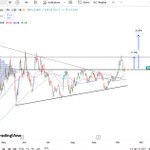




This is an irrational selloff.
Fears on neocloud financing are fair. But, the result in my eyes seems like it will be survival of the fittest. And I believe $NBIS are the fittest.
This gap between fear and fundamentals is creating the type of opportunity I look for. Big volume inefficiency above and trading at key support on the weekly. I'm buying here with long-term outlook.
NFA

36
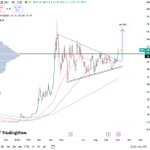
Very tough market to predict right now.
So, rather than short term guesswork, and in terms of capitalising on fear by building positions in long term equities, $BE looks technically great.
Chris Camillo also bought some.
What I like is how there's very a clear technical invalidation level (line right where we are) - key support w/ confluence of em vrvp. +30% to next high-vol node.

33
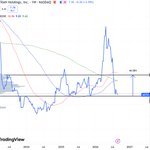
As an investor it's nice how markets have the worst case scenario (rate hikes) priced in. AI-driven disinflation + US govt desire to get out of the debt mess = upside potential

The US government cannot afford higher interest rates.
If interest rates average +150 basis points above CBO’s February projections by 2036, US deficits would increase by nearly $6 trillion over this period.
The deficit would then rise to 8.8% of GDP, the highest level since WWII, excluding 2008 and 2020.
This would also push the US public Debt-to-GDP ratio to a record 133%, up from ~100% currently.
If rates average +50 basis points above projections, deficits would increase by nearly $2 trillion, lifting the Debt-to-GDP ratio to 124% by 2036.
Just weeks ago, the 10Y Note yield traded at ~5.30%, or ~100 basis points above CBO’s average projected rate over the next 10 years.
The US government needs rate cuts.

1
12
Gavin's post and my consequent chat with Grok has sparked a few thoughts on the ai model + infra landscape; potential routes of the next 5 years...
Firstly, model layer margin compression looks almost inevitable as open-weight and vertically integrated players keep taking share. High % margins at OpenAI/Ant were always a function of limited competition. Once intelligence-per-dollar rises via cheaper tokens, end user ROI improves and volume expands, but the frontier corps themselves capture less of the markup.
That creates a structural advantage for Google, Meta, SpaceX/xAI and open-source models. They don’t need to extract margin at the model layer specifically since they can capture it elsewhere (ads, distribution, proprietary data, hardware, applications) or simply fund training as a cost of expanding the overall ecosystem. For pure-play frontier labs, if their inference margins keep compressing, the ability to reinvest in training and infrastructure relative to more diversified competitors theoretically weakens over time.
One implication is that OpenAI and Anthropic may need to vertically integrate or diversify more aggressively than the market currently is pricing in... owning more of the stack, building proprietary data moats, or expanding into applications and agents. The IPO could be part of that!
The unfortunate but interesting long-term angle is a potential bear case for AI infrastructure demand itself. If model-layer margins get squeezed enough, providers may be forced to cut costs in ways that reduce the service quality: higher latency, lower reliability, fewer high-quality reasoning tokens, and thinner safety/alignment overhead. If the “intelligence” that users actually receive becomes meaningfully worse, some of the volume elasticity that currently supports infra demand could reverse. Cheaper tokens only drive more usage if the quality-adjusted utility stays high enough. Past a certain point, cost pressure might start to halt demand.
None of this is guaranteed... elasticity could stay very high, vertical integration could spread, or new techniques could keep quality rising even at lower margins. But the feedback loop between model-layer economics, service quality, and total compute demand is real, and it’s not obvious which side wins over a multi-year horizon.
p.s. I am no professional, i'm 18 and using sources available to make logical judgements - just interesting to think about.

Why open-weight models that compress margins at the model layer are net positive for AI infra demand, exhibit 1001.
An open-weight token consumes *roughly* the same amount of compute as a frontier token for a similar size model.

65
Nice pullback opportunity here $IQE ! Testing key support with moving average after breaking the chop. Beautiful confluence.


Its taken some time to break out, but $IQE is following the expected breakout and is going strong.
Also broke recent high at 50.3$ - looking to catch a pullback around 50.3-51.

2
133
Foresee retweeted

The market is selling off on “news” that is barely news.
OpenAI reportedly told investors that its annualized revenue was approaching $50B at the end of September, rather than the ~$70B figure that was widely reported last month.
But the gap largely comes down to accounting methodology, not a $20B hole in OpenAI’s business.
Anthropic counts revenue generated through cloud partners such as AWS and Google Cloud, while OpenAI apparently does not. Investors had therefore adjusted OpenAI’s reported figures to make them comparable with Anthropic’s, which helped produce the ~$70B estimate.
So we are essentially talking about whether revenue flowing through cloud partners is included in the headline number or not.
That is a comparability issue, not some sudden collapse in OpenAI’s revenue trajectory.
The fact that the market is treating this as a major negative for AI is, frankly, pretty ridiculous.
Its taken some time to break out, but $IQE is following the expected breakout and is going strong.
Also broke recent high at 50.3$ - looking to catch a pullback around 50.3-51.
$IQE looks good to me here.
We know fundamentally that they sit in a great position as one of the only western InP substrate suppliers. Whether the trump admin's ban on chinese transceivers goes through or not, it poses as clear confirmation that InP is a structural bottleneck. This has been reflected in $AXTI, and I think $IQE is due a catch up.
Also with $LITE and $COHR earnings coming tomorrow and in 2 days respectively, they will likely reiterate the same principles as $AAOI, especially given what $LITE CEO said on news recently about demand>supply etc (did a post on this), which could highlight the InP substrate bottleneck further.
Technicals look great too, with a healthy pullback and recent breakout. Underperformed over the last few months relative to rest of photonics sector.
Lets see how this plays out - NFA!

I'm buying $OUST here.
Been waiting for a pullback into the 200 ma and r/r here seems rly favorable.
They're a prominent player in the robotics supply chain, through LiDar, which gives robots senses/vision - which they'll all need, humanoid or not.
Physical AI will be orders of magnitude above online AI (Jensen + Elon's words not mine) in terms of effect on productivity and real life. $OUST is only $2.5 bn mc. Narrative play at the bare minimum.


1
2
230
If you believe blockchain plays a role on bringing AI agents onchain, please know that Chainlink $LINK are by far the most important company behind this shift.
They've just added a new part of their website, Chainlink for Agents: chain.link/agents, and it seems as though they already have a few partnerships, or integratios at least, lined up.
Building on my recent post below in which I mentioned this use case, it's great to see execution - they're always 10 steps ahead, and you should be too. Value should accrue to $LINK (currently outperforming market too which is gd to see).


It's really great to see this public institutional coverage of $LINK
I am, and have been for years, super bullish on Chainlink. They are a monopoly regarding oracles - whether its tokenisation of real world assets, or AI agents coming onchain, or prediction markets, they all need real world data, and interoperability - and these things NEED Chainlink.
A huge problem in crypto that still needs to be resolved, along with the general industry image and maturity, is the token dynamics. To explain what I mean by this, lets compare crypto to equities:
Lets say you've done the calculations and you have conviction in a public company... you know that by buying their shares, you will reap the rewards through growth manifesting in earnings etc over time (unless there's a market-wide crash).
But with crypto, you can be so right about a company and their future revenue, market dominance and partnerships, yet the investment vehicle, the token, doesn't reflect this. Token buybacks can partially solve this, as we've seen with $HYPE, but this clearly isn't applicable in all cases (see $LINK themselves with the Chainlink Reserve, and $ENA with their buybacks in July 2025).
I remain to be confident in Chainlink as a company, but before investing in any token that's not $BTC, you must realise that its more of a psychological game, and a mattter of reading market sentiment and the market as a whole, that is, if ur not holding long long term like me.
p.s. I do believe crypto will be back, I do believe $LINK is an incredible opportunity right now, and hopefully in this upcoming cycle there will be less sh*t like Trump coin and more focus on fundamentals.
Besides, how else are agents gonna transact?
1
152
It's really great to see this public institutional coverage of $LINK
I am, and have been for years, super bullish on Chainlink. They are a monopoly regarding oracles - whether its tokenisation of real world assets, or AI agents coming onchain, or prediction markets, they all need real world data, and interoperability - and these things NEED Chainlink.
A huge problem in crypto that still needs to be resolved, along with the general industry image and maturity, is the token dynamics. To explain what I mean by this, lets compare crypto to equities:
Lets say you've done the calculations and you have conviction in a public company... you know that by buying their shares, you will reap the rewards through growth manifesting in earnings etc over time (unless there's a market-wide crash).
But with crypto, you can be so right about a company and their future revenue, market dominance and partnerships, yet the investment vehicle, the token, doesn't reflect this. Token buybacks can partially solve this, as we've seen with $HYPE, but this clearly isn't applicable in all cases (see $LINK themselves with the Chainlink Reserve, and $ENA with their buybacks in July 2025).
I remain to be confident in Chainlink as a company, but before investing in any token that's not $BTC, you must realise that its more of a psychological game, and a mattter of reading market sentiment and the market as a whole, that is, if ur not holding long long term like me.
p.s. I do believe crypto will be back, I do believe $LINK is an incredible opportunity right now, and hopefully in this upcoming cycle there will be less sh*t like Trump coin and more focus on fundamentals.
Besides, how else are agents gonna transact?

THE BLOCK: Standard Chartered set a $200 price target on Chainlink's ethereum:0x514910771af9ca656af840dff83e8264ecf986ca for end-2030 in its first coverage of the token, a roughly 25x gain from about $8 today.
The bank argues the tokenization boom will require trusted onchain data, positioning Chainlink as critical infrastructure for TradFi and DeFi.


$IQE looks good to me here.
We know fundamentally that they sit in a great position as one of the only western InP substrate suppliers. Whether the trump admin's ban on chinese transceivers goes through or not, it poses as clear confirmation that InP is a structural bottleneck. This has been reflected in $AXTI, and I think $IQE is due a catch up.
Also with $LITE and $COHR earnings coming tomorrow and in 2 days respectively, they will likely reiterate the same principles as $AAOI, especially given what $LITE CEO said on news recently about demand>supply etc (did a post on this), which could highlight the InP substrate bottleneck further.
Technicals look great too, with a healthy pullback and recent breakout. Underperformed over the last few months relative to rest of photonics sector.
Lets see how this plays out - NFA!
The gap certainly did close quick $SIVE (~35% gain in a few days)
It's rare, but i do love when technicals line up with fundamentals. I remain fundamentally bullish on $SIVE but this was a nice high conviction swing trade too.

Great risk/reward here with $SIVE imo. High beta hence the steep fall. Recovery of market as a whole will assist the reverse.
I'm buying the dip here and holding, but also a potential clean swing trade here w/ volume inefficiency. I expect this gap to close pretty quick. More coming soon on $SIVE fundamentally

Anders is former $SIVE CEO btw.
$GFS, one of Sivers' partnerships, just had earnings.
Here's the key implications on $SIVE.
1. 62% YoY optical growth and
2. 7 new customers :
“accelerating customer demand, and revenue growth across our strategic growth drivers, including Optical Networking within the AI data center"
“We secured seven new optical networking design wins across transceiver, hyperscaler, and networking customers and now expect to over double silicon photonics revenue in 2026.”
TLDR:
More $GFS silicon photonics demand --> more demand for $SIVE laser arrays --> more pricing power and revenue.
Jane Street have opened a short position today. They will profit from the fear they create out of thin air, before using the consequent liquidity to buy up $SIVE before things get serious.

GLOBALFOUNDRIES $GFS Q2’26 EARNINGS HIGHLIGHTS
Revenue: $1.79B (Est. $1.76B) 💚 +6% YoY
Adj. EPS: $0.46 (Est. $0.44) 💚 +10% YoY
EBITDA: $587M (Est. $582M) 💚 flat YoY
FCF: -$3M (Est. $122M) ❤️
Q3 Guide:
Non-IFRS EPS: $0.51 +/- $0.05 (Est. $0.50)
Revenue: $1,885M +/- $25M (Est. $1.88B)
Most interesting point was optical: 62% YoY growth and 7 New customers.
“accelerating customer demand, and revenue growth across our strategic growth drivers, including Optical Networking within the AI data center”

Great for $TE - now up 30% since recent post 2 days ago

TRUMP ADMINISTRATION PREPARING TO SET PRICE FLOOR, TARIFFS ON IMPORTS OF POLYSILICON AND DERIVATIVE PRODUCTS USED IN CHIPS AND SOLAR PANELS-SOURCES
2
650
This is a very interesting angle.
The ban isn’t confirmed and could well just be a threat / negotiating leverage over China for easing InP permit restrictions.
If it doesn’t go through gains could be erased. That said, demand far exceeds supply for whole photonics sector, so no fundamental worries, I just wouldn’t be using any leverage at least for the short term until the ban passes.
If it does pass, like I said in my previous post, this is bad for downstream margins. And I don’t think the market would like the sound of hyper scaler margin compression. This could in turn lead to reduced CapEx.

Why this might end up being bullish $AXTI ...
My base case is that this is negotiating leverage.
The U.S. needs an easing on the InP permit constraint.
The Trump admin is aware of this.
They've talked about it and invested towards it.
So if this leverage is successful in talks with China, the end result might be that China eases InP permit restrictions to the US.
This would unlock a massive market that AXT does not currently have access to
They currently get some permits to ship U.S. companies based outside of the U.S.
But that is a much smaller market than the mainland.
NFA of course. If this escalates into a real ban, China might retaliate. But that would have significant ramifications for the U.S. buildout.
35
Investors are overlooking $CRDO as a beneficiary of the Chinese optical transceiver ban.
While they're not pure play like $LITE, $COHR etc, the transceivers still need interconnects, and Credo are positioned well for the onshoring.
Demand for 800G/1.6T links will shift to non-Chinese suppliers.
Credo sits in that stack in two ways:
• Optical DSPs that go inside high-speed modules (bare in mind competition like $MRVL
• After recently acquiring DustPhotonics on May 28, they now can make their own optical transceivers (ZeroFlap tranceivers) + silicon photonics
Management is guiding optical-related revenue (ZeroFlap transceivers, DSPs, and silicon photonics) above $500–600M in fiscal 2027.
A forced onshoring of the module layer would increase volume for Western connectivity providers, including Credo’s growing optical portfolio.

156
$SIVE $AAOI $COHR $LITE
Trump admin is drafting a ban on new Chinese optical transceivers, which move data at light speed inside every AI data center rack.
China's Innolight has ~ 27% global market share.
Demand is exploding as we go from 800G → 1.6T. That demand will get forced onto the short list of non-Chinese suppliers.
$COHR + $LITE already have massive Nvidia allocations locked in
$AAOI just broke ground on ~400k sq ft of new U.S. capacity and is guiding >$1B in 2026.
$SIVE is already inside the Western silicon-photonics stack (GlobalFoundries, Ayar Labs, high-power DFB laser arrays) - and their valuation still makes no sense.
It's the same national security playbook the FCC just used on Chinese robots and power inverters.
If this ban goes ahead, it's not great for data centres and downstream margins, but amazing for the companies that are positioned well.
I also believe $CRDO will benefit from this onshoring - post coming soon, though the majority of short term speculation will go towards the pure play examples listed above. Sivers and AAOI are my favourites.
1
329
Huge for $SIVE
$NVDA confirms CPO is already in mass production.
Switches are shipping to key customers and running inside Nvidia’s own AI factories, AND major global deployments will hit later this year.
Gilad Shainer ($NVDA VP), said that the “true business opportunity in the optical communications market is in vertical scale up, not horizontal (scale out), which costs 10x the bandwidth”. He said that this “injects a strong boost into the optical communications market”
Ayar Labs leads exactly this with in-package Optical I/0, and $SIVE is the critical supplier of the high-density laser arrays powering it.
This high-volume partnership puts $SIVE in the $NVDA and hyperscaler supply chain.
Super bullish, and there’s a sale on right now! (NFA, DYOR)

Nvidia's announcement of co-packaged optics entering mass production provides a boost to optical communications.
"Gilad Shainer, Senior Vice President of NVIDIA, announced that Co-Package Optics (CPO) has entered mass production."
"According to foreign media reports, Gilad Shainer announced at a recent technology forum that CPO has begun mass production. Switches developed by Nvidia in collaboration with its supply chain have been delivered to close customers and are also being deployed at Nvidia's own facilities. It is expected that a large number of switches with CPO technology will be introduced into AI factories around the world this year."
