

Serial victim of Bluetooth. Finder of problems. Mastodon deets: ∙ @gingerbbm@boing.world ∙ https://teapaw.org/t.co/eIJb75TpVW
Joined August 2020
- Tweets814
- Following393
- Followers43
- Likes2.6K







Stuart Jones ∙ @[email protected] retweeted

Trillion dollar idea: a machine that breaks other machines. But it also causes unemployment. But it also breaks the spirit of artists. But it also convinces you not to take your medication. But it's also very vulnerable to being stolen by spies, depending on how horny you are.



Stuart Jones ∙ @[email protected] retweeted

I don't think I'm doing a good job communicating my view, so I will try to do better in this post.
My view is shaped by over 15 years of writing about fashion (including the effects of fast fashion), reading @wdavidmarx's book "Status and Culture," and private conversations with technologist @quintendf. I will incorporate each of these influences as I make my argument.
Let's put AI aside for now and talk about fashion, where I have better footing. We can start with a basic question: why were slim-fit pants considered good in the early 2000s, but bad today? The simple answer is because fashion moves through a lifecycle.
In the early 2000s, wearing slim-fit pants signaled that you were on the edge of culture. Perhaps you bucked gender norms, read Details Magazine, and drew inspiration from youthful European fashions. After all, this was a time when designers like Hedi Slimane and Raf Simons sent ectomorphic models marching down the runway in skin-tight clothes. And nands like The Strokes and The Libertines gave the style cultural relevance.
Over time, the meaning of that look changed as it spread through the market. In the early 2000s, skin-tight pants looked cool because they signaled gender rebellion and rock-and-roll. But as it got mainstreamed through Mad Men and J. Crew, it became increasingly normalized and sanitized. Today, it represents the opposite of what it did in the early 2000s — gender conformity, out of touch, corporate drone. Also whatever Andrew Tate represents.
This is the basic dynamic that drives fashion forward: people with low cultural capital copy people with high cultural capital, and then people with high cultural capital move on to distinguish themselves. This dynamic has been observed and remarked upon for hundreds of years, including by Bernard Mandeville (1714), Georg Simmel (1902), and Pierre Bourdieu (1979).
This is why we're seeing a swing back towards baggier pants. People who put a lot of effort into improving their cultural capital don't want to look like everyday office drones, political interns, or Andrew Tate.
Although, many astute fashion writers have remarked on a backlash to the backlash. Prada recently sent models back on the runway in slim-fit pants, probably because every male fashion influencer on Instagram nowadays is wearing the same look (e.g., cropped top, big pants, 70s hairstyle).
Now let's look at the fast fashion industry. Fast fashion isn't bad just because the clothing is low quality. It's bad because it speeds up the trend cycle. In the distant past (say, pre-20th century), styles used to last at least a generation, if not more, because production was slow and information moved slowly across geography. Over the 20th century, as fashion went from bespoke to ready-to-wear, the production cycle sped up. By the end of the century, a look would still last maybe a decade before it got old.
Today, developments in information technology and supply chain management have made it possible for a company to rip a look off the runway and put it into their stores before the original designer even has a chance to monetize their creation. So the criticism of companies like Shein, Zara, and H&M isn't just that they make crappy clothes (which they do), but that the minute you buy something, you realize the trend is already over. The people you tried to copy have already moved on, so you have to copy the next thing. Plus, as this copying process accelerates, designs can get more jumbled and ugly. Oh, double riders and fleece are trending? Let's make fleece double riders. It doesn't matter if it looks like ass — the thing won't stick around in the market long anyway.
In his book Status and Culture, @wdavidmarx talks about how people's pursuit of status moves culture forward. Much of the book draws from varoius fields, such as sociology, anthropology, media studies, and the like. But then the last part of the book deals with something curious: Why can various fashions define previous decades, but things have not changed much since the 1990s? Indeed, I would argue that the last big innovation in menswear happened in the 1980s/ 90s with Japanese designers like Yohji Yamamoto and Issey Mikaye. Menswear has been backwards looking every since — never forward.
Every era in the past had a distinct fashion. The 1960s had Mods and the Peacock Revolution, the 1970s had hippies and bohemian dress, the 1980s had power suits and the return of prep. Yet, if you watch a 1990s episode of Friends ... we kind of still dress the same. Yes, the silhouettes have changed a little, but the styles are mostly identical.
Marx suggests this is because status games mostly play out online, where cool things can become uncool in a matter of hours. As a result, nothing really takes hold, so we get fleeting fads instead of era-defining trends. Think of what happens with memes. Something starts funny, and then a corporation's social account uses it to seem relevant. Then the meme is decidedly uncool.
I once had a conversation with @quintendf about this. He suggested that we might be approaching a period where creative people seek to do things off the internet. Maybe that means returning to zines and cassette tapes that are passed around through a dub of a dub. Or maybe it's sensory experiences you can only have in person. During our conversation, I said that for this to happen, we need affordable housing in densely populated areas so creative people can interact with each other offline. And not feel pressured to maximize their income by selling themselves online.
Which brings us back to AI. That Yung Lean video originally went viral because people found it moving. I remember reposting it on Twitter, which led several people to question whether I was secretly paid behind the scenes to do so (I wasn't, as I don't do paid tweets). To me, their questioning only underscores how natural that viral moment was—the video moved lots of people, so they shared it on their socials.
Now that it has been endlessly copied in such trite, meaningless ways, the visual effect feels ever hollower. It has become a meme. As one person put it, "I now cringe when I see it."
If we look back on history, we can see distinct creative movements in art, music, furniture design, fashion, architecture, and more. Neoclassicism led to Romanticism; Art Deco eventually led to mid-century modernism; big-band swing music led to bebop. These movements all follow a familiar formula: a zeitgeist led to a backlash, which created yet another zeitgeist.
How can we have a creative zeitgeist when nothing is allowed to take hold? When every visual language is so easily replicated through AI tools and turned into memes? When visual language speeds from cool to cliché and then gets used by people with low cultural capital?
This is what I meant when I said that AI may contribute to our cultural stagnation. The issue isn't whether AI detracts from the original work. Indeed, it can elevate the original artist and bring them more attention. The question is whether this is good for people who care about creative integrity for its own sake — outside of notions of monetary rewards or fame. And whether this is good for culture.

Stuart Jones ∙ @[email protected] retweeted
🇨🇦 CANADIAN SHOPPING GUIDE 🇨🇦
Want to support Canadian companies? Here are some Canadian businesses that sell high quality menswear. Some also carry womenswear. 🧵


Stuart Jones ∙ @[email protected] retweeted


Stuart Jones ∙ @[email protected] retweeted

In adults, limiting smartphone functionality to texting and calls and blocking all social media and mobile internet for 2 weeks significantly improved attention, self-reported well-being and mental health. 90% of participants experienced a benefit.


Stuart Jones ∙ @[email protected] retweeted

Shout out to everyone who takes the back off the remote control and rolls the batteries around instead of just replacing them.
Stuart Jones ∙ @[email protected] retweeted

Albertans … a new cartoon on TV:
Stuart Jones ∙ @[email protected] retweeted
Really like this project by Ari Versluis and Ellie Uyttenbroek. Titled Exactitudes, it's a series of portraits stretching back 20 years that shows how people style themselves to show they're part of a group and unique individual within that group.


Stuart Jones ∙ @[email protected] retweeted

Can anyone confirm if this is real?

Stuart Jones ∙ @[email protected] retweeted

I sort of thought the quote couldn’t be that bad in context, but the accompanying video is actually somehow worse than expected

“It’s not really enjoyable to make music now… it takes a lot of time, it takes a lot of practice, you have to get really good at an instrument or really good at a piece of production software. I think the majority of people don’t enjoy the majority of time they spend making music.” Founder of @suno_ai_ @MikeyShulman
Always interesting to hear someone with a completely opposite view to me.

Stuart Jones ∙ @[email protected] retweeted

Word of the day is ‘recrudescence’ (17th century): the return of something terrible after a time of reprieve.
Stuart Jones ∙ @[email protected] retweeted

legacy software companies adding an ai chatbot to their product

Stuart Jones ∙ @[email protected] retweeted

I feel like this may prove to be the most prescient cartoon of the 21st century.

Stuart Jones ∙ @[email protected] retweeted

Will Smith sorry for smash mouth
Jimmy Carr sorry for killing joke
Louis C.K. sorry for the strokes
Scientology sorry for bad religion
CIA sorry for dead kennedys
Lazy texters sorry for u2
Owl sorry for the who
Blind dog sorry for wet leg
UK beef industry sorry for madness
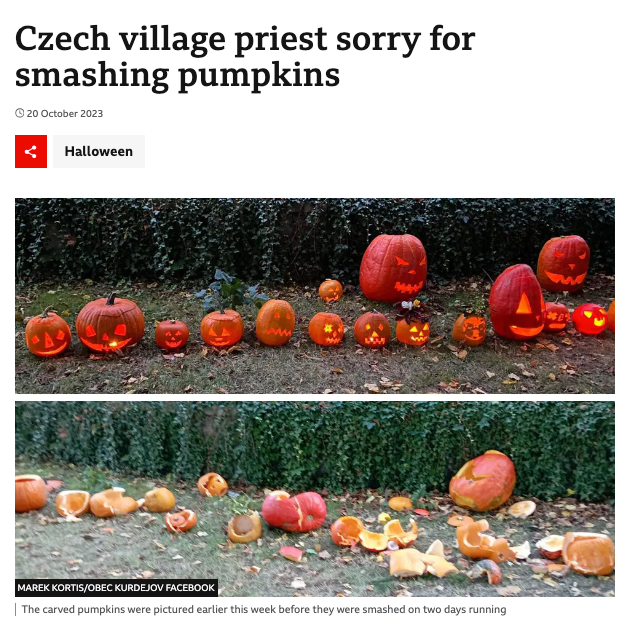
ALT A BBC headline from October last year that reads “Czech village priest sorry for smashing pumpkins” and underneath is a picture of carved pumpkins, pre and post smashing


Stuart Jones ∙ @[email protected] retweeted

I've decided to draw a series of pictures chronicling the worst types of public behaviour.
Any others I should draw?
