

Finance Prof @iesebschool. Director at #bigdata center WRDS @Wharton. @ecgiorg member. Tweets on #AI impact #ownership #governance
BCN
Joined February 2012
- Tweets199
- Following365
- Followers713
- Likes372


How scientific knowledge will be shared and debated. Very exciting, I always felt the constraints of what to show vs what goes to the endless appendix.

research in social science is changing: yes, better executed and robust papers, and more capacity for first-order, hard questions. No wasting time with “epsilon papers”

With math essentially being delegated to OpenAI, here's what I predict for economics and the social sciences more generally:
✅The top tier of research will just become better and it will be normal human-led research where AI is used for scale (e.g. conducting qualitative interviews with relevant populations, running behavioral interventions in the field, analyzing massive text data, etc.)
✅ Field experiments will rise in value and generally making "connections" with firms and being able to run stuff (potentially testing AI pipelines) will be in high demand
✅ Research with administrative data will become even more valuable, but the benefits might be concentrated among some prolific authors who are allowed by the government agencies to use local models to analyze the data at scale. PhD students can probably forget about it
✅Economic history will have a very exciting boom and there will be an enormous race and big rewards for digitizing archives as a source to both identify new research strategies and document new descriptive facts.
✅Review and verification systems will become massively improved with AI assistance and it will become standard practice to do a 360 review of the paper + code + data at the *submission* stage.
⚠️Research that in principle can already be almost completely outsourced to the AI (download and analyze public data, run simple survey experiments, write theory models) is in for a big shock. This would be very bad from the perspective of researchers who depend on this "bread and butter" research, but I think this type of work will just be outsourced to public agencies who can answer their own questions without the need for "peer-reviewed" research.
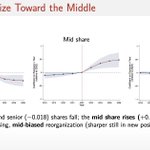
Is middle management back?
In a different guise: AI exposed firms increase the share of middle managers.
Why is that? Middle managers have more AI skills; focus on planning and design; manage agents.
Juniors may lack experience, seniors lack the skills to build. @joseazar


To add one more data point: we find as well no employment effect of AI exposure, using OEWS data. Where we do find a significant impact is on wages and job-to-job transitions, indicating that outside options are worse.
Here is paper with @joseazar
papers.ssrn.com/sol3/papers.…


New post with the excellent @FutureEconJacob examining the evidence (so far) on the impact of AI on the labor market. We reviewed 20+ papers and datasets and attempted to synthesize the evidence. Our take:
1) There is no strong signal that AI has had a negative or positive impact on employment in the aggregate.
2) When looking at specific sectors and demographics, the evidence is fairly mixed. While some have argued for negative impact on AI-exposed, early career hiring, others have identified moderators such as remote work or macroeconomic trends. There is also some evidence of positive impacts as well.
So has AI hit the labor market yet? When looking at the employment statistics--not really. But that does not mean that jobs are not changing significantly, and that there aren't substantial changes in what skills are becoming less relevant versus in greater demand. That's a topic for another post!
Link: aleximas.substack.com/p/has-…
Mireia Gine retweeted

The US labor share is at all time lows, but real wages are going up. So are things going well or not? It depends on whether people care more about consumption of the goods the economy produces, versus positional goods (that depend on relative status).
We wrote a one-page paper, keeping it as simple as possible, w/ @mireiagine.
Link to paper (although the whole paper fits in one image): papers.ssrn.com/sol3/papers.…

The college wage premium has been dropping every year since 2022.
It's already back to the level it was in the mid-1990s.
New paper with @joseazar and @javiersanzespin

🚨New paper with @mireiagine and @javiersanzespin.
After rising for decades, and stabilizing in the 2010s, the college wage premium has been dropping every year since 2022.
It's already back to the level it was in the mid-1990s.
Link to paper: papers.ssrn.com/sol3/papers.…
#EconTwitter

Mireia Gine retweeted
🚨New paper with @mireiagine and @javiersanzespin.
After rising for decades, and stabilizing in the 2010s, the college wage premium has been dropping every year since 2022.
It's already back to the level it was in the mid-1990s.
Link to paper: papers.ssrn.com/sol3/papers.…
#EconTwitter
Mireia Gine retweeted
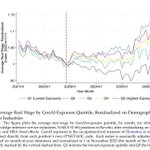
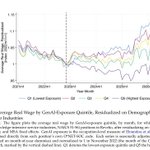
Updated version of my paper with @mireiagine and @javiersanzespin on AI and wages.
Main findings:
1. Exposure to GenAI automation has a negative effect on wages, using both Bureau of Labor Satistics data and Revelio.
2. GenAI exposure reduces worker separation rates and job-to-job transition rates (a proxy for the quit rate). This suggests exposed workers have worse outside options in the labor market than before.
3. Firms' monopsony power (measured by the workers' elasticity of separation with respect to wages) has increased for workers more exposed to automation by GenAI.
Link to paper here: papers.ssrn.com/sol3/papers.…

Mireia Gine retweeted
New paper on the effect of AI on wages with @mireiagine and @javiersanzespin. We use Revelio data on 450 million US job postings (138 million workers) and find that wages declined in firms exposed to GenAI relative to firms in the less exposed quintile.

Mireia Gine retweeted

Recordando a Ernest Lluch con @mireiagine. Como siempre, con un tema que creemos que le habría encantado y con el apoyo de la @FundErnestLluch. Y con esta tristeza que el tiempo no borra.


Mireia Gine retweeted

S'inicia el XXI Seminari Ernest Lluch d'Economia a la, UB: “Empreses amb accionistes comuns, competència i innovació". Amb la professora Mireia Giné (@iesebschool)
📅 10 de novembre⏲️12:00h📍Facultat d'Economia i Empresa de la @UniBarcelona


Mireia Gine retweeted

The staggered roll-out of Facebook at US college increased symptoms of poor mental health, especially
depression.
Paper by Braghieri, @RoeeLevyZ & @alexeymakarin:
papers.ssrn.com/sol3/papers.…

Mireia Gine retweeted


Overall, these results show that many so-called “bad newsletters” are often in the interest of Money Stuff readers. bloomberg.com/opinion/articl…
Mireia Gine retweeted

IESE launches its Artificial Intelligence and the Future of Management Initiative with a session on #AI 's immense impact on businesses and the people who manage them.
Watch it live on Monday on our LinkedIn page: sm.iese.edu/0nroj5
#IESEonline

Mireia Gine retweeted
How sharply has job market demand for #AI skills grown over the past decade? New #IESE research on the topic will be among the issues discussed at Monday's presentation of our AI and the Future of Management Initiative. Streaming info to come.
Read more: sm.iese.edu/uszok1

A smart way to visualize gender disparities using #COVID19 as a shock. Check graph below. 🙏

Given concerns over impacts of #COVID19 disruption on women, we looked at data on 1st submissions to @JEEA_News using same time period comparison as
@RFisman @restatjournal & @profesk @EJ_RES
Share of women submitters falls: 28 to 16%
Breakdown by gender comp of papers below:

¿Qué casa de cuarentena escogéis? Yo me apunto a la #3: Maya Angelou, Plath y Rand saltarán chispas metafísicas!

