Economist @unav @iesebschool. Writing on labor economics, corporate governance, industrial organization.
Spain
Joined June 2009
- Tweets7.1K
- Following4.4K
- Followers6.8K
- Likes5.6K







Pinned Tweet
My paper with Xavier Vives on "General Equilibrium Oligopoly and Ownership Structure" is forthcoming in Econometrica. Link here: 👉econometricsociety.org/syste…


José Azar retweeted

AI productivity gains are showing up, but only in ~15% of jobs.
The three heaviest AI adopters (information, professional services, finance) went from a 2.2% productivity trend to 5.0% since 2022.
The rest of the economy: 0.9% to 1.4%.

José Azar retweeted

Very happy to share a new paper, “Technology Bottlenecks: Measuring Where AI Could Raise the Value of Work It Cannot Yet Do.”
AI exposure measures ask about the work AI is capable of doing. We ask instead where the marginal value of work AI cannot yet do may rise as AI speeds up the rest of the job.
To do so, we employ 288 million U.S. job postings mapped line by line to their closest O*NET tasks and GPT-4 feasibility ratings from Eloundou et al. (2024) to construct a measure, “bottleneck pressure,” for each task in each occupation that posts it.
Using a simple task-based framework, we derive this pressure at the task level, showing that for an AI-infeasible task it is the exposure of the occupation that posts it, so the same task can face very different bottleneck pressure in different jobs.
Reporting bottleneck pressure alongside AI exposure shows both the scope for AI to perform work and where improving the work it cannot do may pay off more as capabilities expand.

José Azar retweeted

Was about to write this but Ben beat me to it. Econ is unique among the sciences in that it is several pretty different fields living under one umbrella.
Empirical econ is the biggest subfield and its closest to biology or chemistry: it’s about designing or—even better—finding a natural experiment, or documenting interesting and important patterns in data. Most of the arguments in that field are about methods, eg do you have identification. More and more are starting to study AI now but obviously this won’t be transformative AI because, well, there is no data on transformative AI.
Then there are macro economists. They work with a set of pretty standard models and mainly expand them by slowly adding/subtracting different sectors or micro founding factors of production in different ways. Many of the arguments are on the parameter values that we should assume when simulating the economy. Early research on transformative AI started there—as demonstrated recently by Chad, Anton et al, the different levels of transformation are due to different assumptions on parameters rather than some new type of economics. The same model can predict basically no impact of AI vs huge transformation, it’s all about assumptions on parameters.
Finally there is micro theory. This is where decision theory, game theory, mech design, org econ (sort of) live. This field works by setting out a set of assumptions and then *deriving* the expected results; alternatively one could start with a result and work backwards to derive the necessary and sufficient assumptions. There is a ton of potential here to do work on transformative AI: start with assumptions on how AI differs than human agents (eg relax basic assumptions on constraints, on scarcity, introduce completely different objective functions), then derive implications. But this is where there is the least amount of work, and it’s important for that to change (and I believe that it already is).
I think we can make a ton of progress from these three subfields on better understanding the potential AGI and post AGI transformation.
But there is another scenario, post strong ASI, where I don’t think economics has much to say about. Here I agree with @Jabaluck that the economy (if you can even call it that) and the agents in it will be so vastly different and beyond our imagination that I wouldn’t know where to start modeling it. Not to discourage others, but post singularity seems like pure epistemic uncertainty to me.
A lot of the critiques I hear about AI and economics come from people who don’t quite get what economists do. They look around at different results and if they don’t like some of them, they say “oh economics isn’t “pilled” or something. But economists don’t debate results, they *derive* results from assumptions. Thats where the debate is. Saying “but you don’t understand a world with 15 billion AI agents”. What does that mean for the economy? What are those agents doing, who is buying what they are producing, what do property rights look like? Depending on those assumptions you’ll get vastly different economic scenarios, from 2% growth and high human labor share to completely alien centralized systems with no prices or markets.

José Azar retweeted

Showing off expensive things might actually make people less interested in being your friend.

José Azar retweeted

“Follow your dreams—ideally in a field that will still require humans when you graduate.”

José Azar retweeted

I'm thrilled to be launching Econvitals today. It's been the main way in which I have been tracking and understanding the economy over the last several months. And I decided I might as well share it with all of you--for free.
Has a combo of website, email lists & social media.

José Azar retweeted

Why do firms acquire competitors? Not just to increase market power, but also to increase political power.
Firms may undertake acquisitions purely to extract political support from politicians who fear the consequences of their failure.
@TomValletti
matteobroso.com/papers/theor…

José Azar retweeted

I really liked the short version of this paper - it hits on something that was already an issue over the last few decades and extends the logic. What I suspect we are also now seeing is a squeeze on essential good consumption (food, energy primarily, water down the line).

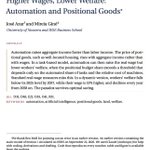
A month ago @mireiagine and I posted a one-page paper showing that automation could make workers worse off even if their real wages in terms of reproducible goods increase, if the labor share goes down, and "positional" goods are sufficiently important.
This is possible in theory, but how important is it in practice? We have a new (full-length) version of the paper that calibrates growth models of future automation (following the work of @alexolegimas @ben_moll @JesusFerna7026). We argue that this is probably not happening right now (although positional relative price increases are reducing welfare gains), but could be enough quantitatively in a future in which more and more of the economy gets automated to reduce worker welfare even if wages increased in terms of reproducible goods.
papers.ssrn.com/sol3/papers.…


José Azar retweeted

New paper: "AI Article Reviews Dominate Human Peer Reviews at Their Best: Evidence and Policy Choices" See: GaryKing.org/peerless. with Steven Worthington. Comments welcome!

A month ago @mireiagine and I posted a one-page paper showing that automation could make workers worse off even if their real wages in terms of reproducible goods increase, if the labor share goes down, and "positional" goods are sufficiently important.
This is possible in theory, but how important is it in practice? We have a new (full-length) version of the paper that calibrates growth models of future automation (following the work of @alexolegimas @ben_moll @JesusFerna7026). We argue that this is probably not happening right now (although positional relative price increases are reducing welfare gains), but could be enough quantitatively in a future in which more and more of the economy gets automated to reduce worker welfare even if wages increased in terms of reproducible goods.
papers.ssrn.com/sol3/papers.…
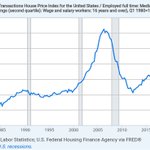
The US labor share is at all time lows, but real wages are going up. So are things going well or not? It depends on whether people care more about consumption of the goods the economy produces, versus positional goods (that depend on relative status).
We wrote a one-page paper, keeping it as simple as possible, w/ @mireiagine.
Link to paper (although the whole paper fits in one image): papers.ssrn.com/sol3/papers.…

José Azar retweeted

Could not agree more … there’s a sort of empty moralism/self-righteousness in the attitude against AI written docs.

José Azar retweeted

I keep seeing people run all sorts of documents through Pangram and get outraged when they come back as AI-positive. I feel like I’m starting to lose sight of what we’re trying to achieve here. Is the outrage always warranted? 1/
José Azar retweeted

OpenAI just released hundreds of AI-generated results on open math problems.
If AI solves more problems with less human input, is human input worth less?
Short answer: not necessarily. It can be worth more—depending on which problems are left and how solvable they are for humans.
Thread, partly inspired by my paper with @EduardTalamas, “The Turing Valley” (accepted, JHC). (1/n)

José Azar retweeted

Thoughts on France’s discontent.
Demographic trends and their unpleasant social security arithmetic.
France’s spends about 15% of gdp on pensions; a HUGE number. What is the rate of return of its SS system for young generations? Its dismal. No wonder the French youth is angry.
Assuming a balanced SS budget, and freezing the current age distribution of the population, a young worker will get only 60% of her contributions back, discounting future flows at a rate of 4%. At a more reasonable market rate of 6% they lose 70% of their contribution. This is the burden for the young of social security’s inter generational transfers to the old. The actual return will be even worse projecting demographics assuming current fertility rates remain constant and net migration is frozen. Freezing today’s SE generosity ratio, the system is fiscally unsustainable.
The political arithmetic of this system is perverse. As people approach retirement age, they benefit more from the system, They have less remaining contributions, and get closer to collecting benefits. The age at which contributors break even is 36 or 44 depending on the assumption on the market interest rate. As the median voter is older, this ponzi scheme is enforced by majority voting. These older voters will eventually balance the budget taxing the youth even more, which will make the youth more unhappy.
For methodological details see the paper below on Argentina. A detailed calibration for European countries and a world atlas of Social Security arithmetic is coming soon in a paper with @ManuelMacera and Martina Ucha.
These demographic trends and inter generational transfers underly @ojblanchard1 and @HannoLustig’s debt worries and @lugaricano’s commentary on dependency ratios in his recent conversation with @tylercowen.
dropbox.com/scl/fi/ok1qrciri…
🤖 Made with AI


José Azar retweeted

Everyone talks about what AI will do. But almost nobody asks who will pay for the machines. Taking advantage of AI will require an extraordinary amount of capital, from data centers to new power plants. Will that capital be around?
I try to address that question in the first draft of my new paper “Saving for the Machines.”
To show how important capital is to fuel the transition to an AI-based economy, I document how the same technology path that generates 11.7% annual growth when households choose their saving rate optimally delivers only 2.2% when the saving rate remains fixed. In other words, if we experience slow growth over the next few years despite fast improvements in AI, this slow growth may reflect too little capital accumulation instead of a technological bottleneck.
The key to this result is that AI raises the capital share by moving tasks from labor to machines, which requires that those machines are built. In comparison, ordinary technical progress makes labor and existing machines better at the tasks they already perform.
To inspect the mechanism, I start from an accounting identity: the saving rate is the capital share times the ratio of investment to capital income. If I take the evolution of the capital share as given, I can ask how much the latter ratio moves in response to that evolution. Crucially, with an optimizing household, this ratio barely moves. As machines take over tasks and the return to capital rises, the household responds by letting consumption grow faster, by the intertemporal elasticity of substitution times the rise in the return. To pay for that faster consumption, capital must also grow faster by the same amount. So, the household keeps investing about the same fraction of what the machines earn. And since machines earn a larger share of output, the saving rate also goes up. With a fixed saving rate, the same accounting identity tells me the opposite: the ratio falls in proportion as the capital share rises.
Will the U.S. and other advanced economies then generate enough capital? For many reasons, I doubt it. We might end up in a situation where many of the opportunities offered by AI are left on the table. This is particularly important for all who think that AI might get us out of many problems, such as fiscal troubles (like in France) or ultra-low fertility. We need to save for the machines, and it is not clear we can do that.
Anyway, this paper has been long in the making (many months of hard work), but I have learned much from it. In particular, working through the model changed my mind about many issues related to AI. Again and again, my intuition said X, but the math said Y. And math always won in the end. That is why we write formal models.
A nice example is Proposition 5, whose proof is the one I like the most in the paper. With improving machines and strong task complementarity, there is no fixed balanced growth path because the target itself keeps moving. The nice part of the proof is to realize that, after the right normalization, the moving target becomes a fixed point, and the saddle gets steeper as machines improve. So instead of falling behind, the economy tracks the moving BGP more and more closely. A fair amount of ODE work to get there, but a very simple economic idea underneath it once you get it.
The paper is here:
sas.upenn.edu/~jesusfv/Savin…
and the slides are here:
sas.upenn.edu/~jesusfv/Slide…

José Azar retweeted

How is AI improving time-series forecasting?
A brief presentation (in Spanish) on recent key developments (including work by @pablo_guerron and @ricco_giovanni)
Slides: galonuno.com/uploads/1/3/4/6…
Video: youtube.com/watch?v=dbD7h9mo…
José Azar retweeted

Francia tiene un gasto público del 57,2% del PIB, casi ocho puntos por encima de la media europea, y una de las mayores cargas fiscales del continente.
Y resulta que la culpa del malestar social es de las privatizaciones y de los mercados.
Igual habría que empezar a preguntarse por qué uno de los Estados más grandes de Europa es incapaz de resolver los problemas que lleva décadas prometiendo solucionar.
Pero nada, seguro que la solución es más Estado.


Francia siempre anticipa las revoluciones populares contra el poder.
El ritmo de las protestas parece intensificarse en todo Occidente contra la vida cara, las privatizaciones y la entrega de la soberanía a los mercados.
Hay un cambio de ciclo en ciernes y se necesitan propuestas políticas a la altura del momento.