
Medical Director, LCC Cancer Center | Honest, data-first oncology trial analysis (PFS ≠ OS). Community practice perspective.
New Jersey, USA
Joined February 2010
- Tweets2.7K
- Following2.3K
- Followers2K
- Likes1.5K


Disagree. The AI "slop" likely was poor human oversight/prompting. Used properly AI is incredible helpful research tool.

I recommended rejection for a paper that was, in my opinion, AI slop in both content and style. I was satisfied the editorial decision was for rejection, but it concerns me is that none of the other reviewers seemed to find problematic the AI-typical rhetoric. I don’t want to punish AI use automatically, and, indeed, I use AI in some of my own writing. The ideas content should be evaluated for what they’re worth. But in persuasive or semi-persuasive writing like position statements/perspectives (which this was), narrative reviews, or discussions of research articles, I do think reviewers/readers ought to be on the lookout for typical, whole-cloth AI writing that is super slick. I’m talking about out-of-the-box default model output that is unedited by human and scores 100% on Pangram. It can dress up vacuous claims and poor logic trains with vague clickbait statements and sales-pitch verbiage that inflates the importance of the supporting evidence. You see it all over LinkedIn and it’s begun to infiltrate scholarly journals. Editorial norms are still forming on this issue. What do you think?
This one bothers me. When SAFFRON opened in Aug 2022 there was real equipoise, savo + osi only had single arm data and chemo was the post-osi standard.
That changed in June 2025 when SACHI, a randomized phase 3 of the same combo, showed a big PFS benefit over chemo and China approved it. I can see the case for SAFFRON continuing to randomize, SACHI was China only and mostly after 1st or 2nd gen TKIs.
I can't see the case for still denying chemo pts the combo once they progressed. Every one of them got in because a biopsy showed MET-driven resistance, and outside China savo was essentially unavailable. That includes pts randomized before June 2025 who progressed after it. SACHI, same combo and same PI, let chemo pts cross over and 43% did.
KRYSTAL-12 allowed crossover to adagrasib, and GEOMETRY-E, capmatinib + osi in this same setting, added it by amendment.
No SAFFRON amendment adding crossover has been reported, and that likely made the OS gap bigger than it would have been with MET-directed therapy available after chemo.

Simultaneous publication @NEJM of #ESMO26 presentation from Dr. Shun Lu. Osimertinib + savolitinib superior to chemo in EGFR+ NSCLC post osimertinib with MET overexpression and/or amp: 338 randomized / 1746 screened: PFS 7.6 vs 5.4m, HR 0.55, OS HR 0.68
nejm.org/doi/full/10.1056/NE…

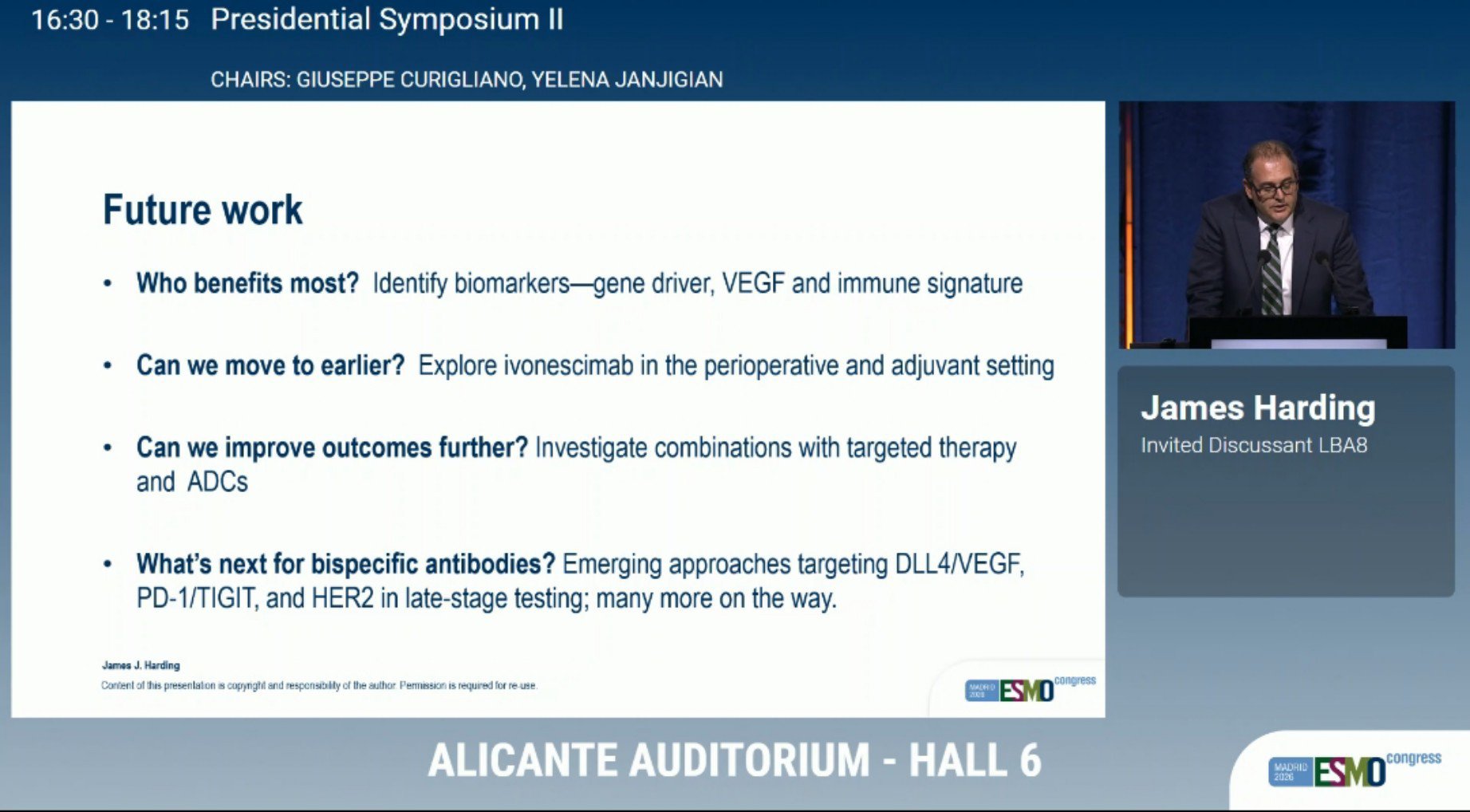
Pan tumor off one positive ph3 outside lung, from one country, at an interim? GI1 is a real result, first ph3 to beat an active PD-L1 arm on OS in BTC. But there was no PD-L1 plus bev arm, so we don't know yet what the bispecific itself adds. EA2251 should tell us.

Ivonescimab is the next pan tumor blockbuster drug . Full stop . @OncBrothers @OncoAlert @myESMO #ESMO26 @JacobPlieth


Nice work by Dr. Powles and the VOLGA team. Durva/EV improved OS with EV given only before cystectomy, which makes sense for pts who struggle after surgery. I'd like to see EFS events by type in each arm, since 21% of controls never had surgery vs 15% on durva/EV.

Presented at #ESMO26:
In patients with muscle-invasive bladder cancer, event-free survival at 24 months was 63.5% with perioperative durvalumab plus neoadjuvant enfortumab vedotin as compared with 45.1% with surgery alone. Full phase 3 VOLGA trial results: nej.md/4z7dQFm
@myESMO

ALT A graph showing event-free survival for the durvalumab–enfortumab vedotin (EV) and control groups (intention-to-treat population).
DeLLphi-305 is a real OS win, HR 0.42, and since many SCLC pts never reach 2L, giving tarla early makes sense. But only 33 of 281 control pts got tarla later, so the trial can’t tell us how much of the gain is early tarla vs any tarla at all.
Presented at #ESMO26:
In a prespecified interim analysis of a phase 3 trial involving patients with extensive-stage SCLC, the median overall survival was 21.1 months with tarlatamab–durvalumab maintenance therapy and 12.7 months with durvalumab alone. Full DeLLphi-305 trial results: nej.md/4iveIgW
@myESMO

ALT A graph from the Original Article "Tarlatamab–Durvalumab Maintenance for Extensive-Stage Small-Cell Lung Cancer." The trial name, DeLLphi-305, is in parentheses after the title. The graph shows the overall survival (intention-to-treat population). The trial results are being presented at the European Society For Medical Oncology 2026 Congress. The logo of the New England Journal of Medicine is at the bottom.
LITESPARK-012 is consistent with KEYMAKER-U03, where qmab/pembro/len had numerically lower ORR (71.3% vs 80.6%) and median PFS (18.0 vs 26.3 mo) than pembro/len. It adds anti-CTLA-4 to a PD-1/VEGF TKI doublet, a different question from ipi with nivo, which 8Y8 tests.

LITESPARK-12 tested Len/pem/CTLA4 vs Len/pem in 1st line advanced RCC. This, and the adjuvant nivo vs ipi/nivo trials both add CTLA4 to Nivo. #ESMO26 8Y8 (ipi/nivo vs Nivo) is long awaited. Uncertainty on the role of CTLA4 is increasingly uncertain @brian_rini @DrChoueiri @OncoAlert


I agree these are impressive results. One apparent correction, though, since these numbers are being shared widely.
The HR 0.66 you quoted is from the first-line patients only, nivo/ipi vs nivo alone. That comparison wasn't statistically significant: p was 0.043, and the trial needed p below 0.006.
The OS result that was significant vs nivo alone is the one on the slide you posted. It includes patients treated in any line (about 40% had prior therapy for metastatic disease): HR 0.61, five-year OS 74% vs 62%.
In first-line patients, the trial clearly shows nivo/ipi beats chemo on OS (HR 0.37, even though most chemo patients later got immunotherapy). It doesn't prove that adding ipi beats nivo alone; first-line PFS vs nivo also fell short of significance. That matters because ipi adds toxicity. Across all lines, grade 3-4 treatment-related side effects were 22% vs 14%, and adrenal insufficiency (any grade) was about 10% vs 3-5%, usually permanent.
Agree chemo alone has no first-line role outside a true contraindication to IO, with one caveat: confirm the MSI result. In the first-line part of 8HW, 16% of patients called MSI-H locally weren't confirmed centrally, and the ones who turned out to be MSS/pMMR had a median PFS under 2 months on nivo/ipi (small numbers).
Agree duration of therapy and oligoprogression are the next questions that are often neglected in ICI trials.

For the final act of CheckMate 8HW, we finally have the significant OS data the doubters have been asking for.
What happens when you have a great treatment and an even better one for a study (and almost everyone crosses over)? You have to wait a really, really long time for OS. Also, some thoughts on splitting the alpha I won’t get into here.
Nivo/ipi vs nivo alone vs chemo, MSI-H/dMMR mCRC. Final OS analysis.
Response rate 72% with nivo/ipi, 58% with nivo alone.
Median OS still not reached.
OS HR 0.66 for nivo/ipi over nivo, statistically significant.
77% of nivo/ipi patients alive at 5 years.
Three out of four patients alive at five years. In metastatic colorectal cancer. 🤯
Not even going to talk about the chemo arm. It's clearly worse, and there is never a time to give chemo in MSI-H unless someone has extreme, active autoimmune disease. “Debulking” is absolute nonsense.
Bottom line: the doubters got their OS. Nivo/ipi is the first-line standard for MSI-H mCRC.
Next steps: how do we decide length of therapy, and how do we manage oligometastatic progression?
#ESMO26
@OncoAlert @TheGutOncLab @OncoAlert

One caveat on ‘SoC’: the control arm got no pembro, which most PD-L1 CPS ≥1 US patients would get. In the PD-L1+ (TAP ≥1) subgroup, the triplet’s OS gain wasn’t significant (HR 0.82; exploratory). No head-to-head data vs pembro + trastuzumab + chemo.


Sadly I’m not surprised. Journals quietly signing off on inflated framing has been all too common for years. Calling a descriptive OS a “positive OS result” is a textbook case, and I agree it should have been caught.

“Prespecified descriptive OS analysis.” Those words should give us pause. Calling this a “positive OS result” in a phase 3 trial manuscript is misleading when OS was outside the formal testing strategy. The results are encouraging, but an OS benefit has not been formally demonstrated in this analysis.
I’m surprised this framing passed journal review. Oncologists and patients shouldn’t need to close-read a manuscript like English professors to understand whether a trial formally demonstrated an OS benefit. Put the bottom line up front.
@Timothee_MD @oncology_bg @SusanGKomen @BCRFcure @OncoAlert @Annals_Oncology @myESMO @ASCO @AACR @SABCSSanAntonio
Thanks for sharing.
Agree. The OS p is nominal, and it's open-label with 7.9% of controls withdrawing consent at randomization vs 3.3% on ribo.
A 2.1-point gap when most relapsed controls didn't get a 1L CDK4/6i isn't a reason to change US practice imo.

NATALEE 6-y results are out! #ESMO26
2.1 delta in survival at 6 years.
Thanks @Annals_Oncology for reporting subsequent therapy data!
👉Only 44.4% of control arm patients with distant recurrence received a first-line CDK4/6i
Does this survival difference truly inform clinical practice in settings where CDK4/6i are standard of care for metastatic disease?
In my opinion, the answer is no.

Agree access at recurrence is a problem. But if US patients get the CDK4/6i at relapse and OS barely moves, then persistent iDFS here mostly means delaying the same outcome, not changing it.

NATALEE study @myESMO shows persistent iDFS and emerging OS signal. Given treatment options for MBC, the treatment upon recurrence matters. Fewer than half the patients in the ET-alone arm get CDK46i on recurrence. Which poses the question: how relevant are OS data to US/OECD outcomes? In the online publication, the OS difference is smaller, and not statistically significant, in US/Western Europe.
annalsofoncology.org/article…

Sobering, agreed. It missed its own pCR bar, though with no chemo comparator and pCR a weak surrogate in HR+ disease, that's all it can tell us.
Three cases of grade 2 ILD and a death are a lot to see in patients treated with curative intent. The 2022 interim data already suggested anastrozole added nothing.
In HER2-low disease, T-DXd's proven benefit is still metastatic.
Probably first negative trial for Trastuzumab deruxtecan. Talent trial. For early stage HR positive Her2 low EBC @myESMO #esmo26 @OncoAlert


Agree, and that monopoly is already eroding. Editors still decide what gets printed. They no longer get the last word on what it means.

Two percentage points is small. We accepted it for taxanes, sure, but that doesn't make it the right bar. NATALEE's OS p-value is nominal, and we don't know how many controls got a CDK4/6i at relapse (in monarchE only 47% got one in 1L), so some of this could be CDK4/6i vs none rather than early vs late. Also open-label, and 7.9% of controls withdrew consent at randomization vs 3.3% on ribo.

Today at #ESMO26, the 6-year results of NATALEE will be presented. Ahead of the presentation, my personal view on the survival gains with adjuvant CDK4/6 inhibitors…
The 6-year OS rates in NATALEE were 91.86% vs 89.73%: an absolute gain of 2.1 percentage points (HR 0.809; 95% CI 0.661–0.989; nominal one-sided p=0.019).
The absolute 7-year OS gain in monarchE was 1.8 percentage points (HR 0.842; p=0.027). I do not think these gains should be dismissed as “only 2%.”
In the EBCTCG analysis, adding taxanes to anthracycline-based chemotherapy—an approach we have accepted as standard for years—provided an absolute 5-year OS gain of approximately 1.9 percentage points. The populations and follow-up periods differ, so we cannot directly compare treatment efficacy. However, the standards we use to judge a few percentage points of survival benefit should be consistent.
Moreover, 95.4% of patients in monarchE had already received chemotherapy. This survival gain represents an additional benefit on top of chemotherapy and endocrine therapy.
Patient selection, toxicity, treatment duration, and cost certainly deserve discussion. However, the survival benefit of adjuvant CDK4/6 inhibitors in appropriately selected patients should not be underestimated.
Not ready to call NATALEE an OS win. The p=.019 is one sided and nominal, on the 5th look at survival.
More than twice as many control pts dropped out right after randomization, and post-relapse CDK4/6i use in the control arm hasn't been reported .
NATALEE at 6 years:
Ribociclib + NSAI vs NSAI alone in HR+/HER2− early breast cancer:
• 6-year OS: 91.86% vs 89.73%
• OS HR 0.809 (95% CI 0.661–0.989); nominal 1-sided P=0.019
• Absolute OS benefit: 2.1%
• 6-year iDFS: 83.23% vs 77.92%
• iDFS HR 0.741 (95% CI 0.646–0.849)
• Absolute iDFS benefit: 5.3%
Is OS significant?
Looking forward to full data .@Timothee_MD @myESMO
@OncBrothers @OncoAlert
#ESMO26 #BreastCancer #NATALEE


HR 0.58 is right where the phase 2b was, and they used a real pembro control, which I give them credit for.
Unfortunately this is RFS on top of a pembro backbone that was itself approved on RFS. COMBI-AD showed big adjuvant RFS and DMFS gains with no significant OS difference.
Patients who recur now have good salvage options, so treating earlier isn't necessarily curing more people.
Fever in 52% vs 8% means nobody was really blinded. I'd want OS before calling this a new standard.

These results with adjuvant Moderna personalized vaccine added to pembro for melanoma look good to me, and are a positive indicator for the adjuvant and perioperative lung cancer trials. #LCSM

Usage isn't survival, and popularity isn't clinical benefit. A pharma-funded tool that's wrong often enough to matter sounds more like a bioethics case study than a success story.

AI is already inside the doctor’s visit, even when patients don’t realize it. More than half of physicians consult OpenEvidence AI tools regularly.
The evidence on where AI helps most is becoming clear: diagnostic accuracy and the guideline-driven management of chronic conditions like hypertension, diabetes, and high cholesterol.
Great chatting about how AI can help doctors improve accuracy on @CBSMornings with @GayleKing, @NorahODonnell, and @nateburleson.
Travesty

Just got the saddest denial - denied SBRT C spine for a painful oligomet from NSCLC - but was recommended to do a level 1 2D plan not even level 2 IMRT ! Do better @OscarHealth - my note was exceedingly clear on maximizing pain control and control in a serious location
Most patients are treated in community practices, not academic centers. Many of us would enroll if trials came with funding and research staff. The accrual problem is structural. Asking critics to hold off until they run an RCT doesn't fix it.

I would like more academic oncologists and clinical investigators to lead RCTs or at least help accrue to RCTs. We hear a lot of critiques. But when it comes to implementation we struggle to accrue nationally to most oncology phase III trials.
We are also struggling with just getting investigator initiated oncology phase III trials off the ground.
Well said. There’s no quality data that this cocktail is standard of care, and presenting it as settled is misleading. @ShrutiGkidney’s work tried to move us forward in a data vacuum, and that’s exactly what we should be encouraging.

We should be supportive of generating more high-quality data in this area, which is exactly what @ShrutiGkidney did here with the largest multicenter TTE to date. The data are imperfect, as are the RCTs, but more data is a good thing.